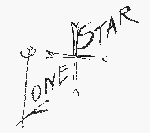
Lone Star’s Portrait

May 1, 2013

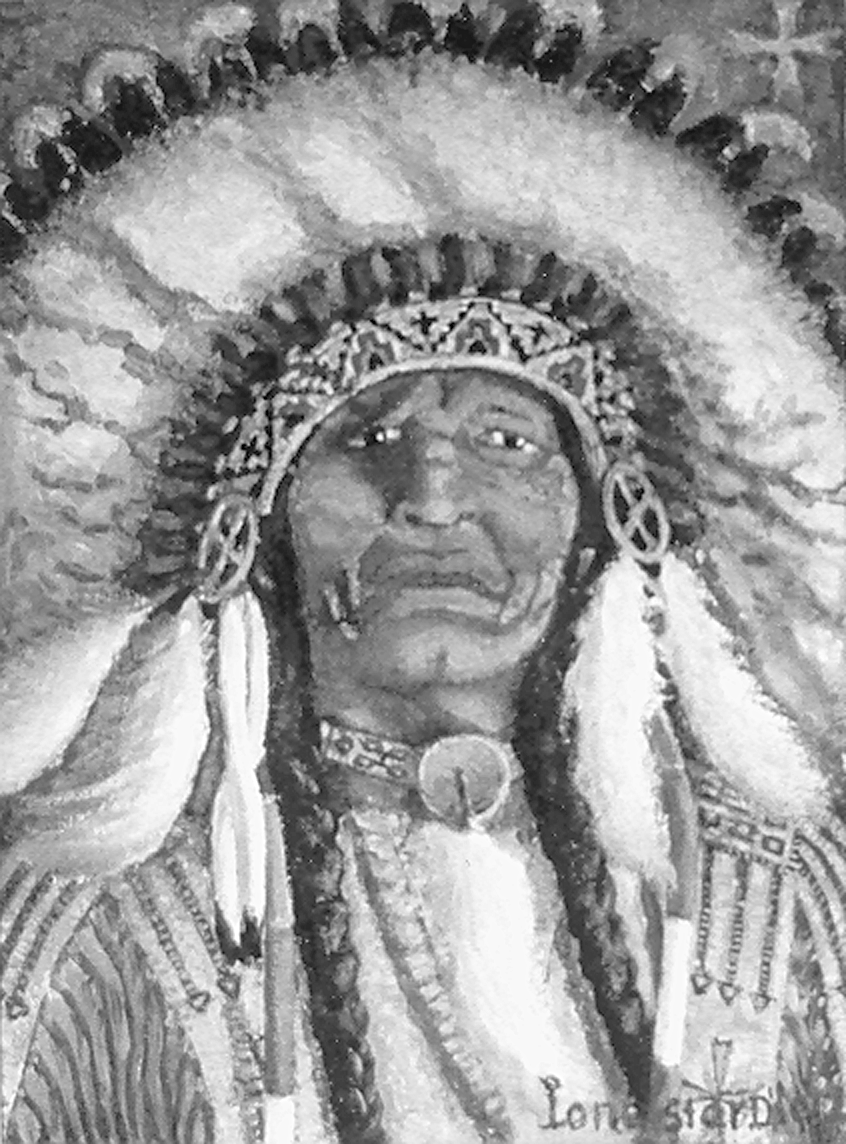
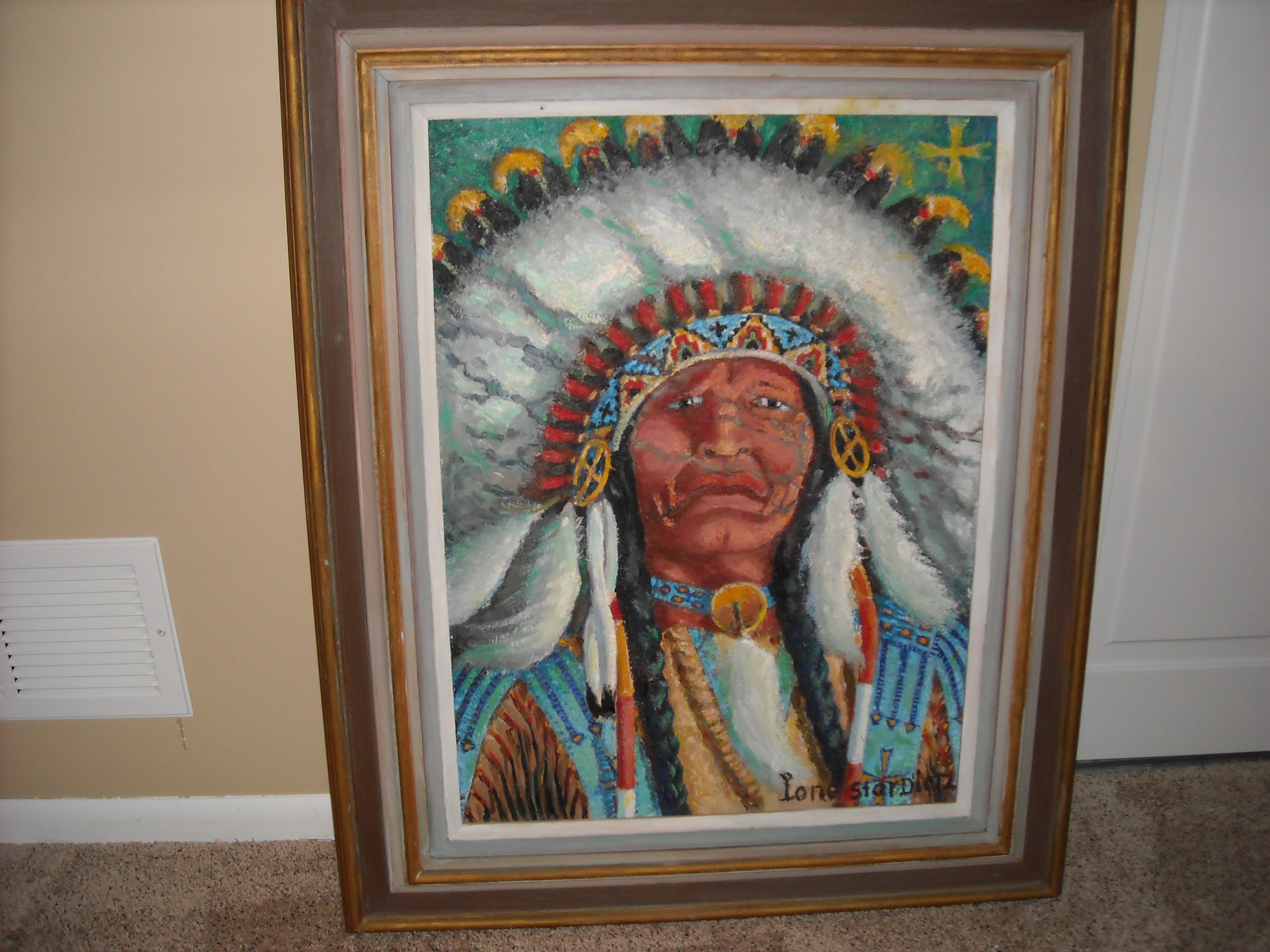
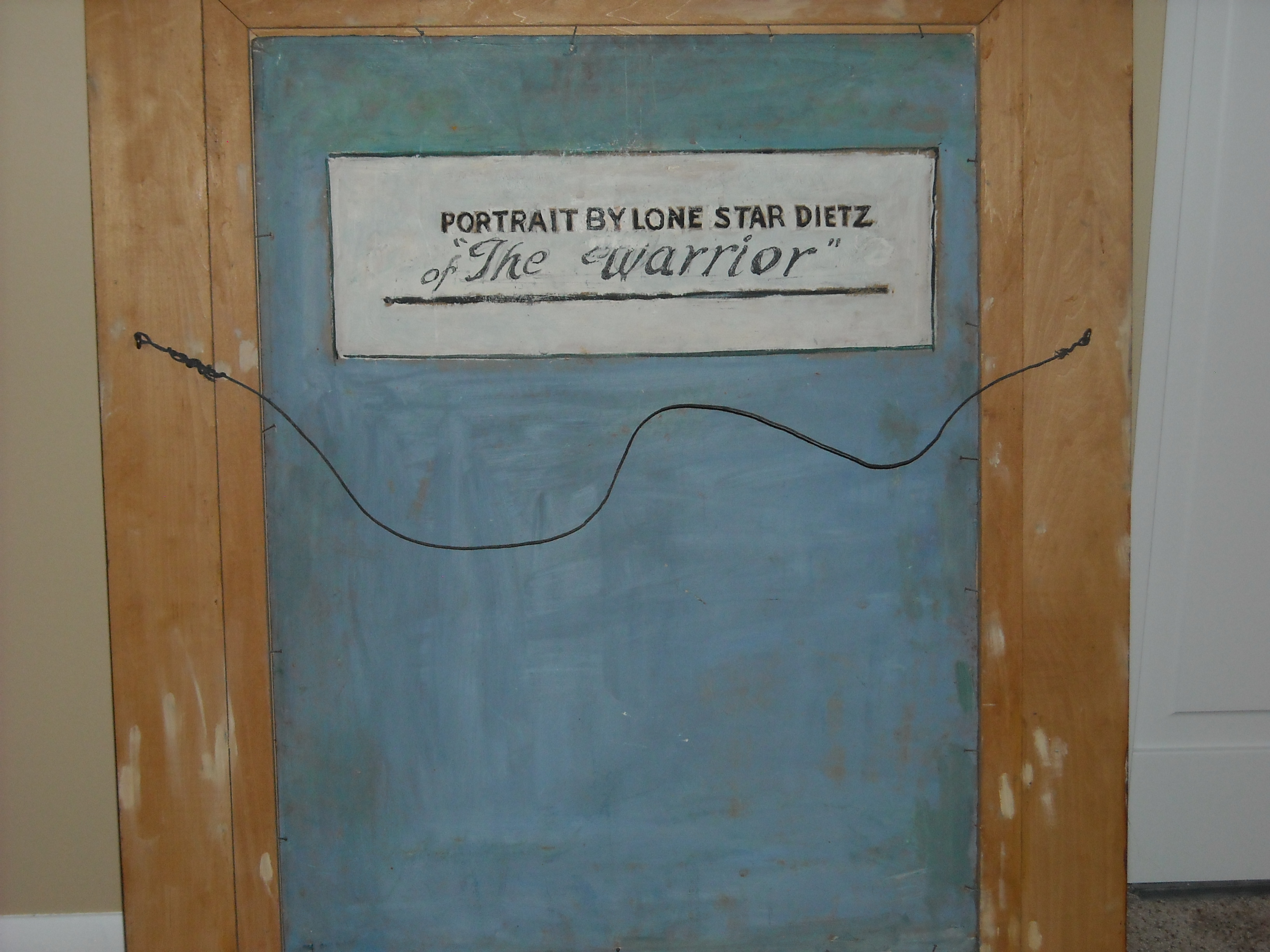
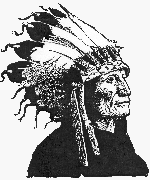
Yesterday, I received n email from the son of Mary Lou Zientek with some photos attached. Mary Lou Zientek was the woman who befriended the Lone Star Dietz and his wife, Doris, in the declining years. Mary Lou managed their estates after Doris died. Mrs. Zientek died on May 7 last year. She distributed artifacts which few valued at that time to places such as Sports Immortals in Boca Raton, Florida (they were in Pittsburgh when Dietz died). She kept a self-portrait Dietz painted in the early 1960s and, one assumes, made a gift to her for her generosity. Previously, I had only seen a black and white photo of the painting See below). Her son sent me color photos. The effect of the painting is much different in color than in black and white. Color photos of both front and back can be seen below. I thank Mr. Zientek for sharing these photos with us.

Lone Star self portrait

Zientek front Zientek back

Where was 1909 Carlisle-St. Louis U. game played?

April 12, 2013

Wednesday, I received a question about the location of the Carlisle-St. Louis University game played on November 25, 1909. Was it played in St. Louis or in Cincinnati was the question. A quick scan of Steckbeck’s Fabulous Redmen found it listed as having been played in Cincinnati. From experience, I have learned not to accept Steckbeck as gospel. He’s usually right, but not always. So, I checked with the Spalding’s Guides to see if they could shed any light on the issue. The 1909 Spalding’s Guide listed the game as being scheduled to be played in St. Louis. The 1910 Guide just gave the score.

Next, I searched newspapers for the day before the game, the day of the game, and the day after the game. Every mention of the game that included a location, far from all of them, placed the game in St. Louis. Many newspapers just gave the score or a brief summary. The November 24 Wilkes-Barre Times-Leader article began, “Seventeen redskins left the Carlisle Indian School last evening for the Thanksgiving game at St. Louis….” The November 26 New Orleans Times-Picayune’s coverage of the game was datelined St. Louis as did the Philadelphia Inquirer’s special.

The September 10, 1909 issue, Volume VI, Number 1 of The Carlisle Arrow listed the location of the game with St. Louis to be played in November in St. Louis. The November 26 edition included a sentence about their victory the previous day in St. Louis. The December 3, 1909 The Carlisle Arrow reprinted an article from the December 26, 1909 St. Louis Globe-Democrat that discusses the game played locally (to them) at National League park (home of the St, Louis Cardinals).

All references I found to that game, other than Steckbeck, place the game as being played in St. Louis at a venue larger than the hosting university’s home field. Perhaps he got confused with the 1906 or 1897 seasons when the Indians did play late season games in Cincinnati. He misplaced another game in Cincinnati: the 1905 game with Massillon Athletic Club which was actually played in Cleveland. Why that particular game was played where it was played is a story unto itself.

1909-11-26 Carlisle Arrow St Louis game

100th Anniversary of Jim Thorpe’s First At Bat

April 8, 2013

Sunday marks another milestone in sports history: Jim Thorpe’s first major league at bat. A year to the day after being selected for the 1912 U. S. Olympic team, on Monday, April 14, 1913, Jim Thorpe made his major league debut by pinch hitting for spitballer Charles Monroe “Jeff” Tesreau in the bottom of the ninth inning in a 3 to 2 loss to the Giants’ cross-town rivals, the Brooklyn Dodgers. He made an out.

However, he started out spring training much better. In a 6-inning split-squad game played at the Giants’ camp in Marlin Springs, Texas on February 28, he hit a three-run homer and singled off the afore-mentioned Jeff Tesreau. On March 5, Frank Demaree struck out Thorpe on a “wide bender” for Thorpe’s first strike out in spring training. Perhaps, this was the origin of the belief that Jim couldn’t hit a curve ball.

On March 12, he hit a long home run off Christy Matthewson, one of First Five inductees into baseball’s hall of fame in Cooperstown. But his fielding was considered weak and his hitting inconsistent. A March 14 wire service item quoted McGraw: “Muggsy of Gotham opines that Injun Jim Thorpe is one of the rawest ever. Raw red skin!” Pop Warner suggested that a year or two of seasoning in the minor leagues under skillful coaching would have helped Thorpe immensely. Instead, McGraw kept him with the Big League team to capitalize on his popularity.

Newspapers reported that John McGraw planned to cut short Thorpe’s $6,000 per year contract after the Giants made their first western road trip. McGraw may not have realized he had not signed Thorpe to a standard National League contract at this time. Pop Warner authored the non-standard contract, which went into effect on April 10, 1913, the Giants’ opening day that year. But that is another story.

Thorpe in Giant uniform 1913


Place where Indian School children played may be saved

February 28, 2013

Something Carlisle Indian School students surely played on over a hundred years ago may be rescued from the demolition ball. The Craigheads living at Craighead Station were strong supporters of the school almost from its inception and took students into their homes on outing periods to live and work in the majority culture. But all their waking hours weren’t spent working. They surely spent some of their time playing with the Craighead children along the creek and on the ever-beckoning bridges over the creek. Students from the earlier years of the school would not have played on the iron bridge because it wasn’t built until 1899. But those, like Emma Strong, who came after the turn of the 20th century surely did as did children of that and later generations. Now there is hope for the bridge to become a dedicated recreational facility for children and adults alike.

The fate of the historic iron bridge across the Yellow Breeches Creek at Craighead Station may be determined at tonight’s township supervisors meeting. It has been in peril for quite some time but its chances for survival look better. Some years ago, Cumberland County, owner of the bridge, determined that the one-lane bridge is unsatisfactory to handle all the vehicular traffic that would like to take that route. In addition to the bridge being narrow, its intersection with Old York Road is dangerous. The state and county developed a plan for a new concrete span a bit upstream from the iron bridge. That plan also calls for bending Zion Road south of the iron bridge to meet with the new bridge, eliminating the need to remove the iron bridge to make room for the new one. South Middleton Township officials offered to take ownership of the iron bridge if they could use the money budgeted by the state for its demolition to put it in better condition for use by walkers, bicyclists, and fishermen. Last fall, the state told the township demolition funds couldn’t be used to preserve the bridge. Many locals thought it absurd that the government would rather spend taxpayers’ money to destroy something of historical and recreational value than to use that money to continue using the structure for the current and future generations.

Yesterday’s Carlisle Sentinel reported that the state may have given erroneous guidance regarding the allowable usage of demolition funds. http://cumberlink.com/news/local/craighead-bridge-may-be-restored/article_a66d6442-806d-11e2-af92-0019bb2963f4.html It’s far from certain yet, but the iron lady that has served us well for over a century may not fall to an ignominious end.

Iron Bridge 2013-02-27 Bupp


Redskins Renamed 80 Years Ago

February 16, 2013

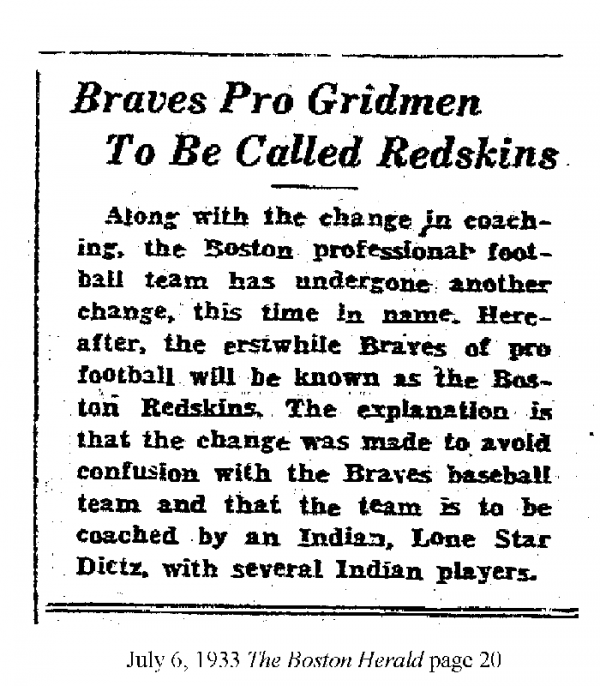
Earlier this week, I received a totally unexpected call from a reporter from the Washington Examiner regarding Lone Star Dietz. I say unexpected for two reasons. First, I was unaware that Dietz’s name had again percolated up in the media’s attention and second, I hadn’t considered it was 80 years ago that George Preston Marshall renamed his Boston NFL team from the Braves to the Redskins or that an 80th anniversary mattered. I guess the last part makes it three reasons.

Oddly, it seems to me, Washington media seldom contact me about Lone Star and the team never has. Questions and requests for interviews tend to come from other places. As popular as the Redskins have been over the years in the nation’s capitol, one wonders why neither fan clubs nor bookstores have deemed hearing more about the man who is alternately vilified and deified by people who generally haven’t read his biography. On the other hand, I shouldn’t wonder why when Bob Wheeler, author of the definitive biography of Jim Thorpe, has never been on C-SPAN’s BookTV.

Here is a link to the article the reporter was researching when he called me: http://washingtonexaminer.com/thom-loverro-the-disputed-history-of-lone-star-dietz-the-inspiration-for-the-redskins-name/article/2521717

Thorpe Lost Olympic Medals 100 Years Ago

January 29, 2013

Last Thursday, Carlisle Sentinel reporter Joe Cress called to remind me that the 100th anniversary of the discovery of Jim Thorpe’s professionalism was imminent. Joe was essentially right. In late-January 1913, Roy Johnson of the Worcester Telegram, wrote an article challenging Jim Thorpe’s amateur status, based on a conversation he had with Charles C. A. Clancy, manager of the Winston-Salem baseball team of the Carolina League. According to Johnson’s article, Clancy claimed that he paid Thorpe to pitch and play first base for his team during the 1910 season. On January 19, 1913, charges claiming Thorpe was not an amateur were filed with the AAU. On January 23, an interview of Clancy was published in which he denied that Thorpe played for his team or on any other team in the Carolina Association. On January 25, Pop Warner restated Clancy’s position that Thorpe had not played for his team. That same day, the AP reported that Thorpe was negotiating a contract with the Tecumseh professional hockey team to play for them the next season.

An International News Service article dated January 25, 1913 included a claim by Peter Boyle stating that he played with Jim Thorpe in the Eastern Carolina Association. He also claimed that he was traded to the Rocky Mountain team in 1910 for Thorpe who was then playing for Fayetteville. On January 27, the AAU informed newspapers via telegram that “All doubt as to the truth of the charges has vanished and the members of the American Olympic Committee are prepared to make their apologies to the Swedes for having used Thorpe in the Olympic games.” Shortly after that, Thorpe sent the AAU a letter (probably written by Warner) admitting his “professionalism” and returned his gold medals and other trophies.

Soon after this, Thorpe signed with the New York Giants but that is a story in itself.

http://cumberlink.com/news/local/history/thorpe-admitted-to-professionalism-years-ago/article_22e2ec04-6903-11e2-a4b1-0019bb2963f4.html

A Typo Cause Problems a Century Later

January 13, 2013

Today, I received a question from Jeff Miller asking if I knew anything about the Springfield Canning Company, particularly with regard to Pop Warner, whose life Jeff is researching. I clearly recalled reading about Pop’s relationship with the Springfield Canning Company from the Proceedings of the Joint Congressional Inquiry into Carlisle Indian School and assumed that is what prompted Jeff’s question. A quick search on that documented verified that, on page 1337, Pop Warner was identified as having a relationship with Springfield Canning Company. Knowing that Jeff is an experienced researcher led me to conclude that he hadn’t been able to find information about Springfield Canning Company through normal means before he contacted me. I had a hunch I knew why he couldn’t find anything: the company was named something other than what was recorded in the proceedings of that investigation.

It is well known that Warner’s home town was Springville, New York. I live on East Springville Road but my mail is all too often misaddressed to Springfield Road. Because this happens so frequently, I take great pains in making sure clerks get it right because my post office also delivers mail to addresses on a Springfield Road, which is miles from my house. As a result, delivery of mail sent to me can be delayed if not lost completely. So, I did a quick search on Springville Canning and immediately came up with references to it on the site for the Concord, New York Historical Society which is located in Springville, New York. http://townofconcordnyhistoricalsociety.org/timeline.php3

It seems highly likely Springville Canning Company is the correct name of the firm and the government stenographer just got it wrong as so many clerks do now. I’ll leave to Jeff the task of researching this further.

Crowdfunding at Indiegogo.com

January 12, 2013

As you may or may not know, I am working on a book about the Craighead Naturalists. Last year, circumstances led me to join a committee to preserve Craighead House for posterity. That effort will require us to raise a considerable amount of money. Because the Craigheads have inspired people all over the country and around the world, there may be numerous people interested in helping who are unaware of the project. In the past, reaching these people would have been impossible. Now, using a concept known as crowdfunding, numerous donors from around the world are making projects possible by each donating a small amount of money. Of the crowdfunding web sites, Indiegogo.com appears to be the one best suited to supporting Craighead House.

Being a complete novice at crowdfunding, I decided to learn more about it by setting up a pilot project for my upcoming book on the Craigheads. Besides learning about how to set up a campaign, this pilot project should also generate a little bit of publicity for Craighead House.

I’d like to ask for a favor. I set up an Indiegogo.com campaign this week as a pilot project. So far, it hasn’t attracted viewers. Could you take a look at it and give me your opinion about it? I plan to add additional photos and video weekly. http://www.indiegogo.com/CraigheadNaturalists/x/2063083 I don’t expect you to donate because you probably already have copies of my books that are being used as perks for donations by the pilot project. An increased view count might get the campaign more visibility on Indiegogo.com.

Thanks,

Tom

New Direction

December 14, 2012

My posts of late have been infrequent due to being pressed for time by other responsibilities. In spite of this, I received more questions than ever from readers. Some I can answer, others I can’t. What I propose to do is to post readers’ questions in this space to allow others to share their knowledge and/or to do a bit of research. I also propose post writings of others here—should anyone submit them for publication. I await your response.

Dietz’s Incarceration

December 3, 2012

One of the several mysteries surrounding Lone Star Dietz is what transpired between the time he surrendered himself to authorities to serve his 30-day sentence on January 8, 1920 and the third week of March, 1921 when he interviewed for the head coaching job at Purdue. Most of the missing thirteen months remains a mystery but a chance discovery sheds light on a tiny bit of it.

A February 11, 1920 article from the Anaconda Standard briefly discussed his incarceration. Just across the Idaho panhandle from southern Washington State, the Standard often covered Washington State news. Whether this piece was original or was copied from a Spokane newspaper has not yet been determined. That the article was not published the day after Dietz’s sentence was completed argues for its not being an original article.

“LONE STAR DIETZ FREE MAN AGAIN” headed the short piece. The article made clear that he pleaded “nolo contendre” to the charges. “He did not plead guilty to the falsification charge, but under a provision of the federal statute simply made no resistance to the accusation.” A Portland Oregonian article written the day of his incarceration revealed a little about his demeanor when he arrived at the jail. It explained that Dietz arrived at the Spokane County Jail to serve a Federal sentence at 4:00 p.m. wearing the same light gray suit he wore throughout his trial. The photo accompanying this article depicted him in formal attire, not the business suit he wore at the time. “He seemed somewhat nervous as he entered the marshal’s office to give himself up to the authorities. Later, as he sat in the marshal’s office and chatted with employees, he seemed to gather himself together and laughed and chatted about his case.” Apparently enjoying having a celebrity who was unlikely to cause trouble in their midst, the jail workers made him feel at home—to the extent one can feel at home in the hoosegow.

Other than that, nothing was previously known regarding what happened while he was in jail but it was correctly assumed he served his sentence without incident. The Standard article tells us that he served in typical Dietz fashion: “During the last two weeks of his confinement in the jail, Dietz was listed as a ‘trusty’ and given the privileges of the jail.” That was not surprising in the least. Now to find out what he did after walking out of the jail.