Thorpe Lost Olympic Medals 100 Years Ago

January 29, 2013

Last Thursday, Carlisle Sentinel reporter Joe Cress called to remind me that the 100th anniversary of the discovery of Jim Thorpe’s professionalism was imminent. Joe was essentially right. In late-January 1913, Roy Johnson of the Worcester Telegram, wrote an article challenging Jim Thorpe’s amateur status, based on a conversation he had with Charles C. A. Clancy, manager of the Winston-Salem baseball team of the Carolina League. According to Johnson’s article, Clancy claimed that he paid Thorpe to pitch and play first base for his team during the 1910 season. On January 19, 1913, charges claiming Thorpe was not an amateur were filed with the AAU. On January 23, an interview of Clancy was published in which he denied that Thorpe played for his team or on any other team in the Carolina Association. On January 25, Pop Warner restated Clancy’s position that Thorpe had not played for his team. That same day, the AP reported that Thorpe was negotiating a contract with the Tecumseh professional hockey team to play for them the next season.

An International News Service article dated January 25, 1913 included a claim by Peter Boyle stating that he played with Jim Thorpe in the Eastern Carolina Association. He also claimed that he was traded to the Rocky Mountain team in 1910 for Thorpe who was then playing for Fayetteville. On January 27, the AAU informed newspapers via telegram that “All doubt as to the truth of the charges has vanished and the members of the American Olympic Committee are prepared to make their apologies to the Swedes for having used Thorpe in the Olympic games.” Shortly after that, Thorpe sent the AAU a letter (probably written by Warner) admitting his “professionalism” and returned his gold medals and other trophies.

Soon after this, Thorpe signed with the New York Giants but that is a story in itself.
http://cumberlink.com/news/local/history/thorpe-admitted-to-professionalism-years-ago/article_22e2ec04-6903-11e2-a4b1-0019bb2963f4.html

A Typo Cause Problems a Century Later

January 13, 2013

Today, I received a question from Jeff Miller asking if I knew anything about the Springfield Canning Company, particularly with regard to Pop Warner, whose life Jeff is researching. I clearly recalled reading about Pop’s relationship with the Springfield Canning Company from the Proceedings of the Joint Congressional Inquiry into Carlisle Indian School and assumed that is what prompted Jeff’s question. A quick search on that documented verified that, on page 1337, Pop Warner was identified as having a relationship with Springfield Canning Company. Knowing that Jeff is an experienced researcher led me to conclude that he hadn’t been able to find information about Springfield Canning Company through normal means before he contacted me. I had a hunch I knew why he couldn’t find anything: the company was named something other than what was recorded in the proceedings of that investigation.

It is well known that Warner’s home town was Springville, New York. I live on East Springville Road but my mail is all too often misaddressed to Springfield Road. Because this happens so frequently, I take great pains in making sure clerks get it right because my post office also delivers mail to addresses on a Springfield Road, which is miles from my house. As a result, delivery of mail sent to me can be delayed if not lost completely. So, I did a quick search on Springville Canning and immediately came up with references to it on the site for the Concord, New York Historical Society which is located in Springville, New York. http://townofconcordnyhistoricalsociety.org/timeline.php3

It seems highly likely Springville Canning Company is the correct name of the firm and the government stenographer just got it wrong as so many clerks do now. I’ll leave to Jeff the task of researching this further.

Crowdfunding at Indiegogo.com

January 12, 2013

As you may or may not know, I am working on a book about the Craighead Naturalists. Last year, circumstances led me to join a committee to preserve Craighead House for posterity. That effort will require us to raise a considerable amount of money. Because the Craigheads have inspired people all over the country and around the world, there may be numerous people interested in helping who are unaware of the project. In the past, reaching these people would have been impossible. Now, using a concept known as crowdfunding, numerous donors from around the world are making projects possible by each donating a small amount of money. Of the crowdfunding web sites, Indiegogo.com appears to be the one best suited to supporting Craighead House.

Being a complete novice at crowdfunding, I decided to learn more about it by setting up a pilot project for my upcoming book on the Craigheads. Besides learning about how to set up a campaign, this pilot project should also generate a little bit of publicity for Craighead House.

I’d like to ask for a favor. I set up an Indiegogo.com campaign this week as a pilot project. So far, it hasn’t attracted viewers. Could you take a look at it and give me your opinion about it? I plan to add additional photos and video weekly. http://www.indiegogo.com/CraigheadNaturalists/x/2063083 I don’t expect you to donate because you probably already have copies of my books that are being used as perks for donations by the pilot project. An increased view count might get the campaign more visibility on Indiegogo.com.

Thanks,

Tom

New Direction

December 14, 2012

My posts of late have been infrequent due to being pressed for time by other responsibilities. In spite of this, I received more questions than ever from readers. Some I can answer, others I can’t. What I propose to do is to post readers’ questions in this space to allow others to share their knowledge and/or to do a bit of research. I also propose post writings of others here—should anyone submit them for publication. I await your response.

Dietz’s Incarceration

December 3, 2012

One of the several mysteries surrounding Lone Star Dietz is what transpired between the time he surrendered himself to authorities to serve his 30-day sentence on January 8, 1920 and the third week of March, 1921 when he interviewed for the head coaching job at Purdue. Most of the missing thirteen months remains a mystery but a chance discovery sheds light on a tiny bit of it.

A February 11, 1920 article from the Anaconda Standard briefly discussed his incarceration. Just across the Idaho panhandle from southern Washington State, the Standard often covered Washington State news. Whether this piece was original or was copied from a Spokane newspaper has not yet been determined. That the article was not published the day after Dietz’s sentence was completed argues for its not being an original article.

“LONE STAR DIETZ FREE MAN AGAIN” headed the short piece. The article made clear that he pleaded “nolo contendre” to the charges. “He did not plead guilty to the falsification charge, but under a provision of the federal statute simply made no resistance to the accusation.” A Portland Oregonian article written the day of his incarceration revealed a little about his demeanor when he arrived at the jail. It explained that Dietz arrived at the Spokane County Jail to serve a Federal sentence at 4:00 p.m. wearing the same light gray suit he wore throughout his trial. The photo accompanying this article depicted him in formal attire, not the business suit he wore at the time. “He seemed somewhat nervous as he entered the marshal’s office to give himself up to the authorities. Later, as he sat in the marshal’s office and chatted with employees, he seemed to gather himself together and laughed and chatted about his case.” Apparently enjoying having a celebrity who was unlikely to cause trouble in their midst, the jail workers made him feel at home—to the extent one can feel at home in the hoosegow.

Other than that, nothing was previously known regarding what happened while he was in jail but it was correctly assumed he served his sentence without incident. The Standard article tells us that he served in typical Dietz fashion: “During the last two weeks of his confinement in the jail, Dietz was listed as a ‘trusty’ and given the privileges of the jail.” That was not surprising in the least. Now to find out what he did after walking out of the jail.

Thorpe’s Helmet & Football

November 26, 2012

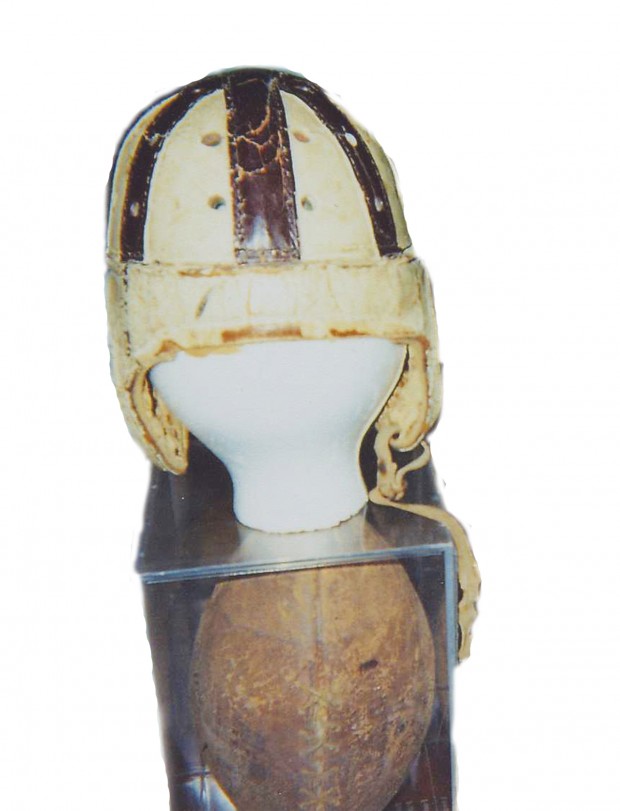
A reporter from the local newspaper called me the other day to verify someone’s claim that he possessed a helmet Jim Thorpe once wore and a football he once kicked. Both artifacts were from 1927, the year Big Jim played for the Portsmouth Shoe-Steels. Portsmouth, Ohio lies in southern part of the state along the Ohio River. The team was sponsored by a local company that manufactured metal parts for shoes.

John Carpenter, who is reputed to own the country’s largest collection of sports memorabilia, has an old helmet he believes Thorpe wore when he played for the Shoe-Steels and a football Thorpe kicked in a game. Carpenter lives across the Ohio River from Portsmouth, a factor that makes his claims more plausible. I don’t know and doubt if anyone can know with certainty if these items were ever associated from Jim Thorpe. I don’t have the expertise to determine exactly when the helmet and football were made. If they were made after 1927, they probably didn’t come from Thorpe.

The stories of how these artifacts came into Carpenter’s hands are believable because Thorpe was known for giving away things. Bob Wheeler, Thorpe’s biographer, confirmed that Thorpe’s parents raised him to be generous. While we can’t ever know for sure, there’s a good chance these things were at least touched by him at one time.

http://cumberlink.com/news/local/history/jim-thorpe-remembered-for-generous-heart/article_c933435c-377f-11e2-9659-0019bb2963f4.html

100th Anniversary of 1912 Carlisle-Army Game

November 9, 2012

Follows is the short article I was asked to write for The Torch, the monthly magazine of the U. S. Army War College, to commemmorate the 100th Anniversary of the 1912 Carlisle-Army football game:

The Cadets of West Point took the field on The Plain November 9, 1912, aiming to avenge their 1905 loss to Carlisle Indian School in the two schools’ only previous battle, also on The Plain. Missing from the second battle were the players and coaches from both 1905 teams and Major William A. Mercer, Carlisle Superintendent and Calvary officer, who had arranged that game by gaining permission from the War Department. Also AWOL in 1912 were the large crowd, dignitaries, and media interest the first game attracted. Present in 1912 were Jim Thorpe, Gus Welch, Joe Guyon, Pop Warner, Leland Devore, Dwight Eisenhower, Babe Weyand (in the bleachers), and Pot Graves, a cast surely destined for a movie.

Ominous clouds filled the sky and a cold wind blew across the field, making passing and punting risky businesses. Both sides’ emotions ran high as the combatants craved a victory. Carlisle arrived undefeated, the only blemish on their record a scoreless tie with Washington and Jefferson College, a month earlier. Army was 3-1 with a 6-0 loss to Yale. Holding the Eli of Yale to only four first downs and a low score gave the Cadets hope for success over the Indians.

Newspaper accounts after the game never considered its outcome in doubt, but those looking only at the scoreboard, at least for the first half, may have thought otherwise. The Indians bested the Cadets for most of the first half but didn’t score due to errant forward passes in the end zone. The turning point of the second quarter came when Carlisle fullback Stancil “Possum” Powell was expelled from the game for punching Army quarterback Vern “Nig” Pritchard. The 27-yard penalty combined with Powell’s ejection dampened the Indians’ spirits. Army then moved the ball forward the remaining 27 yards with fullback Geoffrey Keyes pushing the ball across the goal line. Pritchard missed the kick after the touchdown.

Momentum shifted in the Indians’ favor on the kickoff opening the second half when All-America tackle and team captain Leland Devore jumped on Joe Guyon, who had been getting the better of him all day, getting himself thrown out of the game. Army defensive backs Dwight Eisenhower and Charles Benedict knocked each other out of the game for the rest of the quarter in a failed attempt to sideline Thorpe. The Indians scored 27 unanswered points to lick Army worse than any opponent had beaten them in many years.

Guiding The White Brethren

October 26, 2012

The electronic version of the Fall 2012 edition of the magazine for the National Museum of the American Indian (NMAI) is finally out. My article on Carlisle Indians who went on to coach other teams is on page 46 (page 44 of print version). The idea for this article came to me after attending Lone Star Dietz’s enshrinement ceremony into the College Football Hall of Fame. He is the only Carlisle Indian to be inducted as a coach. Six others, some of whom also coached, were enshrined previously but as players. It is unlikely that any others will receive this honor because no other Carlisle Indian coached as long or with nearly as much success as Dietz.

American Indian athletic prowess is getting much attention this year due to 2012 being the 100th anniversary of Jim Thorpe’s extraordinary triumphs in the pentathlon and decathlon at the 1912 Stockholm Games. Anyone unfamiliar with Native Americans’ success in the Olympics can read my several previous blog entries on this topic.

Worthy of note is that Dietz and the others had great success coaching white college and professional players. Many of them, including Dietz, coached Indian teams at one time or another but the vast majority of their coaching careers were with white college teams. Having played with Carlisle and knowing the Warner System gave these men instant credibility and opened doors for them. After going through those doors, success or the lack of it was the deciding factor. After all, sports have always been a meritocracy. Performance matters above all. Carlisle players succeeded on the field both as players and coaches. The graduate system of coaching that was tried in the early 20th century limited coaching opportunities for those who hadn’t attended major colleges but numerous smaller schools welcomed Carlisle Indians to lead their teams. Although far from an ideal situation, these men were given the opportunity to succeed or fail on their own merits and they largely succeeded.

http://content.yudu.com/A1yt4b/fall2012/resources/index.htm?referrerUrl=http%3A%2F%2Fwww.americanindianmagazine.org%2Fabout-us

Today’s Event at the National Museum of the American Indian

August 17, 2012

Several decades ago, Robert W. Wheeler then a grad student at Syracuse hitchhiked coast to coast carrying an incredibly heavy reel-to-reel tape recorder to interview acquaintances of Jim Thorpe for his master’s thesis. The project grew as the miles rolled on. His budget, however, didn’t grow. But Bob persevered.

Years—it probably felt like decades—later, he had not just a master’s thesis but a full length biography of the world’s greatest athlete. After reading the book, Dick Schaap referred to Bob as Jim Thorpe’s Boswell, drawing an analogy to the thoroughness of his research in comparison to that done by James Boswell in documenting the life of Samuel Johnson. Since Wheeler’s book was first published, several other biographies of Thorpe have been written but they all draw on the painstaking work done by Wheeler.

The National Museum of the American Indian (NMAI) is celebrating of the 100th anniversary of Jim Thorpe’s triumphs in the Stockholm Games along with other Native Americans’ participation, many for medals, in the Olympics. The entrance to the exhibit features a blown up photograph of Carlisle Indian Frank Mt. Pleasant broad jumping in his Dickinson College track uniform. Here is a link to information about the exhibit: http://nmai.si.edu/explore/exhibitions/item/504/

Today, Bob Wheeler is giving a talk at the NMAI that I will be attending. Those unable to attend can hear Bob speak on the NMAI’s webcast of the event. Here is a link to the webcast: http://nmai.si.edu/calendar/?trumbaEmbed=date%3D20120817 Also speaking will be Flo Ridlon, Bob’s wife, who played a crucial role in getting Thorpe’s Olympic medals restored. Both are spellbinding speakers. This is an event not to miss.

Lone Star Dietz Article in Indian Country Today

August 14, 2012

Yesterday’s edition of Indian Country Today includes an article by Jack McNeel on Lone Star Dietz. The headline, which probably wasn’t written by Mr. McNeel, understandably focuses on Dietz’s posthumous induction recently into the College Football Hall of Fame. But the article covers more than that. He covered as much of Dietz’s highly eventful life as space would allow.

Something I particularly like is that McNeely chose to use a photograph of Dietz with the Washington State team that isn’t widely used. It’s nice to see something you haven’t seen before. In this case, I probably saw it briefly when going through the Washington State photo archives some years ago but didn’t remember seeing it.

There are a few things in the article that need a little bit of clarification. First, Tournament of Roses wasn’t arranging its annual football game in the fall of 1915 because they had only hosted a game once before and that was back in 1902. The Washington State victory over Brown in 1916 was what established the game as an annual event and much of the credit for that goes to Lone Star Dietz for putting West Coast football on the same level as the eastern powers.

The statement, “Soon after, many college sports were suspended for World War I,” may compress the timeframe too much for readers unaware of what happened during that period. Dietz’s men lost two games in 1916 and were undefeated again in 1917 but weren’t invited to Pasadena because of the popularity of military teams. It was after the 1917 season that college sports were curtailed freeing Dietz to coach many of his former players on the Mare Island Marines team.

The phrase “Indian agent from the Sioux Nation” may be misleading and cause unfamiliar readers to think the agent was an Indian. The agent was a white man assigned to the Pine Ridge Agency, one of several reservations on which Sioux live.

“Benjey’s research indicates that Dietz’s father took the dead baby…” would more accurately be phrased, Benjey’s research indicates that Dietz’s father claimed to have taken the dead baby…. However, W. W. Deitz (he spelled his name differently that Lone Star spelled it) denied that publicly.

Here is a link to the article:

http://indiancountrytodaymedianetwork.com/2012/08/13/william-lone-star-dietz-posthumously-inducted-into-football-hall-of-fame-128617