Archive for the ‘Publishing’ Category

Flag Mystery Solved

July 11, 2009

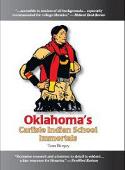
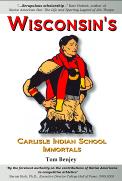
Thanks to a local internet trunk being out of service, this blog is posted late. Is being dependent on modern technology wonderful? A second proof arrived for Oklahoma’s Carlisle Indian School Immortals and it will be accepted. That means books will be printed soon. This brings us to the next book in the series, Wisconsin’s Carlisle Indian School Immortals.

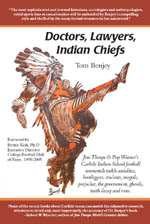
Relatives of Chauncey Archiquette contacted me after seeing the message about the pristine 1897 Carlisle-Cincinnati game program. Chauncey wasn’t included in Doctors, Lawyers, Indian Chiefs because I had little information on him at the time and because, at 160,000 words, the book was running long. Now that I am doing a book on Wisconsin stars, of which there were many, there should be room for him and some others such as Wilson Charles and Wallace Denny.

Here is an update on the flag in the band photo that was discussed in the previous message. Richard Tritt, photocurator at Cumberland County Historical Society, researched the photo and found the following:

I found the photo in our collection, but only in school publications and in postcards. It appears as a large full page photo in the CARLISLE ARROW, July 27, 1906. There is no story. It appears again with a story about the band being at an event in the CARLISLE ARROW of Jan. 31, 1908. The same photo was used on a postcard that was issued prior to Feb. 28, 1907. It is printed on an undivided back postcard, thus the date. After that date postcards were divided on the back. Even with the best of the four copies that I have, the stars on the flag can’t be counted. The top row of the stars is hidden by the leaves in the tree. We do know that it had to have been taken before July 27, 1906. The 1908 written on the copy that she had is probably because her copy was taken from the 1908 issue of the ARROW.

So, the flag wouldn’t have been a 1908 flag because the photo was taken prior to July 27, 1906. George Gardner’s great grandson is right. This is surely not a 1908 flag.
Problems with Proofs

July 4, 2009

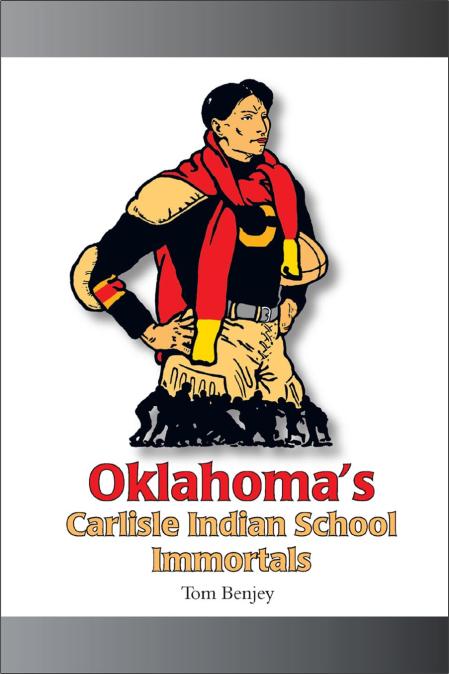
Proofs for the text and cover of Oklahoma’s Carlisle Indian School Immortals arrived Thursday. The purpose of the proof is to determine that everything is perfect before printing the batch of books. The cover looks great to me. The colors are vibrant and Bob Carroll’s drawings of the players’ faces provides an attractive background for the text on the back cover. There is a problem with the text, however.

Rather than taking up space in the narrative with dry demographic about the players, I put this information in boxes, one for each player. The boxes were shaded in light gray for visual interest. Herein lies the problem. Five of the fifteen demographic data boxes appear to have no shading. The boxes looked perfect in the advance reading copies (ARCs), but those were produced by a different printer. Panic set in immediately. The PDFs sent to the printer look perfect. The printer’s technician informed us that the shading was done at 9% and they accept nothing below 15%. That doesn’t answer the question as to why two-thirds of the boxes were shaded correctly.

As it turns out, the boxes that printed correctly have graphics with transparency on the same page but the bad ones don’t. It appears that the printer’s software or equipment does something different in these cases. Be that as it may, I have to submit new PDFs with 15% gray shading. That means that I will probably have to pay the graphic designer for his time and the printer fees for resubmitting a new PDF and for a new proof. I also have to wait several days to see if this solves the problem.

0977448681

New Research Tool

May 18, 2009

Over the weekend, I stumbled across a new tool that could help those of us who research things long past. WolframAlpha.com is touted by some as the biggest challenger Google has faced. Others point out that it isn’t a search engine of the Google sort. WolframAlpha (W/A) is the brainchild of Steven Wolfram, founder of Wolfram Research, the company that brings us Mathematica. Not surprisingly, W/A uses Mathematica as its engine “…to make all systematic knowledge immediately computable and accessible to everyone.” W/A allows users to type in English language questions and receive answers reminiscent of the way computer interfaces in 1950s move computers.

Thinking this might be a useful tool for researching such things as the weather when Carlisle Indian School students arrived, I gave it a try. First, I threw it a softball by asking, “USA gross national product 1912.” W/A’s response was “(no data available).) Next, I tried “weather Carlisle, PA October 1879.” W/A returned “(no weather data available for October 1879).” Knowing that weather data is available for Philadelphia, I changed Carlisle to Philadelphia but got the same result. It seems that Wolfram hasn’t loaded all of the weather data that is available as of yet. Now for something simpler.

I entered “college football scoring record 1912” and confused W/A. It responded, “Wolfram\Alpha isn’t sure what to do with your input.” W/A seems to have some information for the NFL and major league baseball but is unaware of college sports. In the same box that tells us W/A is confused, they ask for experts. Perhaps this is an opportunity for Tex Noel, and David DeLasses.

A Brave, New Technology for the New Year

January 2, 2009

My New Year starts off with learning a new technology. ebooks are all the rage now, or so we’re told. What is an ebook you say? It’s an electronic book. Instead of lugging pounds of paper around with us, we’re now able to carry a lightweight electronic appliance that stores words as binary digits instead of in ink on paper. I say words because the first generation of these devices does not handle graphics well and color not at all. The advantages of ebooks are many: lower cost per book ($10 is the price on many new releases), ability to search the book as easily as other computer documents, font scaling to make larger type immediately available to these aging eyes, portability, and ease of acquisition. Amazon.com markets a device they call the Kindle, perhaps because they think it will light the fire for this new technology. Included with the device is Whispernet, a wireless broadband network that supports one-click purchase of new books – from Amazon, of course. Before thinking that the Kindle is the cheap razor for which Amazon sells the blades, consider the price. At $359 (down from $400), they ain’t cheap but are almost continually out of stock. New and refurbished units are available on eBay but few are bargains.

Leading competitors for Kindle include the Sony Reader Digital Book PRS-700 and Mobipocket eBook Reader. According to Sony, its device is the first one to use the EPUB international standard for ebook publication. The Mobipocket Reader runs on devices ranging from desktop computers to cell phones as well as things in between. The Mobipocket format purportedly runs on or can readily be converted to run on Amazon and Sony devices. I’ll find out more this weekend.

Next time I’ll share my experience preparing one of my writings for this brave, new world.

Getting GPSed

September 20, 2008

This is off topic – way off topic – but please indulge my little rant. This week three of my brothers and I took our soon-to-be-95-year-old father on our annual tour. It used to be old car museums but has since expanded to also include tractors, airplanes, trains and historical sites. Getting useable directions to these places is always a challenge so two of my brothers used technology to address this problem – two different technologies.


One searched the Internet for maps with driving directions that are all-too-often questionable if not downright wrong. The other had a $300 GPS unit. Having heard others besides  him sing the praises of these magical units, I had him ride shotgun and get the driving directions to the new Air and Space Museum by Dulles airport near Washington, DC. It worked perfectly. It put us on the right roads and told us where to turn right up to pulling in the gate. That’s where the problems began. Fortunately the guard had dealt with people using GPS units before and quickly got us turned around and on our way to the main entrance. It seems that GPS units take you to the closest entrance, whether it is open to the public or not. Sending us to the back gate wasn’t the only thing it did wrong.


I started to say that we got GPSed but, after wandering around in Baltimore and Philadelphia, getting GiPSied may be more accurate. It had trouble finding the Schuylkill Expressway where it was lower than the streets that ran alongside it and seemed to be oblivious to one-way streets. For awhile we felt like Charlie in the Kingston Trio song, “The MTA.”

What Indians Called White People

September 12, 2008

I found something unexpected in the January 1912 edition of The Red Man when I turned a page and saw an article titled “How the American Indian Named the White Man” by Alexander F. Chamberlain, Professor of Anthropology at Clark University. I was curious at first because I didn’t understand what was meant by the title. However, the first sentence made things very clear: “‘Paleface’ is not the only name by which the ‘white man’ is known to the ‘red.’” The author’s premise was quite reasonable. It makes perfect sense that Indians would coin names for us that described white people as they saw them. It also reminded me of the punchline in that Tonto and the Lone Ranger joke we told as kids: “What do you mean we, paleface?” But I digress. The author explained that different tribes coined different names and had different names for some of the European nationalities.


Many of the names, as expected, had to do with skin color. Several tribes called us “white,” “white person,” “white skin,” etc. In addition to these the Algonkian Arapahos referred to us as “yellow-hided.” Whether it had to do with skin or hair color or courage is unknown. Kiowas used a term that meant “hairy mouth” and the Zunis referred to the early Spaniards as “moustached people.” “They of the hairy chest” was used by Algonkian Miamis.


Ears also played a role. Kiowas used the same word for white men that they used for donkeys and mules. It meant “ears sticking out” because Indians’ ears were partially covered by their hair. Crows and Upsarokas called white men “yellow eyes.” Our voices were not altogether pleasing to theKiowas as they also called white men “growlers.”


Clothing also played a role in the naming. Mohawks of the Lake of the Two Mountains in Quebec thought the tam o’shanters worn by early Scot settlers looked like cow patties and called them “ota,” their word for cow droppings. Englishmen would agree with the Objibwa who described Scots as “he who speaks differently.”

March Madness

April 11, 2008

Pardon me while I go off topic. I promise not to do this frequently. Watching the NCAA championship game Monday night brought back some memories – not as a player, besides being short, I was not very good – growing up in downstate Illinois. You see, the term “March Madness” was coined in Illinois to describe its then wide-open high school basketball tournament. This format gave even the smallest schools a shot at beating the large schools and sometimes David won. In 1952 Hebron, with a student population of 98, beat Quincy in overtime to become the smallest school to be state champions. The town continues to celebrate the Green Giants’ victory on their globe-shaped water tower that is painted to resemble a basketball. I recall the 1964 Cobden Appleknockers’ run for glory. This four-year high school boasting a student body of 128, half of which were girls, fielded a team that included two brothers and three cousins. The team dedicated its season to starting guard Tom Crowell who had drowned. The Appleknockers did not win it all, losing 50-45 to the Pekin Chinks. I don’t tease anyone about their team’s name because our local high school, Boiling Springs, calls its teams the Bubblers.

During the introductions I noticed that Ed Hightower was one of the officials. While attending graduate school at Indiana University I observed that he officiated many of their games. Someone with season tickets informed me that Indiana officials – read Bobby Knight – considered him to be the best. I recalled the Hightower name from one of the old guys who held court in the closest thing we had to a malt shop. He praised the play of a Hightower who had played for nearby Alton High some years prior. I never saw or heard much more about Hightower the basketball player. My wife and I notice that Ed Hightower still works a lot of Indiana and Texas Tech games. A few years ago she noticed that Ed was developing male pattern baldness.

After this year’s March Madness subsided I looked up Ed Hightower on the internet and found that he is too young to be the person those guys were talking about. However, his day job is as Superintendent of Edwardsville, Illinois schools, the same district that I attended from grades 4 through 9. He is also on the Board of Trustees for Southern Illinois at Edwardsville where I got my bachelor’s degree some decades ago. Seeing Ed officiate those games brings back memories of following snow plows to important games and waiting for a repair crew to replace a backboard shattered in pre-game warm-ups.

Although Ed Hightower has received awards for his work, the Golden Whistle most notable, and has been selected to work twelve Final Fours, his job has not always been the easiest. A notable example was the game he worked in which Chris Webber called a timeout he didn’t have. He has missed games due to injury but at least, as my wife noticed, his baldness seems to have gone away.