Archive for the ‘Pop Warner’ Category
December 8, 2008
On Friday Antonio Banderas conducted the U.S. premier of his film, El Camino de los Ingleses (The English Road), titled Summer Rain in the U.S., at Carlisle Theatre. This was not the first movie to be premiered at this 1939 Art Deco picture palace. In August of 1951, Jim Thorpe returned to Carlisle to premier his film biography, Jim Thorpe: All American, in which he was portrayed by a young actor by the name of Burt Lancaster. Unfortunately, that film is now dated and needs to be remade, or better yet, an entirely new film needs to be made. Perhaps that will happen.
It seems that a filmmaker interested in shooting a film about Jim Thorpe, Pop Warner or the Carlisle Indian School breezes through town every couple of months gathering information for his or her next production. The most notable, perhaps, of those in recent years was announced in 2004 John Sayles was writing the script for Carlisle School for Walden Media. Nothing further has been seen about that film and that may be for the better. The Hollywood Reporter wrote that Carlisle School, “follows a ragtag group of young Native Americans who achieve prolific victories on the football field that lead them to national prominence. The players, among them future sports legend Thorpe, attended the boarding school in Pennsylvania that, from 1879-1918, housed Native Americans from childhood through college.”
Anyone who knows anything at all about Carlisle Indian School is well aware that its teams were anything but ragtag. To the contrary, Carlisle was frequently criticized for being just the opposite. The recent books about Thorpe and Carlisle have not been the most accurate either. But better things may be in the offing. Kate Buford’s biography of Jim Thorpe is to be released in 2008 and there aren’t many days left in the year. Bob Wheeler is finishing up his audiobook on Jim Thorpe. This is something to look forward to. Thorpe’s Boswell is not just reading his landmark book on Thorpe, he is also including clips from the interviews he made decades ago of people, many of whom are now long dead. It will be great to hear Ike talk about playing against Thorpe in his own voice. I can’t wait.
Tags:Antonio Banderas, Bob Wheeler, Burt Lancaster, Carlisle Theatre, John Sayles, Kate Buford
Posted in Carlisle Indian School, Jim Thorpe, Pop Warner | Leave a Comment »
December 5, 2008
Jim Sweeney, the life-long Army fan who told me about the Sports Illustrated article, shared with me that on Thanksgiving Day he was able to watch, on ESPN2 no less, two Jesuit high schools from New York City play each other in an 85-year long Thanksgiving tradition. Xavier High played Fordham Prep at Fordham Field in the Bronx. Sweeney’s (also JoePa’s) alma mater, Brooklyn Prep, was, until it closed in 1973, the third Jesuit high school in the City. You probably already know that Joe Paterno played tailback in Brooklyn Prep’s double-wing and that his brother, George, was fullback. Something few of us know is that both Xavier and Fordham Prep are NOW running the single-wing. What a treat it must have been for Jim to watch these teams in the comfort of his living room.
Another result of the Sports Illustrated article or the fact that NFL teams are dabbling with the single-wing is that I was interviewed yesterday by the local NBC affiliate about the connection between the Wildcat formation and Carlisle Indian School. After interviewing me, reporter George Lettis visited Carlisle Barracks and shot part of his piece on Indian Field. WGAL’s website has an article on its website that can be found at http://www.wgal.com/sports/18199527/detail.html. The broadcast video can be found at http://www.youtube.com/watch?v=iP9FogxDRII. In addition to footage of Lettis and me, portions of the documentary Tom McCue and I made to celebrate the 100th anniversary of the single-wing are included. Narrator Lynn Myers’ voice comes through loud and clear.
It will be interesting to see how long NFL coaches run the Wildcat or other versions of the single-wing before they admit that the fundamental formation was developed a century ago by Pop Warner for the Carlisle Indians. Some think that NFL coaches will continue to obfuscate this point so as not to appear to be behind the times by 100 years.
Tags:Brooklyn Prep, Fordham Prep, George Lettis, James Sweeney, Joe Paterno, Lynn Myers, Miami Dolphins, Sports Illustrated, Tom McCue, WGAL, Wildcat formation, Xavier High
Posted in Carlisle Indian School, Pop Warner, Single-Wing | 4 Comments »
December 2, 2008
The December 1 issue of Sports Illustrated has an article on the single-wing. The writer, Tim Layden, first discusses the formation’s current use at Apopka High 15 miles northwest of Orlando and in the NFL by the Dolphins in their unexpected victory over the unsuspecting New England Patriots. Also mentioned is Todd Bross, organizer of the annual spring conclave at Kings College in Wilkes-Barre, PA. (It was Todd Bross and Ted Seay who urged me to research Pop Warner’s correspondence course in football that was first published in 1908). Layden discussed the renaissance the single-wing is undergoing but was apparently unaware that little Windber Area High School is running it as he was probably unaware of my documentary in which they were featured.
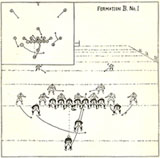
The article talks about viewing old films over Ed Racely’s garage on Cape Cod. Racely, now 80, has been studying the single-wing longer than anyone. Layden then goes into the single-wing’s history beginning with President Theodore Roosevelt’s 1905 threat to ban the game unless rule changes weren’t made to clean up the game. He goes on the mention that Pop Warner coached Carlisle Indian School from 1907 to 1914 and quotes Warner as having first used early incarnations of the single wing by the Carlisle Indians in response to the 1906 rule changes. He is apparently unaware of Pop’s earlier tenure at Carlisle (1899-1903) and of my research that uncovered Warner’s weeklong visit with the Carlisle coaches shortly before the start of the 1906 season. He made no mention of the revisions to Warner’s correspondence course between 1909 and 1911, nor did he mention my publication of the offense pamphlets from the correspondence course. The diagrams found those pamphlets represent the earliest known documentation of the single-wing. A 1924 newspaper interview of Warner was accompanied by a diagram of a formation that “The Old Fox” designed in 1902 to protect injured linemen Antonio Lubo, Martin Wheelock and Albert Exendine and to adjust for injured first-string center, Nikifer Schouchuk. It’s too bad that wingback diagram wasn’t made public a couple of decades earlier. The Sports Illustrated article can be found at:
http://vault.sportsillustrated.cnn.com/vault/article/magazine/MAG1149161/index.htm
Tags:Bill Belichick, Ed Racely, Miami Dolphins, New England Patriots, Nikifer Schouchuk, Sports Illustrated, Ted Seay, Tim Layden, Todd Bross, Wildcat formation, Windber
Posted in Albert Exendine, Antonio Lubo, Carlisle Indian School, Football, Martin Wheelock, Pop Warner, Single-Wing | 5 Comments »
November 27, 2008
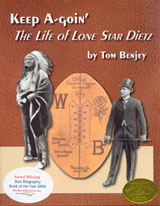
These days authors are supposed to have video previews of their books posted on the web for all to see. I was also instructed to make a video of me reading from my new book. Knowing full well that few would want to look at me reading for any period of time, I took a different approach. I read the words Pop Warner said in a 1924 interview in which he told of an episode that clearly shows what kind of stuff the Carlisle Indians were made of. After getting the thing started, I mostly disappear from view and am replaced by other footage and still photographs. Warner’s story is fascinating and, as best I can tell, is true. Because he told it over twenty years after it happened, he may have had some details confused. But the major things check out.
The story is a bit long but, when I’ve read it in book talks, audiences enjoy it because it is such a good story and, to my knowledge, hasn’t been told since the 1920s. YouTube.com enforces a strict time limit on videos that may be posted on their site, so it was necessary to split the story into two pieces. The first, and longer, part has been created and posted. The second and more interesting conclusion will be posted next week. “Carlisle Indians Had The Right Stuff” can be found at www.YouTube.com/TomBenjey. This is a chance to learn more about people such as Albert Exendine, Nikifer Schouchuk, Antonio Lubo, Martin Wheelock, James Johnson, Charles Williams and Richard Henry Pratt.
Feel free to make comments, either positive or negative.
Tags:Carlisle vs. Cornell 1902, Nikifer Schouchuk
Posted in Albert Exendine, Antonio Lubo, Carlisle Indian School, Charles Williams, Doctors, Lawyers, Indian Chiefs, James Johnson, Martin Wheelock, Pop Warner, Richard Henry Pratt | Leave a Comment »
September 30, 2008
I met county archivist Barbara Bartos at the Cumberland County Historical Society last night. She informed me that the archives from the Prothonotary’s Office contained automobile registration records prior to when the Commonwealth started issuing license plates.
In February, 1903 Senator Grim of Bucks County introduced a bill requiring the registration of automobiles. The legislature enacted an auto licensing law on April 23, 1903 that required motor vehicles to be registered with the county Prothonotary and a $2 fee be paid to the county Treasurer for a license tag to be affixed to the vehicle. Pop Warner may have owned an automobile before this act went into effect but, if he did, he did not register it in Carlisle. It is unlikely that, due to his notoriety, Warner would have been able to avoid licensing his automobile, if he had one. The Cumberland County Prothonotary issued ten automobile registrations between May 4, 1903 and March 11, 1904, the approximate date of Warner’s departure for Cornell. Seven of the vehicles registered were for owners who resided in Carlisle; the others resided elsewhere in the county. The automobiles registered in the first year of registration included recognizable names, both in makes of vehicles: Olds, Cadillac, Packard and Rambler as well as family of owners: Henderson, Biddle, Plank and Chronister. As one would expect, the list of early car owners includes wealthy families. Not included was Glenn S. Warner. So, it is highly likely that he did not own an automobile prior to May 4, 1903, the date on which W. H. Newsham of Carlisle registered his Olds. Not only wasn’t Warner the first man in town to own a car but he wasn’t among the first.
James C. McGowan provided no source for his information so one assumes that he concluded from the mention of Warner’s automobile on the Indian School campus in 1907 as a novelty that no one else in town had a car. That is simply not true. Errors of this nature would not be so egregious if they were not being foisted off on students and educators by McGowan and WorldandI.com as being true.
http://www.worldandi.com/subscribers/feature_detail.asp?num=25819
http://www.worldandi.com/subscribers/feature_detail.asp?num=25821
If such a simple part of McGowan’s article is wrong, what about the rest of it? Does WorldandI fact check what it posts on its site?
Tags:Add new tag, automobile registration, Barbara Bartos, Cumberland County, James C. McGowan, Prothonotary, WorldandI.com
Posted in Carlisle Indian School, Pop Warner | Leave a Comment »
September 26, 2008
A piece posted on a website used by educators and students contains a number of significant errors concerning the Carlisle Indian School, so I was suspicious when it stated that Pop Warner was the first person in Carlisle to own a car. Carlisle is the seat of Cumberland County and was then a prosperous place. Logic suggests that the first car in Carlisle would have been purchased by someone in one of the wealthy families. Also, its placement in the article implies that Warner purchased it around 1912, a date that seems late for the first automobile to appear in a county seat.
Carlisle Indian School publications first mention Warner’s automobile in early 1907, shortly after he returned to Carlisle from a 3-year stint back at his alma mater, Cornell. He may have brought the car with him or he may have purchased it with his substantial pay raise. Neither make nor year of the car was mentioned in the school newspaper’s articles. A 1910 article in The Carlisle Arrow informed readers that Warner had bought another cat, a Chalmers-Detroit 30. I had licensed a photo of Warner tinkering with his $15 auto for the Lone Star Dietz biography so checked with the Chalmers Registry to determine if the car in the photo was the Chalmers-Detroit 30. Joe A responded quickly that the car in the photo was a Franklin but not enough of the car was shown to determine the year and model. Franklins were made in Syracuse, NY which was Warner’s home state.
A newspaper article from late 1906 stated that the Commonwealth of Pennsylvania had already licensed almost 13,000 cars. Seeing that led me to contact PennDOT which, surprisingly quickly, directed me to a person who might be able to tell me when the first Car was licensed in Carlisle. That person informed me that PennDOT keeps no records on “dead tags,” license plates no longer in use, so has no historical data. Bummer. Boiling Springs historian and photo curator at Cumberland County Historical Society, Richard Tritt, came to the rescue. He informed me that Barbara Bartos has the records for the licenses issued by the county before PennDOT began issuing them. Now I may be able to solve this mystery.
Tags:Barbara Bartos, Chalmers-Detroit 30, Franklin, James C. McGowan, PennDOT, Richard Tritt, WorldandI.com
Posted in Carlisle Indian School, Pop Warner | Leave a Comment »
September 23, 2008
Today while conducting an email conversion regarding some advertising, I received an unexpected stroke. Maryann Batsakis, Sales Representative for ForeWord Magazine, informed me that the subtitle of my new book was the best she had seen in her seven years at ForeWord. She also informed me that she started in the mailroom where she opened every package that came in and saw every book. Since then she has seen all the award-winning books. So, she speaks with some authority. However, I may have a leg up because she appreciates my sense of humor. One time I mentioned a password I sometimes use and she responded that she liked it. I explained that it was too difficult to use Of all the gin joints in all the towns in the world she has to walk into mine. That cracked her up.
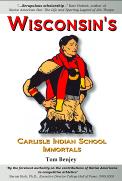
So if Doctors, Lawyers, Indian Chiefs doesn’t receive any other awards, I can feel good that my subtitle, Jim Thorpe & Pop Warner’s Carlisle Indian School football immortals tackle socialites, bootleggers, students, moguls, prejudice, the government, ghouls, tooth decay and rum, is the best.
Some may wonder why I was so verbose. Subtitles are used to help describe what the book is about and also to help search engines find the book for readers who might be interested in it. Doctors, Lawyers, Indian Chiefs covers so much ground that a long subtitle is needed. This might help explain why some books, especially very technical ones, have lengthy subtitles that contain a lot of jargon.
Tags:ForeWord Magazine, subtitle, Tuxedo Press
Posted in Carlisle Indian School, Doctors, Lawyers, Indian Chiefs, Football, Jim Thorpe, Pop Warner | Leave a Comment »
September 5, 2008
Yesterday’s email brought a curious announcement. I am going to receive a free, signed copy of a new book to be released soon. The Toilet Paper Entrepreneur by Mike Michalowicz, about which I know nothing, was looking for humorous bathroom graffiti. I sent in my all-time favorite from the back of the men’s room door at The Blessed Oliver Plunket, a bar/restaurant featuring live entertainment located across the street from the Cumberland County Historical Society. The Plunket, as it was better known, has numerous stories to tell but I’m not the one to tell them. In the late 70s, as I was leaving the men’s room, I noticed a scribble on the door:
No sign of intelligent life…Kirk Out
Apparently that witticism has found its way into a book.
Back to Donna Newashe McAllister’s question…
I expected that more people would comment on this and would like to see more myself. So, I’ll share some of my thoughts.
My wife and I have discussed this issue to some degree and I think it is an issue with multiple facets. First, I’m not so sure that American Indian athletes have necessarily declined. Judging today’s athletes with those who were at the Carlisle Indian School may not be fair. Those guys were world-class athletes coached by one of the most innovative coaches of all time. Pop Warner is criticized much today but few question his knowledge or his ability to coach football. During its heyday, Haskell had fine athletes and was led by Dick Hanley, Lone Star Dietz and Gus Welch, all of whom were excellent coaches. Dietz belongs in the College Football Hall of Fame. Neither Haskell nor the tribal colleges can afford to hire coaches of their caliber today.
Bob Wheeler tells me that Bill Thorpe shoots better than his age, 80, in golf. To compare anyone with Jim Thorpe is unfair. He was the greatest athlete of all time and could do anything well. I can’t imagine how he could be competitive in the pole vault, but he was. Sam Bird’s grandchildren and great-grandchildren are big in the rodeo. Some of the others didn’t have children and many settled off the reservation. For example, Joe Guyon was a big star at Carlisle, Georgia Tech and in the NFL where Joe Guyon, Jr. played for Catholic University.
But you seem to be focused more on leadership than on athletic ability. It appears to me that many of the better leaders did not return to the reservation after finishing at Carlisle or Haskell. Several were officers in WWI and were leaders in the service but didn’t return to lead their tribes. Some kept one foot in each world and their children found more opportunity in white society. For example, Thomas St. Germain’s son, grandson and great-grandson were/are renowned research physicians at Tulane University School of Medicine.
It may be that Indians are playing leadership roles individually but not together as a group. MANY of the Carlisle players went into coaching but Dietz, Exendine and Welch were about the only ones who made it their life’s work. Coaching was an even more precarious occupation then than now and only the best schools paid well. So, most devoted their considerable talents to other occupations. Even Exendine and Welch practiced law in the off-season.
Surely, other people have some insight into this issue.
Tags:Bill Thorpe, Blessed Oliver Plunket, Bob Wheeler, Dick Hanley, Mike Michalowicz, The Toilet Paper Entrepreneur
Posted in Albert Exendine, Carlisle Indian School, Football, Gus Welch, Jim Thorpe, Joe Guyon, Lone Star Dietz, Pop Warner, Sampson Bird, Thomas St. Germain, William Newashe | 2 Comments »
August 11, 2008
Thorpe received a lot of hype, even before dominating the Pentathlon tryouts. One such example is shown below. As coach of the Carlisle track team, Pop Warner placed himself in charge of Thorpe’s and Tewanima’s training for the Olympics. As part of their training regime he had them sit out most of the school’s spring meets. So, for the first time in several years, a team other than Carlisle won the Pennsylvania Intercollegiate Athletic Association’s track meet held on Hargest’s Island (today’s City Island) at Harrisburg. Thorpe did not attend the meet but Tewanima made an appearance. He ran 18 miles from the Indian School to Hargest’s Island, arrived at the field when the 2-mile run was underway. According to the report in The Carlisle Arrow, “he circled the field amid the cheers and applause of’ nearly everyone on theground. Tewanima made the eighteen-mile run in a little less than one hour and fifty minutes and seemed fresh at the finish and able go many more miles.”
Thorpe’s absence gave others an opportunity to shine. Bruce Goesback placed 1st in the 220 hurdles, 3rd in the 120 hurdles, 4th in broad jump and high jump. Possum Powell finished 2nd in both high jump and shot put. John Squirrel was 3rd in both 440-yd dash and broad jump. Sampson Bird came in 2nd in the hammer throw and 4th in discus. Gus Welch place 2nd in the half-mile and won the 440-yd dash but was disqualified of “alleged interference” with another runner. Arthur Coons placed 3rd in pole vault, Joel Wheelock came in 4th in both hurdle events, and Blackdeer, the only distance man to score points, came in 4th in the 2-mile run.
Carlisle still placed second to Penn State without its Olympians and beat all other colleges in the meet.

Jim Thorpe's Physique
Tags:Arthur Coons, Blackdeer, Bruce Goesback, City Island, Hargest's Island, Lewsi Tewanima
Posted in Carlisle Indian School, Gus Welch, Jim Thorpe, Joel Wheelock, Pop Warner, Sampson Bird, Stancil Powell | Leave a Comment »
August 7, 2008
The press was filled with articles about Carlisle’s expected participation in the upcoming games. Various track meets, competitions and races winnowed the field down to those who would eventually participate.
The Boston Marathon, which was run on April 20, was used to select the U.S. long distance team. Prior to the race Pop Warner thought that Mitchell Arquette, St. Regis Mohawk, would do even better than Tewanima. However, Michael J. Ryan, of the Irish American A.C. unexpectedly won the race and in world-record time. Andrew Sockalexis, Penobscot from Maine and not enrolled at Carlisle, came in second in conditions so muddy that runners had to run on sidewalks to get decent footing. After the conclusion of the race, the U.S. Olympic marathon team was set: Ryan and Sockalexis were selected as was Lewis Tewanima, the only Carlisle distance runner on the 1912 U.S. Olympic team. Apparently, the other Carlisle distance men didn’t do well enough in spring meets to qualify.
Jim Thorpe had a good spring. He was running so well that Warner was quoted as saying , “the man who beats him in the 120 yard [hurdle] event at the Pennsylvania relay meet will have to stagger the world’s record.” In May Thorpe competed in a tryout for the Olympic Pentathlon, a new event that consisted of five track and field competitions: 1) Running broad jump, 2) javelin throw with best hand, 3) 200-meters flat race, 4) discus throw with best hand, and 5) 1,500-meters flat race. He had not thrown the javelin previously but was expected to pick that up quickly. Also new to him was the 1,500-meters run in which his stamina was expected to carry him. Thorpe easily qualified for the Olympic team by winning three events: broad jump, discus and 200-meter run. He placed second in the other two, losing to the national champion in the javelin and finishing two yards behind the leader in the 1,500-meters. His prospects for a successful Olympics were good. Also named to the U.S. team to compete against Thorpoe in the pentathlon and decathlon was Avery Brundage.

Tewanima wins race & Arquette comes in 5th
Tags:1912 Olympics, Andrew Sockalexis, Avery Brundage, Boston Marathon, Lewis Tewanima, marathon, Mitchell Arquette, Penobscot, Pentathlon, St. Regis Mohawk
Posted in Carlisle Indian School, Jim Thorpe, Pop Warner | 2 Comments »



 Tom Benjey's Weblog
