Carlisle generated much press in the months leading up to the Stockholm games, a good bit of which was focused on the Hopi distance runners. Rather than comment on it, I will present a particular April 1912 newspaper article in its entirety.
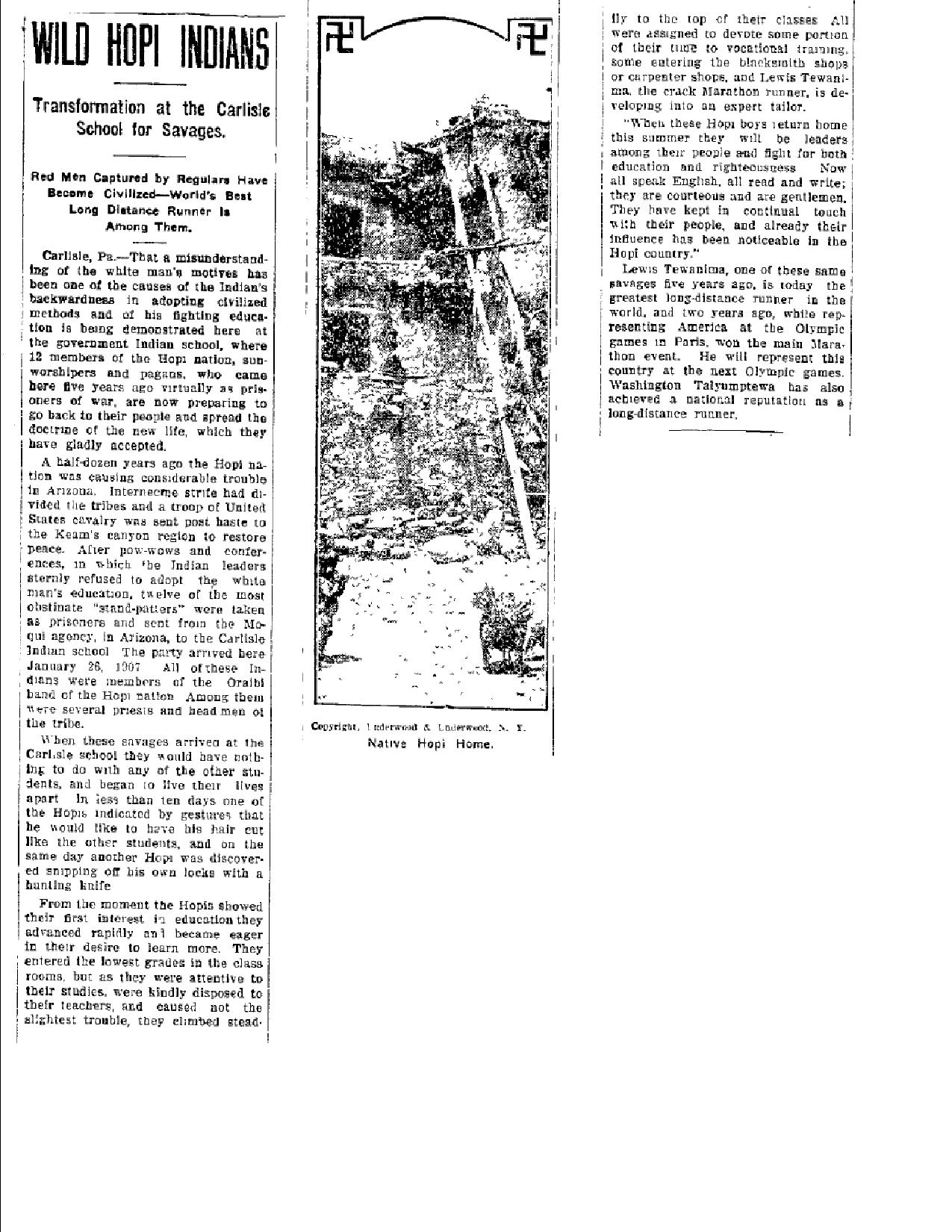
Carlisle generated much press in the months leading up to the Stockholm games, a good bit of which was focused on the Hopi distance runners. Rather than comment on it, I will present a particular April 1912 newspaper article in its entirety.
Some think that 1912 was the year Native American broke onto the Olympic scene but, as shown in the last few blogs, they arrived much earlier. But 1912 was to be better for American Indians in the Olympics than the previous games. But it was not surprising.
As early as New Year’s Day 1912 and as far away as Fairbanks, Alaska, newspapers carried an article with a Carlisle, Pa. byline promoting Jim Thorpe for the upcoming Olympics. That article was surely generated by Pop Warner’s PR machine. An excerpt illustrates the exuberance in which he was promoted:
This youthful redskin hunts, plays lacrosse, tennis, indoor baseball, handball and hockey, all with equal skill, and can fill almost any position on a football team with credit. As halfback he probably is seen at his best, whirling, twisting, dashing and plunging, for one moment bewildering his opponents with lithe, panther like leaps, and the next crushing his way through the mass of would-be tacklers with the ferocity of a mad bull.
The piece ends with what may have been a preemptory defense against claims of professionalism:
Although busy with track work while here, he practiced baseball and played amateur baseball since leaving Carlisle, refusing numerous offers to play on minor league teams.
But Carlisle’s track team was not a one-man operation. Less than two weeks later papers gave Thorpe’s teammate some coverage:
Louis Tewanima of Carlisle Indian School will be a starter in this year’s Boston Athletic Association Marathon race and hopes to make the American Olympic Games team.
Pop Warner announced in early January that he expected Tewanima and Thorpe to make the Olympic team. On March 1st the commentator, who wrote the Diamond Gossip that was distributed widely, opined that the reason so many athletes were deciding against attending the Games was that Thorpe was going to Stockholm. Less than a week later, Warner’s PR machine announced that several other students wanted to make the Olympic team. Warner himself said that he thought five of his Carlisle trackmen might make the cut. He expected that Arquette would “make the foreigners scamper in the 10,000 meters,” but refused to identify the other two. “I don’t care to let any one know as yet who my two new phenoms are. One of them is one quarter-miler of exceptional ability. The other will be entered in the 400 and 500 meters races.”
I have read that Gus Welch made the team but was unable to compete due to injury. Could he have been one of Warner’s mystery men?
This year marks the 250th anniversary of the building (perhaps hewing may be more accurate) of Forbes Road. The Seven Years War between France and Britain was raging around the globe. Pennsylvania found itself at the epicenter of the North American theater of what Americans generally call the French and Indian War. General Forbes set out from Carlisle in 1758 to take Fort Duquesne (present-day Pittsburgh) from the French. He followed Indian paths from Carlisle south along what is today Route 11 to Chambersburg and headed west along what later became Route 30. He widened and improved the crude existing roads and, beginning at Bedford hacked his way west to Pittsburgh. 157 years later, in 1915, Pop Warner likely followed the same route when he left Carlisle to take the reins at the University of Pittsburgh.
Warner took more than his belongings to Pitt; he also took his single- and double-wing offenses. But before football season started, he held a summer camp for his players at Camp Hamilton, a facility Pitt owned just outside the town of Windber. To get to Windber, Warner would have backtracked on Forbes Road past Ft. Ligonier and halfway to Bedford before heading north to Camp Hamilton. It was at Camp Hamilton that Pop schooled his new players in the intricacies of the single- and double-wing. Many Carlisle players headed west to Altoona and Pittsburgh to play for independent teams, but they would not have followed Forbes Road because they most likely traveled by train.
Camp Hamilton became an expensive luxury for Pitt during the Depression, so ownership of it passed to Windber Area School District. In 2003, after posting Windber’s 500th win, Coach Phil DeMarco was looking for something new. That something new turned out to be the single-wing. So, the single-wing returned to Camp Hamilton after a long absence, not so long, however, as Pop Warner’s absence from Pittsburgh. Windber ran the single-wing at Camp Hamilton back in the 1930s when they won two state championships with it by beating John Harris one year and Steelton another.
The 250th anniversary of Forbes Road celebrates more history than the victory of the British over the French, it also honors the opening of the Northwest Territory to settlement and other things that traveled along the road, wanted or not.
The advance reading copies (called ARCs in the trade) arrived for my new book and are being sent out to reviewers. This is a big moment in a writer’s life: seeing thousands of hours of hard work turned into something tangible. In the old days (pre-computer), ARCs were called galleys, bound galleys or galley proofs. Authors, editors and publishers go over these babies with a fine-tooth comb looking for errors, typos or things that have changed since writing was complete. It is an impossible task because, after all this scrutiny, some typos escape and find their way into the final book. But we try.
Another important use of ARCs is to see how the photos and artwork come out in print. Overall they came out very well, better than expected. But a cartoon about the Oorang Indians from a 1922 Baltimore newspaper is too dim. The challenge now is to figure out how to darken it without losing the detail.
This weekend I received some additional information and a correction regarding Louis Island from a family member who happened to see a previous blog. That was fortuitous because I want the book to be as accurate as possible. This blog is already proving to be of some value. That encourages me to continue with it.
Having these ARCs provides local booksellers the opportunity to provide their customers something extra. People can look at an ARC and pre-order the book if they choose. The bonus, besides being sure of getting a copy of the book as soon as it comes out, is to receive an inscription of his or her choice signed by the author. On-line booksellers also take pre-orders but personalized inscriptions are impractical.

I have become aware that a historically significant letter written by Pop Warner is up for sale on an Internet site: http://www.historyforsale.com/html/prodetails.asp?documentid=227287&start=2&page=48
The letter was written on October 8, 1951 on Warner’s personal stationery as he was retired by that time and living in Palo Alto, California, where he had earlier coached Stanford University. The letter to Col. Alexander M. “Babe” Weyand contains Warner’s recollections as to when he invented various things and his opinions as to which Carlisle victories were the most significant.
This letter is important because it helps clarify issues currently being debated, some of which I am to blame for raising the issue. Due to Alison Danzig’s writing it had long been thought that Warner had developed the single- and double-wing formations later than Warner states in this letter. I based my 2006 documentary celebrating the centennial of the birth of modern football on statements Warner made in his landmark 1927 book on football and some other sources. This letter supports my position. In their recent books on Jim Thorpe, Sally Jenkins and Lars Anderson generally support the position that Carlisle pioneered modern football when the rules changed drastically in 1906. But Warner’s letter partially debunks their positions that the double-wingback was first unleashed against Army in 1912. He also lists what he considered Carlisle’s most important victories. The 1912 Army game was not among them. More on that in a future post.
The question I have is: why is this important letter up for sale and not in an archive? Two repositories come quickly to mind; Cumberland County Historical Society (CCHS) or West Point – CCHS because it holds numerous records and artifacts from the Carlisle Indian School and West Point because it holds Weyand’s papers. I don’t know if West Point buys papers for its collection but CCHS certainly does. It recently purchased 28 letters written by Jim Thorpe in the 1920s that had nothing to do with Carlisle. The asking price for the Warner letter is about twice what CCHS paid for each of the Thorpe letters. One of the reasons historical documents are so expensive is that there are autograph collectors who are willing to pay large sums just for signatures of famous people. But Warner’s letter to Weyand is valuable for the information it contains.
When asked what was the key to his success at Carlisle Indian School, Pop Warner famously answered that it was the absence of alumni. While this statement is not literally true, it is correct in the context in which it was made. Of course Carlisle had alumni, but what it didn’t have were alumni associations, major alumni donors and influential alumni with the ability to influence the direction of the athletic department. Warner was thus able to run the football team the way he saw fit. He didn’t have to deal with alumni interference as he had at Cornell. He felt blessed by its absence.
One of the changes that took place after the 1914 congressional investigation of Carlisle was the formation of an Alumni Department. Reorganization may be a more accurate word, but any previous organization may have had so few resources that it was barely active. After the dust settled on the changes made following the investigation, the building that formerly housed the Native Art Department was given to the Alumni Department for its home. A curriculum change a couple of years prior had eliminated the Native Art Department but had not reassigned the building. Lone Star Dietz had been reassigned to teach mechanical drawing and Angel DeCora had a sinecure. The building that still stands on Carlisle Barracks opposite Pop Warner’s home just inside the former entrance to the school had become a hangout for students and was apparently not being put to a constructive use. The alumni Department quickly ordered a large pennant for each of the graduating classes to that time and hung them around the walls. Student crafts were removed from the building and replaced with souvenirs purchased in New York.
The Alumni Department was allocated a few pages in each issue of The Red Man, Carlisle’s monthly literary journal. The Masthead for that section is shown below. The reason I thought about the Alumni Department is that I recently received a phone call from a local collector who had just purchased a plate from the Carlisle Alumni Department at a sale. He wasn’t sure that it was legitimate but took a small gamble and bought it. I haven’t seen it yet but his verbal description sounds familiar to the artwork on the masthead.

Yesterday I came across a December 8, 2007 article in The News Tribune out of Tacoma, Washington. In it reporter Todd Miles wrote, “Not since 1917 have the Washington State Cougars had a minority head coach in football.” Putting aside the fact that Washington State’s teams weren’t called the Cougars in 1917, the statement is still incorrect. Yes, Lone Star Dietz coached the 1918 Mare Island Marine team that was featured in WSC’s yearbook because ten players were from WSC. And, although Dietz considered it Washington State’s second Rose Bowl team, it didn’t wear crimson and gray. The major error is that not one but two minority coaches were overlooked. This is why we study history.
When Dietz was unceremoniously dumped in early 1919, WSC wanted another coach who was steeped in the Warner system because Dietz had been wildly successful with it. So, the administration looked for someone with experience, not just with the single and double-wing formations but with the whole system. Recall that Ace Clark thought that the way Lone Star conditioned his players and reduced the amount of scrimmaging left them in better shape for the games. Albert Exendine was a logical choice but he was under contract at Georgetown. Eventually Gus Welch was tracked down on a former battlefield in France and recruited for the job.
Gus Welch was Chippewa from Wisconsin and Al Exendine was Delaware and Cherokee from Oklahoma, but they have a lot of similarities. Both attended Carlisle Indian School and starred on its teams, Exendine at end and Welch at quarterback (blocking back in Warner’s single-wing). Both got their law degrees from Dickinson School of Law (now part of Penn State) across town from the Indian school. Both had long careers of coaching football in the fall and practicing law the rest of the year. Both were inducted into the College Football Hall of Fame as players. And both coached Washington State. Welch led the team from 1919 through 1922 and Exendine took over in 1923, lasting through the 1925 season. Each has a chapter devoted to him in Doctors, Lawyers, Indian Chiefs.
So, Washington State has a history of hiring minority head football coaches, just not lately.




 Tom Benjey's Weblog
