Archive for the ‘Pop Warner’ Category
July 4, 2009
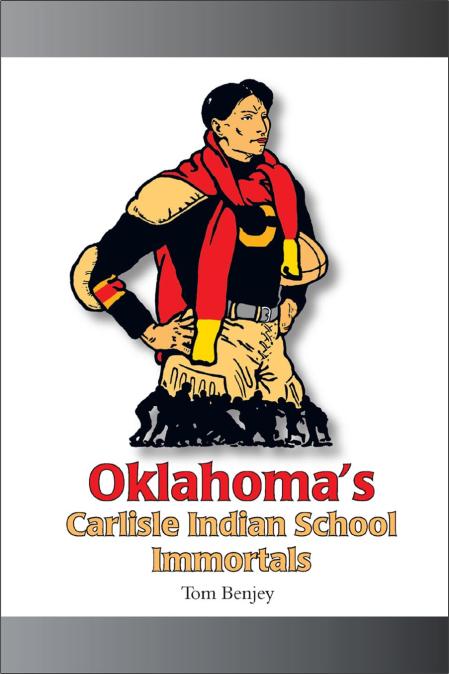
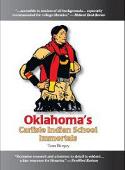
Proofs for the text and cover of Oklahoma’s Carlisle Indian School Immortals arrived Thursday. The purpose of the proof is to determine that everything is perfect before printing the batch of books. The cover looks great to me. The colors are vibrant and Bob Carroll’s drawings of the players’ faces provides an attractive background for the text on the back cover. There is a problem with the text, however.
Rather than taking up space in the narrative with dry demographic about the players, I put this information in boxes, one for each player. The boxes were shaded in light gray for visual interest. Herein lies the problem. Five of the fifteen demographic data boxes appear to have no shading. The boxes looked perfect in the advance reading copies (ARCs), but those were produced by a different printer. Panic set in immediately. The PDFs sent to the printer look perfect. The printer’s technician informed us that the shading was done at 9% and they accept nothing below 15%. That doesn’t answer the question as to why two-thirds of the boxes were shaded correctly.
As it turns out, the boxes that printed correctly have graphics with transparency on the same page but the bad ones don’t. It appears that the printer’s software or equipment does something different in these cases. Be that as it may, I have to submit new PDFs with 15% gray shading. That means that I will probably have to pay the graphic designer for his time and the printer fees for resubmitting a new PDF and for a new proof. I also have to wait several days to see if this solves the problem.
Tags:Bob Carroll, Oklahoma, PDF problems
Posted in Albert Exendine, Carlisle Indian School, Football, George May, Henry Roberts, Isaac Seneca, Jim Thorpe, John B. Flinchum, Mike Balenti, Pete Hauser, Pop Warner, Publishing, Richard Henry Pratt, Stacy Matlock, Victor Kelly, Wauseka, William Newashe | Leave a Comment »
June 16, 2009
Ever consider what would have happened to Jim Thorpe had he not returned to Carlisle in 1911? Pop Warner and Moses Friedman have received a lot of criticism, much of it earned, for their handling of the Jim Thorpe scandal. But what if they hadn’t let him return? It appears that Friedman didn’t really want him back anyway. How differently would things have turned out if, after Albert Exendine bumped into Thorpe, in Anadarko, Oklahoma in the summer of 1911, Warner didn’t want him back?
It is curious that that Jim Thorpe, a 3rd string All American in 1908, sat out the 1909 and 1910 seasons without being recruited by a major football power or even a small Oklahoma college. My sense is that he had had all the schooling he wanted and wasn’t prepared academically for college. Other Carlislians who went on to play football at major colleges generally attended the Dickinson College Preparatory School prior to enrolling in college. Thorpe hadn’t done that. In the early 1920s, he mentioned that numerous colleges had approached him about enrolling in their institutions when he was playing college football. However, that likely happened after he returned to Carlisle in 1911.
It is highly unlikely that Jim Thorpe would have played in a high enough profile program to be named 1st string All America in football in 1911 if he didn’t return to Warner and Carlisle. Perhaps he would have made the Olympic team if found a trainer and a club of the caliber necessary to prepare him to make the team. It’s possible but seems unlikely, especially since he hadn’t taken steps to find a trainer or club before returning to Carlisle less than a year before the Olympic Games.
So, my conclusion is that Jim Thorpe profited from returning to Carlisle. Losing the medals was a price he paid for that decision, but he still made out better in the long run than he would have if he had stayed in Oklahoma. Conflicting opinions are welcomed.
Posted in Albert Exendine, Carlisle Indian School, Football, Jim Thorpe, Pop Warner | Leave a Comment »
June 2, 2009
Lest some think the following story about Pop Warner’s toughness is apocryphal, I will share a similar story about another coach of that era. Warner was not happy with his new prospect’s development as a player and pulled him out of his place at a practice. Pop told James that he was not playing nearly aggressively enough and said, “Now get down there and show me how it should be done.” Warner lined up opposite Phillips as he did when trying to demonstrate a technique to a player. When the signal was given, Phillips charged so hard that he knocked Pop unconscious. When he came to and cleared his head, Warner just said, “Now, that’s the way it’s done!”
In Dutchman on the Brazos, Caesar “Dutch” Hohn shared an experience he had with his coach at Texas A & M, Charlie Moran. Moran was teaching the offense a new play but it wasn’t working due to Hohn’s interference. Hohn was lined up across from a guard named “Fatty” Lilliard and on every snap of the ball, “I’d hit Fatty in the face with the heel of my hand, knock him off balance, and break up the play.”
Moran snorted, “Who’s letting that damn Dutchman through here?” Lilliard responded, “There’s nothing you can do when a man hits you in the face with his hands.” “Is that so?” said Moran just before pushing Lilliard aside and taking his position. He then told the quarterback to call the same play.
Seeing that Moran was cocked live a Colt 45 ready to hammer him, Hohn remembered what his Coach told the team earlier: “Don’t spare me, because I expect to knock the hell out of you.”
Hohn recalled, “I had the reach on him, and he wasn’t any heavier than I was. Remember, also, that I was able to use my hands. There was one more fact Moran must have forgotten; I knew the starting signal. I timed myself, and when the ball was snapped I got the jump on him, bowling him over, and broke up the play. That was the day I made the team.”
Tags:Caesar "Dutch" Hohn, Charlie Moran, Fatty Lilliard, Texas A & M
Posted in Carlisle Indian School, Football, James Phillips, Pop Warner | Leave a Comment »
May 31, 2009
Like most of the interesting things I find, I unexpectedly stumbled across a November 19, 1908 Nebraska State Journal article that said the upcoming game between the Carlisle Indians and the University of Denver had been canceled. Post-season (about anything after Thanksgiving in those days) road trips were not unusual for the Indians. As early as 1896, they played a night game in the Chicago Coliseum on December 19 against that year’s Champions of the West, Wisconsin. And 1908’s trip wasn’t as long or as elaborate as some. It started early with a November 21 game against Minnesota in Minneapolis. Five days later, the opponent was St. Louis University in St. Louis. Six days after that it was Nebraska in Lincoln. Three days after that was to be the Denver game in Denver. According to the article, Denver officials were informed by Carlisle officials that the game was called off because, “…that leave of absence could not be secured for so long a journey.” The article didn’t say if it was Superintendent Friedman, who was new at his post, Commissioner of Indian Affairs Francis Leupp, or someone else. There had been recent communications with Pop Warner and he had said nothing about a cancelation. Denver didn’t take it lying down.
According to the paper, they went straight to the top: “President Roosevelt has been asked to use his influence in having a contract between representatives of Denver University and the Carlisle Indian school for a football game between the elevens of the two schools lived up to.…they at once asked the president through former United States Senator Patterson, to request that the Indians be given the leave necessary. A portion of Senator Patterson’s message reads: ‘The Denver boys want a square deal and turn to you to get It for them.’ Governor Buchtel, who is chancellor of Denver University, also wired Congressman Bonynge and Senator Teller to secure, if possible, the Intervention of Commissioner of Indian Affairs Leupp.”
I don’t know what happened next but do know that the Indians won three and lost one on the road trip. The loss was to Minnesota. The wins were over St. Louis, Nebraska and Denver.

Carlisle Quarterback Mike Balenti
Tags:Francis Leupp, Governor Buchtel, Moses Friedman, Senator Patterson, Theodore Roosevelt
Posted in Carlisle Indian School, Football, Mike Balenti, Pop Warner | 1 Comment »
May 7, 2009
Galleys for Oklahoma’s Carlisle Indian School Immortals, the first book in my upcoming series on Native American Sports Heroes, have arrived. At about 160,000 words, Doctors, Lawyers, Indian Chiefs is too long for most middle school and many high school students to read. So, I am splitting it up into a series by state, the first of which is Oklahoma because it has the largest Indian population of any state. It also was home to many of the Carlisle stars. Splitting up the book into smaller volumes has another advantage; it makes room for some more players. Doctors, Lawyers, Indian Chiefs got to be so long that I had to stop adding players, but now I have places to tell their stories. For example, Henry Roberts and Mike Balenti are in Oklahoma’s Carlisle Indian School Immortals but aren’t in Doctors, Lawyers, Indian Chiefs.
The new book will be in hardback so that it is attractive to libraries and is under 200 pages long, including the index and appendices. My hope is that school and public libraries across Oklahoma, and elsewhere, add this book to their collections. A book reviewer suggested that grandparents may be interested in giving this book to their grandchildren as gifts. I would like that because my readers to date tend to be over 40. Young people should know about the lives and achievements of Carlisle Indian School students.
Like my other books, Oklahoma’s Carlisle Indian School Immortals is heavily illustrated with rarely seen period photos and cartoons. Bob Carroll of the Professional Football Researchers Association even drew portraits of all the players for the book. This book will be released in September.

Posted in Albert Exendine, Archie Libby, Carlisle Indian School, Doctors, Lawyers, Indian Chiefs, Emil Hauser, Football, Frank Cayou, George May, Henry Roberts, Isaac Seneca, Jim Thorpe, John B. Flinchum, Mike Balenti, Pete Hauser, Pop Warner, Richard Henry Pratt, Single-Wing, Stacy Matlock, Stancil Powell, Victor Kelly, Wauseka, William Newashe | Leave a Comment »
April 8, 2009
Today I received a fax of the front page of the July 22, 1935 edition of the Pawhuska Daily Journal Capital from the Oklahoma Historical Society. The combination news article/obituary clears up the questions regarding Pete Hauser’s untimely demise.
Pete spent the evening of Saturday, July 20, 1935 at a baseball game in Bartlesville, Oklahoma with two friends. Pete, Chauncey Archiquette and George Frass were about 4 miles out of Pawhuska on the Bartlesville Road when their car had a flat tire. For reasons unstated, they parked Archiquette’s car in the middle of the road. A good guess might be that at 3:00 a.m. on a Sunday morning in rural Oklahoma in 1935, they didn’t expect any traffic. As Pete was tightening the lug nuts, Archiquette stood in front of the car and waved at an oncoming vehicle to pass it on the left because there was more room. Miss Violet Stuart of Bartlesville was driving the oncoming car which was owned by her passenger, A. C. Applegate of Dewey. She attempted to pass the stopped car on its right and clipped its left front fender and killed Hauser by breaking his neck.
Pete and Chauncey were long-time friends as both had attended and played football at Haskell Institute and Carlisle Indian School. Pete was living with Chauncey at the time of the accident and was employed by a Depression-era government program, the Indian Emergency Conservation Work, a division of the Civilian Conservation Corps (CCC).
Pete was active in the American Legion after serving at Fort McArthur, Texas during WWI. His Legion Funeral Rites were held at Johnson Chapel. A Legion quartet sang at his funeral and a rifle squad fired a salute at graveside. Honorary pallbearers included old football chums Pop Warner, Jim Thorpe, Albert Exendine, Walter Mathews and Archiquette.
Carolyn Williams was essentially correct in her understanding of the accident.
Tags:Bartlesville, Chauncey Archiquette, George Frass, Pawhuska
Posted in Albert Exendine, Carlisle Indian School, Football, Jim Thorpe, Pete Hauser, Pop Warner | Leave a Comment »
February 16, 2009
I just learned of another formation with roots in the single-wing and figured I better tell you about it before it is banned. Head Coach Kurt Bryan and Offensive Coordinator Steve Humphries of Piedmont High School near San Francisco, California. Like Pop Warner a century before them, Bryan and Humphries designed a formation to compensate for a weight disadvantage. Like Coach Phil DeMarco at little Windber Area High School in Pennsylvania, Piedmont suffered a size disadvantage when playing much larger schools. The size disadvantage wasn’t just a single-game experience, it continued to present itself as seasons wore on and injuries piled up. Large schools have so many players that they win wars of attrition. By the time playoffs come around, small schools can be pretty short on players. The new formation, the A-11, reduces injuries to players running that offense.
What is the A-11?
High school and college rules require that at least five players wearing numbers between 50 and 79, numbers worn by players not eligible to receive passes, line up on the line of scrimmage – except when in “scrimmage kick formation,” i.e. punt or place kick. Bryan and Humphries found a loophole. They have all their players wear numbers from 1 to 49 or 80 to 99 to become eligible pass receivers. They then line up in a formation, the A-11, that qualifies as a “scrimmage kick formation.”

A-11 Base Formation
The formation’s single-wing roots become obvious when one notices the direct snaps from the center to the 1 and 2 backs (tailback and fullback). Both of these players are ideally triple-threat guys but coaches have to live with what they have. What makes the A-11 unique is how the other two backs and six linemen are positioned (the center is on already on the line of scrimmage). Just before the snap, these eight players shift so that six of them are on the line of scrimmage and two are back of it. The players’ numbers allow all of them to be in either location. The defense has just a second to sort out the eligible receivers and frequently guess wrong. North Carolina has made it illegal and California is threatening to follow suit. Find out more at http://www.humphinternet.com/A11/
The A-11 was declared illegal after this blog was written but before it was published. For more info see: http://rivals.yahoo.com/ncaa/football/blog/dr_saturday
Tags:A-11, Kurt Bryan, Phil DeMarco, Piedmont High School, scrimmage kick formation, Steve Humphries, Windber Area High School
Posted in Pop Warner, Single-Wing | 1 Comment »
February 9, 2009
A couple of years ago Angel DeCora’s biographer wrote, “I noticed Benjey did not seem to have access to several of my sources, including Ewers’ papers from the Smithsonian archives…” I didn’t understand her comment because I did have access to John C. Ewers’ Smithsonian file. However, I found some errors in his article on Dietz and saw no point in including those in my book. Now I know what she meant. In a chapter on Dietz that was removed from her recent book, Linda Waggoner makes the following statements:
When his sentence was over, Dietz returned to the east, taking a temporary job at the Philadelphia School of Industrial Art in “Design and Lettering” for the 1920-1921 academic year.[63] Perhaps, he wanted to revisit the past he spent with Angel, but football was still his first love. In 1922 he was hired to coach at Purdue University in Indiana. At the end of January 1923 he married Doris O. Pottlitzer, a “Jewish heiress,” just a week after he was fired from Purdue for illegal recruiting.
Like Ewers before her, Waggoner appears to have misinterpreted The Pennsylvania Museum and School of Industrial Art Circular for 1920-21. Beginning on page 41 of that circular is a list of former students and their last known occupations. They were probably not aware that Dietz was no longer teaching at Carlisle and hadn’t been doing that since 1915. Sara MacDonald, Public Service Librarian at The University of the Arts, successor organization to The Pennsylvania Museum and School of Industrial Art, explained this to me some years ago and reiterated that again last week.

Waggoner’s explanation would have been convenient for me because I haven’t found out what Dietz was doing in the year between when he got out of jail in 1920 and the time he took the coaching job at Purdue in 1921. I have no explanation as to why Waggoner has him coaching the Boilermakers in 1922 and marrying Doris in 1923. He coached Purdue in only one year, 1921, and married Doris in early 1922. They then relocated to Ruston, LA where he coached Louisiana Tech in 1922 and 1923. Lone Star may have thought Doris was a cracker heiress, but it doesn’t look like she was. I suspect that his 1-6 record at Purdue had more to do with his firing than the accusations made against him.
The blog’s owner responded to the Waggoner post that included the above extract as follows:
I look forward to some real scholarship about Dietz’ true identity. I think it’s time to clear this up. Please keep a’goin with this. For those unaware, ‘Keep a’goin'” is the phrase that repeats in the chorus of the Carlisle Indian School song Pop Warner is credited with writing.
Here’s some real scholarship. “Keep a-goin’” was NOT a phrase that Warner repeated in the Carlisle school song. Follows is the school song as published in the January 25, 1907 edition of The Arrow. Also included is the poem from his 1927 book, Football for Coaches and Players, the place where the phrase can actually be found.
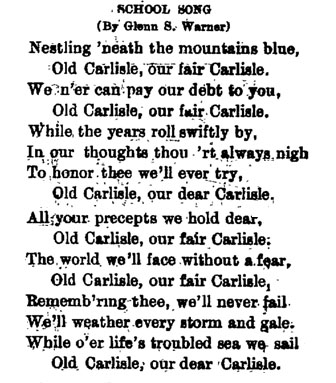

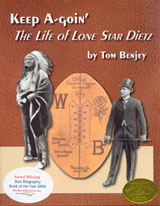
I picked this phrase for the title of Lone Star Dietz’s biography because of the way he kept going in spite of numerous setbacks and because he had it in his hand when he died. He also illustrated the book from which it came.
Tags:Angel DeCora, Doris O. Pottlitzer, John C. Ewers, Keep a-goin', Linda Waggoner, Sara MacDonald, The Pennsylvania Museum and School of Industrial Art
Posted in Carlisle Indian School, Lone Star Dietz, Pop Warner | Leave a Comment »
January 19, 2009
While researching the lives of Henry Roberts and Mike Balenti, I became aware that they, and some other Carlislians played against each other when enrolled in other schools. In response to criticism that Carlisle Indian School had been playing some of the same people for too many years, Pop Warner instituted a policy that limited players to four years on the varsity squad. Mike Balenti had used up his eligibility at Carlisle and Victor Kelley had one year of eligibility remaining at the Agricultural and Mechanical College of Texas. While there were no national eligibility standards, many colleges limited students to four years of eligibility, one for each of their four years of college – assuming that they finished on time. However, colleges often conveniently ignored the time former Carlisle players now at their institutions had played at the Indian school because it wasn’t a college academically. In fact, it wasn’t even a prep school. Putting these vaguaries of eligibility aside, Mike Balenti and Victor Kelley enrolled at A&M (reenrolled in Kelley’s case) to play under new head coach Charlie Moran. Moran, coincidentally, had assisted Pop Warner at Carlisle the previous year before embarking on a career as football coach. Previously, he had been a star player and a baseball coach, but hadn’t coached football. The Aggies, with Kelley at quarterback and Balenti at left halfback, had a powerhouse team. One of the obstacles in their path to the unofficial Southwestern Championship was Haskell Institute. The teams met on October 23 at College Station. Captain and left end of the Haskell squad was Henry Roberts who would later star of Carlisle’s great 1911 team. Not on the field that day for Haskell, but on the squad, were center Nikifer Schouchuk and quarterback Louis Island. It was like old home week at the game which the Aggies won 15-0. Aggie students celebrated wildly after the game because beating the team that had beaten the University of Texas meant a lot to them. At the end of the season Charlie Moran, as coach of the Southwestern Championship team, was given the honor of selecting an All Southwest team. He named Kelley for quarterback, Balenti for left halfback, and Roberts for punter. Carlisle was well represented on that team by alums both past and future.
Tags:Charlie Moran, Haskell Institute, Nikifer Schouchuk, Texas A&M
Posted in Carlisle Indian School, Football, Henry Roberts, Louis Island, Mike Balenti, Pop Warner, Victor Kelly | Leave a Comment »
January 5, 2009
This weekend was productive – maybe. Walt Shiel offered some advice on converting print books to ebook format on a small publishers forum. The first step was to open an rtf file containing the book in question with Microsoft Word. Fortunately for me, Keevin Graham, the graphic designer who lays out my books, had already provided me with an rtf of Doctors, Lawyers, Indian Chiefs. The second step was to save the book as Web Page, Filtered, which produces an html file. So far, so good. The third step was to open the html file with Notepad and save it again, thus eliminating the “secret codes” Word embeds in documents. The resulting file was ready to import into Mobipocket’s ebook creator (available free on the Mobipocket site). There was one small glitch. Doctors, Lawyers, Indian Chiefs has a number of photos, illustrations and tables, items which ebooks don’t display well and which require considerable manual manipulation. FWIW, Keep A-goin’: the life of Lone Star Dietz has a lot more, a factor which will keep it from being converted into an ebook for some time. The illustrations are such an integral part of that book that I’m reluctant to publish an ebook of it without them.
My solution to the problem was to create a new book from Doctors, Lawyers, Indian Chiefs that includes only the background/overview chapters and none of the players’ biographies. Also, at 160,000 words some find the entire book too long and detailed for their taste. Carlisle Indian School Football Immortals: a brief introduction provides the key information about the history of the Carlisle football program and will be of interest to those who are not interested in reading about the individual players. Even this conversion required a lot of manual HTML coding because of all the illustrations and tables are a particular headache. After some “learning experiences” with the Mobibook creator, a prc file was created and uploaded to the Mobipocket site. The prc file was also converted by the Amazon.com Kindle converter and uploaded to its site. I’m waiting to hear back from Sony.
For those who become interested in the players or seeing better quality illustrations after reading the ebook, Tuxedo Press is giving ebook buyers free shipping on print books purchased from them. The net result is that the ebook cost is essentially being refunded because its list price is only $4.99 and Amazon.com is currently offering the Kindle version for $3.99.

Carlisle Indian School Football Immortals: a brief introduction
Tags:ebook conversion, Kindle, Mobipocket, Walt Shiel
Posted in Carlisle Indian School, Football, Jim Thorpe, Pop Warner | 3 Comments »


 Tom Benjey's Weblog
