Archive for the ‘Pop Warner’ Category

Pacific Northwest Trip Canceled

January 26, 2010

The October 24, 1908 edition of The Anaconda Standard reported, in an article titled “Carlisle Cancels Northwestern Trip,” on a wire sent from Portland, Ore. on October 20. The wire began, “The games between the Carlisle Indians and W. S. C. and Multnomah A. C. are off, a letter from the Indians to Manager Martin Pratt of Multnomah yesterday announcing that the proposed expedition had been canceled. The news was badly received at Multnomah, where the clubmen were counting on the Carlisle game as the big attraction of the year from an attendance standpoint.”

W. S. C. stands for Washington State College, which is known today as Washington State University. A strong tie with Carlisle Indian School and the Warner System was established in 1915 when Lone Star Dietz left Carlisle to turn around W. S. C.’s football team and lead them to an undefeated season and a victory on New Year’s Day in Pasadena to establish the Rose Bowl tradition. Dietz was followed as head football coach first by Gus Welch and later by Albert Exendine. Multnomah Athletic Club was founded in 1891 and still operates in Portland, Oregon. At that time, they fielded one of the better football teams on the West Coast.

Carlisle Indian School publications made no mention of this. In fact, the November 6 issue of The Carlisle Arrow made no mention of any games, real or imagined, after the Thanksgiving Day game with St. Louis University. The November 20 issue included this little item:

Our Varsity team will leave for the west on Wednesday, with our coach and the substitutes, to play with Minnesota University, St. Louis University, Nebraska University, and Denver University.

No mention was ever made of a possible extension of the trip to the Pacific Northwest. The Indians lost to Minnesota, 11-6, and athletic relations between the schools were severed for reasons left unstated. The Indians then won the remaining 3 games on their long schedule to finish the 1908 season 10-2-1. The other loss was a 17-0 defeat by Harvard. The other blemish on their record was a 6-6 tie with Penn.

Correct Information Is Hard to Find

January 8, 2010

A November 27, 1949 newspaper article by Deke Houlgate discussed the problems Warner Brothers were having with a screenplay for Jim Thorpe’s biopic. Several scripts had been written and discarded but a new one, titled “All-American,” was expected from the screenwriters soon. However, he questioned how good it would be given the problems the writers faced. He wrote, “One of the present problems at the Burbank studio seems to be that the records for this famous team–records that must reach back prior to World War I—no longer exists or are easily obtainable. The Army of the United States took over the school or campus, without asking, for the use of its fledgling doctors in 1917 and scattered students plus pertinent data all the way from Lawrence, Kansas, to Riverside, California.”

Like most newspaper reporters, Houlgate had some details wrong but he did better than most. First, the Army took Carlisle Barracks back in 1918, not 1917. Second, the facility wasn’t used for “fledgling doctors” as that came later. In 1918 it was used as a hospital to treat soldiers wounded in WWI. Houlgate went on to attempt to set the record straight on some legends that unfortunately still persist:

First off, Carlisle never had an undefeated, untied season. The Indians came close to a perfect record many times but always managed to lose at least one game. Next Jim Thorpe was not the first or only All-American. Third, Pop Warner did not bring Carlisle from obscurity to fame because Bemus Pierce and Metoxen were recognized as All-Americans by Walter Camp in 1896 or years before Glenn Scobie ever coached there.

Houlgate is correct about everything in the last paragraph except that Walter Camp first recognized a Carlisle player as a first team All-American in 1899 when he selected Isaac Seneca as a halfback. He may have named Pierce and Metoxen to his second or third teams but I don’t have a reference at hand to verify that. Whether or not Camp named Carlisle Indians to his All-America teams does not mean that Houlgate’s point is incorrect. The team and its star players were indeed famous before Warner was hired to coach them.

New Jim Thorpe Documentary

November 12, 2009

A new documentary about Jim Thorpe has been released and is playing on some PBS stations. Moira Productions announced that Jim Thorpe: The World’s Greatest Athlete has been finished and is available for viewing. The film appears to largely be the work of Tom Weidlinger (producer, director, writer) and Joesph Bruchac (producer, writer). There were rumors that James McGowan was involved with the film but his name is not listed in its credits on imdb.com:  http://www.imdb.com/title/tt1381609/fullcredits

Bruchac has written books about Jim Thorpe and is thus probably the lead writer on this documentary. He tends to write in the first person as if Thorpe, who he probably never met, is telling the story himself. A brief excerpt from the first chapter of Jim Thorpe: Original All-American states that young Jim was called stupid, something he disliked:

     Stupid. That was what the teacher called me. And not just one teacher, either.

     Stupid. I hated that name. That was one of the worst ones. Not the very worst, but close. It hurt so much because I wondered if it was true.

Stupid is not how Jim’s teacher in the Commercial Course at Carlisle, Marianne Moore, described him. Bill Crawford reported her as saying, “In the classroom he was a little laborious, but dependable; took time—head bent earnestly over the paper; wrote a fine, even clerical hand—every character legible; every terminal curving up—consistent and generous….The commercial students, about thirty, were an ideal group. Among them were James Thorpe, Gus Welch, and Iva Miller…They were my salvation, open-minded, also intelligent.”

 The Balenti brothers, who were among the brightest students at the school, sometimes made fun of Jim. However, being less intelligent than them doesn’t mean he was stupid.

Moira Productions’ website lists the TV schedule for the 1-hour documentary: http://www.jimthorpefilm.com/events/index.html

The listing implies that it shows at 5:30p.m. Sunday on WITF’s HD channel only, but Comcast’s website lists it as showing on both channels 004 and 240. That implies that it will also be broadcast on the regular WITF channel as well.

Carlisle’s Most Outstanding Victories

November 5, 2009

Pop Warner listed what he thought were Carlisle’s most outstanding victories in a 1951 letter to Babe Weyand. Note that his list includes only those games he coached, but it is probably fair to him to include only games he saw in person. Here is Warner’s list:

1899   Carlisle 26 – Penn 6            only game Penn lost this year

1899   Carlisle 45 – Columbia 0       Columbia had beaten Yale, Army and Dartmouth

1899   Carlisle 2 – California 0         Calif. Was Pacific Coast champions, unbeaten and unscored on 

1903   Carlisle 28 – Northwestern 0  only game Northwestern lost that year

1907   Carlisle 26 – Penn 6             only game Penn lost

1907   Carlisle 18 – Chicago 4         Chicago was Big Ten champion

1913   Carlisle 13 – Dartmouth 10     only game Dartmouth lost

I find it curious that Warner included neither win over Harvard and he was on the winning end of both of those contests.

Carlisle’s Most Important Game

October 30, 2009

The following question was posed to me this week:

I have to do a college speech on an event in the 20th century. I decided to do it on a Carlisle Indian School football game and how that particular game brought attention to the school, the players, and the whole story behind it. If you had to pick ONE game that, in your opinion, put the Carlisle Indian School and their football team on the map what game would you pick.

This is a very difficult question to answer because there are several possibilities:

1. In just their third full season of football, the Indians played The Big Four (Princeton, Yale, Harvard and Penn) in successive weeks and were competitive in all four games. A bad call cost them the Yale game and they held Harvard to just four points. National Champions 10-0-1 Princeton beat all of their opponents except Lehigh, Army and Harvard worse than they beat the 5-5 Indians. The Tigers were held to a scoreless tie by Lafayette. Carlisle smashed Penn State 48-5 and beat the previously unbeaten Champions of the West Wisconsin 18-8.

2. In Pop Warner’s first year at Carlisle, the Indians notched their first win over a BIG FOUR team, Penn, 16-5. They also beat California 2-0 in a game played on Christmas Day in San Francisco. Halfback Isaac Seneca was named to Walter Camp’s All America First Team, the first Carlisle player to be so honored.

3. The 10-1 1907 Indians beat a BIG THREE team for the first time when they took Harvard 23-15. They also beat Penn 26-6, Minnesota and Chicago. Their only loss was to Princeton. Warner considered the set of players on this team to be Carlisle’s best and Jim Thorpe was on the bench! The win over Amos Alonzo Stagg gave him much personal satisfaction.

4. The 11-1 1911 team also beat both Harvard and Penn. Warner considered this team to be Carlisle’s best but it lost to Syracuse by one point due to overconfidence and listless play. Clark Shaugnessy ranked the 1911 Carlisle-Harvard game as one of the twelve best games of all time. Jim Thorpe described it as his most favorite game of his long career.

5. The importance of the 1912 Carlisle-Army was debunked in “Jude and the Prince,” an article written by James G. Sweeney and published in the May 2009 journal of the College Football Historical Society.

I’d appreciate reading your opinions regarding Carlisle’s most important game.

Pretty Boy – part 3

October 5, 2009

A May 4, 1915 letter from Superintendent Campbell of the Cheyenne River Agency to Oscar Lipps, Superintendent of Carlisle Indian School, stated, “…you are advised that Pretty Boy and Thomas Hawk Eagle represent one and the same person.” Carlisle officials continued to call him Thomas Hawkeagle as they had always done.

Sports reporters followed suit. Thomas Hawkeagle made the varsity squad in 1914. He didn’t start the first game of the season against Albright College, but got some playing time at right guard in place of Captain Elmer Busch. That pattern continued pretty much through the season. On December 6, in a game played in Atlanta against Auburn, he apparently became part of a football legend. The Auburn website cites a possible origin of the War Eagle cheer:

The 1914 contest with the Carlisle Indians provides another story. The toughest player on the Indians’ team was a tackle named Bald Eagle. Trying to tire the big man, Auburn began to run play after play at his position. Without even huddling, the Auburn quarterback would yell “Bald Eagle,” letting the rest of the team know that the play would be run at the imposing defensive man. Spectators, however, thought the quarterback was saying “War Eagle,” and in unison, they began to chant the resounding cry.

The problem with this explanation is that Carlisle had no player named Baldeagle or War Eagle. However, as we know, Hawkeagle was on the team. The Washington Post coverage of the game reported that Hawkeagle substituted for Hill at left guard in this game. Hawkeagle could have been misunderstood as War Eagle. Thomas Hawkeagle may live today if this attribution of the legend is true.

Next time – Part four of Pretty Boy’s tale.

Fielding Yost Offered Carlisle Job

September 8, 2009

As always, when I search for information on one topic, I find unrelated, but interesting information on something else. This time I came across an article in the January 14, 1907 edition of The Lake County Times about the state of Michigan athletics—the University of Michigan, that is. The article, dateline Ann Arbor, Mich., Jan. 13, discussed the University’s dissatisfaction with conference rule changes. The changes apparently dealt with eligibility and would hurt its track team. “Michigan appears to be hit the hardest by this rule for she will lose five of last year’s conference point winners. These five men took no less than forty-two points In the last meet, and now that they are out It looks as though Michigan will not shine very brightly in the conference this spring”

 “The blow has been dealt and if Michigan remains in the conference to be dictated to by such colleges as Northwestern, Purdue, Minnesota and Indiana, with whom she has, absolutely no athletic relations except during the one-day general conference track meet, there will be the sorest bunch of collegians in Ann Arbor that ever was collected together.” As the reporter expected, Michigan dropped out of the conference and stayed out for about a decade. However, the article included a tidbit of more interest to me.

“Yost, Fitzpatrick and Baird have ambitions. Fielding Yost draws $3,500. He had an offer of $5,000 to go as coach for the Carlisle Indian School and turned it down because things were agreeable here.” The last statement may or may not have been true. Had Carlisle offered Yost the job, the offer had to have been tendered much earlier. Articles were printed in late December, 1906 announcing that Warner was leaving Cornell and returning to Carlisle. Also, Albert Exendine wrote that he had been informed late in the 1906 season that Warner would be returning. This was before Fielding Yost officiated the Carlisle-Vanderbilt game. I wouldn’t say that Yost and Warner feuded but it is clear that Yost did not like Warner. Whether this incident factored into that any way is not known.

The Start of Jim Thorpe’s Athletic Career

August 25, 2009

In a 1966 interview by reporter Virgil Gaither of The Lawton Constitution-Morning Press, Paul LaRoque (pronounced La Rock) shared some stories about his time at the Carlisle Indian School. At the time of the interview, the 72-year-old former star was living in Minneapolis but was in Oklahoma to attend his granddaughter’s wedding. One of his favorite stories was about Jim Thorpe:

 “I’ll never forget the first day we noticed him on the campus. It was in the spring and we were working out for track. Several athletes had been high jumping and the bar was at an even five feet. No one had cleared that height and we were taking a breather when Thorpe strolled by.

 “He was picking up paper around the field as part of his job to pay his way through school. Jim looked at the cross-bar, backed off about three steps and sailed over the bar without much effort.

 “Warner was standing several yards away talking with one of the athletes and didn’t see Thorpe’s jump. We all saw it, but kept quiet because we didn’t want him to take our place on the squad.

 “However, the trainer saw Jim’s leap and raced over to tell Pop. The coach went over and measured the bar, then hollered at Thorpe, who had already walked over to the other side of the field.

 “He asked Jim if he could jump that high again and Thorpe walked over and cleared the bar again with plenty of room to spare.

 “Pop told Thorpe to forget about picking up paper and report for track the next day. That’s the way he started his athletic career at Carlisle.”

Single-Wing Revisited

July 28, 2009

When addressing the incorrect assertion that Pop Warner had developed the single-wing formation while he was coaching at Pitt and Stanford in the 1920s by www.footballhistorian.com, I neglected to include a piece of evidence that demonstrates this statement is patently false.

Below is a photograph of the 1915 Washington State College team lined up in an unbalanced-line single wing formation. The photo can be found on page 79 of Richard Fry’s beautiful book, The Crimson and the Gray: 100 Years with the WSU Cougars, which has unfortunately gone out of print. (Something needs to be done about that.) The identities of the players, uniforms and helmets accurately date the photo. Lone Star Dietz, a single-wing aficionado, coached WSC for the 1915-17 seasons, so it is logical that his team would run it and the double-wing.

Dietz played on the Carlisle Indian School teams from 1909-11, then assisted Pop Warner from 1912-14. After the end of the 1914 season, Warner and Dietz headed to greener pastures. Warner took the head coaching job at Pitt and Dietz caught the train to Pullman.

If Warner hadn’t developed the single-wing at Carlisle as he said, this photo would mean that Lone Star came up with it on his own and never took credit for it, which is highly unlikely. Some of the confusion may be of Warner’s making.

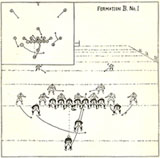
Pop’s correspondence course (1908-11) and his first coaching book (1912) do not include this formation; they show earlier evolutions with balanced lines. The formation in the photo is the one Warner calls Formation A in his 1927 book. He likely held back his best stuff in his earlier publications because it is doubtful that Dietz would have been running the unbalanced-line single-wing as a primary formation in 1915 had it not been perfected used at Carlisle some years before.

WSC Single-Wing 1915

Archiquette Played Against Carlisle

July 17, 2009

While researching the 1905 Carlisle-Massillon game for an article in an upcoming issue of The Coffin Corner, I noticed that Chauncey Archiquette played in that game. I hadn’t previously realized that he was back in a Carlisle uniform in 1905, but he most definitely was. That line-ups in newspaper coverage of games played that year generally include his name support that fact. In Steckbeck’s Fabulous Redmen, the line-ups for the 1904 Carlisle-Haskell game are on the page opposite the beginning of his discussion of the 1905 season. I noticed that Archiquette was in the line-up for that game as well. However, he wore a Haskell uniform. A look into Archiquette’s file showed that, after graduating from Carlisle in 1899, Chauncey had enrolled in a commercial course at Haskell. Newspaper accounts of Haskell games indicated that he had indeed played football for Haskell. This also explains how Archiquette happened to be at Haskell where, among other things, he became a young Jim Thorpe’s idol.

Few Carlisle players played against their old team after leaving the school. James Phillips, for example, refused to suit up for Northwestern in 1903 when they played the Indians. Instead, he watched the game from the stands. Joe Guyon is a notable exception in that he played in the humiliation of the hapless 1917 squad. He started the game but played just a little more than a quarter in which time he scored two touchdowns. Archiquette joined that small group in 1904 when the two Indian schools met for the only time.

Steckbeck marked nine Haskell players’ names with asterisks to denote that, after the 1904 thrashing, they “later enrolled at Carlisle.” It is worthwhile to note that Pop Warner was not at Carlisle for neither the 1904 season when the game was played, nor for the 1905 and 1906 seasons when many of the players transferred.