Archive for the ‘Pop Warner’ Category
June 15, 2010
Apparently, Pop Warner added three post-season games to the 1914 schedule very late in the season, quickly or while on the road or all three. The first mention of the post-season games came in the December 4 issue of The Carlisle Arrow, after the first two of these games had been played. The team likely did not return home after the Thanksgiving game with Brown because the first pot-season game was played two days later in Boston. On December 6, the Indians met Alabama Polytechnic Institute (Auburn) in a game played in Atlanta that figures prominently in Auburn folklore. It was Pop Warner’s last at Carlisle’s helm and Lone Star Dietz’s last before embarking on a career as a head coach.
Some research into student files uncovered the fact that former Carlisle end Charles Guyon, aka Wahoo, was instrumental in setting up that game. At that time, he was th Atlanta branch manager for Spalding Sporting Goods and, as such, was closely involved in athletics in that city. Unfortunately for him, the game had been set up too quickly to generate much publicity and, due to having a bad season, the Indians weren’t a big draw at that time. Guyon fronted the money for the game and lost it. Attempts to have the government refund part of it were fruitless.
The game itself was a defensive struggle. The Indians had the ball in Auburn territory much of the first quarter but failed to score. Auburn stiffened. The second and third quarters were fought to a standstill with neither team able to generate much offense, let alone score. In the final period, Auburn moved the ball with a series of line plunges followed by pass from quarterback Hairston to left end Kearly, who carried the ball to the Carlisle six-yard line. “On the next play Hairston catapulted through the Indian line for the touchdown.” Louiselle kicked the extra point. Carlisle moved the ball with a series of lateral and pass plays but fell short when a pass was intercepted.
The game lives on in Auburn folklore, not for the victory so much as for the play of a Carlisle substitute named Hawkeagle.
Tags:Alabama Polytechnic Institute, Auburn University, Hairston, Hawkeagle, Kearly, Louiselle, Pretty Boy, Wahoo, War Eagle
Posted in Carlisle Indian School, Charles Guyon, Football, Louis Island, Pop Warner | Leave a Comment »
June 10, 2010
A person interested in writing a biography of Pop Warner contacted me last night with some questions that got me thinking about what is not commonly known about Warner. One thing I uncovered is his last game as head coach of the Carlisle Indians. Steckbeck didn’t cover it, most likely because the school paper didn’t say anything about it.
Warner considered the 1914 season to be a disaster and made it his last. Up through the end of November, Carlisle’s season was to end with the annual Thanksgiving game with Brown University. When writing about the Brown game in the December 4, 1915 issue of The Carlisle Arrow, Assistant Coach John McGillis announced three postseason games: 1. Former Harvard All Stars in Boston, 2. University of Georgia at Atlanta, and 3. University of Alabama at Birmingham. The Boston game, in which Carlisle lost 13-6, had already been played by that time. Then the Indians beat Alabama 20-3. It should be noted that Bama still plays some of its big games in Birmingham rather than on-campus in Tuscaloosa.
The Georgia game was never played or had been confused with Auburn because the Indians played the unscored-up Auburn team four days later. However, nothing was written about it in the Carlisle school newspaper, even after it was played. That was probably because Pop Warner had decided to take the Pitt job and leave. Later, Warner wrote that he had been approached by Pitt officials after the Carlisle-Pitt game on October 17 about the head coaching job and he decided to take it.
After the joint congressional investigation earlier in 1914, Warner’s publicity machine appears to have been shutdown, leaving the writing of articles to the coaches. Already mentally in Pittsburgh, Warner didn’t bother to write up anything about the Auburn game. More on that game next time.
Tags:Auburn University, John Steckbeck, University of Pittsburgh
Posted in Carlisle Indian School, Elmer Busch, Football, Pop Warner | Leave a Comment »
May 31, 2010
Not long ago, I wrote about a 1910 game that had received little coverage. Now, Adam Miller has written about a 1903 game that received even less attention. In 1903, Pop Warner put together a post-season road trip to the West Coast on which the Indians were to play Reliance Athletic Association, a team of the best former college players from the state of California, on Christmas Day in San Francisco. Perhaps Warner thought his team would need a scrimmage to break up the trip, or he saw an opportunity to make a little money along the way. Regardless of the reason, he booked a game with the University of Utah to a game to be played on December 19 in Salt Lake City. Miller’s piece covers that game: http://utahfootballcountdown.blogspot.com/p/december-19-1903-utah-vs-carlisle.html. It also includes one of those great period newspaper cartoons.
Pre-game hype heaped hyperbolic praise on James Johnson, who Walter Camp had recently named as quarterback of his All America First Team. Whether Johnson’s head had inflated after reading his newspaper clippings or if Warner was feeling threatened is not known. Warner wrote in what became his autobiography that he benched Johnson the morning of the game over a rule infraction. Because this happened before the game, the rule Johnson had broken was likely a team rule. Warner wrote that he played Joe Baker in his place and that Baker “did an admirable job that afternoon” in the 22-0 victory on a snowpacked field. Newspaper coverage of this game varies from Warner’s recollection.
The Salt Lake Herald’s play-by-play had Johnson playing the entire first half plus kicking a point after touchdown and missing a field goal. Baker replaced Johnson for the second half and led the Indians to three more touchdowns by using the then-new wing-shift play to good advantage.
It may be that Warner’s memory failed him as to when he benched Johnson, but he does appear to have done just that. Johnson’s reaction is the subject of another story.
Tags:Adam Miller, Joe Baker, Reliance A. A., University of Utah, Wing-Shift play
Posted in Carlisle Indian School, Football, James Johnson, Pop Warner | Leave a Comment »
May 24, 2010
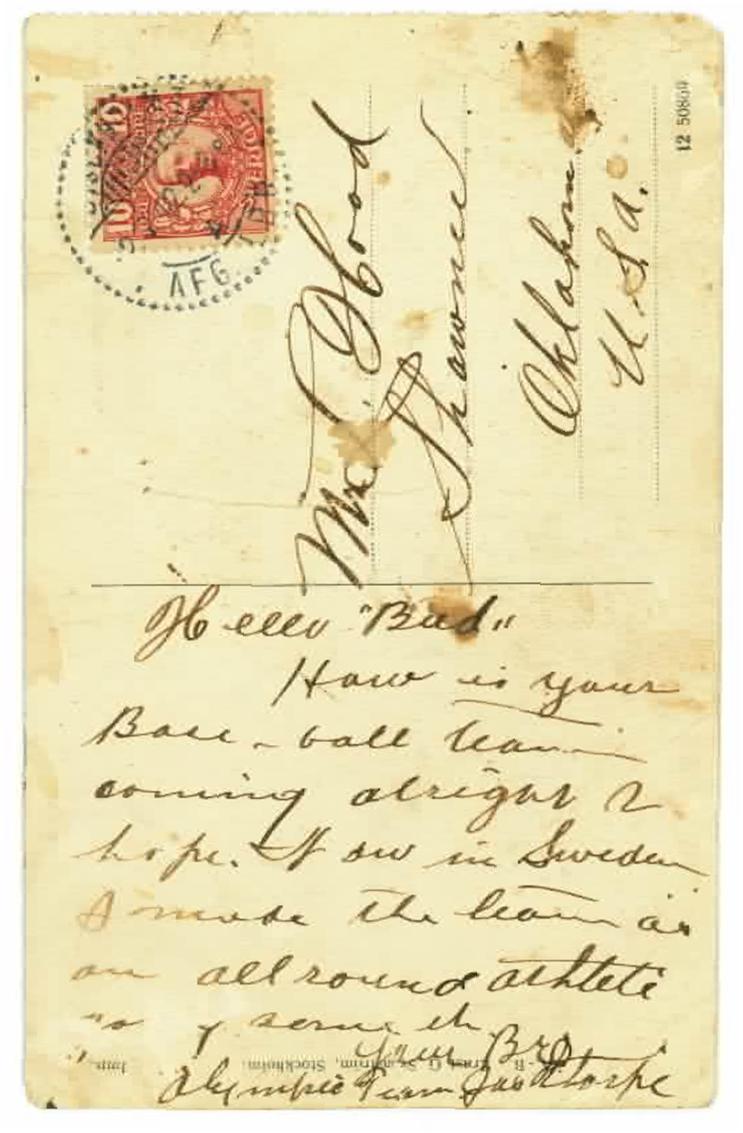
A postcard that Jim Thorpe sent to a childhood friend from the 1912 Stockholm Olympics is being offered for sale. Front and back views of the postcard are provided below.
Luther Hood, recipient of the card, was an Absentee Shawnee and a good friend of the Thorpe family. The families continue a strong friendship today. In tribal culture when a relative dies the family adopts someone to take that person’s place. It seems that Luther may have been an adopted brother to Jim Thorpe, who lost several very close family members, including his twin brother, when he was young. That is why he would have used the terms “Bud” and “Bro.”
The stamp on the card is from Sweden. Closer inspection is required to determine the postmark. The U. S. Olympic team, other than the distance runners and Thorpe, used the ship they traveled over on, the SS Finland, as their hotel during the Olympics. Perhaps the postcard was sent from the Finland.
Bob Wheeler is assisting the owner of what is surely an expensive item in selling it. If you are interested, contact Bob at bobwheelerwrc@aol.com


Tags:1912 Olympics, Luther Hood, postcard, Robert W. Wheeler, Shawnee, signature, Stockholm
Posted in Carlisle Indian School, Jim Thorpe, Pop Warner | Leave a Comment »
May 13, 2010
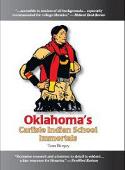
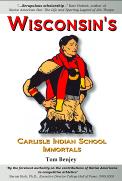
Yesterday, a reader asked about Wisconsin’s Carlisle Indian School Immortals, wondering if it would be a series of blogs or a book. That tells me it’s time to talk about it a bit. Last year I wrote Oklahoma’s Carlisle Indian School Immortals, Volume I of the Native American Sports Heroes Series. I have now completed Volume II of that series. Wisconsin’s Carlisle Indian School Immortals will be released on September 1. Like the earlier book, it follows 17 football stars with ties to a particular state, Wisconsin in this case, from their childhoods on the reservation, generally, to their time at Carlisle, and through their later lives. Background chapters on Carlisle Indian School, its legendary football teams, and coach “Pop” Warner set the stage for the individual biographies.
Not included are busts of the players drawn by Bob Carroll. Bob graciously drew those for Oklahoma’s Carlisle Indian School Immortals just before the end of his life. In their place, is a map that shows all the Indian Reservations in the state of Wisconsin which is intended to assist the reader in knowing where these people spent their early childhoods and, in some cases, returned to after finishing at Carlisle.
Chapters are included for:
Chauncey Archiquette
Wilson Charles
Wallace Denny
Lone Star Dietz
Louis Island
James Johnson
Frank Lone Star
Jonas Metoxen
Thomas St. Germain
Caleb Sickles
George Vedernack
Gus Welch
Joel & Hugh Wheelock
Martin Wheelock
Charles Williams
William Winneshiek
It is my hope that historians, teachers and librarians review this book and make it more available to students who would learn a lot about how disadvantaged people overcame obstacles to excel.
Copies of the softcover version of Oklahoma’s Carlisle Indian School Immortals are now in stock for June 1st release.
Tags:Frank Lone Star, Oklahoma's Carlisle Indian School Immortals, Wallace Denny, William Winneshiek, Wilson Charles, Wisconsin's Carlisle Indian School Immortals
Posted in Caleb Sickles, Carlisle Indian School, Charles Williams, Chauncey Archiquette, Football, George Vedernack, Gus Welch, Hugh Wheelock, James Johnson, Joel Wheelock, Lone Star Dietz, Louis Island, Martin Wheelock, Pop Warner, Thomas St. Germain | 2 Comments »
April 22, 2010
A little research has unearthed a few more facts about the 1910 Harvard Law School football team. After two years as a Walter Camp first team All American at Harvard, Hamilton Fish wasn’t quite ready to put aside his cleats and what passed for a helmet in those days even though he had graduated and had entered Harvard Law School. The term wasn’t underway long when he organized a team from his classmates who had played football in their undergraduate days. He apparently challenged the Crimson varsity to a game because, on Thursday, October 20, the Daily Kennebec Journal reported on a game played the day before at the Harvard horseshoe:
The Harvard Varsity football eleven played this afternoon at the Stadium with a team made up of former Harvard Yale and Princeton football players styling themselves All Stars and won by the narrow margin of 6 to 0. The members of the All Stars team are all now Harvard Law School students and aside from their fumbling they put up so strong a game that the Crimson men were unable to get across the goal, the only points being made on two goals from the field by Lewis.
On November 3, The Post-Standard of Syracuse questioned the likelihood of a game between Carlisle and Harvard Law School: Glenn Warner’s Men Are Sadly Crippled: But Few of the First Team Are in Physical Shape to Be Used in Practice. “The few regulars that were out were put on the second team, which was given a short scrimmage against the third eleven.” It also reported that Carlisle management would likely reach a decision the next day.
The November 14 issue of The Washington Post A PIECE titled INDIANS BADLY BATTERED confirmed that the Indians would be playing the Harvard Law School All Stars the following Wednesday. Warner felt that his injured players, or at least most of them, would be recovered enough to play against Fish’s squad.
Next time—the game.
Tags:Hamilton Fish, Harvard Law School All Stars
Posted in Carlisle Indian School, Football, Pop Warner | 2 Comments »
April 15, 2010
A minor mystery surrounds Carlisle Indian School’s game against Harvard Law School in 1910. Carlisle and Harvard played several times but not in 1910. Schedule conflicts may have had something to do with it. Or it might have been due to money. In April of 1910, Pop Warner announced his schedule for that year’s football team. He packed 14-games into a season that ended with the annual Thanksgiving game with Brown at Providence. New rules were instituted that year that were favorable to the Indians’ style of play, so Warner felt comfortable in upgrading the schedule. He scheduled away games on successive weeks with Syracuse, Princeton, Penn, Virginia (at Washington, DC), Navy, Cornell and Brown. Cornell—a difficult schedule, indeed. By the fall, Cornell had been replaced by Johns Hopkins with no reason being given for the change. A warm-up game with Western Maryland College was canceled after the season started. The November 4 edition of The Carlisle Arrow listed a schedule that included no mention of a game with Harvard Law School. However, the December 2 edition listed the score of the game but had the date wrong. It may be that Warner scheduled the game with little notice because Harvard Stadium was available due to the Crimson having departed to prepare for their upcoming game with Yale in privacy. The Harvard Law-Carlisle game was actually played on November 16. Steckbeck copied The Arrow’s errors into his book. Apparently, he didn’t have out-of-town newspapers at his disposal.
Some November 16, 1910 newspapers from around the country announced that Carlisle was going to play a “hand-picked eleven” representing Harvard Law School. One announcement from an anonymous newspaper writer declared that the Indians’ opposition “is the nearest approach to an all American eleven ever seen in action.” Next time we will explore exactly who these All Americans were. Perhaps a reader who is descended from one of these men can provide more information.
Tags:Harvard Law School
Posted in Carlisle Indian School, Football, Pop Warner | Leave a Comment »
March 26, 2010
As so often happens, I came across an interesting article when looking for something else. This time it was a 1933 interview of Gus Welch by Alan Gould of the Associated Press. By this time Gus Welch had gained a reputation as a great storyteller, having won the coveted Brown Derby Award at annual coaches conferences. For whatever reason, no award was made in 1933 but Welch told an interesting story about, as were many of his stories, a teammate at Carlisle. He recalled a headstrong player named Asa Sweetcorn who, as a running guard [probably a pulling guard in modern parlance], felt that his contributions were being disregarded in Warner’s newspaper columns. He reacted by drawing attention to himself. Instead of running plays as his coach diagrammed, Sweetcorn “…would go ripping around an end, legs and arms flying, making gestures at everybody but taking out nobody. I took him aside to find out what was going on. Slyly he wispered to me: `Gus, that’s psychology. I keep `em all worried and guessing and then they say, My what a great running guard this Sweetcorn is.’”
Reporters rewarded him with positive mention in their columns and opposing teams started to take notice of him. Navy concentrated much of their effort against Sweetcorn to his detriment. Soon he was groggy and bloody. At half-time, Pop suggested that a substitute be sent in for him. Welch responded, “No, this Sweetcorn is just faking. Let him stay in.” After taking terrible beatings game after game, Asa began to wise up a bit but not completely. Lying on the field badly beaten in a game, he had about reached the limit of punishment he could withstand, he said something to Welch about needing a “medicine man” but Welch disagreed, “Never Mind medicine man; send for a priest.”
Next time, find out how Sweetcorn fooled Sally Jenkins.
Tags:Asa Sweetcorn, Navy, Sally Jenkins
Posted in Carlisle Indian School, Football, Gus Welch, Pop Warner | Leave a Comment »
February 1, 2010
On Friday at noon, I checked the Carlisle Sentinel on-line to see what, if anything, was in the news. An article saying that North Hanover Street, one of the two main drags through town, was closed. On reading the article, which was time-stamped 11:30 a.m., I learned that a fire in the building that houses Wardecker’s Mens Wear, was the cause of the street closing. I wasn’t too worried about my friend Freddy Wardecker, the proprietor of the business because he would surely have been able to get out of the building quickly. However, I was worried that his collection of Carlisle artifacts might have burned.
Wardecker’s Mens Wear, formerly Blumenthals, was in operation when the Indian School was located nearby at Carlisle Barracks. Mose Blumenthal worked as a tailor at the school and operated his store downtown. As a result of his close association with the staff and students, he established a business relationship with the school’s athletic department. Pop Warner or the Superintendent would send chits to Blumenthals that authorized the boys listed on the chits to be given clothing in the amount stated on the chit. The boys would come in to the store, select the clothing items they wanted, and socialize. Blumenthal had a page or pages in a ledger for each of the boys on which he would record the clothing they had received and the amounts he received in payment. If the clothing cost more than the amount on the chit, the boy had to come up with the difference.
In later years when these men returned to Carlisle, these men dropped in at Wardecker’s to visit and sometimes signed their photographs. The store has Carlisle Indian School memorabilia as well as irreplaceable original documents. It would have been a catastrophe had these items burned. Fortunately, they didn’t.
A visit to Wardecker’s is necessary for anyone interested in Carlisle Indian School and especially so for researchers. It’s good that it is still possible.
Tags:Fred Wardecker, Mose Blumenthal
Posted in Carlisle Indian School, Football, Pop Warner | Leave a Comment »
January 28, 2010
While researching the life of Wallace Denny for “Wisconsin’s Carlisle Indian School Immortals,” I became curious of whether trainers can be inducted into the College Football Hall of Fame. The short answer is yes but not through the same process as coaches and players. A trainer can be nominated for the Outstanding Contribution to Amateur Football Award. It seems like a longshot but I may just nominate him.
Wallace Denny, fullblood Oneida, started his football career as a player for the Carlisle Indian School. When Pop Warner arrived in 1899, he observed that Denny had more to offer off the field than on it, at least while play was in progress, and made Denny his “utility man.” Wallace became Warner’s right-hand man. He put the chalk lines on the field, repaired equipment and rubbed players’ aching muscles. Before long, he was tending to various injuries, aches and pains. He and Warner improvised appliances to protect wounded parts of players’ bodies to allow them to play. Over time, Denny became a bit of a psychiatrist as he counseled players who needed psychological boosts. When Warner was back at Cornell from 1904 through 1906, Wallace and Bemus Pierce devised a set of signals that used words from their native languages to identify the various plays Carlisle ran. The opposition was told exactly which play was to be run but they understood neither the words nor the plays they represented.
Warner and Denny rejoined again in 1907 when Warner returned to Carlisle and remained a team until they retired in 1940. Denny didn’t move to Pittsburgh with Warner in 1915 but may have joined him on football weekends because Charlie Moran served as trainer for Carlisle’s coach in 1915, Victor Kelley.
Wallace Denny became a trainer before such a position existed and pioneered it for four decades. By the time he retired, trainers were standard members of coaching staffs.
Tags:football trainer, Nellie Robertson Denny, San Jose State, Stanford, Temple, Wallace Denny, Wisconsin's Carlisle Indian School Immortals
Posted in Bemus Pierce, Carlisle Indian School, Football, Pop Warner | Leave a Comment »



 Tom Benjey's Weblog
