Archive for the ‘Pop Warner’ Category
November 29, 2010
Pop Warner is viewed by most historians as the great football innovator and especially for his work at Carlisle Indian School. However, not all the innovations at Carlisle were Warner’s brainchildren. In 1906, the Indians were coached by former players Frank Hudson and Bemus Pierce who Warner helped prepare for the revolutionary rule changes that were implemented that year. After Warner departed for Cornell to start his season, Hudson and Pierce were pretty much on their own. But that wasn’t much of a problem. The Carlisle Indians were called a lot of things but witless wasn’t one of them.
One of the major rule changes was the legalization of the forward pass. Completing a pass wasn’t the easiest thing to do, particularly when both teams wore similar brown or black leather helmets. Passers needed a way to identify the eligible receivers. So, during the very first season in which the forward pass was legal, the Indians experimented with special helmets to help the passer find his target. The November 21, 1906 edition of The Lake County News described this early attempt at receiver identification. Five players wore snow white helmets and one wore a blazing red one. The article used the term headgear rather than helmet which, given the early state of helmet development, is probably more accurate. Given that the four backs and two ends are eligible to receive passes, the total of six special helmets makes sense. It seems fair to surmise that the red one would be worn by the player who does most of the passing and that the white ones are worn by those who can go out for passes.
In 1933, Michigan State started using a winged helmet for all its players to differentiate their men from the defenders. Less than a decade later, Lone Star Dietz’s Albright College team painted crosses on the tops of the receivers’ helmets but didn’t invent that idea as it had been used before, possibly even at Carlisle.
Tags:Forward pass, Painted helmets, Winged helmets
Posted in Bemus Pierce, Carlisle Indian School, Football, Frank Hudson, Lone Star Dietz, Pop Warner | Leave a Comment »
November 18, 2010
I was recently sent an article on a particular topic on the history of football—it doesn’t matter which article because this is a common error—that attributed or blamed, depending on one’s perspective on Pop Warner that he did not do. That Warner had a split tenure at Carlisle Indian School is either not widely known or is forgotten by many when they write about Carlisle football. In this instance, the matter has to do with the 1904 Carlisle-Haskell game and the mass transfer of football talent from Haskell to Carlisle that happened after that game.
For a little background, President Theodore Roosevelt was to spend a few days around Thanksgiving at the 1904 St. Louis World’s Fair. Promoters saw an opportunity to attract greater attendance by staging a football game for Teddy to attend. Their first choice was to host the Army-Navy game that year. That idea was turned down immediately. The next thing that came to mind was to have the two prominent government Indian boarding school teams play each other as both were running roughshod over the competition in their respective parts of the country. Carlisle was already scheduled to play Ohio State on Thanksgiving, so the game with Haskell Institute of Lawrence, Kansas, was set for the Saturday following the holiday.
Why did Warner have nothing to do with this game, one asks? Well, Pop Warner left Carlisle after the 1903 season to return to coaching his alma mater, Cornell. The reason for that move, according to his critics, was that he was paid more money. They are probably correct. Warner coached Cornell through the 1904, 1905 and 1906 seasons and, other than teaching his new formations to Carlisle’s Indian coaches in 1906, probably had little to do with the operation of that program. He had no reason to recruit Haskell players for Carlisle. He might have tried to entice the best ones to enroll at Cornell, but that seems improbable.
Superintendent Richard Henry Pratt had been relieved of command of Carlisle Indian School in the summer of 1904 and replaced by then Captain William A. Mercer. With no athletic director in place and the coaches hired just for the season, Mercer filled the void left by Warner’s departure and became involved with the football program. The next year, he arranged the first Carlisle-Army game but that is a separate story.
Tags:Haskell Institute, Major Mercer, Ohio State, St. Louis World's Fair, Theodore Roosevelt, William A. Mercer
Posted in Carlisle Indian School, Football, Pop Warner, Richard Henry Pratt | Leave a Comment »
November 2, 2010
Now that we’ve dealt with some obvious errors in Rich Manning’s article, let’s get to the original issue: formations. The single-wing section in the Carlisle Indian School article in LeatherHelmetIllus.com starts this way:
In 1907, ‘Pop’ Warner returned to Carlisle. Together he and the Indians developed a new formation that would revolutionize football. The single wing shifted the halfback out wide, to outflank the opposing tackle. The new offense formed a shape that look like a wing. It opened up options and disguised intentions. The ability to show one thing and do another combined with the new rules made it possible to run, throw or kick at any time. ‘Pop’ Warner unveiled the new formation against the University of Pennsylvania, on Oct. 26, 1907.
I have read that the single-wing was unleashed in several different years due to Pop Warner’s inconsistent memory and writers’ imaginations. After researching this topic a bit, I came to believe that the single-wing did not arrive fully formed as the unbalanced-line, direct snap version depicted as Formation A in Warner’s 1927 book. I have concluded that the formation evolved over time as Warner implied on page 136 of his 1927 classic where he stated that it was first used by the Carlisle Indians and that he had used it or variations of it since the rules change of 1906. That he spent a week in Carlisle before the start of the season preparing coaches Bemus Pierce and Frank Hudson for the rule changes gives credibility for it having been first used by the Indians in 1906 when he wasn’t their coach. Fortunately, some documentation exists.
Warner began marketing a correspondence course on football in 1908 for which I have located and have reprinted the Offense pamphlet along with its annual updates. The 1908 pamphlet includes a number of offensive formations, which is not surprising as Warner was noted for tinkering with them. That newspaper coverage of the 1907 Penn game mentioned that multiple formations were used is not surprising. However, it is far from clear that end-back formation, the earliest documented version of Warner’s single-wing, was the formation being described for many of the plays as it didn’t feature a direct snap to a running back. That would come later. However, the punt formation did allow direct snaps to the backs and Warner had devised a set of running and passing plays from this formation.
He even described Play No. 17 thusly, “This is the long forward pass play used so successfully last season.” Last season would have been 1907, so this is likely the formation from which Frank Mt. Pleasant and Pete Hauser completed all those passes, not an early incarnation of the single-wing.
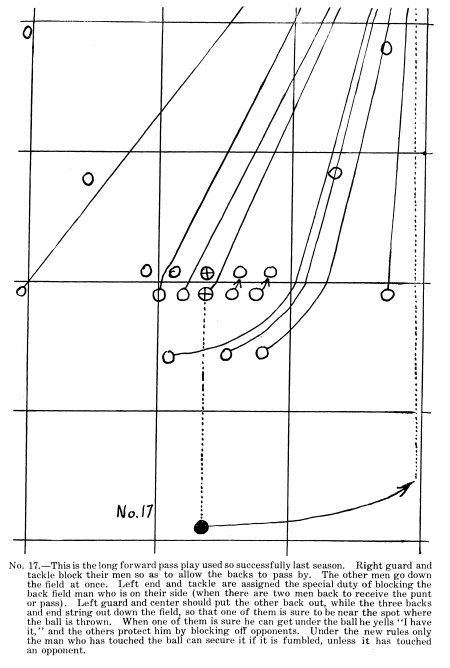
Play No. 17 from 1908 correspondence course Offense pamphlet
Tags:LeatherHelmetIllus.com, Rich Manning
Posted in Albert Exendine, Bemus Pierce, Carlisle Indian School, Football, Frank Hudson, Frank Mt. Pleasant, Jim Thorpe, Pete Hauser, Pop Warner, Single-Wing | Leave a Comment »
October 29, 2010
Let’s now look at Rich Manning’s statement regarding Jim Thorpe:
The [Pennsylvania] game also marked the debut of Jim Thorpe. He broke free for 45 yards the second time he touched the ball.
This statement didn’t ring true because Pop Warner wouldn’t likely put an untested player like the young Thorpe into the pressure of a big game. He was more likely to have given him some playing time in the warm up games to better prepare him for game situations. One of the purposes of the warm up games at the beginning of the season was to give new players playing time in game situations with little pressure. However, the 1907 schedule didn’t provide Warner much opportunity to try untested players. Lebanon Valley College and Susquehanna University were the only games with lopsided scores. Unfortunately, the reports for those games in the Carlisle school newspaper didn’t list the names of all the players who got into those games. One assumes that Jim Thorpe got significant playing time in the 91-0 blow out of Susquehanna. Although we don’t know that for sure, it wasn’t necessary to research that point because the write up of the Bucknell game provides all the information we need to show that Warner didn’t debut Thorpe against Penn.
The Indian School newspaper reprinted coverage from The Evening Sentinel about the Bucknell game, including, “After the next kick-off [Jim] Thorpe made a long run, but dropped the ball,” and in the second half, “Thorpe did most of the work carrying the ball, and proved an excellent ground gainer. He followed his interference well and held the ball.”
So, Warner debutted Jim Thorpe a week earlier than Manning stated, assuming that he didn’t play in the early blow outs or that they didn’t count because they were warm up games.
The next blog will deal with the errors in the article related to formations .
Tags:Bucknell University, Rich Manning, University of Pennsylvania
Posted in Carlisle Indian School, Football, Jim Thorpe, Pop Warner, Single-Wing | Leave a Comment »
October 27, 2010
I was recently asked if Pop Warner unveiled the single-wing against Penn in the Carlisle Indians’ fifth game of the 1907 season. Penn was actually Carlisle’s 7th opponent that year but that was probably just a typo made by the person asking the question. This was the first time I had heard (or read) that the single-wing was first used in that particular game. I have seen it attributed to several other times but not that one. A little research found a source for this claim but quite possibly not the only person to make it. Follows is an extract from an article on the Carlisle Indians in LeatherHelmetIllus.com:
‘Pop’ Warner unveiled the new [single-wing] formation against the University of Pennsylvania, on Oct. 26, 1907. So far that season no team had crossed the Quaker’s goal line. Carlisle was undefeated. A large crowd of 22,800 fans looked on. They were expecting a good game but they got more than they bargained for. Carlisle scored on the second play: a 40 yard pass from Hauser to Gardner, caught on the run. The diversified offense racked up 402 yards, to 76 yards for Penn., Carlisle went 8 of 16 passing. The game also marked the debut of Jim Thorpe. He broke free for 45 yards the second time he touched the ball. The Indians won 26 – 6.
After finding this, I set about locating game accounts in period newspapers. Before resolving the issue of the single-wing, I noticed a significant error—or the sports writers of the day had it all wrong. Nowhere did I find mention of (William) Gardner scoring a touchdown or anything else in that game. What I did find in the coverage by The Washington Post, The New York Times, United Press and other wire service accounts was that the Indians’ first score came on a field goal kicked by Pete Hauser early in the game. That score was followed by Fritz Hendricks’ 100-yard touchdown run after picking up Hollenbach’s fumble. Payne closed out the first-half scoring with a touchdown of his own around Penn’s end from the 4-yard line. Penn played better in the second half and didn’t allow Carlisle an offensive touchdown. However, Little Boy scored his touchdown by diving on a Penn punt that Albert Exendine had blocked and fell behind their goal line. Hauser closed out Carlisle’s scoring with a second field goal. Frank Mt. Pleasant kick the extra points after each touchdown. Although Mt. Pleasant and Hauser received much praise for their passing in this game, none of their tosses went for a touchdown to Gardner or anyone else.
The next blog will deal with the errors related to Jim Thorpe and the single-wing.
Tags:Albert Payne, Fritz hendricks, LeatherHelmetIllus.com, Little Boy, Rich Manning
Posted in Albert Exendine, Carlisle Indian School, Doctors, Lawyers, Indian Chiefs, Football, Frank Mt. Pleasant, Jim Thorpe, Pete Hauser, Pop Warner, Single-Wing, William Gardner | Leave a Comment »
September 28, 2010
The on-field influences the government Indian schools, Carlisle mostly but also Haskell to some extent, had on the development of college football are well known. Less well-known are the impacts on the rules under which the game is played. Most football historians are aware that Carlisle Indian School was frequently criticized for not adhering to eligibility rules similar to those agreed to by the major colleges. In 1908, Pop Warner instituted a limit of four years of eligibility on the varsity team for Carlisle’s players. Years spent riding the bench without playing were most likely not counted against the four years. Something that is not known as well is that major colleges routinely ignored the fact that players they recruited from Carlisle had already played for four years prior to enrolling in college. That was about to change in 1905 if some had their way.
A November 29, 1904 article datelined Chicago that was printed in The Boston Globe announced that eligibility rules were about to be enforced more stringently, at least by some schools. “A meeting of representatives of leading western colleges” (read Big Ten) agreed on rule changes to which they were to comply. Two schools were singled out specifically: “Carlisle and Haskell Indian Schools, two formerly unclassified institutions, were raised to the ranks of colleges, and students who have competed for four years from those institutions in the future will not be allowed to compete in events controlled by western colleges.” Since Carlisle and Haskell seldom played more than a total of two games a year against the schools that became the Big Ten, this rule was probably aimed at the schools themselves. Several former Carlisle players had played for these schools after having used up their eligibility at the Indian school. Some that come quickly to mind are: Frank Cayou, Illinois; James Johnson, Northwestern; James Phillips, Northwestern; William Baine, Wisconsin; and Ed Rogers, Minnesota.
Next time – Freshmen.
Tags:Eligibility rules
Posted in Carlisle Indian School, Dickinson College, Doctors, Lawyers, Indian Chiefs, Ed Rogers, Football, Frank Cayou, Haskell Institute, James Johnson, James Phillips, Pop Warner | Leave a Comment »
September 25, 2010
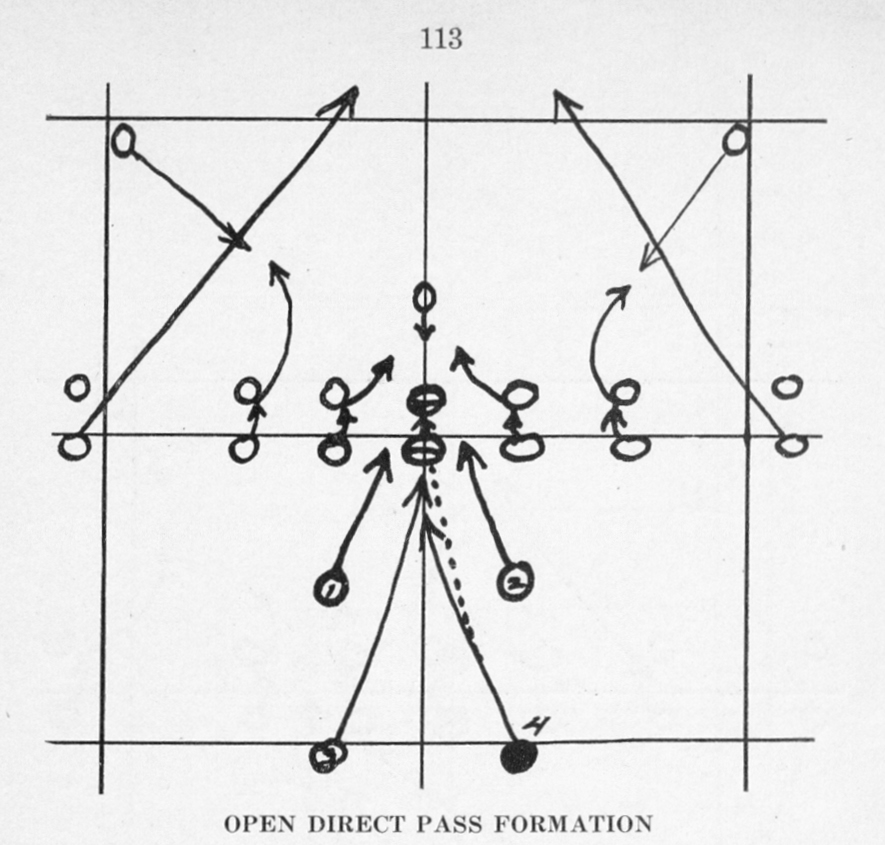
Watching Michigan playing Bowling Green today, I saw a formation that looked familiar. In that formation, Michigan’s backs were all in the backfield, arranged almost in a box. Any of the four backs could receive a direct snap from center, at least in theory. It wasn’t the only formation I saw RichRod use in the game and probably isn’t his primary formation. However, he did use it for multiple plays and for sizeable gains. After a few moments’ thought, I remembered where I had seen a similar formation before. I could be wrong about his formation due to not having a diagram of it, but it sure looked familiar on TV.
Page 113 of Pop Warner’s 1912 book, A Course in Football for Players and Coaches, begins a discussion of Warner’s Open Pass Direct Pass Formation (see bottom of this message). The diagram for this century-old offensive scheme is a bit different than the one RichRod uses but provides the foundation upon which his is based. Both offenses feature direct snaps to multiple backs as well as both pass and run plays from the same position in the formation.
A difference between the formations appears to be that Rodriguez moves backs 1 and 2 to behind the tackles where Warner had them behind the guards. One assumes that the wider position helps make backs 1 and 2 more effective blockers for off-tackle plays and end runs. They might even assist with protecting the passer. Warner included a note stating that experience showed that moving the ends closer to the tackles had proved more effective in blocking the defensive tackles than having them set wide as shown in his diagrams.
A difference between Warner’s plays and those used today is that today centers lob the ball back, generally to the quarterback, where Warner’s centers often led the back receiving the snap. Warner’s scheme requires highly skilled centers but gives the offense advantages over those in which the back receiving the center snap stands flatfooted waiting for the ball to arrive.

Tags:Direct snap, Michigan, Rich Rodriguez, University of Michigan
Posted in Carlisle Indian School, Football, Pop Warner, Single-Wing | Leave a Comment »
September 2, 2010
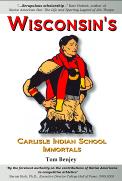
The second volume of the Native American Sports Heroes Series is now out and available to readers. Wisconsin’s Carlisle Indian School Immortals was released yesterday and is expected to be of interest to libraries and readers interested in Native American history, sports and government Indian boarding schools. This book follows the following players from their youths on the reservation, through their times at Carlisle to their later lives:
- Chauncey Archiquette
- Wilson Charles
- Wallace Denny
- Lone Star Dietz
- Louis Island
- James Johnson
- Frank Lone Star
- Jonas Metoxen
- Thomas St. Germain
- Caleb Sickles
- George Vedernack
- Gus Welch
- Hugh Wheelock
- Joel Wheelock
- Martin Wheelock
- Charles Williams
- William Winneshiek
Readers will learn who became doctors, lawyers and Indian chiefs. Some became musicians and led all-Indian bands. One was invited to join Richard Byrd’s Second Antarctic Expedition. Another was instrumental in establishing the Rose Bowl. Readers will also learn more about the naming of the Washington, DC NFL team and about the all-Indian NFL team. Several served in WWI even though non-citizen Indians were not drafted. Most lived long, productive lives but some didn’t. Some married girls they met at Carlisle, others married white girls and still others married girls from the reservation. One even married a congressman’s daughter.
The reading level is such that anyone from seventh grade through senior citizen can appreciate it and It is my hope that school children will read it to gain a better understanding of their history.
Tags:Frank Lone Star, Jonas Metoxen, Wallace Denny, William Winneshiek
Posted in Caleb Sickles, Carlisle Indian School, Charles Williams, Chauncey Archiquette, Football, George Vedernack, Gus Welch, Hugh Wheelock, James Johnson, Joel Wheelock, Lone Star Dietz, Louis Island, Martin Wheelock, Pop Warner, Thomas St. Germain, Washington Redskins | 2 Comments »
August 26, 2010
I was just reviewing some materials on the hidden ball play that Carlisle ran successfully against Harvard in 1903 and learned that getting the play off correctly was more complicated than it seemed. For starters, the kickoff had to be deep enough to give the players time to assemble around the person who received the kick, James Johnson in this case. The Harvard kicker put his first kick out of bounds and had to rekick. There must not have been much of a penalty for that in those days because he was able to put the second kick on the goal line.
Johnson’s teammates had to line up precisely to make the other team think they were forming a wedge to block for Johnson. Room for Johnson to stand next to Dillon was essential to making the play work. It was (and probably still is) illegal to hand or pass the ball forward on a kickoff. The ball had to go backward or laterally. By standing alongside Dillon, Johnson was able to reach back to place the ball under his jersey, thus keeping the play legal. Doing it this way also screened what was he was doing from the prying eyes of the Harvard defenders.
Another potential hurdle that has to be cleared is the official. An official who is unfamiliar with the play may incorrectly disallow the touchdown and penalize the team for running it. Warner took care to inform the Referee, Mike Thompson of Georgetown, that the play was to be run so that he would pay special attention to the handoff and make sure that it was legal.
By paying attention to all the little details, including selecting a ball carrier with speed, especially for a big man, Warner pulled off a trick that is still being talked about over a century later.
Tags:Charles Dillon, Harvard 1903, Hidden Ball Play, Mike Thompson, Trick play
Posted in Carlisle Indian School, Football, James Johnson, Pop Warner | 1 Comment »
July 19, 2010
One of the problems with dating Pop Warner’s innovations is that his memory 20 years after the fact was far from perfect, as are most people’s. The well-known difficulties in dating the births of the single-wing and double-wing with certitude are due, at least in part, to Warner’s inconsistent memories. A month and a half ago, I wrote a bit about the 1903 game with Utah in which Joe Baker led the Indians to a 22-0 win over the Mormonites by running the new wing-shift play several times for three second-half touchdowns (they counted 5 points in those days).
In his autobiography—actually a series of magazine articles written by Warner that were compiled into book form—Warner stated that during the 1912 Thanksgiving Day game against Brown, Harvard’s coach, Percy Haughton, was his guest on the sidelines to see Warner’s new surprise play—the wing-shift. Haughton disapproved, saying, “These series plays are never worth a darn. If such plays do work, it is usually in the first attempt, because they are trick plays and surprise is the feature that usually makes them successful.” After seeing Carlisle run them for long gains later in the game, Haughton grudgingly admitted, “Well, it did work that time.”
For a newspaper series of favorite plays from several coaches in the 1930s, Lone Star Dietz described the “Dead-Indian Play.” What he described was the old wing-shift that Carlisle ran so well. Because the wing-shift, or dead-Indian play, was a series of two plays it had to be called ahead of time. The player, generally a back, who carried the ball on the first play would linger on the ground long enough to give six of his teammates time to line up to one side of him. The rest would position themselves in the backfield. When the downed man could see that all were in place, he hopped up and snapped the ball to a backfield man to start the second play, catching the defense off guard.
Tags:1903, 1912, Brown University, Dead-Indian Play, Joe Baker, Percy Haughton, University of Utah, Wing-Shift play
Posted in Carlisle Indian School, Football, James Johnson, Lone Star Dietz, Pop Warner | Leave a Comment »



 Tom Benjey's Weblog
