Archive for the ‘Pop Warner’ Category
March 28, 2011
Recently, I received a question about the 1899 Carlisle Indian School-Hamilton College football game. That person hadn’t been able to find anything about it and wondered if it was actually played. I had never given that game any thought because the Indians played three of the Big Four and beat Penn for the first time that year. 1899 was also Pop Warner’s first year at Carlisle and Walter Camp named Isaac Seneca to his All America First Team, the first Carlisle player to be so named. It’s easy to see why the game with Hamilton College could be overlooked. For starters, this was the first, and only time these two schools played. Secondly, the game was played in Utica, NY and was probably the only time Carlisle played in that town. Thirdly, even though Hamilton had been having decent seasons the past few years, they weren’t in the class of the big teams Carlisle normally played on the road. After all, Pop Warner’s Cornell team beat them 41-0 the previous year. But that may be the hint we’ve been looking for.
Pop Warner may have had a relationship with Hamilton’s coach plus Hamilton College may have offered Carlisle a good bit of money to play them. Clinton, NY, Hamilton’s home is near Colgate and Cornell plus Warner’s home was in Springville, NY. So, there may have been some familiarity. Hamilton was more than holding its own against Colgate at that time and was even competitive against Cornell in 1899. Hamilton supporters may have thought that they had a pretty good team that year and wanted to see how they stood up against a powerhouse.
I found Carlisle Indian School newspaper mention and New York Times coverage of the game, so it was definitely played. What is most interesting is why was it played? More research is needed to determine that.
Tags:Clinton NY, Cornell, Hamilton College, Utica NY
Posted in Carlisle Indian School, Football, Isaac Seneca, Pop Warner | 7 Comments »
March 17, 2011
While researching the last blog, I noticed that James Johnson was 24 at the time Walter Camp named him quarterback on his 1903 All America first team. His “advanced” age for a college football player brought to mind the criticisms that Carlisle Indian School played older players than did their college opponents. It seems logical that the Indians would have been older because most Carlisle students had little formal education prior to entering it. That Pop Warner considered their ages to be an advantage probably added to critics’ belief that Carlisle’s players were older. Something I saw on the list of Johnson’s All America cohorts caused me to see this in a different light.
Tackle J. J. Hogan (Yale) and guard A. Marshall (Harvard) were both 24 also and three others–end C. D. Rafferty (Yale), halfback W. M. Heston (Michigan) and fullback R. C. Smith (Columbia)—were 23. The others were 20, 21 or 22 as one would expect college All Americans to be. Perhaps 1903 was an anomaly, a year in which players were older than in other years. 1902 was a bit different; guard E. T. Glass (Yale) was 25! However, only one other player, tackle J. J. Hogan (Yale), at 23 was over 22. 1901 was greatly different than the two following years; three players—end D. C. Campbell (Harvard), tackle O. F. Cutts (Harvard) and guard W. G. Lee (Harvard)—were all 28 years old!! The rest were 20 or 21, but those three 28-year-olds brought up the average age. In 1900, end D. C. Campbell (Harvard) and halfback W. R. Morley (Columbia) were 27 and 24, respectively. Quickly scanning lists of Camp’s selection for years prior to 1900 yielded several players who were older than 23, some significantly older. After 1903, players aged 23 and older occurred less frequently but continued to be named to All America teams, even after Carlisle fielded its last team in 1917. As late as 1923, end H. H. Hazel (Rutgers) was 27.
While Carlisle players may have been a bit older on average than many college players, many of the best college players were quite old, much older than what we would expect today.
Tags:A. Marshall, C. D. Rafferty, D. C. Campbell, E. T. Glass, H. H. Hazel, J. J. Hogan, O. F. Cutts, R. C. Smith, W. G. Lee, W. R. Morley, Walter Camp All America 1903, Willie Heston
Posted in Carlisle Indian School, Football, James Johnson, Pop Warner | 1 Comment »
February 1, 2011
Recently James Vautravers asked me a question about the 1911 Carlisle-Harvard game which was arguably the Indians’ greatest victory:
Everything I have ever read about the 1911 Carlisle-Harvard game says that Percy Haughton was in New Haven scouting Yale that day. But almost everything I’ve read about the game is false. So I was wondering if this might be false too.
Wheeler’s Jim Thorpe book (which omits all the popular false info about this game) does not directly confirm or deny the story, but he has a quote from Haughton which seems to imply that Haughton was at the game to witness it.
Do you know whether or not Percy Haughton was actually in New Haven that day?
Most of what Wheeler included about Percy Haughton regarding the 1911 Carlisle-Harvard game was quoted from Pop Warner as indicated in Wheeler’s endnotes. A reader could easily interpret what Warner said to imply that Haughton was present at the game. However, Warner attended only one of Iowa State’s games in 1895, the year that he coached two teams: Iowa State and Georgia. Actually being present at a game was less important for a head coach than it is today for several reasons. First, coaches not only did not call the plays then, they were prohibited from doing so. Coaches’ legal involvement in the flow of the game was greatly limited as compared to today. Second, team captains played a much larger role then than now. Lone Star Dietz even had to resort to bribery to get his quarterbacks to call pet plays that they didn’t like. Captains were much more involved in the running of the team than they are today. And there was generally only one captain because players played both ways and very often were on the field for the whole game. So, it is plausible that Haughton may have been away scouting Harvard’s rival for their upcoming grudge match. A parallel would have been Bo Schembechler skipping the Michigan-Wisconsin game to scout the Buckeyes.
To be continued…
Tags:1911 Harvard football, Bo Schembechler, James Vautravers, Percy Haughton, Robert Wheeler
Posted in Carlisle Indian School, Football, Jim Thorpe, Lone Star Dietz, Pop Warner | Leave a Comment »
January 30, 2011
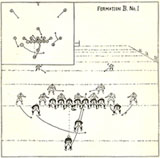
In responding to a comment from Jeff Miller, I did a little more research on the hidden ball play and found something useful. In its coverage of the 1897 Cornell game, the December 1897 edition of the Penn State school newspaper, “The Free Lance,” described the dastardly play that Pop Warner ran under against their boys in the cover of almost darkness. Now we know for sure that Warner did first run the play essentially as he said he did. What we still don’t know is whether Heisman ran it a year or two earlier. Perhaps the Auburn, Vanderbilt or Georgia school newspapers covered their teams’ respective games.

Tags:1897, Allen Whiting, Cornell, Hidden Ball Play, John Heisman, Penn State College
Posted in Carlisle Indian School, Football, Pop Warner | 6 Comments »
January 27, 2011
Pop Warner told a different story on page 104 of his autobiography:
“When I was coaching at Cornell in 1897, I had the scrub team work the hidden ball play against the varsity in a practice game. The later in the season against Penn State, the hidden ball play was used for the first time in a game. In those days, Penn State was not as strong on the gridiron as they would later become and this game was merely a workout for Cornell.
“This play was used only once in the game and this was late in the fourth quarter after Cornell had already secured a big lead on the scoreboard….And the play worked like a charm. The Cornell ballcarrier untouched and scored a touchdown.”
Warner also wrote about how he had elastic installed in the hem of Charles Dillon’s jersey sometime before the 1903 Carlisle-Harvard game and how James Johnson placed the ball up the back of Dillon’s jersey after receiving the kickoff that opened the second half of the game. After Dillon crossed the goal line, another player (probably Johnson) removed the ball from his jersey and touched it down as was required by the rules at that time.
Determining the accuracy of Warner’s claim that his first use of the hidden ball play was in the 1897 Cornell-Penn State game could easily be verified by asking Joe Paterno as it would have happened early in his tenure in Happy Valley. Determining the accuracy of Heisman’s claim will be more difficult. It will likely require the perusal of newspaper coverage of the game by at least the Atlanta Constitution and the two schools involved. However, lack of mention in newspaper coverage doesn’t necessarily mean it didn’t happen because sportswriters often get things wrong.
I guess we will have to wait for Jeff Miller’s biography of Pop Warner to know who first used the hidden ball play.
Tags:Charles Dillon, Jeff Miller
Posted in Carlisle Indian School, Football, James Johnson, Pop Warner | 2 Comments »
January 25, 2011
It is with some trepidation that I return the blog from its vacation. Readers have been very supportive, so supportive in fact that more people read the blog while it was on vacation that had read it for several weeks. Also, one day had a record high number of readers. (Actually, one day in August 2008 was a bit higher but that was due to a glitch of some sort.) Even though more people are reading the blog when I don’t write anything than when I do, I will persist in continuing to put some thoughts in digital ink.
Jeff Miller, who is working on a biography of Pop Warner, wrote me with questions regarding the origin of the famous hidden-ball play. He found that others claim that John Heisman first used that play: “The Orlando Sentinel ran an article in which it stated that John Heisman used it first in a game against Vanderbilt in 1895. Leather Helmet Illustrated claims Heisman first used it in a game against Pop Warner’s University of Georgia team in 1895.” Recalling reading Warner’s account of his using the trick play, I thought I should investigate the matter a bit.
The first thing I did, even before pulling Warner’s autobiography off the shelf, was to do a quick search on Heisman and the hidden ball play. Not surprisingly, I found something different than what was in Leather Helmet Illustrated. The Encyclopedia of Alabama entry for Heisman includes the following:
“The Vanderbilt game in 1895 was memorable for the introduction of a hidden-ball play into the game. Trailing Vanderbilt, 9-0, in the second-half, Heisman instructed Auburn quarterback Reynolds Tichenor to stuff the ball under his shirt. The wedge of players surrounding him then scattered to all parts of the field, distracting the Vanderbilt players. Tichenor, who pretended to be tying his shoe, got up to run down the field unopposed for a touchdown. The play would later be outlawed.”
To be continued…
Tags:Jeff Miller, John Heisman, Reynolds Tichenor
Posted in Carlisle Indian School, Football, Pop Warner | Leave a Comment »
December 28, 2010
Historians are familiar with Carlisle’s impressive victories over Army, first in 1905 and later in 1912. But few know that Carlisle almost replaced Navy as the Cadet’s end-of-season foe in 1913. Newspapers started hyping the 1913 football season in early August that year. First, it was announced that, “The Army, after several years of defeat by the Navy, is going to follow a new policy this season and there are few hard games on the soldiers’ list. A new feature of Army’s schedule will be a game on November 1 with Notre Dame.” On August 8, a news report datelined Trenton, NJ announced that negotiations were being held to move the Army-Navy game to the local fairgrounds. An August 12 news report out of Annapolis reported that, “Army and Navy football managers are at loggerheads over arrangements for the annual football game. The date is to be Nov. 29. West Point has objected to the number and situation of seats accorded them at Philadelphia and proposed the game be played at West Point and Annapolis alternatively or in New York every year. Navy stands pat on Franklin Field at Philadelphia.”
The August 28 Washington Post announced that the 1913 Army-Navy game was off and that, on that very day, Pop Warner would be signing a contract for the Carlisle Indians to play Army at West Point on November 29. The next day’s paper blared, “West Point-Carlisle Game Is Officially Announced,” “General Dismay at Naval Academy,” and “Took It for Granted That Game Would Eventually Be Arranged.” Army and Navy officials in Washington retained hopes that the inter-service game would yet be played.
On September 2, Navy officials threatened to break off all relations with West Point unless the school’s football teams meet on the playing field that year. The day after that, the Secretary of the War Department called a meeting with the two academies’ athletic directors and hammered out an agreement for Army and Navy to meet on November 29 at the Polo Grounds in New York City. The Washington Post reporter covering this story mused, “Just how Army will get out of the Carlisle muddle remains to be seen.”
Tags:Polo Grounds, Washington Post
Posted in Carlisle Indian School, Football, Pop Warner, William Garlow | Leave a Comment »
December 17, 2010
Reviews of the programs for the athletic banquets for years 1908-10 (Carlisle’s athletic banquets covered calendar years not school years) found no mention of John Russeau (in any of the various spellings). That means that he didn’t get enough playing time in any of the varsity sports to letter at Carlisle. That he appeared in the 1908 team photo shows that he was on the team, probably as one of the scrubs. That he was assigned the task of coaching the Painters implies that Pop Warner thought he understood the game well enough to teach younger players how to play the game. Unfortunately, he is also credited with some things that he most likely didn’t do.
For example, his Rice Lake Hall of Fame biography includes this statement: “John played at tackle and end on both sides of the line and scored two touchdowns, one on a 20 yard pass reception against Baltimore College in 1906 and the other on a fumble recovery in the end zone against Carlisle Prep College.” The Carlisle varsity never played a Baltimore College. However, Baltimore City College was playing high school teams around that time and may have played Carlisle’s Second Team (sometimes called “The Hustlers”). There was no school called Carlisle Prep College but Dickinson College did have a preparatory school, (called Conway Hall from 1905 to 1917) that Carlisle’s varsity annihilated in 1908 53-0 when the season opener with Albright College fell through because they didn’t field a team that year. It’s quite possible that John Russeau recovered a fumble in the end zone against them because everyone got to play in blowouts like that one. He may have gotten into the game with Mt. St. Mary’s if it had materialized.
The Second Team was to play home games against the Swatara team of Steelton on October 10 and Conway Hall on Thanksgiving. They were also to play road games in Washington and Baltimore. The Third Team (also called “The Hustlers”) also had a schedule of games against athletic clubs, college reserves and prep schools. John probably played in several of these games, one of which was played in Baltimore against Walbrook Athletic Club. This punting contest played in a snowstorm which made it unlikely that Russeau caught a pass in that game. He probably played in several second and/or third team games and may have scored in some of them. But there is no evidence found of him playing in a varsity game.
To be continued…
Tags:John Roussian, John Russeau, John Russian, Rice Lake Hall of Fame, The Hustlers, Walbrook Athletic Club
Posted in Albert Exendine, Carlisle Indian School, Football, Pop Warner | 2 Comments »
December 14, 2010
A 1951 Rice Lake Chronotype article about john Russeau stated that he had been at Carlisle Indian School from 1906 to 1910. The Carlisle Arrow article about him coaching the Painters football team in 1909 seems to support that he was involved in the football program and that he was at Carlisle in the 1909-10 school year. Further research is needed to learn more about his time there. The 1951 article also included some of Russeau’s observations of Pop Warner that, to my knowledge, haven’t been reported elsewhere but are consistent with what is known about “The Old Fox” including what he has written about himself.
Russeau described Warner as “a strict disciplinarian who would take no excuses for ‘holding back’ by his players and who enforce rigorous training by the whole team. His favorite penalty for rule infractions, according to John, was a long cross-country run, with the player in full football uniform. ‘Pop’ made sure the delinquent did not lag in his run—from one to five or ten miles—by following along on horseback.”
While this might seem far-fetched, it is quite possible because horses could still be found in the stables on Carlisle Barracks. The Model T Ford was not put into production until 1908 and few could afford automobiles before that. Cavalry officer Major William A. Mercer was superintendent of Carlisle Indian School part of the time Russeau was there and kept his horse on campus. Mercer’s successor, Moses Friedman, also had horses—or at least his wife did. The Carlisle Arrow of May 28, 1909 reported that Mrs. Friedman’s horse fell on her and broke her thigh bone. Also, horse were used on the school’s farms and were likely readily available for Warner’s use. It is quite possible that Mercer or Friedman welcomed Warner’s riding as exercise for their horses.
To be continued…
Tags:John Russeau, Moses Friedman, Rice Lake Chronotype, William A. Mercer
Posted in Carlisle Indian School, Football, Pop Warner | Leave a Comment »
December 2, 2010
Pop Warner made many observations regarding his Carlisle Indian players, almost all regarding their behavior, much of which he thought was a result of their culture. But on one occasion he discussed an anatomical difference he had observed. Warner claimed that the lower legs of white boys and Indians were different. It was his observation that one group’s lower legs dropped straight down from the knee whereas the other’s curved outward.* It was this difference that gave the Indian boys an advantage in kicking the football over white boys.
Warner often mentioned how his Indian players would practice some skill endlessly, in some case for years, until they perfected it. An example was Frank Hudson who drop-kicked footballs year round including when there was snow on the ground. He simply moved indoors to the gym during inclement weather. Hudson also practiced with both feet until he became ambidextrous (it’s not clear if ambipedal is a word) and was able to dropkick field goals with either foot. He also became the game’s best dropkicker, arguably of all time. In addition to practicing a skill, Warner noticed that that the Indians watched proficient players’ closely to learn a skill. An example he gave was of Mike Balenti kicking four field goals, two from over 40-yards away, against Navy without having attempted one in a game before. Balenti attributed the success to his having watched Hudson and Frank Mt. Pleasant.
Warner thought that many more Carlisle players were good at kicking than were the white players he coached before and after because of a physiological advantage. He believed that the shape of Indians’ lower legs was better suited to kicking. It would be interesting to know if Warner was seeing things or if what he said is true.
*I misplaced the article in which Warner stated this and would appreciate it greatly if someone could inform me as to where I can find it.
Tags:Drop kick, dropkick, field goal
Posted in Carlisle Indian School, Football, Frank Hudson, Frank Mt. Pleasant, Mike Balenti, Pop Warner | 4 Comments »



 Tom Benjey's Weblog
