Carlisle Indians Played Football in 1891!

November 16, 2009

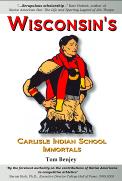
While researching Frank Lone Star for my upcoming book, Wisconsin’s Carlisle Indian School Immortals, I came across a piece in the November 4, 1892 issue of The Indian Helper, in which Frank’s older brother, John Lone Star, had joined a newly organized football team called the Rovers. This, of course, piqued my interest, so I looked further. The November 25 issue reported that the Rovers had lost to the Pirates. The Pirates were described as the “Champion Foot-ball Team of the school.” From that I gathered that the Rovers and Pirates were intra-mural teams of some sort. It also mentioned that the Pirates’ trainer (coach in modern parlance) was Benjamin Caswell. In 1894, Caswell would captain the school’s football team, the first one to play a full schedule.

The article also reported that the Pirates also defeated the “School Team on Saturday, by a score of 16 to 10.” In his memoir, Superintendent Pratt wrote that interscholastic football at Carlisle had been banned in 1890 and not reinstated until 1893. So, why would there have been a school team?

But the Rovers weren’t through for the year. They beat Martin Archiquette’s team 22 to 8 on Thanksgiving Day. One can only assume that Archiquette’s team was another intra-mural team. The Pirates weren’t through either. On the following Saturday, they lost to the Regulars. What did that name mean? Were they just regular guys or were they the team that represented the school?

Curious, I delved a little deeper. On November 13, 1891, The Indian Helper stated, “They say we are to have a foot-ball team. The ball is already here.” That could have been just some gossip. Of course the school had a ball because the boys were already playing among themselves. A little ad in the November 28 New York Times told me that there was more to it.

1891-11-28 Carlisle vs NY YMCA

Was Pratt’s memory faulty? Was this a one-off game against a foe who promised to play cleanly? After all, it was a Christian organization. More research will be needed to discover the truth.
New Jim Thorpe Documentary

November 12, 2009

A new documentary about Jim Thorpe has been released and is playing on some PBS stations. Moira Productions announced that Jim Thorpe: The World’s Greatest Athlete has been finished and is available for viewing. The film appears to largely be the work of Tom Weidlinger (producer, director, writer) and Joesph Bruchac (producer, writer). There were rumors that James McGowan was involved with the film but his name is not listed in its credits on imdb.com:  http://www.imdb.com/title/tt1381609/fullcredits

Bruchac has written books about Jim Thorpe and is thus probably the lead writer on this documentary. He tends to write in the first person as if Thorpe, who he probably never met, is telling the story himself. A brief excerpt from the first chapter of Jim Thorpe: Original All-American states that young Jim was called stupid, something he disliked:

     Stupid. That was what the teacher called me. And not just one teacher, either.

     Stupid. I hated that name. That was one of the worst ones. Not the very worst, but close. It hurt so much because I wondered if it was true.

Stupid is not how Jim’s teacher in the Commercial Course at Carlisle, Marianne Moore, described him. Bill Crawford reported her as saying, “In the classroom he was a little laborious, but dependable; took time—head bent earnestly over the paper; wrote a fine, even clerical hand—every character legible; every terminal curving up—consistent and generous….The commercial students, about thirty, were an ideal group. Among them were James Thorpe, Gus Welch, and Iva Miller…They were my salvation, open-minded, also intelligent.”

 The Balenti brothers, who were among the brightest students at the school, sometimes made fun of Jim. However, being less intelligent than them doesn’t mean he was stupid.

Moira Productions’ website lists the TV schedule for the 1-hour documentary: http://www.jimthorpefilm.com/events/index.html

The listing implies that it shows at 5:30p.m. Sunday on WITF’s HD channel only, but Comcast’s website lists it as showing on both channels 004 and 240. That implies that it will also be broadcast on the regular WITF channel as well.

Removal of Jim Thorpe’s Remains

November 9, 2009

Both AP and UPI wire services report that Jim Thorpe’s sons plan on suing the Borough of Jim Thorpe, PA to have his remains removed from the town that now bears his name to the graveyard near Shawnee, OK in which Thorpe’s father and other relatives are buried. Jim’s youngest son, Jack, is quoted as saying, “According to Sac and Fox tradition, Dad’s soul will never be at peace until his body is laid to rest, after an appropriate ceremony, back here in his home. Until then, his soul is doomed to wander. We must have him back.”

According to the UPI, Thorpe wanted to be buried in the Oklahoma cemetery with his relatives but, at the time of his death, his family didn’t have the resources to build what his widow thought to be a proper monument to her late husband and the governor of Oklahoma declined to provide to necessary funding. Mrs. Thorpe then negotiated an arrangement in which the boroughs of Mauch Chunk and East Mauch Chunk, two towns in which Big Jim never set foot, would merge and be renamed after the football star. They were also to build an appropriate monument. According to all accounts both sides lived up to the agreement, but the expected tourist interest never materialized.

The attorney representing the Thorpe family plans to file a law suit in Federal Court in Philadelphia later this month under the 1990 Native American Graves Protection and Repatriation Act. That act requires that federal agencies and institutions that get federal funding return American Indian remains to their families or tribes. I suspect that this law was intended to deal with bones and artifacts that graverobbers sold or gave to museums, schools or government agencies, not for agreements freely entered into. This is a tough case because there are no bad guys. The question I have is: who would suffer most if his remains are not returned to the family? Perhaps Bob Wheeler, the author of the definitive Jim Thorpe biography, can shed more light on this.

Carlisle’s Most Outstanding Victories

November 5, 2009

Pop Warner listed what he thought were Carlisle’s most outstanding victories in a 1951 letter to Babe Weyand. Note that his list includes only those games he coached, but it is probably fair to him to include only games he saw in person. Here is Warner’s list:

1899   Carlisle 26 – Penn 6            only game Penn lost this year

1899   Carlisle 45 – Columbia 0       Columbia had beaten Yale, Army and Dartmouth

1899   Carlisle 2 – California 0         Calif. Was Pacific Coast champions, unbeaten and unscored on 

1903   Carlisle 28 – Northwestern 0  only game Northwestern lost that year

1907   Carlisle 26 – Penn 6             only game Penn lost

1907   Carlisle 18 – Chicago 4         Chicago was Big Ten champion

1913   Carlisle 13 – Dartmouth 10     only game Dartmouth lost

I find it curious that Warner included neither win over Harvard and he was on the winning end of both of those contests.

Winneshiek’s Return to Carlisle

November 3, 2009

William Phineas Winneshiek, Winnebago from Hatfield, Wisconsin, wasn’t a star football player at Carlisle but surely had friends that were. He probably played on a shop team or for the band, because he was a musician. After leaving Carlisle in 1915, he played semi-pro football for the Altoona Indians and, in 1916, assisted fellow Altoona Indian and musician, Joel Wheelock, coach the Lebanon Valley College team. In 1922 he played in the NFL for the Oorang Indians. However, music was where he made his living. A website maintained by his grandson includes photos of Winneshiek: http://firstpeople.iwarp.com/phineus.html

On December 11, 1936, Bill Winneshiek, who was then known as Chief Winneshiek (probably because he was descended from a hereditary chief) wrote Hugh Miller to thank him for giving him some photographs of the Indian School. He also expressed his feelings about what he saw on his recent visit to the old school:

Mr. Miller, I know that you are one of the few White men living that will realize fully the great injustice that was brought upon the Indian Race when Our Great Democratic Government decided to: “Take Away From The Redman The Last Remaining Treasure (Carlisle Indian School) He Had in U. S. A.

Buildings had been burned down; complete destruction of the tall smokestack, which once answered the purpose of a monument; The Campus , which was once the pride of all who saw it for it was kept always in its natural beauty by the Indian students had faded into an unkept meadow; Our school mates who had been called by the Great Spirit and laid at rest near the Athletic Field, had been disturbed and moved to a more lonelier spot by the soldiers who now inhabit the Grounds where the American Indian made his last stand. No Government, no Race of People could have been more Cruel, No Christians, whether they be White, Yellow, Brown, Black or Red, could forget Providence long enough to commit that one last barbarous act as when Carlisle Indian School was taken from the Red Man. The saddest thing that has yet befallen the Indian.

Carlisle’s Most Important Game

October 30, 2009

The following question was posed to me this week:

I have to do a college speech on an event in the 20th century. I decided to do it on a Carlisle Indian School football game and how that particular game brought attention to the school, the players, and the whole story behind it. If you had to pick ONE game that, in your opinion, put the Carlisle Indian School and their football team on the map what game would you pick.

This is a very difficult question to answer because there are several possibilities:

1. In just their third full season of football, the Indians played The Big Four (Princeton, Yale, Harvard and Penn) in successive weeks and were competitive in all four games. A bad call cost them the Yale game and they held Harvard to just four points. National Champions 10-0-1 Princeton beat all of their opponents except Lehigh, Army and Harvard worse than they beat the 5-5 Indians. The Tigers were held to a scoreless tie by Lafayette. Carlisle smashed Penn State 48-5 and beat the previously unbeaten Champions of the West Wisconsin 18-8.

2. In Pop Warner’s first year at Carlisle, the Indians notched their first win over a BIG FOUR team, Penn, 16-5. They also beat California 2-0 in a game played on Christmas Day in San Francisco. Halfback Isaac Seneca was named to Walter Camp’s All America First Team, the first Carlisle player to be so honored.

3. The 10-1 1907 Indians beat a BIG THREE team for the first time when they took Harvard 23-15. They also beat Penn 26-6, Minnesota and Chicago. Their only loss was to Princeton. Warner considered the set of players on this team to be Carlisle’s best and Jim Thorpe was on the bench! The win over Amos Alonzo Stagg gave him much personal satisfaction.

4. The 11-1 1911 team also beat both Harvard and Penn. Warner considered this team to be Carlisle’s best but it lost to Syracuse by one point due to overconfidence and listless play. Clark Shaugnessy ranked the 1911 Carlisle-Harvard game as one of the twelve best games of all time. Jim Thorpe described it as his most favorite game of his long career.

5. The importance of the 1912 Carlisle-Army was debunked in “Jude and the Prince,” an article written by James G. Sweeney and published in the May 2009 journal of the College Football Historical Society.

I’d appreciate reading your opinions regarding Carlisle’s most important game.

Espresso Book Machine Going to Waste

October 26, 2009

This past Friday, I was in Ann Arbor doing research for a future book. When we finished our work in the archives, my wife suggested that we check out the Espresso Book Machine (EBM) that was installed at the University of Michigan over a year ago. The young special collections librarian was familiar with the machine and told us exactly where it is located. She looked up its hours of operations on the school’s website and noticed that the machine was in operation from 10:00 a.m. to 12:00 p.m. weekdays. Because that is only ten hours a week, we decided that the website was in error; the EBM must be in operation from 10:00 a.m. to midnight. The Shapiro Library, which is better known to Michigan alums as UGLI (for Undergraduate Library), is open from 8:00 a.m. to 5:00 a.m. daily, so 10:00 a.m. to midnight makes sense for the EBM. However, the website is not wrong.

We arrived a little after 5:00 p.m. to find the Espresso machine just inside the front door as advertised, sitting idle, also as advertised. An employee of the library explained to us that only two people were trained to use the machine and they only operated it two hours a day, weekdays. On the counter was a folder with a few pages of lists of books available to be printed. None of them interested me. I had expected to find a computer catalogue of thousands of pre-1923 books available to be printed. After all, Google famously scanned Michigan’s entire collection. There had to be numerous books in it that are in the public domain.

The gentleman handed us a stack of pre-printed books that could be purchased, but none of them interested us. The quality of the books looks to the naked eye to be about the same as that of print-on-demand books.

Some months ago, Jeff Wood, the proprietor of Whistlestop Bookshop in Carlisle, PA, and I discussed the possibilities of the Espresso machine, particularly in a college town. One opportunity we envisioned was professors, unshackled from the need to find a publisher willing to invest in their books, writing their own texts for the courses they teach. The college bookstore wouldn’t have to inventory the books, other than a few copies to keep lines down at the beginning of the term. Researchers wishing to read dissertations wouldn’t have to strain their eyes and wrenching their bodies over microfilm machines.

But that is not to be at the University of Michigan. One hopes that other installations more fully utilize their EBMs. More on the machine, including a video of it in operation, can be found at http://www.ondemandbooks.com/home.htm.

Sally Rand’s Nude Ranch

October 22, 2009

The connection between the topic of this message and my work is tenuous to say the least, but it caught my eye. Readers may find it to be informative. A friend of mine, who shall remain nameless, along with some friends, made a trip through the western states in the late 1940s. One of his stops was Sally Rand’s Nude Ranch. I thought little more about that until I read that the Craighead twins also stopped there on their way to catch a ship to Indian for their famous trip to visit their friend, Bapa, who was an Indian prince. They documented their stop at the “ranch” in Life with an Indian Prince, their account of the trip. My friend may have shared some knowledge about this attraction with the twins before their trip because they had confined their previous travel to places where wildlife could be studied. This time they studied a different kind of wildlife.

No, the “ranch” was not in Nevada. It was an attraction with the Golden Gate International Exposition that was held in 1939 and 1940 at Treasure Island in San Francisco. This event was also known as the 1939 San Francisco World’s Fair. Rather than being located on the Great Plains or some grassy meadow, Sally Rand’s Nude Ranch was housed in a nightspot known as The Music Box. The Music Box was in the Treasure Island Amusement Zone, the place where “flesh” shows were found. The area was also known as the “Gayway.” But that wasn’t where it always was.

In 1936, Sally advertised across Texas for a few attractive young girls to work at her NUDE RANCH in Fort Worth, Texas. The bold-faced type surely eliminated any confusion that potential applicants may have had about what the work entailed at this Depression-era enterprise. Her requirements were also clear: “Can be any height. Perfect figures necessary. Highest salaries paid.”

For those interested in knowing more, follow this link: http://www.bisonbill.com/sallyranch1.html

Lonestar Played in the NFL

October 19, 2009

Not long ago, I learned that some Carlisle Indians other than the ones on the Oorang Indians also played in the NFL. Chris Willis’s book, The Columbus Panhandles, tells the story of one of the charter members of the NFL (called the American Professional Football Association when it was first formed in 1920). The 1920 Panhandles’ roster included one player that claimed Carlisle Indian School as his alma mater. That was Frank Lone Star. John Steckbeck’s classic about the Carlisle Indian School football teams, Fabulous Redmen, makes no mention of him playing football. An appendix to Willis’s book lists Frank as having played guard and tackle in three games in the 1920 season. A search of newspaper coverage for these games confirms Willis’s data.

Unfortunately, Carlisle’s school records don’t indicate that Frank Lonestar ever played football there—at least not on the varsity squad. Frank Lonestar, Chippewa from Shell Lake, Wisconsin, first arrived at Carlisle in August 1903. After completing the five-year term, he re-enrolled for a three-year term. Just before the end of that term of enrollment, he ran away but re-enrolled in September 1911. He ran away again, returned in March 1912, and left for good in May 1912. While at Carlisle, he learned the printing trade and could have played on the Printers’ shop football team. Shop teams received little press, so it’s not known for sure if he played for them. He kept in touch with the school while working in Cleveland, Ohio. He died at his brother’s home in Shell Lake on October 30, 1915.

Frank’s untimely death made it impossible for him to play for the Columbus Panhandles in 1920. Playing under assumed names was common in the early days of professional football, especially by people whose employment might be jeopardized if their employer learned they were playing football for money.

One possibility is Lone Star Dietz because he was looking for a coaching job at that time. He went by the name William Lone Star at Carlisle. That name is close to Frank Lonestar. Also, Dietz would have likely known that Frank was dead because his death was announced in The Carlisle Arrow. In addition, Frank’s hometown was in the county immediately north of Dietz’s. Tackle was his natural position, too.

In 1920, Lone Star Dietz was 36, an advanced age for an athlete in that era, a factor that would explain him playing only three games. Of course, it may not have been Dietz, but if it wasn’t, who was it?

Carlisle Students at Craighead

October 15, 2009

Jean Craighead George recalls a former Carlisle Indian School student and his wife visiting Craighead Station, probably in the 1930s. The man had worked for Jean’s grandmother, Agnes Miller Craighead, on his outing periods by tending her flower gardens. He was disappointed that the once beautiful gardens were gone and the yard in which they were once located had been converted into a playground for Agnes’s grandchildren and their friends. Jean doesn’t recall the man’s name but does remember how much pride he had in the gardens. He wasn’t the only Carlisle student to live and work at Craighead Station.

Charles and Agnes Craighead were early and constant supporters of Carlisle Indian Industrial School. In the October 1882 edition of The Morning Star, Lt. Pratt thanked them and the others “for their kindness and helpfulness in giving our pupils a place in their homes where the customs and labors and amenities of civilized life could be impressed upon them than is possible they should be in a school of that size.”

It is difficult to know how many students spent time at the Craigheads because we only know the names of a few who spent time there. The following are the names of students known to have been with the Craigheads:

Emma Strong

Sosipatra Suvoroff

Mary Kadashan

Della Cayuga

Melinda Cayuga

I would be greatly obliged if anyone who knows of someone who spent time at Craigheads would contact me.