Pretty Boy – part 5

October 12, 2009

Apparently, raising cattle wasn’t a very profitable undertaking at that time on that land because the Carlisle superintendent requested that the Cheyenne River Agency superintendent find him employment: “Thomas has made a most excellent record at Carlisle and it is hoped an opportunity will present itself to put him to work where he can earn ready cash while caring for his property.” Upon Hawkeagle’s arrival, the agency superintendent responded, “We will do all we can to find work for him but as there are no vacancies in the regular force any employment given to him would be of irregular nature and temporary only.” About a year later, in October 1916—after the cattle were fattened, one assumes—the Cheyenne River Agency superintendent wrote Ford to reinstate Thomas. That attempt was not immediately successful because the Chief Clerk at Carlisle wrote Ford recommending that they hire him. In ensuing correspondence, Superintendent Oscar Lipps gave Thomas a good recommendation. It is not known if he ever got back on at Ford or not, but it seems unlikely because he registered for the WWI draft at Cherry Creek, South Dakota.

Tribal rolls indicate that Thomas Hawkeagle was born in 1894. However, his WWI draft registration has his date of birth as April 14, 1893. Birthdates are often fuzzy for people born in that time period.

The 1920 Federal Census lists him as a single head-of-household living with Margaret Wolf (55), his widowed aunt, and her daughter, Nellie Wolf (16), his cousin. The 1920 tribal census lists him as married to Nellie. In 1921 they are also listed as married with son Claude born on August 4, 1920. The 1937 roll, the last one available to me, lists Thomas and Nellie as having four children: Claude, Ben H., Sylvester and Irene Matilda. Beginning with the 1927 roll, his family name was shifted to Eagle Hawk.

And this is all I know about the man who was once called Pretty Boy.

Pretty Boy – part 4

October 8, 2009

On April 30, 1915, Thomas Hawkeagle’s request to be allowed to drop his academic work and spend all day learning and working at his trade was turned down. The reason given was that, with only two weeks of school remaining, it wouldn’t be to his advantage to miss the final examinations and likely not be promoted. On that same day, he filled out paperwork to determine his eligibility for Federal aid. Given that he was an orphan with no income, he was probably deemed eligible. He owned 320 acres of land and would inherit land from his mother, but that didn’t provide immediate income.

He may have wanted to be released from academic work early to allow him to leave for Detroit two weeks earlier than he would if he completed the school year. He may have thought the opportunity with Ford Motor Company would disappear if he didn’t take advantage of it immediately. It didn’t.

Thomas Hawkeagle and several other boys from Carlisle Indian School spent most of the spring and summer learning how to make Model Ts. After successfully completing their apprenticeship, they would be eligible to earn wages twice what other employers paid. From all accounts, he performed well and enjoyed working at the Highland Park Plant. At the start of the school year, he and the other football boys returned to school.

Hawkeagle was finally a starter on the football team, but changes made in the wake of the 1914 Congressional Inquiry deemphasized athletics and band, dooming the team to no longer be competitive at their previous level. The team’s dismal 1-3-1 record may have had something to do with his mid-season departure, but the stated reason was to return home to his ranch to “care for the stock that has recently been issued to him.” But that wasn’t the last Carlisle would hear of Thomas Hawkeagle.

Next time – Part five of Pretty Boy’s tale.

Pretty Boy – part 3

October 5, 2009

A May 4, 1915 letter from Superintendent Campbell of the Cheyenne River Agency to Oscar Lipps, Superintendent of Carlisle Indian School, stated, “…you are advised that Pretty Boy and Thomas Hawk Eagle represent one and the same person.” Carlisle officials continued to call him Thomas Hawkeagle as they had always done.

Sports reporters followed suit. Thomas Hawkeagle made the varsity squad in 1914. He didn’t start the first game of the season against Albright College, but got some playing time at right guard in place of Captain Elmer Busch. That pattern continued pretty much through the season. On December 6, in a game played in Atlanta against Auburn, he apparently became part of a football legend. The Auburn website cites a possible origin of the War Eagle cheer:

The 1914 contest with the Carlisle Indians provides another story. The toughest player on the Indians’ team was a tackle named Bald Eagle. Trying to tire the big man, Auburn began to run play after play at his position. Without even huddling, the Auburn quarterback would yell “Bald Eagle,” letting the rest of the team know that the play would be run at the imposing defensive man. Spectators, however, thought the quarterback was saying “War Eagle,” and in unison, they began to chant the resounding cry.

The problem with this explanation is that Carlisle had no player named Baldeagle or War Eagle. However, as we know, Hawkeagle was on the team. The Washington Post coverage of the game reported that Hawkeagle substituted for Hill at left guard in this game. Hawkeagle could have been misunderstood as War Eagle. Thomas Hawkeagle may live today if this attribution of the legend is true.

Next time – Part four of Pretty Boy’s tale.

Pretty Boy – part 2

October 1, 2009

Breaking in on the Carlisle Varsity football team was always tough and especially so from 1911 through 1913 because those were particularly strong teams. Pretty Boy most likely played on the second or third team at first and tried to work his way up. His student file from the National Archives doesn’t indicate which trade he was taking up but, because he owned 320 acres of land, he might have been studying farming. He went on outing in April of 1913 to work on William R. Taylor’s farm near Robbinsville, New Jersey. He remained there until August 30, 1913, which allowed him to return just in time for football season. Mr. Taylor gave him high marks as a worker but a controversy arose while he was out in the country.

 F. A. Campbell, Superintendent of Cheyenne River Agency, sent two checks made out to Pretty Boy to Carlisle and they were forwarded to the New Jersey farm. Pretty Boy refused to endorse these checks so they could be credited to his account, saying that Pretty Boy was his dead brother and his name was Thomas Hawk Eagle. Superintendent Friedman eventually had the checks returned to Cheyenne River Agency, stating “…that we are unable to locate this boy at Carlisle.”

Campbell was not easily discouraged. In April 1915, he send two checks (it’s not clear if they were the same checks as sent earlier of not.) The cover letter accompanying the checks included the statement: “The above Indian [Pretty Boy] is one of your pupils.” Friedman responded, “I have your favor of the 36th, enclosing check for Pretty Boy in the sum of $5.70. I understand this boy is known here as Thomas Hawk Eagle and unless advised to the contrary check will be handed to him.”

Next time – Part three of Pretty Boy’s tale.

Pretty Boy

September 28, 2009

The next few blogs will be a little different from those done in the past. I’ve encountered a person whose story probably won’t fit neatly into any of my upcoming books, so I’ve decided to serialize it on the blog. I don’t know how many installments will be required because it’s just being written now. After reading the first installment, someone who knows things about the person may see it and provide information about him that I don’t know. Here goes.

 Pretty Boy, as he was known on the Cheyenne River Agency in South Dakota (postal address Dupree, SD) thought he was born in February 1893 when he applied for enrollment at Carlisle Indian School on September 1, 1912. When he registered for the WWI draft, he thought his date of birth was April 14, 1893. Perhaps he learned something about his background in the intervening period.

He was an orphan when he applied, but it isn’t known for how long yet. When he was examined at CIIS by Dr. H. B. Fralic, he was found to be in good health with the exception of his eyes which were considered suspicious by the examining physician. His father died of unknown (to him) causes and his mother died of tuberculosis. He had a sister who was in good health.

Prior to coming to Carlisle, Pretty Boy attended school in Rapid City, South Dakota from 1903-1906. In 1906, he transferred to Cheyenne River Boarding School, which he attended until he left for Carlisle. Being a large young man at 6’1” tall, Pretty Boy was a natural for the athletic teams. Weighing just 163 3/ pounds, he was light for his height, but Pop Warner probably figured that he could fatten him up a bit.

Next time – Part two of Pretty Boy’s tale.

Bob Carroll

September 24, 2009

I post this blog with much sadness and gratefulness. Today’s mail brought the new issue of The Coffin Corner and opened it with great anticipation as I always do. This time an extra sheet was enclosed. Sadly, it announced the demise of Bob Carroll. Bob Carroll co-founded the Professional Football Researchers Association in 1979 and has worked tirelessly for it these past 30 years. As a favor to me, he drew the frontispiece for my recent book. A reproduction of his artwork follows. I will miss seeing his drawings in future issues. His obituary follows.

Robert N. Carroll Jr.

North Huntingdon

Robert N. Carroll Jr. North Huntingdon Robert Nuehardt Carroll Jr., 73, of North Huntingdon, died Tuesday, Aug. 25, 2009. He was born July 10, 1936, in Wheeling, W.Va., the son of the late Robert Nuehardt Carroll Sr. and the late Katherine Foran Carroll. He was a retired art and English teacher at McKeesport High School and was a writer of several books on sports. He is survived by his wife, Suzanne Sprowls Carroll; daughter, Katherine Aileen and her husband, Chris Potter, of Brownwood, Texas; son, Martin David “Hoss” and his wife, Cynthia Carroll, of North Huntingdon; brother, Charles H. Carroll, of Parkersburg, W.Va.; grandchildren, Maizy Lynn Carroll, Kyra Aileen Potter and Nicole Lynn Benevento; great-grandchildren, McKenna, Dominick and Caleb; sister-in-law, Aileen Beery, of Wheeling; and nieces and nephews. There is no visitation. Services are private. Arrangements are by the GILBERT FUNERAL HOME AND CREMATORY INC., 6028 Smithfield St., Boston, Elizabeth Township. Memorial contributions may be made to the Pro Football Hall of Fame, 2121 George Halas Drive, NW, Canton, Ohio, 44708.

Frontispiece

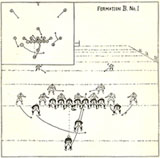
Single-wing at Edwardsville High School

September 20, 2009

In June, I wrote about Edwardsville High School Head Football shifting over to the single-wing under new Head Coach Mark Bliss last year. A letter from my 8th grade English and home room teacher (whom all the boys had crushes on) caused me to think about Edwardsville football and how they are doing in this their second year with the single-wing.

A couple of searches located the Tigers’ 2009 schedule and performance to date. As members of the Southwestern Conference, they always face a tough schedule. This year the pre-season rankings had the East St. Louis Flyers at #1 in Class 6A (last year they were Class 7A state champs). USA Today ranked the Flyers at #10 in the country. The Belleville East Lancers were ranked #10 in Class 8A. Last year they made it to the second round of the playoffs and their coach thinks this is the best set of players he’s had at Belleville East. The Belleville West Maroons were ranked #8 in Class 8A. Yes, this is the Belleville West that has been in the news recently because one of its students was beaten by two others when he tried to find a seat on a school bus. I told you this was a tough conference.

The tigers started out their season with a 56-6 win over Roosevelt High of St. Louis, Missouri. Next they beat Chicago Corliss 46-0. Then conference play started. The Belleville East Lancers beat them 27-7 and last Friday they lost to East St. Louis 48-15. Now they have to win them all to have any hope of making the playoffs.

Some may blame the problems on the shift to the single-wing, but if one considers the number of points scored by the Belleville East and East St. Louis offenses, it is unlikely that the Tigers could have won regardless of what offense they were running. They need a defense.

Were Frank Jude and Ed Rogers Brothers?

September 14, 2009

The September 15, 1904 edition of The Arrow contained an often overlooked tidbit:

“Miss Louise Rogers, class of 1902, Carlisle, who graduated this year from the Bloomsburg Normal, is teaching a school of Anglo-Saxon children at Grand Rapids, Minn. Miss Rogers is a sister to Coach Rogers and left-end Jude.”

The revelation that Ed Rogers and Frank Jude is a tough one to verify. For starters, the National Archives has no student file for Jude. Student files do exist for Ed and Louise Rogers but don’t tell us everything we need to know. Ed’s card for his 1894 enrollment has William D. Rogers in the home address field. It also lists both parents as living at that time. His file includes no physical examination record. Those are useful because they list the numbers of brothers and sisters and their states of health. Louise’s file was thinner but did include her 1897 enrollment card. Her home address was listed as W. A. Rogers or Mrs. Mary Smetsinger. Both her parents were living. Louise’s husband’s file (she married another former Carlisle student named Eugene Warren) contained nothing that would shine any light on the issue at hand but did contain his thoughts on the relative merits of on- and off-reservation schools.

A quick search for Mary Smetsinger on Ancestry.com didn’t find anything that looks promising. This will require much more time to explore. Perhaps a relative of Frank Jude or Ed or Louise Rogers will know something about this.

A Visit to the National Archives

September 10, 2009

Yesterday, we did some research at the National Archives in Washington, DC. Where the Carlisle Indian School student files reside—the ones that still survive, that is. The National Archives are located in a beautiful building at 7th and Pennsylvania Avenue. The building isn’t hard to find but parking is a challenge for us small-town folk. First, we found a two-hour meter that wouldn’t take quarters, only nickels and dimes. A helpful guard told us an empty spot in front of our car was legal but lacked a meter because it broke. That took care of the first two hours. Now to start the research.

After passing through security and being wanded because my belt buckle (I think) set off their alarm, we were directed to the station where ID cards are assigned. After taking an on-line course, we filled out a computer form for the ID cards and had digital photos taken. In a few minutes more we had new photo IDs that were good for a year. (Later in the day, a guard noticed that our IDs expired on 9/9/2009, so we had to get new ones made that expired on 9/9/2010.) Next stop: pull requests.

Researchers do not wander through the stacks of archives for good reason as evidenced by the politician who was found with documents stuffed up his pant leg. So, one must request the documents desired by submitting forms—in quadruplicate, one student per form, maximum 20 forms per pull. A man showed us how to fill out the forms and we hurried to get them in for the 11 o’clock pull (Records are pulled at 10, 11, 1:30 and 2:30, also 3:30 on Wednesday, Thursday and Friday because they are open to 9 p.m. on those days.). After filling out a set for the 1:30 pull, we moved the car to the back side of the building that had the European-style parking ticket machines. Only after giving it my credit card did I notice the two-hour maximum and that cars would be towed after 4 p.m. Two hours later, I found a parking garage that was open to 7 p.m.

Files from the 11 o’clock pull appeared in the reading room around noon, so it was time to go to work. One thing that surprised us was that we didn’t have to wear gloves when handling these 100-year-old documents. Once we found files we wanted to duplicate, it was time to make photocopies. Earlier we bought debit cards for that purpose. We found enough material to have the need to add money to the cards. Being aware that the cashier went home at 5 p.m., we put more money on the cards than we thought we’d need so we could make all the copies we needed. The bottom line of the card states, “Unused value on this card is not refundable.” Now we have a reason to make another visit to the Archives.

Fielding Yost Offered Carlisle Job

September 8, 2009

As always, when I search for information on one topic, I find unrelated, but interesting information on something else. This time I came across an article in the January 14, 1907 edition of The Lake County Times about the state of Michigan athletics—the University of Michigan, that is. The article, dateline Ann Arbor, Mich., Jan. 13, discussed the University’s dissatisfaction with conference rule changes. The changes apparently dealt with eligibility and would hurt its track team. “Michigan appears to be hit the hardest by this rule for she will lose five of last year’s conference point winners. These five men took no less than forty-two points In the last meet, and now that they are out It looks as though Michigan will not shine very brightly in the conference this spring”

 “The blow has been dealt and if Michigan remains in the conference to be dictated to by such colleges as Northwestern, Purdue, Minnesota and Indiana, with whom she has, absolutely no athletic relations except during the one-day general conference track meet, there will be the sorest bunch of collegians in Ann Arbor that ever was collected together.” As the reporter expected, Michigan dropped out of the conference and stayed out for about a decade. However, the article included a tidbit of more interest to me.

“Yost, Fitzpatrick and Baird have ambitions. Fielding Yost draws $3,500. He had an offer of $5,000 to go as coach for the Carlisle Indian School and turned it down because things were agreeable here.” The last statement may or may not have been true. Had Carlisle offered Yost the job, the offer had to have been tendered much earlier. Articles were printed in late December, 1906 announcing that Warner was leaving Cornell and returning to Carlisle. Also, Albert Exendine wrote that he had been informed late in the 1906 season that Warner would be returning. This was before Fielding Yost officiated the Carlisle-Vanderbilt game. I wouldn’t say that Yost and Warner feuded but it is clear that Yost did not like Warner. Whether this incident factored into that any way is not known.