Endorsements

March 22, 2012

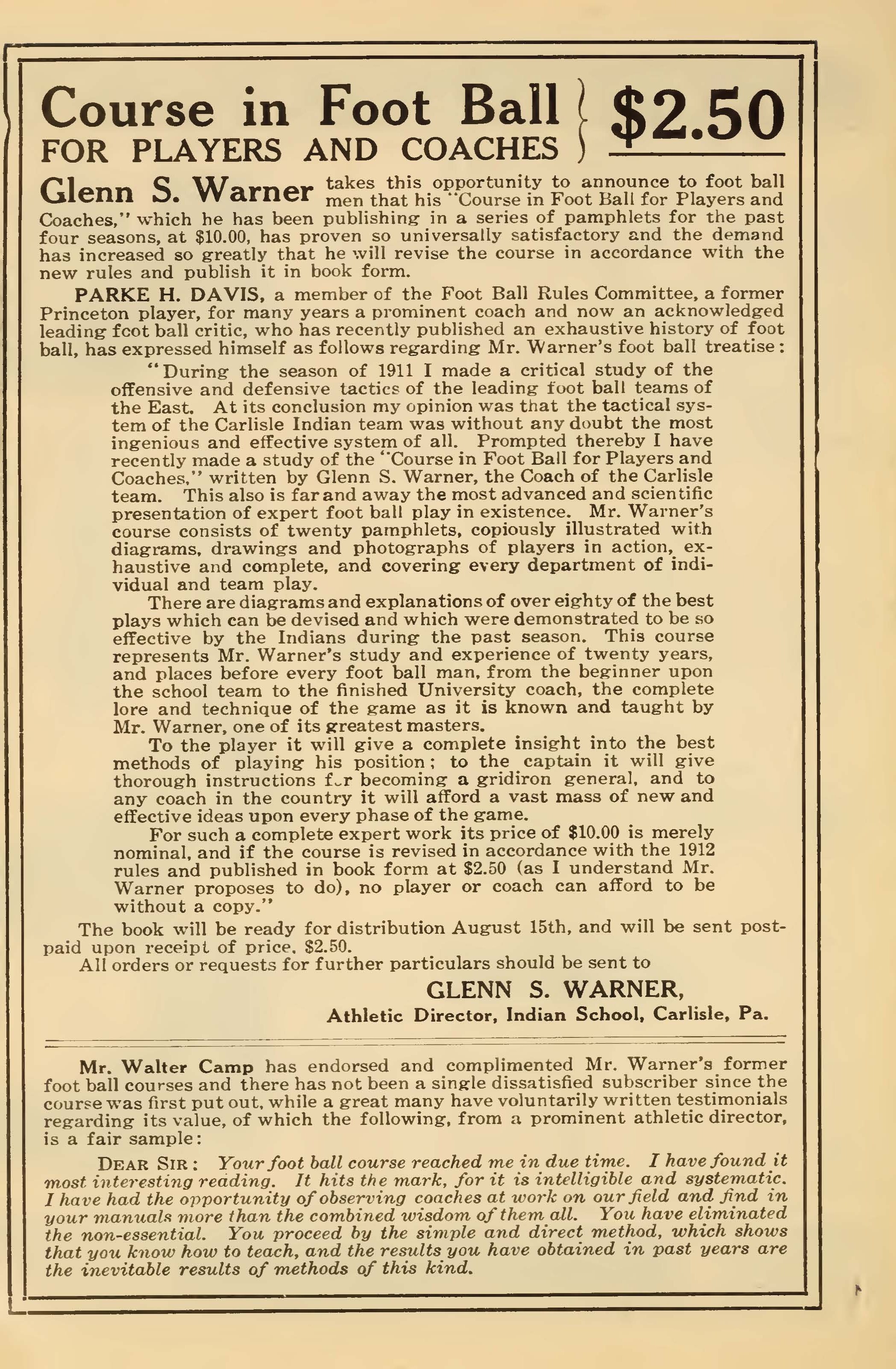
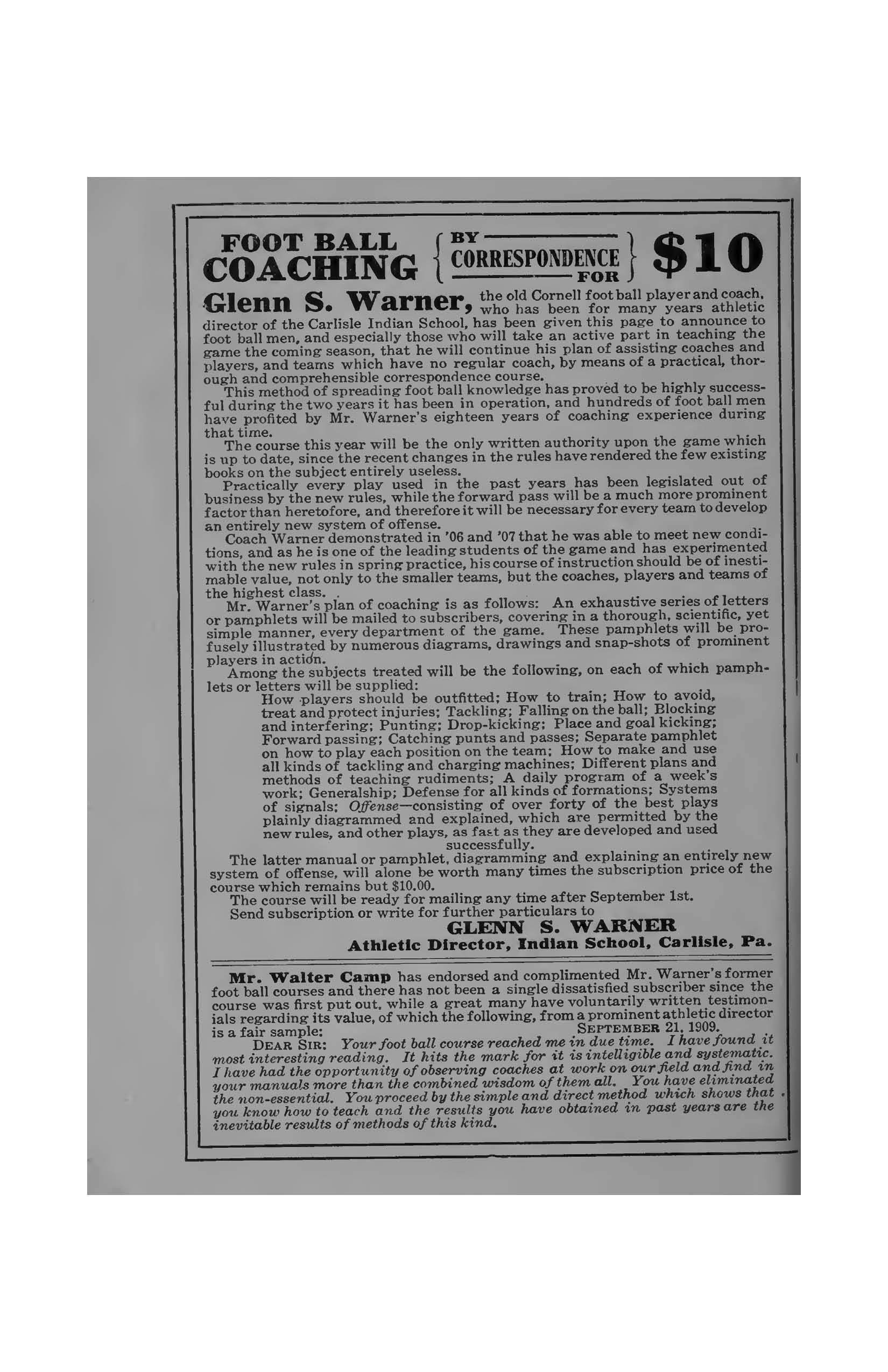
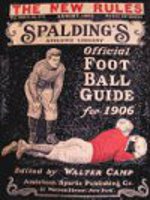
Before getting to Warner’s new approach, we should talk about endorsements.  Celebrity endorsements are not a recent invention.  A prime example of this phenomenon can be seen on the ad found in the 1910 Spalding’s Guide.  At the bottom of the page, under the double lines, in boldface type is the name of the greatest football expert of the day, Walter Camp.  The ad copy states, “Mr. Walter Camp has endorsed and complimented Mr. Warner’s former foot ball courses and there has not been a single dissatisfied subscriber since the course was first put out…”  It says that Camp endorsed Warner’s course without including any specifics of what Camp said about it. Generally, a quote from the endorser is placed prominently in the ad. Perhaps Camp merely approved the use of his name without actually stating anything about the course. Following the Walter Camp endorsement of sorts was one from an anonymous “prominent athletic director.”

Your foot ball course reached me in due time. I have found it most interesting reading. It hits the mark for it is intelligible and systematic. I have had the opportunity of observing coaches at work on our field and find in your manuals more than the combined wisdom of them all. You have eliminated the non-essential. You proceed by the simple and direct method which shows that you know how to teach and the results you have obtained in past years are the inevitable results of methods of this kind.

Who was this mystery athletic director? A couple of possibilities come quickly to mind: 1) he wasn’t a major figure in the game of football or was controversial, or 2) he was a major figure but didn’t want his name to be associated publicly with the correspondence course. My money would go with first one because someone who didn’t want his name to be published probably wouldn’t have written Warner in the first place.

Next time—Warner’s new approach

Problems with Warner’s Correspondence Course

March 20, 2012

In 1910, Warner had three sets of customers all expected to pay the same $10 for that year’s course but, depending on the set they were in, received something different.  Old customers who first bought the course in 1908 or 1909 received the annual supplements where new customers received all the pamphlets from the original course plus the 1910 supplements.  This surely created a logistics headache for him.  To simplify things, he might have packaged a set of course pamphlets with the first supplement he released for the year, thus giving old customers a second or third copy of the course.  Arguing against him doing that is the likelihood of subscribers giving their duplicates to friends.  Warner would surely have foreseen that possibility.  Evidence to support that he didn’t send duplicate copies of the pamphlets to old customers is that none of the (few) archives that have copies of the course mention having multiple copies although some have annual supplements.

A hint that Warner received static from his old customers over the pricing is that Warner addressed that issue in the ad copy when he wrote, “The latter manual or pamphlet, diagramming and explaining an entirely new system of offense, will alone be worth many times the subscription price of the course which remains but $10.00.”

Not having a copy of the 1911 Spalding Guide yet, I don’t know what the ad copy for that year stated, but do expect that logistics problems and complaints over pricing from old customers compounded over time.  These issues may have become great enough by 1912 to cause Warner to take his training course in a different direction while making it affordable for a broader audience. The next installment in this conversation will discuss Warner’s new approach.  In the meantime, if you know of anyone who has copies of Warner’s correspondence course, particularly the Offense pamphlets, please let me know.

Ads for Warner’s Correspondence Course

March 16, 2012

The copy of the 1909 Spalding’s Guide that I have doesn’t include an ad for Warner’s correspondence course. It could just be missing a page as the advertising pages at the backs of those books are often in bad shape or, not infrequently, missing. If you have a copy of the 1909 Spalding’s Guide that includes an ad, please let me know. Moving on to 1910, we find a very different ad. This time, it is titled “FOOT BALL COACHING {BY CORRESPONDENCE FOR} $10.” The text-intensive ad copy begins with Warner’s name in bold print the size of the title, followed by two paragraphs that extol the virtues of his correspondence course and that is has been in use for two years. That implies that, even if he didn’t advertise it in the 1909 Spalding’s Guide, he continued to offer it. Looking at the copy of A Course in Football for Players and Coaches: Offense on my bookshelf, I see a 1909 supplement for the offense pamphlet. It appears that Warner continued to sell the basic course from 1908 but supplemented it with updates. Since he refers to the cost of the course as a subscription, he implies that those who bought the course in 1908 would pay an additional $10 fee each year for supplements.

The first paragraph includes a curious phrase, “…has been given this page….” Whether he wrote euphemistically or not is unknown. Ads for products, other than books written by Walter Camp, do not regularly appear in the pages of the Spalding’s Guides as the advertising space was reserved for the company’s own products. It is understandable that Walter Camp would be provided space because of his close relationship with Spalding. Whether Warner given the space as a reward for using or extolling the virtues of Spalding’s products is not known. That Walter Camp endorsed Warner’s course is clear.

<to be continued>

If you have, or know of someone who has, a copy of either the 1911 Spalding’s Guide or the 1911 Offense Supplement for Pop Warner’s correspondence course, please let me know.

Pop Warner’s Correspondence Course

March 14, 2012

While preparing the Spalding’s Guides for reprinting, I noticed ads for Pop Warner’s book in the backs of several of them. On closer inspection, I noticed that they changed a bit from year to year. Today, I will discuss these ads in sequence from when they first appeared to when they disappeared and conjecture why the ads no longer ran.
The first ad that I found appeared in the 1908 Spalding’s Guide. It is probably not a coincidence that 1908 was the year in which Warner released his then untitled correspondence course on football. The ad was boldly titled “EXPERT FOOT BALL COACHING FOR $10.” The text-intensive advertisement made the case for the need for such a book by stating that the new rules in place since 1906 “…have so radically changed the game that all writings or books on the subject are practically of no use.” Warner’s credentials as an experienced, innovative coach: “The originator of this plan is Glenn S. Warner, who has acted as Head Coach of prominent foot ball teams for the past thirteen years, and whose coaching and training enabled the Carlisle Indians to make such a remarkable record last year, and to be given credit for playing the most scientific and up-to-date game of any team since the adoption of the new rules. Mr. Warner has for many years been most successful in teaching the open game and there is no one in the field today who is better qualified to carry out this plan than he.”
The ad goes on to describe how Warner’s correspondence was organized as a set of pamphlets or letters on a number of subjects. The first group of subjects were aimed at teaching players how to best play the game and were sold or $5 as Group One. The pamphlets covering equipment, strategies, signals, formations and plays among other things comprise Group Two. Coaches, captains and teams would buy the entire course, including both groups, for $10. Warner promised to start sending the pamphlets around September 15, the traditional start of practice at that time.

4th Anniversary

March 9, 2012

Four years ago this week, on March 7, 2008—can it be that long ago already?– I posted my first message to this blog. Three hundred and sixty-six messages and numerous photos later, I wonder if you, the readers, find your time spent here worthwhile. I get little feedback from readers, either positive or negative, about the value of the information presented herein. What I generally get are questions about Carlisle Indian School students, often from family members. On several occasions, family members, most often grandchildren or great grandchildren, have provided me very useful information about their relative. Such information fills in holes about the person that I would never otherwise be able to find. In some cases—Mike Balenti comes quickly to mind–it would have been very difficult to write a chapter about the person without the information the relative sent to me as a result of this blog.

A few times, this blog has served as a means for family members to make contact with relatives they didn’t know existed or with whom relations had been severed by a previous generation. It is very rewarding to know that this blog played a role in these people establishing or reestablishing relationships.

A few months ago, readership jumped significantly and continues at that higher level. It could be that, due to the ever-growing number of topics covered herein, this blog shows up more often on searches and unsuspecting people are brought here unwittingly. Or, it could be that the collective amount of useful information is growing and providing more people something of value. I don’t know. A little feedback would be helpful in determining if I am doing anything of value. Now, I must go to physical therapy to work on the residue of health issues that interrupted this blog last summer and early fall.

ATF Came Calling Today

March 6, 2012

Today, I received an email completely out of the blue from the United States Department of Justice Bureau of Alcohol, Tobacco, Firearms and Explosives (ATF). The message was from an ATF historian wanting to know if I had any photographs of one-time agent William Gardner. What made the request all-the-more surprising was that, when I was researching Gardner’s life, the Department of Justice disavowed having any knowledge of him, even after I appealed their initial decision. Obviously, Justice does know something about the Untouchable who busted up breweries alongside Eliot Ness many decades ago.

While talking with the ATF historian, I learned that the Bureau had undergone several reorganizations over the years and the Untouchables’ files had been thought to be lost somewhere along the way. Recently, eight of the files were found, including Bill Gardner’s. Perhaps the person writing a definitive biography of Eliot Ness uncovered them while doing his research. Now, I must wait for copies to arrive to see what remains in his file and to learn some things I didn’t know about his time with the Justice Department.

Apparently, Eliot Ness, who was a physically small man who played in a very rough game with the likes of Al Capone, recruited Gardner, a large powerful man, for his muscle. Ness may have wanted Gardner for protection both when out on operations and to be with him should the thugs attempt reprisals against him. Ness has written that he initially intended to use Gardner in undercover work but, immediately after seeing him, changed his mind. A six-foot-tall Sioux with a muscular build would not blend in well in Chicago; he would definitely not blend into the background. Gardner’s experience on the football field probably served him as well as his Dickinson law degree when he was raiding those bootleggers. It will be interesting to see what is lurking in his file.

College Players in Carlisle-Haskell Game

March 1, 2012

Due to misreading a few lines in an article, I thought they have played another game that wasn’t included in Steckbeck’s Fabulous Redmen, but a closer reading cleared up the confusion. Before rereading it, I came across an article in a Wisconsin newspaper about the 1904 Carlisle-Haskell game that included a couple of statements that caught my eye:

The program stated that every one of the players was a full-blooded Indian, but we doubted it in the case of one man with curley [sic] hair, and in the case of another who formerly played with the U. W. [University of Wisconsin–Madison] team and at least made no claim of Indian ancestry at that time. Most of them really were Indians, though they didn’t look the part except when they wrapped themselves in red blankets waiting to begin.

It is well known that a number of the Haskell players later enrolled at Carlisle, but not so well known that some players played on major college football teams before or after playing for Carlisle or, in a few cases, both.

I haven’t figured out which University of Wisconsin player the newspaper reporter had in mind yet. The only player on the 1903 Wisconsin squad that I know for sure played for either Carlisle or Haskell was William Baine. But he didn’t play in the World’s Fair game. However, two former University of Minnesota players played for their old alma mater, Carlisle. Perhaps, the writer confused players for his neighboring state’s team with those of his home state. Ed Rogers and John B. Warren both played for Minnesota in 1903. Rogers played for Carlisle from 1897 to 1901 before enrolling at the University of Minnesota law school. John B. Warren eventually came to play for Minnesota but by a more circuitous route. The April 22, 1904 edition of The Red Man & Helper included an article about him that included his football history. He played for Carlisle in 1898 and 1899. After graduating in 1900, he enrolled at the Indiana Pa. Normal School where he continued to play football in 1900 and 1901. He enrolled at Minnesota in 1902 and lettered at right tackle. In 1903, Warren shifted to right guard and Rogers was elected captain of the Minnesota squad.

1904 found both Ed Rogers and John Warren working as football coaches. Rogers coached at Carlisle and Warren was hired as coach and athletic director of Chilocco Indian School. Because Chilocco played a major role in the operation of the model government Indian school exhibit at the World’s Fair, Warren and his athletes spent the summer at the Fair, most likely playing baseball. He could have easily made contact with Haskell officials that summer and fall. On the Saturday after Thanksgiving, Rogers suited up as a player for Carlisle and Warren donned the moleskins for Haskell.

1904 All Southwest

February 28, 2012

Delaney went on to declare Haskell a better team than his St. Louis U. team: The title of Champions of the Southwest must unquestionably be conceded to the Haskell Indians. Their record is as follows: they defeated Texas, 4 to 0; Kansas, 23 to 6; Missouri, 39 to 0; Washington [of St. Louis], 47 to 0; Nebraska, 14 to 6. They were beaten at the Stadium by the Carlisle Indian team, score 38 to 4.

Next thing of interest to us in Delaney’s column was the selection of his picks for All Southwestern Eleven first and second teams. Haskell players stood out there as they had as a team. He placed DuBois at right tackle, Fallis at quarter, and Pete Hauser at right halfback on his First team. Two more Fighting Indians made his Second Team: John Warren at left guard and Chauncey Archiquette at right halfback. Please note that sports writers of that day took liberties when assigning players to backfield positions on their All Star teams. It wasn’t unusual, for example, to see someone who played halfback put in the fullback position if he thought that halfback was better than any of the fullbacks that year.

Delaney not only selected players but provided some rationale for picking them: Right Tackle should go to DuBois of Haskell Indians for ability and experience. Left Guard—Warren of Haskell seems to be the most likely man for substitute and plays an unusually good game. Center—The best fight seems to be here, for there are three men about equal in Michelson of Kansas, Prugh of Rolla and Felix of Haskell. [He said nothing more about Felix and didn’t put him on either first or second team.] Quarter-backs—this year who have gained considerable notice are Fallis of Haskell Indians and Pooler of Kansas University, they both being very good in a broken field. Fallis seems to have the edge on Pooler in speed and is an expert dodger, good on running back punts and is a sure tackler. His ability to size up a play, his grand leadership and control of his men, combined with his coolness in action, makes him the man to lead the team. Right Half-back—unquestionable belongs to P. Hauser of Haskell with Archiquette of Haskell, his team-mate, substitute, they being so nearly matched that only after some time was P. Hauser selected. Both played hard, brilliant football, and it was their work that won for Haskell Indians the Southwestern championship. Archiquette is better running back punts and on a broken field, while Hauser is very fast running with the ball, a good line bucker and end runner, and plays a harder and more consistent game than his team-mate….

The back-field consists of careful, fast and heavy players, not easily drawn from their positions and unusually good in bracing up a line. All are good punters, excellent dodgers and sure handling punts. Everything considered, this is easily the best team ever representing the All Southwest.

 <Next Time—Another missing Carlisle game?>

1904 Olympic Football Champions

February 23, 2012

It is well known that Carlisle Indian School shellacked Haskell Institute at the 1904 St. Louis World’s Fair on the Saturday after Thanksgiving. What isn’t widely known is that the St. Louis University team was deemed the Olympic Champions that year by virtue of playing, and winning, all their home games at the fair site which doubled as the location of the 1904 Olympics. The 1905 Spalding’s Guide includes a photo of the team titled “St. Louis University, Olympic World’s Champions.” While the pre-Billiken St. Louis U. footballers went undefeated, untied, and unscored upon through their eleven-game schedule, they were probably not even the second or third best team to play in front of an Olympic audience that year. The only major schools played were Kentucky, Arkansas and Missouri.

The Haskell Institute Fighting Indians were also undefeated in regular season play that year but gave up six points each to Nebraska and Kansas. They had also beaten Texas and Missouri. At that time, comparative scores were considered but Haskell and St. Louis had only one common opponent: Missouri. St. Louis shut them out 17-0 where Haskell humiliated them 38-0. Additionally, Haskell played a much tougher schedule, mostly on the road. Martin A. Delaney, Coach of St. Louis University’s football team, wrote about the World’s Fair/Olympics impact on football in the region:

During the season of 1904 football in the Southwest received a stimulus which did more to develop the game in this section than ten years of independent effort on the part of the various teams could possibly have done. This stimulus was given by the Physical Culture Department of the Louisiana Purchase Exposition. The department took charge of the schedules of St. Louis’ principal teams—those of Washington and St. Louis Universities—furnished them grounds, and brought the best teams in the section to meet them. As a consequence, these teams and the teams who played them had a season of unexampled success and development.


<More Next Time>


A Small Brag

February 21, 2012

Today’s blog message is in the form of a small brag. Please bear with me. Publishing via Print On Demand was the topic of this month’s meeting of the Washington Biography Group meeting. Unfortunately, I was unable to be present due to being out of town but, due to my experience with the topic, was asked to provide some notes about what I would have contributed to the discussion. So well received were my notes that Pat McNees, recording secretary for the WBG, posted them on her blog, Writers and Editors. If you have any interest in knowing something about printing books via Print On Demand, you might want to read these notes: http://www.writersandeditors.com/blog.htm?post=839828.