I occasionally get asked about the value of Lone Star Dietz paintings. I have no idea what they would bring in the art market and I don’t know of any that sold at auction. Even that wouldn’t provide a precise value but it would give us an idea how his works go relative to other artists works. The subject matter could bring the price up for a subject many people would be interested in having and would lower the price for something less desirable.
My suggestion to someone wanting to sell a painting is to put it up for auction on ebay or another similar site with the starting price being the lowest amount the person would take for the painting. It might go higher, sell for the minimum price, or get no bids at all. In any situation, the seller would either get an acceptable amount or would still have the painting.
Two people are interested in selling Dietz paintings at present. The one immediately below wants to know what it’s worth. The second one is up for sale now on ebay.
Identifying the starters and frequent substitutes went like a breeze. The reserves didn’t go nearly as well. They are always harder to determine because they get so much less press than the varsity regulars. Their names were misspelled worse than the regulars and their names appeared in the school newspaper less frequently.
The first game the Reserves played was against Mercersburg Academy. The September 27 edition of The Philadelphia Inquirer listed some unfamiliar players’ names or names similar to those of students who had already left. Achambault, Matlock, Crow, Wynaco, Knox, Kettle, and Leo required some research. Quarterback Knox was the most interesting. He seems to be Augustine Knocks-Off-Two. Crow turned out to be Boyd Crowe.
Dickinson College’s prep school, Conway Hall, was next. The October 5 Philadelphia Inquirer had Robbin playing quarterback. The closest name I could find to that was Robinson, of which several attended Carlisle. George Robinson appeared to be the most likely one, although he was only seventeen.
The Lebanon Daily News of October 13 listed Quick Bear at left end, Crow at quarterback, and Knox at right halfback against Albright College. Ernest Quick Bear had played for the Indians but was gone by then but younger brother Levi was there. Their father Reuben Quick Bear was among the first bunch of Sioux students to come from the Rosebud Reservation in 1879.
Robbin again substituted for Crow against Bloomsburg as reported in the October 26 edition of The Philadelphia Inquirer.
No new names were introduced in the coverage of the Hillman Academy game.
The Philadelphia Inquirer introduced several new names in its coverage of the November 13 game with Muhlenberg. Eastman, and Gibson were resolved fairly quickly. Oneida and Pigtop weren’t. The Allentown Democrat added some confusion by spelling the latter two as O’Neida and F. Bigtop. It also sent in Indian for White instead of Eastman. Indian Jack was the closest I got and he left in the late 1880s. No student was named Oneida, by either spelling, but numerous Oneidas had played on the football team.
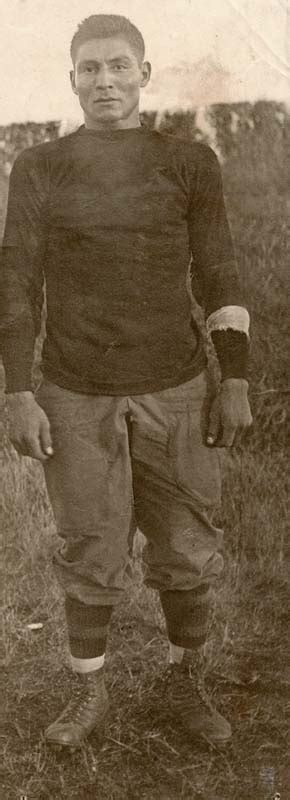
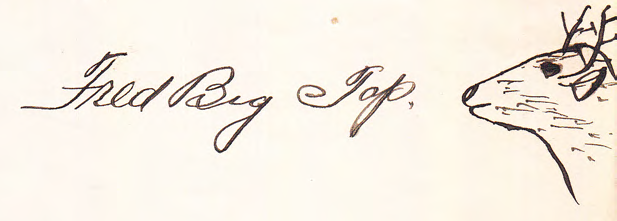
Finally, The Philadelphia Inquirer added Moy and Deerfoot and continued Bigtop for the Holmesburg contest. Moy couldn’t be George May because he hadn’t arrived at the school yet. Perhaps it was Thomas Montoya. Pigtop was Fred Big Top. His signature gives a hint as to his name’s meaning.
New Information!!!
While browsing the October 23, 1914 edition of The Carlisle Arrow, I came across the following:
Grant White, better known as “Indian,” is the first Carlisle Indian ever to cross the goal line at Albright College, but despite that fact, the second team was defeated.
Note that the varsity generally played Albright College in Carlisle. Now we know that Grant White was the player listed in the 1913 and 1914 line-ups and that he was the person The Philadelphia Inquirer had referred to as “Indian.”
After going through the games played by the first string—some time around 1900—Carlisle started scheduling a few games each year for its second and third strings. Pundits often referred to these teams as the reserves or scrubs. All four terms can be found in coverage of these games. Their opponents were generally small colleges or prep schools. While researching these games, I’ve come across a number of Carlisle Indian School football players’ names I cannot resolve. I haven’t been able to identify the names below in school records or publications although they were listed in newspaper accounts of games.
1906 Wholes – Might this player be Clarence Woodbury, aka Hole-in-the-Day?
1908 McGill – I have no idea who this might be
1908 Barlow – Students named Carlow & Garlow were enrolled at Carlisle but no Barlow
1908 O’Bline – The closest I found was O’Brien but none were of the proper age when at Carlisle
1908 McClure – Frank McClure was long gone by this time
While researching records and newspapers, I’ve come across a number of Carlisle Indian School football players’ names I cannot resolve and I still have the 1913-1917 seasons to go. I haven’t been able to identify the names below in school records or publications although they were listed in newspaper accounts of games. Most of them were in write-ups of games involving the reserves as varsity starters and frequent substitutes posed few problems. Sometimes the digital imaging site at Dickinson College helps. For example when I submitted “Wanneshie Carlisle Indian” to the Internet search engine, it returned a link to the Student File for William Winneshiek on the Dickinson College site. I found no other person with a name near as close as this on my own, so I’m guessing he was the guy. Any help in determining who the players were would be most appreciated. I wouldn’t be surprised to find out some were nicknames.
After finishing what I hoped was the final draft of my complete history of the Carlisle Indian football team and waiting for my editor’s comments, I started working on the appendices. Perhaps most important is the listing of the young men who played on the varsity each year. Aware of the difficulties Steckbeck had in compiling rosters given the incomplete records that existed both then and now, I rolled up my sleeves and dug into the task. It’s been tedious to the extreme and I’m sure I’m missing people but records are sketchy, especially for the early years. When I found a complete listing of the 1905 squad in the school newspaper and a photo of the entire team with a legend identifying all the players, I thought I had it made. The school newspaper article even included the first names of the players, something rarely done on the sports pages. While crosschecking against game write-ups in newspapers from across the country, I came across a curious little item.
A piece about injuries in The Pittsburgh Press included a couple of seemingly innocuous sentences: “Hunt is taking the place of the injured Kennedy at center. Big Long Horn is a new sub-center and passes the ball well.” I had no idea who Long Horn was, big or otherwise, having not heard of him before and not seeing his name on any roster. Searches of the school records for Longhorn or Long Horn returned only a reference to an assistant carpenter at the Kiowa Reservation in 2010. Line-ups in newspaper coverage of games throughout the season included Longhorn either starting or backing-up a line position, mostly center, starting with the The Philadelphia Inquirer’s coverage of the Indians’ first game against P. P. P. Y. M. C. A. of Columbia, PA and immediately followed by The New York Times’ coverage of the Villanova game. The next week, The Philadelphia Inquirer did a most unusual thing: it published a complete roster of Carlisle players at that time, all 54 of them by name, age, tribe, and home state. Long Horn was listed as a 24-year-old Seneca from New York. The October 21 Boston Evening Transcript also mentioned him: “Long Horn, right guard on the second eleven, has lately developed as a good centre, and the coaches believe that he will make a sure hand at passing the ball.” A week later, he was getting playing time at center against Penn.
The Pittsburgh Press shed some light on the issue before the Harvard game: “Scott, whose Indian Name is Long Horn, is badly bruised as a result of the Dickinson game….” Thus, the mystery is solved. Long Horn was Frank Scott’s Indian Name. A quick look at The Philadelphia Inquirer’s coverage of the Villanova game had Scott at left guard and didn’t mention Long Horn. Pittsburgh Daily Post had Scott playing center against Dickinson College and also made no mention of Long Horn. That both names don’t appear together in any line-up is further evidence Scott and Long Horn are the same person. But other such mysteries may still exist.
You have likely read about numerous Carlisle Indian School students who ran away but you probably haven’t read about any who ran away to Carlisle. I hadn’t. While checking out a student who was trying out for the football team in 1900, I encountered something I’d never heard of before. The son of a Chippewa mother and a German immigrant father was living on the White Earth Reservation in Minnesota when, in 1891 when the boy was eight-years old, his parents sent him to the Educational Home in Philadelphia.
Originally set up to serve orphans from the Civil War, with few of them left, it shifted its mission to serve American Indian children. After staying there four years, the boy returned to his parents’ home in Minnesota.
Finding his home life abusive and seeing few opportunities on the reservation, he wanted something more out of life. Two months after returning, he saw an opportunity. Alice Parker, a rising senior at Carlisle Indian School, was recruiting students to return to Carlisle with her. The details of how the boy ran away from home to go with her are lost to posterity.What is known is that Miss Parker arrived at Carlisle on Saturday, September 5, 1896, bringing a group of 15 Chippewa students with her, one of which was a 13-year-old boy who was 5’3 ½” tall and weighed 101 pounds. As his student file no longer includes his application for admission, exactly how he got himself admitted without his parents’ permission is unknown.
He flourished at Carlisle. An avid reader, in June 1900 he led all students in the number of books he had checked out of the library to read. He enjoyed playing sports but was too small to make any of the varsity teams. Eventually, he started pitching batting practice to the baseball team in the gym over the winter. As he improved, Pop Warner put him on the baseball team. He also practiced with the football team and was allowed to eat at the training table. The heavier diet put weight on him and helped him to grow. Soon, he was the star pitcher and captain of the school’s baseball team. After graduating from Carlisle, he attended the Dickinson College prep school and pitched for the college squad, racking up victory after victory. In the spring of 1901, Connie Mack, legendary manager of the Philadelphia Athletics, came to Gettysburg to scout Gettysburg College’s star pitcher, lefty Eddie Plank, hurl against Dickinson College. Plank won the 15-inning game and Mack signed him to pitch for the Athletics. He also signed the Carlisle Indian who was pitching for Dickinson College but to a minor league contract for some seasoning.
Any guess who this right hander who ran away to Carlisle was? Hint. He and Plank are both enshrined at Cooperstown.
I generally don’t bother to refute misinformation promulgated about Carlisle Indian School but, with reports on what happened at First Nations schools in Canada operated by the Catholic Church often being conflated with American schools, I now find it necessary to comment on a Facebook post (included below) that was forwarded to me for comment. Mr. Edwards appears to have visited Carlisle Barracks but is unfamiliar with its history. Some errors are so off they require no research on my part.
His sentence that includes the phrase “til ’51 or 2” is worded awkwardly but appears to mean that Mr. Edwards’ relatives played on the grounds at Carlisle Barracks in the early 1950s. If they had done that, they likely had some affiliation with the Army because Carlisle Indian School closed permanently in 1918.
Edwards’ comment about seeing fingerprints in the mortar on the Indian Field grandstand are incorrect unless the Army brought Indian masons back to Carlisle to build the new, concrete grandstand years later. Students learning the building trades likely built the original wooden grandstand around 1906, but they were long gone by the time the masonry grandstand was erected. However, they did build a masonry building: the Native Arts building which still stands. The school newspaper lauded the students for the quality of their work on the building in which the famous Winnebago artist, Angel DeCora, taught. It is diagonally across the street from the house in which Pop Warner lived. That house was also built by students. The funding for both these structures came from the Athletic Department.
A quick look at newspapers from August 1927, when the graves were moved, gives the total at 187. Perhaps Mr. Edwards was confused by hearing that over 1,000 students were enrolled in the school at its peak and mistook that for being the number of graves. Superintendent Pratt has been criticized for sending sick children home to die. He likely did that to keep diseases from spreading to other students and there was little he could do for many of them. The state-of-the-art of medicine had not advanced very far at the time the school was in operation. Lifespans were short. People, white and Indian alike, died at early ages. Tuberculous was rampant and took many lives. Pratt sent bodies of dead children home to those parents who wanted their remains whenever he could because a large graveyard filled with dead students wouldn’t have been good advertising for his school.
The graves were not moved to make room for a road. Officer housing was built on that site.
I had heard that the moving of the graves had been done in a haphazard manner but the newspaper articles suggest otherwise. Sixteen men were assigned to do the job. While errors were likely made, it appears that remains were paired with the headstones as both were relocated from the old cemetery to the new one. Some records were surely lost when the Indian School was closed with little advance notice. So, it would not be surprising to learn that some graves were mismarked. Something that argues for the overall data to be accurate is that the headstones were created shortly after the students died and would have been mostly correct, although some details could have been wrong. This was a government project after all so some screw ups were inevitable.
From where I’m standing a few yards to my right, a few yards to my left and back to that building almost where the stop sign is behind them vehicles is the old graveyard at Carlisle. There’s children under there…. but you won’t hear about that you’ll only hear about the graveyard out front. If I remember correctly, without looking it up, there was about 1,200 students back there and during the early 30s they ripped the graves out deep enough to make the road and piled them at random out front in 190 holes 192 I think or whatever……strange things happen here that’ll make yer neck hairs stand up…… this isn’t far from the “good ice” …their winter ice rink. In back and to my left is the field where Jim Thorpe, my family George Thomas todadaho, my great uncle, til ’51 or 2 I believe and his sister Edith Thomas, my GG, used to play. You can see the students fingerprints in the mortar between the Rocks when they built the grandstand there’s even fingerprints where they ended each pass in the morter.
If you don’t start learning about boarding schools here at Carlisle it’s like starting a book in the middle of it. You don’t know anything until you start here.
While reviewing the chapter on the 1908 season from my upcoming book on the complete history of the Carlisle Indian School football team, my wife thought Warner having the football team practice in the basketball cage seemed strange. What was a basketball cage anyway? I had often wondered that myself. As a boy, I would check the local newspaper’s, the Alton Evening Telegraph, “Cage Schedule” to find when the high school basketball games were being played. Much later I learned that basketball games were once played in cages. Of course that meant little to me.
To better answer Ann’s question, a little research quickly found that basketball was once played in 12-feet-tall wire mesh cages that surrounded the courts. Players complained of having tic tac toe grids imprinted on their bodies from being slammed into the cages. Later, rope mesh replaced the metal, probably because they cost less. But why did they need to cage the players away from spectators?
We have to go back to basketball’s roots. It was invented in 1891 by James Naismith to fill the gap between the end of football season and the beginning of baseball season. In Springfield, Massachusetts where the game was created, only indoor sports were practical that time of the year. Naismith borrowed some rules from other sports, including football’s then out-of-bounds rules. In football, the ball is fumbled out of bounds relatively infrequently but errant and tipped passed are common in the roundball game.
The first few rows of basketball spectators sat just outside the out-of-bounds lines, which meant that players routinely tussled with opponents and fans, who were partisans of one team or the other, for the ball. This quickly became unacceptable to basketball officials, who solved the problem by erecting cages. Why differing from football on out-of-bounds rules wasn’t considered is anybody’s guess.
While reviewing the chapter on the 1906 season from my upcoming book on the complete history of the Carlisle Indian School football team, my wife noticed something she thought was odd from the newspaper coverage of that year’s Penn State game: “Mt. Pleasant received the ball and ran it back to the 35-yard line where he was tackled by Maxwell. The ball flew from his grasp and McCleary secured it out of bounds.”
Teams gaining possession of an out-of-bounds ball seems odd to a modern reader, so I contacted Timothy Brown, author of How Football Became Football: 150 Years of the Game’s Evolutionfor some insight into out-of-bounds rules in early football. He responded with a paragraph from his book:
“Early football also differed substantially from today in the way it handled theball going out of bounds as well as in spotting the ball for runners tacklednear the sideline. Balls fumbled “in touch” or out of bounds remained live,leading offensive and defensive players to scramble over benches, water jugs,band members, cinder tracks, and all manner of obstacles to grab the ball. Anexample of such a play occurred when Chicago traveled to Stanford in 1894,the first game between teams east and west of the Rockies. When the ballwent “in touch” during a game in San Francisco, Chicago’s Ad Ewing, ahurdler on the track team, used his hurdling skills to leap a picket fencesurrounding the Haight Street Grounds and recover the ball while Stanford’smen scaled the fence the old-fashioned way. Such out-of-bounds scramblescontinued until a 1926 rule awarded possession to the player last touching theball before it went out of bounds.”
One can only imagine the melees that resulted on occasions when Stanford’s band stood close to the sidelines and an errant fumble flew or rolled into their midst.
I had never understood why Richard Henry Pratt was promoted to Brigadier General after he retired. It didn’t make sense to me, but I had never given it enough thought to consider researching it. Now, the answer comes to me when I’m not looking for it. While trying to hammer down the precise date of Pratt’s removal from his position as Carlisle superintendent, I came across a June 12, 1904 New York Times article that discussed the matter. In addition to telling the story of why and how Pratt got fired, it explained how his promotion came about.
A year before this article was written, Pratt wrote President Roosevelt requesting that, when he reached the retirement age of 65 two years later, he be retired as a Brigadier General. Apparently not amused by the request, the President issued an order retiring him at his then current rank of colonel, not Brigadier General.
In a stroke of luck, Congress bailed Pratt out. They passed a bill providing that all officers who served in the Civil War be promoted one grade above the one they were holding when they retired. This is how Pratt became a Brigadier General.