Archive for the ‘Pop Warner’ Category

Ads for Warner’s Correspondence Course

March 16, 2012

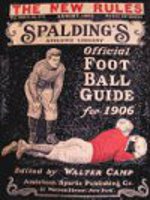
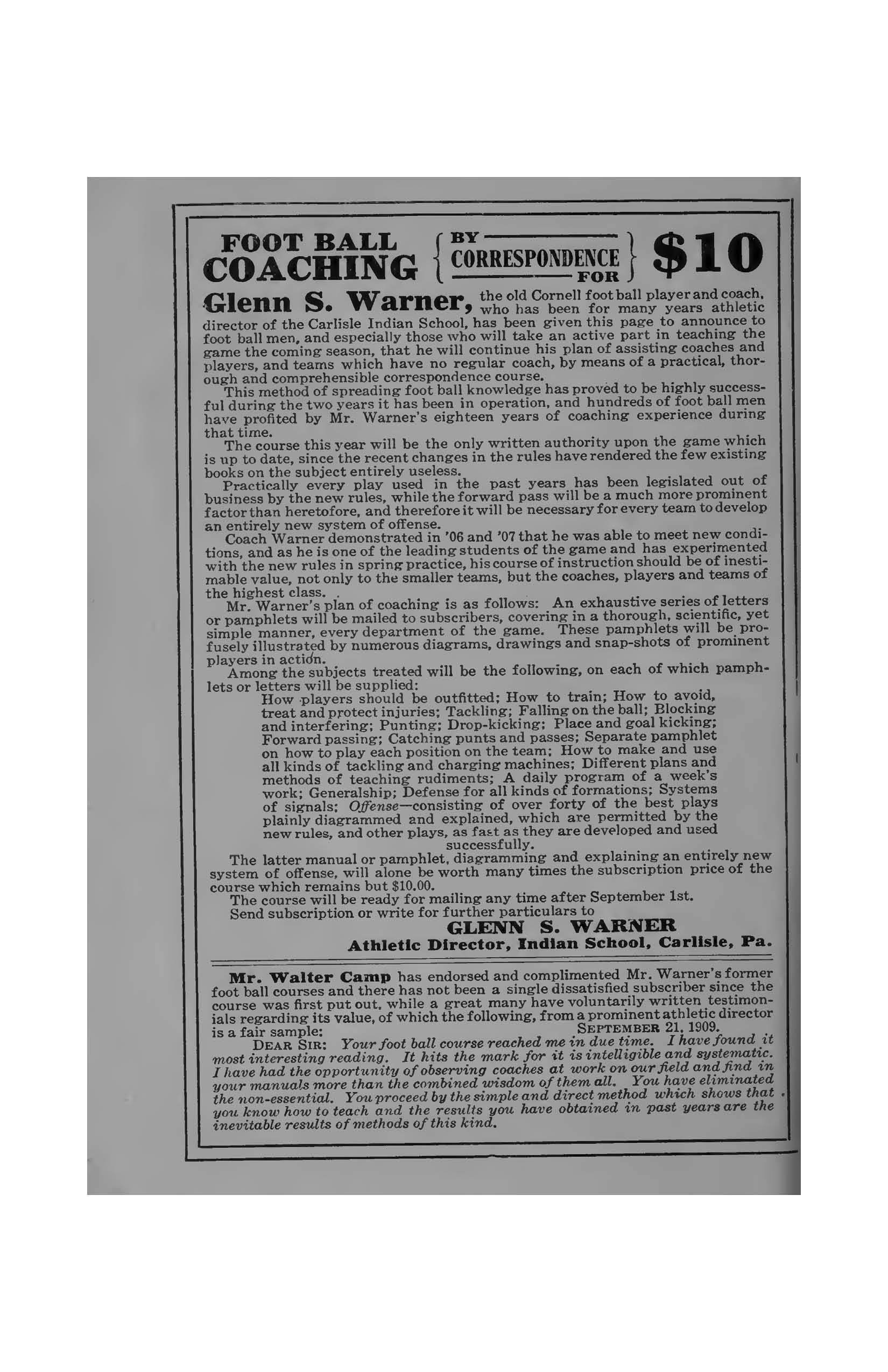
The copy of the 1909 Spalding’s Guide that I have doesn’t include an ad for Warner’s correspondence course. It could just be missing a page as the advertising pages at the backs of those books are often in bad shape or, not infrequently, missing. If you have a copy of the 1909 Spalding’s Guide that includes an ad, please let me know. Moving on to 1910, we find a very different ad. This time, it is titled “FOOT BALL COACHING {BY CORRESPONDENCE FOR} $10.” The text-intensive ad copy begins with Warner’s name in bold print the size of the title, followed by two paragraphs that extol the virtues of his correspondence course and that is has been in use for two years. That implies that, even if he didn’t advertise it in the 1909 Spalding’s Guide, he continued to offer it. Looking at the copy of A Course in Football for Players and Coaches: Offense on my bookshelf, I see a 1909 supplement for the offense pamphlet. It appears that Warner continued to sell the basic course from 1908 but supplemented it with updates. Since he refers to the cost of the course as a subscription, he implies that those who bought the course in 1908 would pay an additional $10 fee each year for supplements.

The first paragraph includes a curious phrase, “…has been given this page….” Whether he wrote euphemistically or not is unknown. Ads for products, other than books written by Walter Camp, do not regularly appear in the pages of the Spalding’s Guides as the advertising space was reserved for the company’s own products. It is understandable that Walter Camp would be provided space because of his close relationship with Spalding. Whether Warner given the space as a reward for using or extolling the virtues of Spalding’s products is not known. That Walter Camp endorsed Warner’s course is clear.

<to be continued>

If you have, or know of someone who has, a copy of either the 1911 Spalding’s Guide or the 1911 Offense Supplement for Pop Warner’s correspondence course, please let me know.
Pop Warner’s Correspondence Course

March 14, 2012

While preparing the Spalding’s Guides for reprinting, I noticed ads for Pop Warner’s book in the backs of several of them. On closer inspection, I noticed that they changed a bit from year to year. Today, I will discuss these ads in sequence from when they first appeared to when they disappeared and conjecture why the ads no longer ran.
The first ad that I found appeared in the 1908 Spalding’s Guide. It is probably not a coincidence that 1908 was the year in which Warner released his then untitled correspondence course on football. The ad was boldly titled “EXPERT FOOT BALL COACHING FOR $10.” The text-intensive advertisement made the case for the need for such a book by stating that the new rules in place since 1906 “…have so radically changed the game that all writings or books on the subject are practically of no use.” Warner’s credentials as an experienced, innovative coach: “The originator of this plan is Glenn S. Warner, who has acted as Head Coach of prominent foot ball teams for the past thirteen years, and whose coaching and training enabled the Carlisle Indians to make such a remarkable record last year, and to be given credit for playing the most scientific and up-to-date game of any team since the adoption of the new rules. Mr. Warner has for many years been most successful in teaching the open game and there is no one in the field today who is better qualified to carry out this plan than he.”
The ad goes on to describe how Warner’s correspondence was organized as a set of pamphlets or letters on a number of subjects. The first group of subjects were aimed at teaching players how to best play the game and were sold or $5 as Group One. The pamphlets covering equipment, strategies, signals, formations and plays among other things comprise Group Two. Coaches, captains and teams would buy the entire course, including both groups, for $10. Warner promised to start sending the pamphlets around September 15, the traditional start of practice at that time.

Even More 1903 Carlisle Stars

February 13, 2012

Ed Rogers and James Phillips weren’t the only Carlisle Indians to play for a future Big Ten team in 1903.  Player #4 (players on team photos in Spalding’s guides are conveniently numbered for the ease of the reader) on the University of Wisconsin team photo on page 20 is William Baine. He played for the Indians  from 1899 to 1900, then returned to Haskell Institute to play before enrolling at Wisconsin in 1903. Prior to coming to Carlisle, Baine had played for Haskell and its cross-town rival, the University of Kansas. While at Carlisle, William was enrolled in Dickinson College Preparatory School.

The photo of the 1903 Macalester College team on page 68 includes Lone Star Dietz as player #11. Dietz played for Friends University part of the 1904 season but a Friends team photo is not to be found in the 1905 Spalding’s Guide. Dietz enrolled at Carlisle in 1907. It isn’t clear what he did during the 1905 and 1906 seasons.

On page 123, Archie Rice, Sporting Editor of the San Francisco Chronicle, named Weller of Stanford as fullback of his 1903 All-Pacific eleven but mitigated that with his next sentence: “There is a possibility that Bemis [sic] Pierce of the Sherman Indians, but formerly of Carlisle, might be more valuable for the team than big Weller….” When Pierce left Carlisle for Sherman Institute in Riverside, California, the Carlisle school newspaper reported that he was to coach that Indian School team, but it appears that he also donned the moleskins to get into the action as a player.

That the 1903 season results and team photos for both Haskell Institute and Sherman Institute were omitted from the 1904 Spalding’s Guide is unfortunate. According the David DeLasses’ www.cfbdatawarehouse.com, Sherman Institute went 4-4 in 1903 with a win over Southern Cal and losses to Stanford and Carlisle. That site has Haskell Institute going 7-4 with wins over Texas, Kansas and Missouri and losses to Nebraska, Chicago and Kansas State. The 1905 Spalding’s Guide has a lot more about Haskell.

More 1903 Carlisle All Stars

February 9, 2012

Walter Camp didn’t name any other Carlisle players to All-America team teams that year but James Johnson wasn’t the only Carlisle player to receive an honor. Walter Camp also picked an All-Western Team for 1903 “from the University teams of the Middle West,” essentially the teams that would become the Big Ten plus Notre Dame. “What does this have to do with Carlisle Indian School?” you say. Plenty.

Camp’s All-Western Team included Ed Rogers, Captain of the 1903 University of Minnesota team, at end and James Phillips, Northwestern University guard. Perhaps Camp shed some light on his picks when he wrote, “Rogers is an Indian, experienced, quick, and certain” and “Phillips is another Indian, and as he would not play against Carlisle, Northwestern’s line was correspondingly weakened. That game also showed what a large part Phillips had been in Northwestern’s defense.” Rogers and Phillips had both starred at Carlisle before leaving to embark on careers as lawyers. While at Carlisle, Rogers had taken courses at Dickinson College and Dickinson School of Law while playing football for Carlisle. However, in 1898 as a Dickinson College student, Ed played for Dickinson in their game against Penn State. The college’s school newspaper claimed that he was a bona fide player because Carlisle’s season was already over and he was a legitimate student enrolled in the college. However, his Dickinson College football career was limited to that one game. Later, he starred at Minnesota and captained his teammates to a 6—6 tie with Fielding Yost’s undefeated Point-a-Minute team in the first Little Brown Jug battle.

James Johnson and Ed Rogers were eventually inducted into the College Football Hall of Fame. James Phillips ended his collegiate football career at the end of the 1903 season, married, and migrated west to Aberdeen, Washington where he had an illustrious career, but that is a story for another time.

The story of Carlisle Indians starring for colleges and universities in 1903 is far from complete…

Carlisle Players in WWI — 1918

January 27, 2012

War years, at least those for WWI and WWII, affected college football greatly, so much, in fact, that Spalding’s guides for those years had to adapt to the changed environment.  The 1919 guide, for example, includes a large section, titled Part II Spalding’s Official Foot Ball Guide: Army and Navy Foot Ball.  A July 24, 1919 letter from President Woodrow Wilson to Hugh Miller extolling the virtues of football in training troops for combat served as a frontispiece for this section of the book.  Ironically, or not, Miller wrote publicity pieces for Pop Warner when Warner coached the Carlisle Indians.  Apparently, Hugh Miller was more than just a hack writer who did Warner’s bidding.

This focus on military teams was necessary because the 1917 and 1918 football seasons were disrupted, to put it mildly, by the large number of college football players who were inducted into the service during WWI.  Many colleges stopped fielding teams where others played with lesser talent than usual.  Most college teams included military teams on their schedules.  It’s fair to assume that the military academies were not impacted nearly as much as their civilian counterparts.  Carlisle Indian School canceled its 1918 season because the school was closed to allow Carlisle Barracks to be used as an army hospital.  However, many of the former students continued to play football—even after they enlisted.

Perusing the pages of the Army-Navy section revealed the names of several Carlisle students with whom I was not familiar. Follows is a list of those names and the teams on which they played:

Name                                    Unit

Sgt. Mickel                          Air Service Department, Garden City, NJ

Buffalohead                       Fort Ontario, Oswego, NY

M. Le Claire                        Camp Travis, Fort Sam Houston, TX

Ojibway                               Wissahickon Barracks, Cape May, NJ

Webster                              3rd Army Troops, Europe

Kalama*                               35th Division, Europe

*Selected as center for All-American Expeditionary Forces Eleven

If you know anything about any of these men, please get in touch with me.


Cornell Wore Plain Jerseys in 1903

January 10, 2012

Among other things, today’s mail brought a copy of the 1904 Spalding guide and it provides some valuable information with regard to determining who first used football jerseys with stripes below the elbows.  A photograph of the Cornell team on page 30 captured most of the team members in their playing uniforms, not their letter sweaters.  The black and white photo has the players wearing dark-colored jerseys under what Spalding called sleeveless football jackets.  The v-necked jackets laced up the front and were cut back where sleeves would have been connected, had there been any, to provide freedom of movement for the players’ arms.  All of the sleeves, necks and a bit of the bodies of the jerseys were visible with the jackets on.  One assumes that the jerseys were solid carnelian, a brownish shade of red, because Cornell’s school colors are that color and white.  The school colors were chosen as a (possibly humorous) reference to the University’s founders, Ezra Cornell and Andrew Dickson White.  Those who are associated with the school are commonly referred to as “Cornellians” and the reddish-brown color is sometimes spelled cornelian.

From the photo of what was most likely the 1903 Cornell team because photos had to be submitted to Spalding well before the start of fall practice in order for the guide to be laid out, printed and distributed ahead of the beginning of 1904 football season.  The Carlisle team photo on page 22 of this book is definitely that of its 1903 team because Pop Warner is in it and James Johnson is holding the football.  Johnson was captain of the 1903 Carlisle team and played for Northwestern in 1904.  Warner returned to Cornell for the 1904, ’05 and ’06 seasons.  As reported previously, Cornell was wearing jerseys with stripes below the elbow in 1905 as shown in the 1906 Spalding guide.  I have to wait for the 1905 guide to arrive before seeing if they had shifted to the unusual stripe configuration for Warner’s first year back at his alma mater (unlikely unless Warner had nothing to do with it).

Were Carlisle’s Jerseys Unique?

January 6, 2012

As mentioned in this blog previously, I am in process of reprinting the Spalding Football Guides for the years that Carlisle Indian School fielded a team.  That process is progressing well but I have not yet found the 1901 and 1911 books as yet and don’t hold much hope of coming across books for the years from 1894 to 1898.  Be that as it may.  I am already discovering interesting things without having a full set.

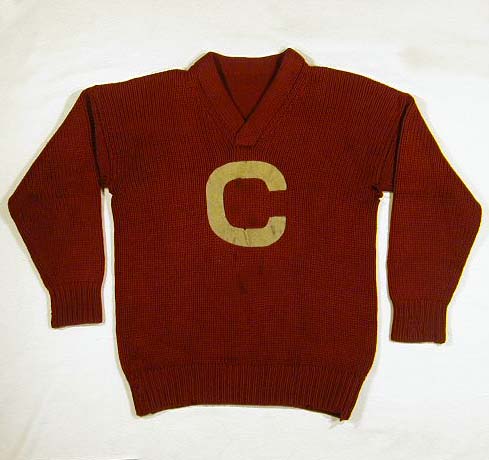
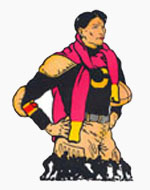
While flipping through the 1906 volume, I noticed that the Cornell team was wearing jerseys quite similar to those worn by the Carlisle Indians (a Carlisle jersey is depicted in the color drawing on the masthead of this blog).  I had seen photos of many other teams wearing jerseys with stripes but none with the stripes located just below the elbow on an otherwise solid-color shirt.  Of course, I haven’t done exhaustive research on this matter, so the possibility remains that this pattern was not unique, just not widely used.  All the period photos are in black and white, so nothing can be known for certain about the colors on these jerseys just from the photos.  Regarding the dates of photos in Spalding’s guides, most team photos seem to have been taken at the end of the previous season.  In Carlisle’s case, players were generally wearing their letter sweaters which were a solid red and were acquired from Spalding in various styles (see photo below).

So, the Cornell team of 1905 wore jerseys similar to those that Carlisle was noted for wearing.  But when did the Indians start wearing them and were they special ordered?  A circa 1902 photo of James Phillips shows the stripes clearly as does the team photo for that year.  More research is needed to determine exactly when Carlisle and Cornell started wearing those jerseys and who made them.  What is known is that in 1902 Carlisle, then coached by Pop Warner, wore them as did the 1905 Cornell team that was also coached by Pop Warner.  Were these stripes another Warner innovation?  Much more research is needed to answer these questions.


Another Incubator of the Forward Pass

December 15, 2011

Periodically, one reads articles regarding the early development of the forward pass in football. It is now well known that Notre Dame did not invent the forward pass in their 1913 defeat of Army. It is also well known that Eddie Cochams, coach of the St. Louis University squad was an early implementer of the new strategy. Now, in a 1921 book, The Forward Pass in Football, written by Elmer Berry, Head Coach of Football and Baseball, Associate Director of Physical Education Department, Professor of Physiology and Physiology of Exercise at International Young Men’s Christian Association College, Springfield, Massachusetts, I hear of another proponent of the airborne pheroid.

It is doubtless fair to say that the early development of the forward pass was largely due to two teams, Springfield College of the Y. M. C. A. and the Carlisle Indians. Their game in 1912 at Springfield is said by competent experts to have been probably the greatest exhibition of open football ever staged. It is doubtful if two such finished exponents of the open game have ever met before or since. To Coach J. H. McCurdy of the Springfield team goes the honor, in the writer’s judgment, of the early recognition and development of the strategy of the forward pass, for in this respect at least, Springfield excelled even the wonderful Indian teams produced by Glen Warner. No one team can longer claim a leadership in this or any other department of the game, but it is fair to say that the Springfield team has continuously demonstrated an unusual aptitude for the forward pass and a high degree of leadership at least among the Eastern teams. It is not strange, in view of the fact that the great leaders of football have not taken more kindly to the forward pass, that its underlying principles have not been more thoroughly worked out and organized. It is the chief purpose of this work to state if possible some of these principles and fundamentals to the end that the open game of football, always in the past and still to some extent opposed by certain groups, may be better understood, more successfully coached and more firmly and thoroughly established.

Further research is required to determine how much salt to take with Berry’s claim.

100th Anniversary of carlisle’s Great victory

November 12, 2011

100 years ago on November 11, 1911, Carlisle achieved perhaps its greatest victory when the Indians defeated the Harvard Crimson 18-15 at Cambridge. This game is also considered to be Jim Thorpe’s greatest and one of the best games ever played in the annals of football.

Newspaper articles in the days leading up to the game, reported that Harvard Coach Percy Haughton planned to start his second team to wear down the Indians, who were known to make few substitutions, and put his first team in later in the game to finish off the exhausted Indians. So confidant in his strategy was Haughton that he didn’t bother attending the game. Instead, he spent the day in New Haven, CT scouting Yale for the upcoming rivalry game. Warner was confident about his team’s chances even though he said Captain Sampson Bird and tackle Bill Newashe would probably be unable to play because of injuries but he said nothing about Jim Thorpe’s leg and ankle.

Prior to the game, Warner bandaged his star tailback’s leg and swollen right ankle so that he could play, even if he couldn’t run at full speed and cut to escape would-be tacklers. Warner kept Thorpe’s condition a secret as part of his game strategy. Knowing that Harvard would be keying on his All America halfback, Warner used him mostly as a decoy who blocked for the person who was actually carrying the ball. A well-run single-wing offense, with all its fakes, makes it difficult to determine who has the ball. Guessing that Thorpe had it wasn’t a winning strategy for Harvard’s defense that day. Newashe was able to start but couldn’t finish the game as Hugh Wheelock substituted for him later in the game. Thorpe was eventually replaced by Eloy Sousa but not until his damage was done.

<continued>

Should I Write Customized Books?

October 29, 2011

This week I succeeded, after considerable struggle, to create ebooks for Prostate Cancer and the Veteran. Now, people who have a Kindle or a Nook or another device, including a PC with ebook software, have this book available to them—and at a lower cost than the print version. I won’t go into the gory details of converting a print book to an ebook but converting to the Kindle was easier than converting to the Nook (ePub format). I won’t bother with other formats unless there is demand for them. Also, I understand that some devices have software that allows them to read books in Kindle or Nook format.

Writing this short book and creating print and ebook versions along with receiving requests for information on various Carlisle players has caused me to think about making little books on individual players or families of brothers who played. Each book would contain the three introductory chapters that provide background on the Carlisle program, the team and Pop Warner. That would be followed by a chapter or chapters on the player or players being covered in the book. Ebooks could also be created when requested.

I don’t plan on charging off on a project to create any individual player books but will seriously consider it if enough people request them. So, if you’re interested in a single player or family of players, let me know. Otherwise, I won’t know that there is anyone out there interested in a book on a specific player. I could also create books based on a specific relationship. Two that come to mind are Carlisle Indians in the NFL and the Carlisle Indian School – Washington State College Connection.

As I said before, if there are no requests, I must assume that there is no interest.