Archive for the ‘Pop Warner’ Category
June 5, 2012
While browsing through Two Hundred Years in Cumberland County for something unrelated to Carlisle Indian School, I stumbled across a short article that, although moderately interesting in itself, brought an entirely different article to mind. In 2008, I wrote about an article written by a James C. McGowan that is loaded with falsehoods. Honest errors are one thing but some of these seem to be made up from whole cloth. To make matters worse, this false information has been disseminated from WorldAndI.com, a paid “educational” web site that flogs subscriptions for schools, districts and individuals, since 2007.
The article that caught my attention today was titled, “Autoists Arrested.” In July, 1906, G. Wilson Swartz, Esq. and Albert E. Caufman were brought before Burgess Brindle for breaking Carlisle Borough’s five-mile-per-hour speed limit. None of the police officers who observed the drivers would testify that Swartz “goes faster than some of the drivers of the big machines….” This is further evidence to show that McGowan’s claims about Warner being the “first man in town to own an automobile” is patently false. One wonders about McGowan’s motives for promulgating such unfounded claims. Accuracy is something about which McGowan and, by extension, WorldAndI.com have little concern.
McGowan wrote the following in a section of the article that attacked Pop Warner:
As the Redmen beat one top team after another, including Pitt, Navy, Yale, Syracuse, and Rutgers, the Athletic Fund swelled with cash. Pop Warner took to wearing diamond jewelry, and he became the first man in town to own an automobile.
Anyone the least bit familiar with Carlisle Indian School football knows that the Indians never beat Yale. Even those who are familiar would be hard pressed to name a year in which Carlisle beat Rutgers because there is no record of the two teams playing each other. Warner wasn’t living in Carlisle in 1906 and didn’t return to live there until 1907, at which time he had an automobile. Little is known about that car but Warner was known for buying inexpensive old clunkers and tinkering with them until he got them running. Regardless, this piece further demonstrates that other Carlislians had autos well before Pop Warner.
http://www.worldandi.com/subscribers/feature_detail.asp?num=25821
Tags:1906 speeding ticket, Albert E. Caufman, Burgesss Brindle, First automobile, G. Wilson Swartz, James C. McGowan, WorldandI.com
Posted in Carlisle Indian School, Pop Warner | Leave a Comment »
April 23, 2012
Page 110 includes headshots of soldiers who played on the Camp Funston (Fort Riley, Kansas) football team in 1917. Number 29 is Pvt. Thomas Hawkeagle (aka Pretty Boy and Hawk Eagle). Nothing further could be found about him in the book but it is well known that he played on the 1914 Carlisle team and distinguished himself so much against Auburn that he figures prominently in the legends of the origin of the War Eagle cheer. Hawkeagle was the last Carlisle player mentioned in the 1918 Spalding Guide for activity in the 1917 season. There were likely others but they weren’t mention by Spalding or I just missed them. John Flinchum was listed on page 224 as the captain of the 1918 team, playing at left tackle. No coach was listed for 1918 because none had been hired at that point.
Non-players in the form of officials were listed in the back of the book on pages 233 through 249. Officials were separated into various groups: collegiate, service and scholastic, as well as by region, state or conference. Southern Officials were grouped by white and colored. Even the officials that were set apart as being active-duty military had this separation even though the Service Officials did not. Indians were not segregated from other officials as Indian players had been allowed to play on otherwise all-white teams for many years. Oddly, only one former Carlisle player was listed as an official and that was Mike Balenti.
The advertisement for Warner’s 1912 book was still being run in the 1918 guide. This time, it included an anonymous testimonial for “The coach of an unbeaten Western college” who was surely Lone Star Dietz whose Washington State team had gone unbeaten in 1917. Dietz’s team was not invited to the Rose Bowl that year because military teams were drawing large crowds at that time. Dietz and his players would be invited at the end of the 1918 season but that time they wore Mare Island Marine uniforms.
Tags:Baylor University, Camp Funston, Fort Riley, Pretty Boy, Thomas Hawkeagle, War Eagle
Posted in Carlisle Indian School, Football, John B. Flinchum, Lone Star Dietz, Mike Balenti, Pop Warner, Washington State University | Leave a Comment »
April 17, 2012
The photo on page 30 of Carlisle Indian School’s starting eleven for 1917, the last team that would represent the school, includes one player who would be heard from later, Nick Lassau. To learn more about Nick, aka Long Time Sleep, read up on the Oorang Indians of 1922 and 1923. Note that Carlisle’s uniforms had changed to include stripes across the midriff and the stripes that had been below the elbow were moved up above the elbow to align with the midriff stripes. Page 35 may contain the last thing written about a Carlisle team in a Spalding’s Guide: “Carlisle showed improvement over the previous year, but until they get a team of first rate caliber they will do well not to schedule so many matches with the big colleges.”
Page 41 begins the section on Foot Ball in West Virginia with the All-West Virginia Elevens selected by H. A. Stansbury, Athletic Director of West Virginia University. It was no surprise that Pete Calac of West Virginia Wesleyan headed the list. No other Carlisle Indians were on it, most likely due to not playing for a West Virginia school.
Page 50, immediately preceding the Foot Ball in the District of Columbia section, contains a photograph of the Georgetown University team on which the players are numbered but no legend is provided. Number 2, front row center in a sweater, is Georgetown’s Head Coach, Al Exendine, star end on the great 1907 Carlisle team. Georgetown was the class of DC college teams as had become the norm under one of Warner’s former assistants.
John Heisman, Head Coach of Georgia Tech, authored the Review of Far Southern Foot Ball. So, it is no surprise that he named Joe Guyon to his All-Southern Team at half-back. About his own team, Heisman wrote, “This team was considered by many as the best of the year anywhere. Whether it was or not need not here be debated. But certain is that in Strupper, Guyon and Hill it possessed three back-field men who were the equal of any other three that could be named the country over.” He said nothing about Guyon’s brother.
<next time—More Carlisle Players in The Great War>
Tags:Golden Tornado, John Heisman, Strupper
Posted in Albert Exendine, Carlisle Indian School, Charles Guyon, Doctors, Lawyers, Indian Chiefs, Football, Joe Guyon, John B. Flinchum, Nick Lassa, Pete Calac, Pop Warner | Leave a Comment »
April 15, 2012
Beginning on page 7, Camp discussed three unbeaten eastern teams, two of which had ties to Carlisle. Carlisle’s former coach, Pop Warner, completed his third consecutive undefeated season at Pittsburgh since leaving Carlisle after the 1914 season. More on Georgia Tech later.
When discussing the state of Pacific Coast football on page 9, Camp gives a Carlisle alum high marks: “Washington State, with seven veterans of the previous season’s team, was again coached by ‘Lone Star’ Dietz, and under his guiding hand established a clear title to the Pacific Coast Championship…She [Washington State] would give many eastern teams a hard battle.”
On page 11, in lieu of his annual All America Team, Camp lists Honorable Mention college players. Ends selected included Pete Calac, formerly of Carlisle, then playing for West Virginia Wesleyan. Backs included Joe Guyon, formerly of Carlisle, then playing on Georgia Tech’s undefeated “Golden Hurricane” team.
Page 13 listed All-America selections made by other pundits. Dick Jemison of the Atlanta Constitution named Guyon to his All-America team as a half-back. Lambert G. Sullivan of the Chicago Daily News placed William Gardner at end on his The Real “All-Western” Eleven on page 17. The All-Southern Eleven picked by seven football writers in the South placed Joe Guyon at half-back. And Fred Digby of the New Orleans Item put Guyon at full-back on his All-Southern Eleven as did Zip Newman of the Birmingham News. “Happy” Barnes of Tulane did the same. Closing out the college all-star teams on page 23 was the All-West Virginia Eleven picked by Greasy Neale, coach of West Virginia Wesleyan. He selected his own player, Pete Calac, as one of the ends.
A photo of the Georgia Tech team appears on page 8 of the 1918 Spalding’s Guide. Figure number 1 is Head Coach John Heisman. That is no surprise. Neither is it that number 13 is Joe Guyon. The last person listed, number 22, is C. Wahoo. From previous research, I know that is Charlie Wahoo, Joe Guyon’s brother Charles Guyon, who also used the fabricated name of Wahoo. That all the other figures in the photo are numbered in order and that Wahoo is positioned out of order is suspicious. So is that his figure is smaller than the others. It’s well known that Heisman didn’t think much of him and that he used recruiting his brother for the team to leverage an assistant coaching position for himself. Could this picture have been “photoshopped” to include him using a primitive tool available at the time?

<next time—More Carlisle Players in The Great War>
Tags:Dick Jemison, Fred Digby, Georgia Tech, Golden Tornado, Greasy Neale, Happy Barnes, John Heisman, Lambert Sullivan, Walter Camp, Xip Newman
Posted in Carlisle Indian School, Charles Guyon, Doctors, Lawyers, Indian Chiefs, Football, Joe Guyon, Lone Star Dietz, Pete Calac, Pop Warner, William Gardner | 2 Comments »
April 5, 2012
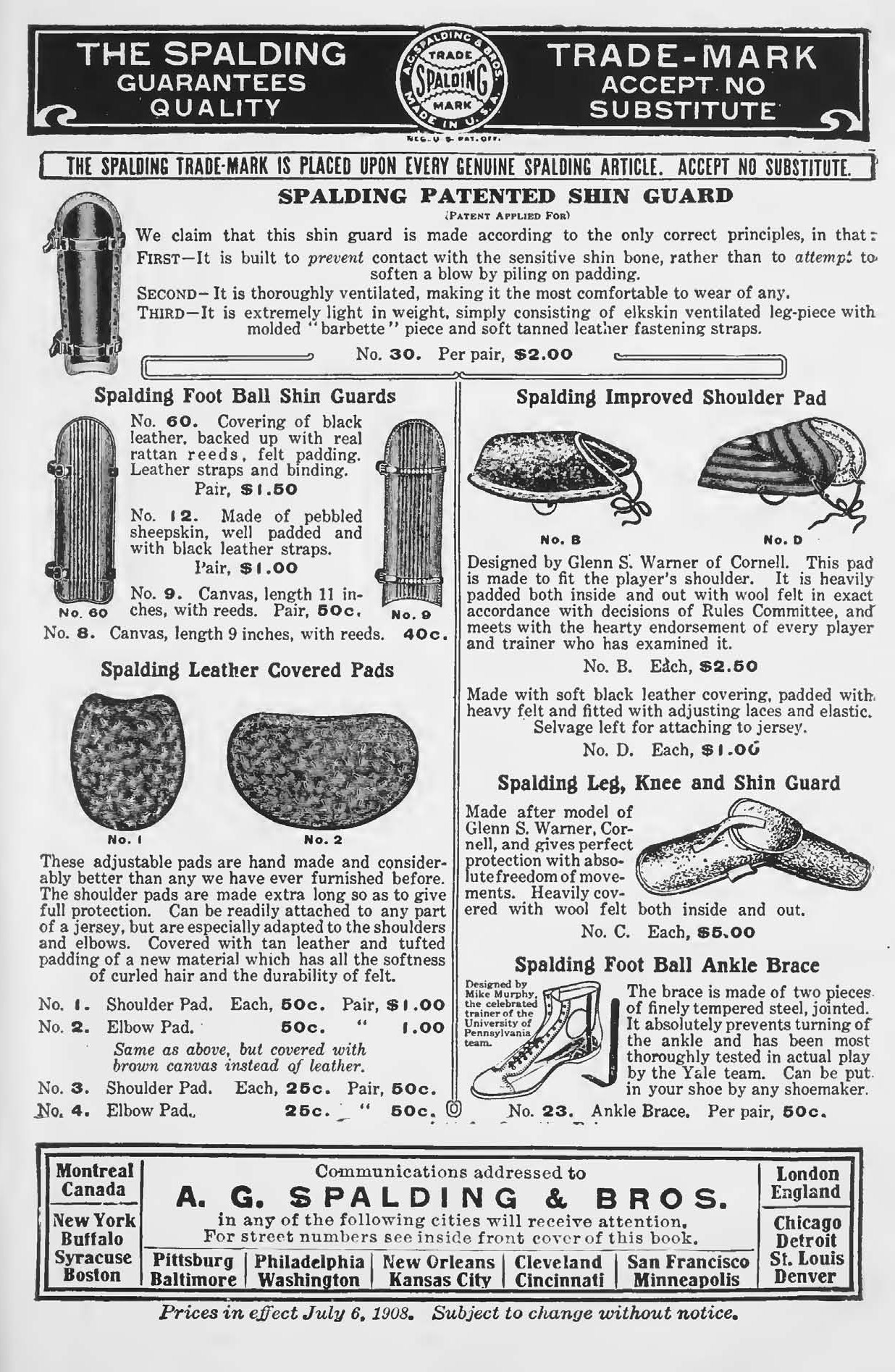
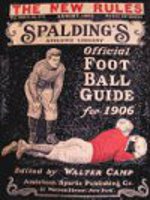
Quickly flipping through one of Spalding’s Guides for football shows that these annual guides served two major functions: 1) providing the football community analysis of the previous and upcoming seasons and 2) serving as a catalog of Spalding’s football-related items. Spalding didn’t sell advertising to competitors for placement in these widely read little books. In fact, the only non-Spalding ads I have noticed are those for Walter Camp’s and Pop Warner’s books. Why, one wonders, would ads for just these two outsiders be allowed?
For starters, Walter Camp wasn’t really and outsider as, for many years, wrote major pieces for the guides and served as editor of them. As editor, he may have organized the layout of the book including determining what would be included and where it would go in the books. Spalding surely dictated much about the advertising. Ads for Camp’s books may have been partial payment for all the work he did for Spalding or his position with Spalding gave him a favored position that allowed him to buy ad space where others were not allowed. A closer looks at Walter Camp’s book listings reveals that they were probably published by Spalding. That means that Camp’s books were Spalding products that Camp was likely paid to author. But Warner had no special relationship with Spalding as far as we know.
Or did he?
The unnumbered pages in the back of the 1908 Spalding’s Guide include a catalog page that has shin guards at the top. Just below the shin guard ad, in the right hand column, is an ad for “Spalding Improved Shoulder Pad.” Comment about its improvements and over what will be reserved. The first line of ad copy starts, “Designed by Glenn S. Warner of Cornell.” So, Warner has some sort of relationship with Spalding with regard to product development. That could explain why an ad for Warner’s correspondence course and book are included in Spalding Guides.
<next time—Errors in Ads>

Tags:Spalding's Guides, Walter Camp
Posted in Carlisle Indian School, Football, Pop Warner | Leave a Comment »
April 3, 2012
The title of Warner’s 1912 book varies from the title in the advertisement in the 1912 Spalding’s Guide. The ad gives the title as Course in Foot Ball for Players and Coaches but the title on the cover of the actual book is Football for Players and Coaches and A Course in Football for Players and Coaches is on the book’s title page. The latter title is surely the book’s complete title, especially because it is so similar to the title of the correspondence course. The title on the cover was probably shortened for artistic purposes and to make it stand out to a shopper in a bookstore because the shortened title could be printed in larger type. Another difference between the ad and the book is that foot ball is two words in the ad and one word in the book, both on the cover and on the title page.
That difference was surely Spalding’s choice because they controlled the typesetting of the Spalding’s guides. Spalding apparently chose to use the two word convention both on the guides’ covers and in their interiors. It appears that Pop Warner shifted to the modern convention years earlier than did Spalding because Spalding continued to use foot ball as late as 1919 and, possibly, later. I haven’t bothered to look beyond 1930 yet, but Spalding hadn’t changed to the modern convention then.
It is my opinion that the cover art was done by Lone Star Dietz. I say that because the figures look so similar to those in others drawn by Dietz and because Dietz’s symbolic four-pointed star signature can be seen on the grassy area between the runner’s legs. It’s hard to tell who did the interior illustrations as Warner had some artistic talent of his own. As in the 1927 book that Warner and Dietz co-illustrated, I can’t tell whose drawing it is without a signature. The player in the drawing with the ball is wearing a Carlisle jersey with the distinctive stripes below the elbow.
<more on the book next time>

Posted in Carlisle Indian School, Football, Lone Star Dietz, Pop Warner | Leave a Comment »
March 30, 2012
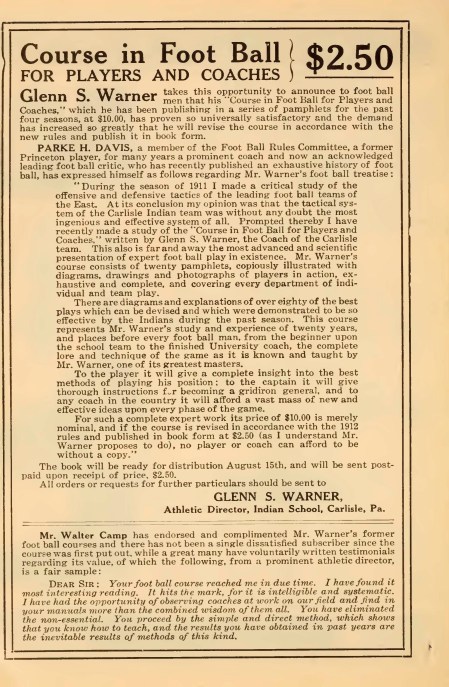
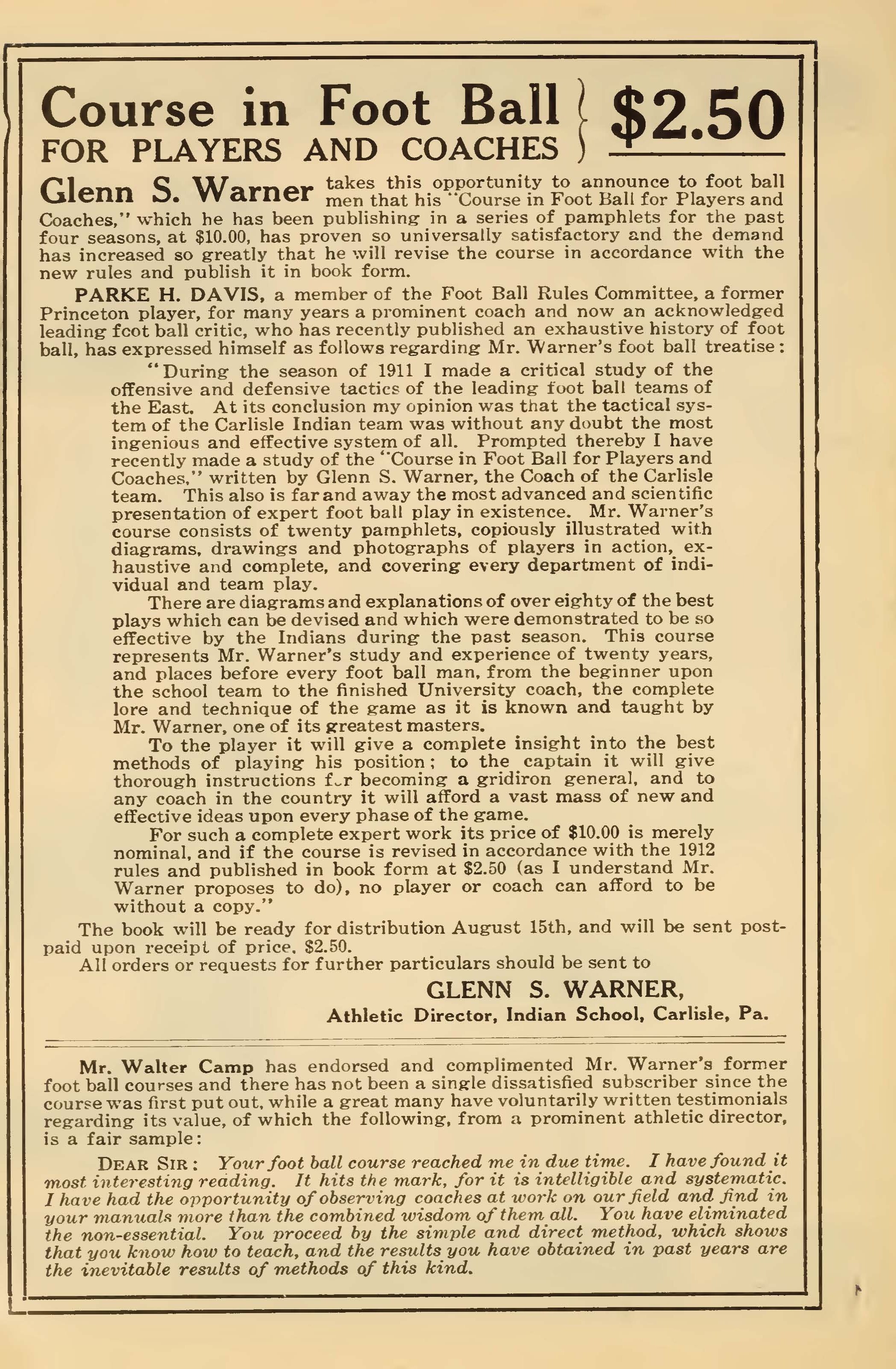
The endorsements at the bottom of the 1912 ad were the same as previously: one from Walter Camp and the other from an unnamed prominent athletic director. Most of the ad is an endorsement written by Parke H. Davis. The first paragraph is most interesting.
During the season of 1911 I made a critical study of the offensive and defensive tactics of the leading foot ball teams of the East. At its conclusion my opinion was that the tactical system of the Carlisle Indian team was without any doubt the most ingenious and effective system of all. Prompted thereby I have recently made a study of the ‘Course in Foot Ball for Players and Coaches,’ written by Glenn S. Warner, the Coach of the Carlisle team. This also is far and away the most advanced and scientific presentation of expert foot ball play in existence. Mr. Warner’s course consists of twenty pamphlets, copiously illustrated with diagrams, drawings and photographs of players in action, exhaustive and complete, and covering every department of individual and team play.
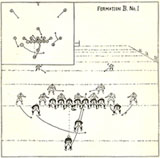
Warner may have done the drawings or he may have enlisted Lone Star Dietz to do them or they each may have done some as they later did for Warner’s 1927 book. That Dietz did the cover art for the 1912 book argues for his having done some of the interior illustrations. Various “famous players” are photographed performing various football skills including kicking, punting, and catching punts. Frank Mt. Pleasant is the only player specifically identified with a photo as Warner included three frames of Mt. Pleasant throwing a forward pass. Each frame represents a different part in the throwing motion. What looks to be a young, skinny Jim Thorpe is shown dropping the ball to punt it. Gus Welch (possibly) is shown following through after punting the ball.
<more on the book next time>
Tags:1912 Spalding's Guide, Parke H. Davis, Walter Camp
Posted in Carlisle Indian School, Football, Frank Mt. Pleasant, Gus Welch, Jim Thorpe, Lone Star Dietz, Pop Warner | 1 Comment »
March 28, 2012
Warner’s ad in the 1912 Spalding’s Guide was very different from the previous ads because his product was different. This is apparent from the new price emphasized in very large type at the top of the ad. The title remained the same, [A] Course in Foot Ball for Players and Coaches, but the price was only a quarter of the amount he charged in previous years. Ad copy mentioned that the correspondence course “…has proven so universally satisfactory and the demand has increased so greatly that he will revise the course in accordance with the new rules and publish it in book form. Publishing new versions of the course each year was legitimate, probably necessary, at that time because rule changes came fast and furious in those days. The revolutionary rule changes of 1906 required refinement in the immediately following years to complete the job of opening up football and reducing fatalities. These annual changes necessitated significant changes to strategy and formations. But keeping up with them was a chore.
An even bigger chore was handling the logistics of servicing customers who had bought the correspondence course in previous years differently than those who were buying it for the first time. Those who first bought it in 1908 surely balked at paying the same $10 fee four times. 1912 would have been the fifth. Keeping track of the individual pamphlets and, worse yet, getting out the mailings as pamphlets became ready would have been a nightmare. Postage costs would have been substantial.
Warner’s solution was to bind the 1912 version of the course as a hardback book (I don’t think paperbacks were commonplace then) and sell for $2.50. That he self-published the book is clear from the address to which orders were to be sent: Glenn S. Warner, Athletic Director, Indian School, Carlisle, Pa.
<more on the book next time>
Tags:1912 Spalding's Guide, A Course in Football for Players and Coaches
Posted in Carlisle Indian School, Football, Pop Warner | Leave a Comment »
March 22, 2012
Before getting to Warner’s new approach, we should talk about endorsements. Celebrity endorsements are not a recent invention. A prime example of this phenomenon can be seen on the ad found in the 1910 Spalding’s Guide. At the bottom of the page, under the double lines, in boldface type is the name of the greatest football expert of the day, Walter Camp. The ad copy states, “Mr. Walter Camp has endorsed and complimented Mr. Warner’s former foot ball courses and there has not been a single dissatisfied subscriber since the course was first put out…” It says that Camp endorsed Warner’s course without including any specifics of what Camp said about it. Generally, a quote from the endorser is placed prominently in the ad. Perhaps Camp merely approved the use of his name without actually stating anything about the course. Following the Walter Camp endorsement of sorts was one from an anonymous “prominent athletic director.”
Your foot ball course reached me in due time. I have found it most interesting reading. It hits the mark for it is intelligible and systematic. I have had the opportunity of observing coaches at work on our field and find in your manuals more than the combined wisdom of them all. You have eliminated the non-essential. You proceed by the simple and direct method which shows that you know how to teach and the results you have obtained in past years are the inevitable results of methods of this kind.
Who was this mystery athletic director? A couple of possibilities come quickly to mind: 1) he wasn’t a major figure in the game of football or was controversial, or 2) he was a major figure but didn’t want his name to be associated publicly with the correspondence course. My money would go with first one because someone who didn’t want his name to be published probably wouldn’t have written Warner in the first place.
Next time—Warner’s new approach
Tags:endorsement, Spalding's Guide, Walter Camp
Posted in Carlisle Indian School, Football, Pop Warner | Leave a Comment »
March 20, 2012
In 1910, Warner had three sets of customers all expected to pay the same $10 for that year’s course but, depending on the set they were in, received something different. Old customers who first bought the course in 1908 or 1909 received the annual supplements where new customers received all the pamphlets from the original course plus the 1910 supplements. This surely created a logistics headache for him. To simplify things, he might have packaged a set of course pamphlets with the first supplement he released for the year, thus giving old customers a second or third copy of the course. Arguing against him doing that is the likelihood of subscribers giving their duplicates to friends. Warner would surely have foreseen that possibility. Evidence to support that he didn’t send duplicate copies of the pamphlets to old customers is that none of the (few) archives that have copies of the course mention having multiple copies although some have annual supplements.
A hint that Warner received static from his old customers over the pricing is that Warner addressed that issue in the ad copy when he wrote, “The latter manual or pamphlet, diagramming and explaining an entirely new system of offense, will alone be worth many times the subscription price of the course which remains but $10.00.”
Not having a copy of the 1911 Spalding Guide yet, I don’t know what the ad copy for that year stated, but do expect that logistics problems and complaints over pricing from old customers compounded over time. These issues may have become great enough by 1912 to cause Warner to take his training course in a different direction while making it affordable for a broader audience. The next installment in this conversation will discuss Warner’s new approach. In the meantime, if you know of anyone who has copies of Warner’s correspondence course, particularly the Offense pamphlets, please let me know.
Tags:1910 rule changes, Correspondence course
Posted in Carlisle Indian School, Football, Pop Warner, Publishing, Single-Wing | Leave a Comment »






 Tom Benjey's Weblog
