Archive for the ‘Football’ Category

1923 Louisiana Tech-Centenary College Game

January 12, 2010

A reader submitted the photo included at the bottom of this post. I’m sorry that it isn’t clearer but this is what I was sent. I have never seen or even heard of one of these buttons before. It is purported to be a button for the 1923 Louisiana Tech-Centenary College annual Thanksgiving Day game. I can’t make out the date from the button but believe that it is authentic because Louisiana Tech played Centenary on Thanksgiving Day in 1922 and 1923, both years that Dietz coached in the Pelican State. Also, it seems unlikely that a forger would pick a relatively obscure event rather than one that would generate more interest (read a higher price). Let’s talk a little about Lone Star’s time in Ruston, Louisiana.

Lone Star coached the Bulldogs for two years compiling an 11-3-1 record with two of the losses coming at the hands of the Centenary Gentlemen. Less than half of those games were played at home at a time when strong teams generally played most of their games at home. (Note that Carlisle Indian School and Haskell Institute were strong teams that played most of their games on the road, a factor that makes their records all the more astounding.) Louisiana Tech had done well before Dietz’s arrival but against weaker opposition. He was apparently hired to upgrade the program and he did.

No reason was given for Dietz’s departure for Wyoming but money cannot be discounted. Wyoming wanted to upgrade its program and hired Dietz to do that. Also, Dietz had remarried in early 1922 to a woman from Indiana and may have needed more income. Even when single, the dapper Dietz was never known as being a miser.

Dietz’s history of putting life into previously lifeless programs while compiling a Hall-of-Fame worthy record is a strong argument for his induction into the College Football Hall of Fame.

Correct Information Is Hard to Find

January 8, 2010

A November 27, 1949 newspaper article by Deke Houlgate discussed the problems Warner Brothers were having with a screenplay for Jim Thorpe’s biopic. Several scripts had been written and discarded but a new one, titled “All-American,” was expected from the screenwriters soon. However, he questioned how good it would be given the problems the writers faced. He wrote, “One of the present problems at the Burbank studio seems to be that the records for this famous team–records that must reach back prior to World War I—no longer exists or are easily obtainable. The Army of the United States took over the school or campus, without asking, for the use of its fledgling doctors in 1917 and scattered students plus pertinent data all the way from Lawrence, Kansas, to Riverside, California.”

Like most newspaper reporters, Houlgate had some details wrong but he did better than most. First, the Army took Carlisle Barracks back in 1918, not 1917. Second, the facility wasn’t used for “fledgling doctors” as that came later. In 1918 it was used as a hospital to treat soldiers wounded in WWI. Houlgate went on to attempt to set the record straight on some legends that unfortunately still persist:

First off, Carlisle never had an undefeated, untied season. The Indians came close to a perfect record many times but always managed to lose at least one game. Next Jim Thorpe was not the first or only All-American. Third, Pop Warner did not bring Carlisle from obscurity to fame because Bemus Pierce and Metoxen were recognized as All-Americans by Walter Camp in 1896 or years before Glenn Scobie ever coached there.

Houlgate is correct about everything in the last paragraph except that Walter Camp first recognized a Carlisle player as a first team All-American in 1899 when he selected Isaac Seneca as a halfback. He may have named Pierce and Metoxen to his second or third teams but I don’t have a reference at hand to verify that. Whether or not Camp named Carlisle Indians to his All-America teams does not mean that Houlgate’s point is incorrect. The team and its star players were indeed famous before Warner was hired to coach them.

Be Careful What You Read

January 5, 2010

While reading a December 1928 newspaper, I came across an article by the great sportswriter Grantland Rice in which he credited the Carlisle Indians with doing more to popularize the game of football than anyone else:

“It was Pop Warner and his Carlisle Indians who did more to spread the gospel of football to crowds around the country than anything else. Wherever the Indians roved and roamed the multitude flocked. Those were the days of Bemus Pierce, Metoxen, Hudson, Mount Pleasant, and later such stars as Thorpe, Guyon and Calac. Old Boy Jim, meaning Thorpe, was the king of the lot, a great football player for 20 years….Warner’s teams are always interesting to watch. As a rule, they have something unexpected ready to reach for in case they need it. Even a rival lead of two touchdowns can be wiped out in one period if the other side isn’t abnormally cagy.”

Because of the Indian School’s fame, reporters often created links where they didn’t exist. Included in Jonas Metoxen’s death notice in a 1942 newspaper was the statement that he “…won fame as a blocking halfback for Jim Thorpe….” Little research is needed to determine that this statement is incorrect. Metoxen and Thorpe were not at Carlisle at the same time. Metoxen played in the late 1890s where Thorpe played dome, but not all, the years between 1907 and 1912. A smaller error is that Jonas generally played fullback.

One needs to be very careful when reading books and articles about the Carlisle Indians because many are loaded with errors. Relating a former player with Jim Thorpe is probably the most common of all. The school operated from 1879 to 1918 and Thorpe but Jim Thorpe was a student for only a small portion of those years. Also, very few of the boys were good enough to play on the varsity squad, so very few that were at Carlisle when Jim was played alongside him. Many, if not most, played on shop teams or the like, but only the very best played on the varsity. Newspaper clippings often list the starting line-ups and the substitutes that got into the games. If a person can’t be found in one of those, he probably didn’t play for Carlisle.

Joe Gilman Part II

December 2, 2009

How long Joe Gilman stayed in Minneapolis isn’t known nor is exactly what he did during this time period. Perhaps his Carlisle student file would shed a bit of light on it. We know that he eventually showed up at Carlisle because his name began to appear in the school’s newspaper. His first mention was for playing tackle in the first game of the 1913 football season against Albright College. He didn’t get further mention during the football season, probably because a more experienced player returned from summer break. Even though several star players left the team after each of the 1911 and 1912 seasons, the Indians sustained only one loss in each season from 1911-13. Joe Gilman was contending against some strong players.

 In December, he was listed as being in the receiving line with Mary Bailey at a reception held by the Susan Longstreth Society. Joe had either been at school for several years without receiving prior mention or had some education, particularly with English, prior to coming to Carlisle. Because he doesn’t seem to be listed on the 1910 Federal Census as being enrolled at Carlisle at that time, Joe probably hadn’t arrived many years before 1913.

 The Carlisle Arrow listed him as placing third in both 220-yard and 440-yard dashes in the handicap track meet held among students as part of 1914 Commencement activities during which Joe Gilman received an industrial certificate in blacksmithing. This implies that he was at Carlisle for at least two years prior to this. So, he likely came to Carlisle in 1911. However, he wasn’t finished yet.

Joe returned for the 1914-15 school year and was promoted to the Freshman class. He also played football but, again, wasn’t a starter. He did get into the Penn game and probably more but the line-ups weren’t generally included in the school paper’s coverage of that year’s games.

Joe Gilman was to be the starting center for the Freshman basketball team that winter but an opportunity in Detroit was of higher priority.

End of Part II

Joe Gilman Part I

November 29, 2009

I recently received an email from Joe Gilman’s great granddaughter in response to my October 17, 2008 blog about Carlisle Indian School students working as apprentices at Ford Motor Company learning to assemble Model Ts. Those unfamiliar with Model T Fords and their assembly line might enjoy viewing this video about them: http://www.youtube.com/watch?v=S4KrIMZpwCY  In the early days of the Model T, one mechanic assembled an entire car by himself; in later days workmen specialized in putting on specific parts of the car. Apprentices were probably taught how to assemble the entire car to allow them to work at any position on the assembly line.

Because Joe wasn’t a football star at Carlisle, his biography doesn’t neatly fit into one of my books. However, it is interesting and deserves to be told. So, I am serializing a shortened version of his story beginning with today’s blog.

Joe Gilman’s name first appears on the 1901 census of the Leech Lake Pillager band of the Chippewa as the 9-year-old son of Pah Dway We Dung. That fact that no father was listed implies that his father was dead or not of that tribe. His having an English name and his mother having a Chippewa name implies that his father was a white man. Later censuses classified Joe as being half-blood but that is inconclusive because the other half need not be a white man. It could also be a man from another tribe. Searching on his mother’s name revealed entries for 1895-97 that listed Pah Dway We Dung as having a son named Joe with no family name. The 1898 census listed her as having a son named May Quom. After that her son was listed as Joe Gilman. It seems reasonable that Joe’s Chippewa name was May Quom.

Joe began being listed by himself in 1907 at age fifteen. His mother may have died at that time. Family tradition has it that she remarried sometime in Joe’s youth. His stepfather shot his dog when he was 12 or 14 causing his to run away to Minneapolis where, according to his older daughter, he danced on the streets for money.

End of Part I


Correction

November 21, 2009

The Carlisle Indians played the Manhattan YMCA in football on November 28, 1895 not 1891 as reported in the blog of November 16. The reason for the error is that Newspaper Archive indexed the New York Times for November 28, 1895 as being for November 28, 1891. I blindly accepted their data as being accurate without checking for myself. I discovered the error when trying to find an article covering the game. Unable to find one, I noticed that the date on the paper did not agree with the index. I will be more careful in the future.

Carlisle Indians Played Football in 1891!

November 16, 2009

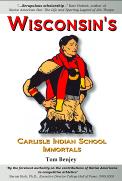
While researching Frank Lone Star for my upcoming book, Wisconsin’s Carlisle Indian School Immortals, I came across a piece in the November 4, 1892 issue of The Indian Helper, in which Frank’s older brother, John Lone Star, had joined a newly organized football team called the Rovers. This, of course, piqued my interest, so I looked further. The November 25 issue reported that the Rovers had lost to the Pirates. The Pirates were described as the “Champion Foot-ball Team of the school.” From that I gathered that the Rovers and Pirates were intra-mural teams of some sort. It also mentioned that the Pirates’ trainer (coach in modern parlance) was Benjamin Caswell. In 1894, Caswell would captain the school’s football team, the first one to play a full schedule.

The article also reported that the Pirates also defeated the “School Team on Saturday, by a score of 16 to 10.” In his memoir, Superintendent Pratt wrote that interscholastic football at Carlisle had been banned in 1890 and not reinstated until 1893. So, why would there have been a school team?

But the Rovers weren’t through for the year. They beat Martin Archiquette’s team 22 to 8 on Thanksgiving Day. One can only assume that Archiquette’s team was another intra-mural team. The Pirates weren’t through either. On the following Saturday, they lost to the Regulars. What did that name mean? Were they just regular guys or were they the team that represented the school?

Curious, I delved a little deeper. On November 13, 1891, The Indian Helper stated, “They say we are to have a foot-ball team. The ball is already here.” That could have been just some gossip. Of course the school had a ball because the boys were already playing among themselves. A little ad in the November 28 New York Times told me that there was more to it.

1891-11-28 Carlisle vs NY YMCA

Was Pratt’s memory faulty? Was this a one-off game against a foe who promised to play cleanly? After all, it was a Christian organization. More research will be needed to discover the truth.

New Jim Thorpe Documentary

November 12, 2009

A new documentary about Jim Thorpe has been released and is playing on some PBS stations. Moira Productions announced that Jim Thorpe: The World’s Greatest Athlete has been finished and is available for viewing. The film appears to largely be the work of Tom Weidlinger (producer, director, writer) and Joesph Bruchac (producer, writer). There were rumors that James McGowan was involved with the film but his name is not listed in its credits on imdb.com:  http://www.imdb.com/title/tt1381609/fullcredits

Bruchac has written books about Jim Thorpe and is thus probably the lead writer on this documentary. He tends to write in the first person as if Thorpe, who he probably never met, is telling the story himself. A brief excerpt from the first chapter of Jim Thorpe: Original All-American states that young Jim was called stupid, something he disliked:

     Stupid. That was what the teacher called me. And not just one teacher, either.

     Stupid. I hated that name. That was one of the worst ones. Not the very worst, but close. It hurt so much because I wondered if it was true.

Stupid is not how Jim’s teacher in the Commercial Course at Carlisle, Marianne Moore, described him. Bill Crawford reported her as saying, “In the classroom he was a little laborious, but dependable; took time—head bent earnestly over the paper; wrote a fine, even clerical hand—every character legible; every terminal curving up—consistent and generous….The commercial students, about thirty, were an ideal group. Among them were James Thorpe, Gus Welch, and Iva Miller…They were my salvation, open-minded, also intelligent.”

 The Balenti brothers, who were among the brightest students at the school, sometimes made fun of Jim. However, being less intelligent than them doesn’t mean he was stupid.

Moira Productions’ website lists the TV schedule for the 1-hour documentary: http://www.jimthorpefilm.com/events/index.html

The listing implies that it shows at 5:30p.m. Sunday on WITF’s HD channel only, but Comcast’s website lists it as showing on both channels 004 and 240. That implies that it will also be broadcast on the regular WITF channel as well.

Removal of Jim Thorpe’s Remains

November 9, 2009

Both AP and UPI wire services report that Jim Thorpe’s sons plan on suing the Borough of Jim Thorpe, PA to have his remains removed from the town that now bears his name to the graveyard near Shawnee, OK in which Thorpe’s father and other relatives are buried. Jim’s youngest son, Jack, is quoted as saying, “According to Sac and Fox tradition, Dad’s soul will never be at peace until his body is laid to rest, after an appropriate ceremony, back here in his home. Until then, his soul is doomed to wander. We must have him back.”

According to the UPI, Thorpe wanted to be buried in the Oklahoma cemetery with his relatives but, at the time of his death, his family didn’t have the resources to build what his widow thought to be a proper monument to her late husband and the governor of Oklahoma declined to provide to necessary funding. Mrs. Thorpe then negotiated an arrangement in which the boroughs of Mauch Chunk and East Mauch Chunk, two towns in which Big Jim never set foot, would merge and be renamed after the football star. They were also to build an appropriate monument. According to all accounts both sides lived up to the agreement, but the expected tourist interest never materialized.

The attorney representing the Thorpe family plans to file a law suit in Federal Court in Philadelphia later this month under the 1990 Native American Graves Protection and Repatriation Act. That act requires that federal agencies and institutions that get federal funding return American Indian remains to their families or tribes. I suspect that this law was intended to deal with bones and artifacts that graverobbers sold or gave to museums, schools or government agencies, not for agreements freely entered into. This is a tough case because there are no bad guys. The question I have is: who would suffer most if his remains are not returned to the family? Perhaps Bob Wheeler, the author of the definitive Jim Thorpe biography, can shed more light on this.

Carlisle’s Most Outstanding Victories

November 5, 2009

Pop Warner listed what he thought were Carlisle’s most outstanding victories in a 1951 letter to Babe Weyand. Note that his list includes only those games he coached, but it is probably fair to him to include only games he saw in person. Here is Warner’s list:

1899   Carlisle 26 – Penn 6            only game Penn lost this year

1899   Carlisle 45 – Columbia 0       Columbia had beaten Yale, Army and Dartmouth

1899   Carlisle 2 – California 0         Calif. Was Pacific Coast champions, unbeaten and unscored on 

1903   Carlisle 28 – Northwestern 0  only game Northwestern lost that year

1907   Carlisle 26 – Penn 6             only game Penn lost

1907   Carlisle 18 – Chicago 4         Chicago was Big Ten champion

1913   Carlisle 13 – Dartmouth 10     only game Dartmouth lost

I find it curious that Warner included neither win over Harvard and he was on the winning end of both of those contests.