Archive for the ‘Carlisle Indian School’ Category
July 13, 2009
Tex Noel just came across a new website that has an article about the single-wing on it. Being well aware of my interest, he sent me this link: (It may be necessary to copy this URL and paste it into your browser.) http://www.footballhistorian.com/football_heroes.cfm?page=18#Single-Wing%20Formation…1920s
The page is very attractively done and has links to sister sites for baseball and basketball. The problems start when you read what is written on the site. The title for the article is Single-Wing Formation…1920s. I found it curious that the single-wing was filed under the decade of the 1920s instead of when it originated. The first sentence of the article explains that: The single-wing formation was conceived by Glenn “Pop” Warner while coaching at Pittsburgh and Stanford Universities.
After reading this, there is little point in reading further. Apparently, the writer has not read Pop Warner’s letters, books and articles about when he originated the single-wing. As long-time readers know, I researched the birth of the single-wing a couple of years ago and found something quite different from what FootballHistorian.com wrote. To my knowledge, I am the only person to have located the different versions of the offense pamphlets from Warner’s correspondence course that pre-dated his 1912 book. www.Tuxedo-Press.com reprinted Warner’s single-wing trilogy which consists of the 1912 and 1927 books plus the various versions of the offense pamphlet that could be found with an introduction to explain them a bit. Anyone interested in learning the history of the single-wing would enjoy reading them.
I attempted to navigate the site but was unable to find an email address to contact. I did find a Jim Thorpe page. He states that Thorpe “…simply outran the opposing defense and chalked-up a phenomenal total of 1,869 yards in only 191 carries.” I don’t do stats; that’s Tex Noel’s department, so I will leave that up to him. Apparently, he didn’t read what opponents had to say about tackling Thorpe.
After discussing the 1912 football season, he wrote, Thorpe then was acclaimed “the best in the world” by winning Gold Medals in the 1912 Olympics in both the decathlon and the pentathlon in Stockholm, Sweden. This gives the reader the impression that the Olympics happened after the football season. Hmmm.
Tags:footballhistorian.com, Tex Noel
Posted in Carlisle Indian School, Doctors, Lawyers, Indian Chiefs, Jim Thorpe, Single-Wing | Leave a Comment »
July 11, 2009
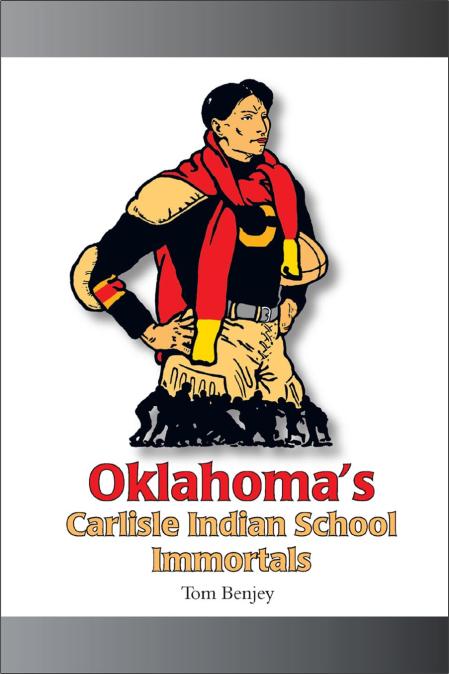
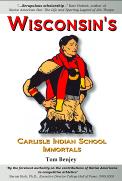
Thanks to a local internet trunk being out of service, this blog is posted late. Is being dependent on modern technology wonderful? A second proof arrived for Oklahoma’s Carlisle Indian School Immortals and it will be accepted. That means books will be printed soon. This brings us to the next book in the series, Wisconsin’s Carlisle Indian School Immortals.
Relatives of Chauncey Archiquette contacted me after seeing the message about the pristine 1897 Carlisle-Cincinnati game program. Chauncey wasn’t included in Doctors, Lawyers, Indian Chiefs because I had little information on him at the time and because, at 160,000 words, the book was running long. Now that I am doing a book on Wisconsin stars, of which there were many, there should be room for him and some others such as Wilson Charles and Wallace Denny.
Here is an update on the flag in the band photo that was discussed in the previous message. Richard Tritt, photocurator at Cumberland County Historical Society, researched the photo and found the following:
I found the photo in our collection, but only in school publications and in postcards. It appears as a large full page photo in the CARLISLE ARROW, July 27, 1906. There is no story. It appears again with a story about the band being at an event in the CARLISLE ARROW of Jan. 31, 1908. The same photo was used on a postcard that was issued prior to Feb. 28, 1907. It is printed on an undivided back postcard, thus the date. After that date postcards were divided on the back. Even with the best of the four copies that I have, the stars on the flag can’t be counted. The top row of the stars is hidden by the leaves in the tree. We do know that it had to have been taken before July 27, 1906. The 1908 written on the copy that she had is probably because her copy was taken from the 1908 issue of the ARROW.
So, the flag wouldn’t have been a 1908 flag because the photo was taken prior to July 27, 1906. George Gardner’s great grandson is right. This is surely not a 1908 flag.
Tags:Chauncey Archiquette, Cumberland County Historical Society, George Gardner, Richard Tritt, Wallace Denny, Wilson Charles
Posted in Carlisle Indian School, Doctors, Lawyers, Indian Chiefs, Publishing | 3 Comments »
July 8, 2009
George Gardner’s granddaughter sent me a scan of a photo of the 1908 Carlisle Indian School band. George’s brother, William, was better known than George due to his exploits on the football field, the sidelines and alongside Eliot Ness. However, George was quite active at Carlisle and also played on the football team. In the photo below, he is in the second row from the top, third from the left.
George’s great-grandson doesn’t think the flag in the photo is a 1908 flag. My eyes aren’t good enough to determine whether it is or not. On Saturday, November 16, 1908 the areas that had previously been known as Oklahoma Territory and Indian Territory were admitted into the union as our 46th state. The flag necessarily changed as a result because a star was added.
Below are images of the 45-star flag that was used from 1896 to 1908 and the flag that was used from 1908 to 1912. My eyes aren’t good enough to determine which is in the photo, so I did a little detective work. This photo appeared on the front page of the January 31, 1908 edition of Carlisle’s school newspaper, The Arrow. The photo does not appear to have been taken in the winter. The photo had to have been taken before January 31, 1908 and in good weather. Therefore, it was likely taken when the flag had only 45 stars.
Perhaps someone with sharper eyes or a higher resolution photo can prove me wrong. Keep in mind that US flags never expire. It is always proper to display an older version of the flag provided it is in good shape.

US Flag 1896-1908
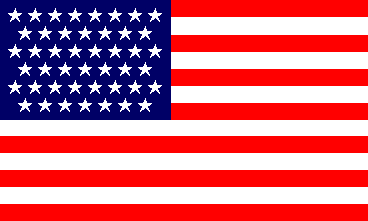
US Flag 1908-1912

Tags:1896 Flag, 1908 flag, Carlisle Indian School Band, Eliot Ness, George Gardner, Oklahoma statehood
Posted in Carlisle Indian School, Football, William Gardner | Leave a Comment »
July 4, 2009
Proofs for the text and cover of Oklahoma’s Carlisle Indian School Immortals arrived Thursday. The purpose of the proof is to determine that everything is perfect before printing the batch of books. The cover looks great to me. The colors are vibrant and Bob Carroll’s drawings of the players’ faces provides an attractive background for the text on the back cover. There is a problem with the text, however.
Rather than taking up space in the narrative with dry demographic about the players, I put this information in boxes, one for each player. The boxes were shaded in light gray for visual interest. Herein lies the problem. Five of the fifteen demographic data boxes appear to have no shading. The boxes looked perfect in the advance reading copies (ARCs), but those were produced by a different printer. Panic set in immediately. The PDFs sent to the printer look perfect. The printer’s technician informed us that the shading was done at 9% and they accept nothing below 15%. That doesn’t answer the question as to why two-thirds of the boxes were shaded correctly.
As it turns out, the boxes that printed correctly have graphics with transparency on the same page but the bad ones don’t. It appears that the printer’s software or equipment does something different in these cases. Be that as it may, I have to submit new PDFs with 15% gray shading. That means that I will probably have to pay the graphic designer for his time and the printer fees for resubmitting a new PDF and for a new proof. I also have to wait several days to see if this solves the problem.
Tags:Bob Carroll, Oklahoma, PDF problems
Posted in Albert Exendine, Carlisle Indian School, Football, George May, Henry Roberts, Isaac Seneca, Jim Thorpe, John B. Flinchum, Mike Balenti, Pete Hauser, Pop Warner, Publishing, Richard Henry Pratt, Stacy Matlock, Victor Kelly, Wauseka, William Newashe | Leave a Comment »
June 22, 2009
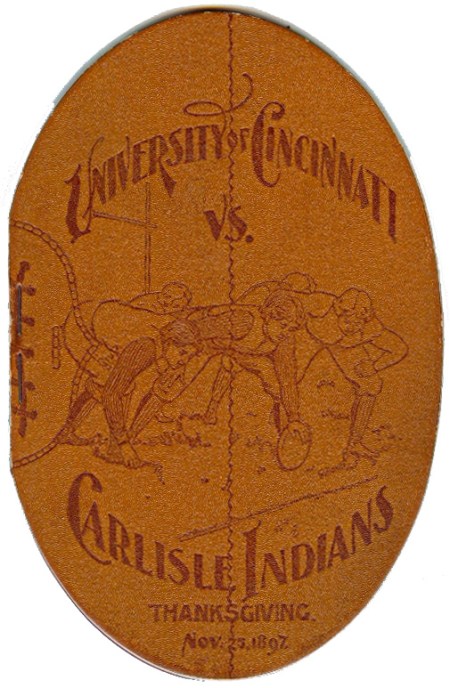
Saturday night, Frank Loney contacted me about a new item he had just acquired. Never before had he been so excited about an acquisition. Yesterday, I went over to look at it. It is simply beautiful. I’ve seen a few old football programs before but none were in the condition of this one for the 1897 Thanksgiving Day game between the University of Cincinnati and the Carlisle Indians. Never before have I seen a 100-year-old program in perfect condition. This one must have been stored out of the sunlight most of its long life. Could it have been a reprint? Frank called the University of Cincinnati archives for an answer to that question. No, no reprint had ever been issued. That Cincinnati didn’t win may have had something to do with that.
In addition to being a historical artifact, it is beautiful. The program is decorated in an Indian motif, likely due to Carlisle being the opponents. This program may not have been in the hands of a spectator because the game was played in a drenching rain. The Indians won 10-0 less than five days after playing a night game against the University of Illinois in the Chicago Coliseum. Carlisle scored all of its points in the first half. According to one newspaper report, “Most of the time of the last half was taken up with fighting.” Isaac Seneca played right tackle. Two years later he would be a first team Walter Camp All-American at halfback. Two days later, missing quarterback Frank Hudson and center Edwin Smith due to injuries, the Indians beat The Ohio State University Medical College for their third victory in a week. The Indians were the only team to defeat Cincinnati, a team that beat Ohio State, Miami, Center College and LSU that year. Chicago was the only other team to beat Illinois.
The program includes a team photo I haven’t seen before and demographic data for the starters. It also includes a photo of W. G. Thompson, the unsung hero of early Carlisle football.
Tags:1897 football program, Artie Miller, Chauncey Archiquette, David McFarland, Edwin Smith, Jacob Jimason, Jonas Metoxen, University of Cincinnati
Posted in Bemus Pierce, Carlisle Indian School, Ed Rogers, Football, Frank Cayou, Frank Hudson, Hawley Pierce, Isaac Seneca, Martin Wheelock | 5 Comments »
June 19, 2009
Today’s blog wanders off-course a bit, but TV’s Tonto was a real-life Mohawk and some Silverheels children attended Carlisle Indian School. Last night my wife and I attended a local summer stock production of The Producers. This brought to mind a Christmas gift from my wife-a set of CDs of old radio shows. While listening to an episode of The Lone Ranger from October 6, 1941, “Loser Takes All,” I heard the villain explain his scheme to his henchman. That scheme was essentially the same one that Max Bialystock and Leo Bloom concocted to defraud little old ladies in Mel Brooks’ classic 1968 film.
Brooks adapted the plot from a gold mine out west to a Broadway play, wealthy eastern investors to sex-starved elderly women, and common criminals to pathetic producers. Instead of having a henchman blow up Nugget Mountain to destroy the unexpectedly profitable mine (which backfires, of course, to reveal a huge vein of gold), Brooks had playwright Franz Liebkind (German for love child and author of Springtime for Hitler) dynamite the theater to stop the unfortunately successful production. The plot’s the same; it’s just details that are changed. Being a G-rated radio show, there were no gay directors, hippie Hitlers or, most unfortunately, no Swedish go-go dancers.
Listen to a short clip of the villain explaining the scheme http://www.youtube.com/watch?v=1va86GOWIXw
Tags:Borrowed plot, Clayton Moore, Franz Liebkind, Jay Silverheels, Leo Bloom, Max Bialystock, Mel Brooks, Nugget Mountain, Prisoner of Love, Springtime for Hitler, The Lone Ranger, The Producers
Posted in Carlisle Indian School | Leave a Comment »
June 16, 2009
Ever consider what would have happened to Jim Thorpe had he not returned to Carlisle in 1911? Pop Warner and Moses Friedman have received a lot of criticism, much of it earned, for their handling of the Jim Thorpe scandal. But what if they hadn’t let him return? It appears that Friedman didn’t really want him back anyway. How differently would things have turned out if, after Albert Exendine bumped into Thorpe, in Anadarko, Oklahoma in the summer of 1911, Warner didn’t want him back?
It is curious that that Jim Thorpe, a 3rd string All American in 1908, sat out the 1909 and 1910 seasons without being recruited by a major football power or even a small Oklahoma college. My sense is that he had had all the schooling he wanted and wasn’t prepared academically for college. Other Carlislians who went on to play football at major colleges generally attended the Dickinson College Preparatory School prior to enrolling in college. Thorpe hadn’t done that. In the early 1920s, he mentioned that numerous colleges had approached him about enrolling in their institutions when he was playing college football. However, that likely happened after he returned to Carlisle in 1911.
It is highly unlikely that Jim Thorpe would have played in a high enough profile program to be named 1st string All America in football in 1911 if he didn’t return to Warner and Carlisle. Perhaps he would have made the Olympic team if found a trainer and a club of the caliber necessary to prepare him to make the team. It’s possible but seems unlikely, especially since he hadn’t taken steps to find a trainer or club before returning to Carlisle less than a year before the Olympic Games.
So, my conclusion is that Jim Thorpe profited from returning to Carlisle. Losing the medals was a price he paid for that decision, but he still made out better in the long run than he would have if he had stayed in Oklahoma. Conflicting opinions are welcomed.
Posted in Albert Exendine, Carlisle Indian School, Football, Jim Thorpe, Pop Warner | Leave a Comment »
June 11, 2009
Immediately below this headline in the December 28, 1914 edition of The New York Times was, “Cato Sells Banishes Books That Teach Them They Are Mongolians.” Judge Cato B. Sells was the Commissioner of Indian Affairs at the time and was putting publishers on notice that the Bureau of Indian Affairs was not going to purchase books for the government schools for Indians that stated that Indians were of the Mongolian race. Sells stated that he had been “advised by the best authority that the Indians are classed by the anthropologists as a distinct race, commonly designated as the red race, or as red men, in contradistinction to the white (Caucasian), yellow (Mongolian), brown (Malay), and black (Negro) races of people, and that he proposes to do everything in his power to oppose an arbitrary classification advanced by a few publishers of school books which classes the Indian as Mongolian.”
He reached that belief that the Indian was not a Mongolian “after personal investigation and consultation with F. W. Hodge of the Bureau of Ethnology in the Smithsonian Institution.”
Apparently, there was a movement afoot at that time to reduce the number of racial classifications and the elimination of American Indians was one of them. I am not an ethnologist, but from what I can tell from perusing the internet, Sells was ultimately unsuccessful in keeping Indians designated as a separate race. He likely did have a financial impact on some textbook publishers.

Cato B. Sells
Tags:Bureau of Indian Affairs, Cato Sells, government Indian schools, Indian race, Mongolian race
Posted in Carlisle Indian School | Leave a Comment »
June 9, 2009
Whilst talking with the granddaughter of someone about whom I have written, she shared the difficulty she was having in getting information from family members about her grandmother. What makes it particularly difficult for her is that her grandmother died young, well before she was born. Something that further frustrates her is that her grandmother had an unmistakable influence on her large family. One would think that some of her nine children would reminisce about her, or at least the older ones who had stronger memories of their mother. But no, they said almost nothing about her.
The granddaughter’s clue that her grandmother had an interest in the arts appeared to her at an early age when she visited her grandfather who was a very quiet man. It struck her as odd that a piano sat in the living room of her grandparents’ simple Oklahoma farmhouse thought to be located on her Sac and Fox grandmother’s allotment. That piano was surely an extravagance for that large family in the Great Depression in the Dust Bowl. She later observed that her aunts, uncles, siblings and cousins had artistic talents ranging from music to drawing to writing. In recent years she has located some of her grandmother’s writings that shed a little light on the person who undoubtedly influenced her children greatly.
Along the way while asking questions to learn more about her family, she was told that “we don’t speak of the dead for a year after their death.” Obituaries are a great information source for biographers and historians. Without them, we would know less about our subjects. Not talking about a person for a year likely puts people in the habit of not thinking, talking or remembering things about them. While researching an entirely different person, I learned that the Pawnees do not talk about their dead. It may well be that this is true of many tribes. If so, much information will be lost forever. In a 2002 National Graphic article about an isolated Venezuelan tribe, Scott Wallace wrote that “the Yanomami consider it taboo to speak of the dead.” Perhaps this custom was widespread throughout the Americas.
Tags:Oklahoma, Pawnee, Sac and Fox, Scott Wallace, Yanomami
Posted in Carlisle Indian School | Leave a Comment »
June 2, 2009
Lest some think the following story about Pop Warner’s toughness is apocryphal, I will share a similar story about another coach of that era. Warner was not happy with his new prospect’s development as a player and pulled him out of his place at a practice. Pop told James that he was not playing nearly aggressively enough and said, “Now get down there and show me how it should be done.” Warner lined up opposite Phillips as he did when trying to demonstrate a technique to a player. When the signal was given, Phillips charged so hard that he knocked Pop unconscious. When he came to and cleared his head, Warner just said, “Now, that’s the way it’s done!”
In Dutchman on the Brazos, Caesar “Dutch” Hohn shared an experience he had with his coach at Texas A & M, Charlie Moran. Moran was teaching the offense a new play but it wasn’t working due to Hohn’s interference. Hohn was lined up across from a guard named “Fatty” Lilliard and on every snap of the ball, “I’d hit Fatty in the face with the heel of my hand, knock him off balance, and break up the play.”
Moran snorted, “Who’s letting that damn Dutchman through here?” Lilliard responded, “There’s nothing you can do when a man hits you in the face with his hands.” “Is that so?” said Moran just before pushing Lilliard aside and taking his position. He then told the quarterback to call the same play.
Seeing that Moran was cocked live a Colt 45 ready to hammer him, Hohn remembered what his Coach told the team earlier: “Don’t spare me, because I expect to knock the hell out of you.”
Hohn recalled, “I had the reach on him, and he wasn’t any heavier than I was. Remember, also, that I was able to use my hands. There was one more fact Moran must have forgotten; I knew the starting signal. I timed myself, and when the ball was snapped I got the jump on him, bowling him over, and broke up the play. That was the day I made the team.”
Tags:Caesar "Dutch" Hohn, Charlie Moran, Fatty Lilliard, Texas A & M
Posted in Carlisle Indian School, Football, James Phillips, Pop Warner | Leave a Comment »


 Tom Benjey's Weblog
