May 23, 2008
People often ask what happened to the great Indian sportsmen. Carlisle produced world class athletes from the mid 1890s to WWI. Haskell picked up the mantle in the 1920s until financial cuts brought about by the Great Depression brought its competitiveness to an end. A few individuals surfaced from time to time but not with the frequency they did in the first two decades of the 20th century. Or so I thought. As it turns out we may have focused our attention in the wrong direction or too narrowly.
Apparently the Bird family holds a Memorial Day rodeo annually in honor of Sammie Bird, son of Carlisle star and captain of the great 1911 team, Sampson Bird. The avuncular Sam Bird bore the responsibility of running the family’s ranches immediately after returning from Carlisle. He looked after his children, grandchildren, siblings and their offspring. It seems that many of the patriarch’s progeny channeled their athleticism toward rodeo competitions. A quick Internet search identified a Sam Bird, grandson of the Carlisle star, his nephew Dustin Bird, and his daughters Brittany and Sammy Jo Bird as current rodeo stars. There may be more.
It is my great hope that someone will read this, fill in the missing pieces and tell me what I have wrong. Then next year I can inform people enough ahead of the rodeo that some will be able to attend.
Tags: Add new tag, Browning, Cut Bank, Dustin Bird, Montana, rodeo, Sam Bird, Sam Burd, Sammy Bird, Sampson Bird, Sampson Burd
Posted in Carlisle Indian School, Football, Sampson Bird | 2 Comments »
May 20, 2008
I called Bob Wheeler to let him know about the auction mentioned last week. http://sports.ha.com/common/view_item.php?Sale_No=709&Lot_No=19835&ic=Left-FeaturedItemMain-071107#Photo. Although the lot was out of almost anyone’s price range, it was important that he know about it, particularly the three audiotapes made by Jim Thorpe. Bob is making an audiobook for his definitive biography of Jim Thorpe and having Jim Thorpe’s voice in it would be a great addition. Bob was way ahead of me – decades ahead. He got copies of the tapes long ago and is working them into his audiobook. So, his audiobook will have things the printed version doesn’t have: Jim Thorpe’s voice for one. It will surely include some of Bob’s experiences interviewing all those people over thirty years ago and will surely include snippets of some of their voices. We’ll just have to wait for it as no release date has been set as yet.
As it turns out, these items come from Joel Platt’s collection that was mentioned in this blog some weeks ago. It appears that Platt periodically offers items for sale. It’s not clear if he receives bids high enough to get him to part with anything. It’s my opinion that the Smithsonian should buy Pratt’s entire collection and use it as the nucleus of a national sports museum – unless Mayor Reed of Harrisburg gets there first.
Tags: auction, Joel Platt, memorabilia, Patricia Thorpe, Robert Wheeler
Posted in Carlisle Indian School, Football, Jim Thorpe | 4 Comments »
May 17, 2008
I just received a copy of Michie by James G. Sweeney. Michie is of course West Point’s venerable Michie Stadium, site of many historic football contests. Sweeney’s description is enough to make one want to spend an October Saturday along the Hudson taking in fall foliage, tradition, spectacle and even a football game all at once. Having served in the Air Force rather than wait for greetings from my friends and neighbors to don an army uniform, I know nothing about West Point. It seems that Army’s football tradition and history is as important to their alumni and supporters as is The Big House to my wife. However, it is not Michie Stadium that caught my attention, it was its predecessor, The Plain.
Before Michie Stadium was inaugurated in 1924, the cadets battled their opponents on The Plain, a large drill field that figures prominently on campus. The Plain was also the site of some historic football games, more historic in my estimation than those played at Michie, but then I’m not a West Pointer. It was on The Plain that the soldiers first met the Indians in hand-to-hand combat in 1905 and the Indians emerged victorious. The Indians of which I speak are the Carlisle Indians who wrestled with future officers for the pigskin three times in their glorious history. The Indians won the first two games, 1905 and 1912, but were routed in 1917, the last year Carlisle fielded a team. After athletics were deemphasized in 1914, Carlisle was no longer competitive and many of the athletes who would have been present in 1917 were in France fighting a shooting war. So, that game doesn’t count for much.
The 1905 and 1912 games were truly historic. Jim Sweeney tells me he is writing something about them. Hearing things from the other side’s perspective will be interesting. Another historic game was played on The Plain in 1913 when a team from a little-known Jesuit college in Indiana was booked to fill an open spot in Army’s schedule.
Tags: Army, James Sweeney, Michie, The Plain, West Point
Posted in Carlisle Indian School, Football | Leave a Comment »
May 13, 2008
No sooner had I posted Friday’s blog when another auction of Carlisle artifacts popped up. Don’t blame me if I’m in a rut; I don’t have any control over these sales. Also, people want to know about such things in a timely manner so they can have a shot at buying these things.
Heritage Auction Galleries has a pile of Jim Thorpe memorabilia for sale, including a helmet and cleats he reputedly wore in games in 1912. They also have quite a number of other things of which I find the audiotapes in Jim Thorpe’s own voice the most interesting. These would be perfect for Big Jim’s biographer to have, assuming that Bob Wheeler has a spare $143,400 lying around. It does include the 20% buyer’s fee. What a bargain. You can see the whole lot at: http://sports.ha.com/common/view_item.php?Sale_No=709&Lot_No=19835&ic=Left-FeaturedItemMain-071107#Photo
At such prices, I can’t suggest that any individual or archive buy any of these things. However, if anyone wants to give me any one of these things, I’d love to have it. A sad thing is that Jim Thorpe’s family tends to get very little from artifact sales as many of the items we have seen offered for sale left the family long ago for little or no money in return. We can hope they do better on this lot. Of everything that has been offered for sale lately, what would you like?
Tags: artifacts, auction
Posted in Carlisle Indian School, Football, Jim Thorpe | Leave a Comment »
May 9, 2008
I have become aware that a historically significant letter written by Pop Warner is up for sale on an Internet site: http://www.historyforsale.com/html/prodetails.asp?documentid=227287&start=2&page=48
The letter was written on October 8, 1951 on Warner’s personal stationery as he was retired by that time and living in Palo Alto, California, where he had earlier coached Stanford University. The letter to Col. Alexander M. “Babe” Weyand contains Warner’s recollections as to when he invented various things and his opinions as to which Carlisle victories were the most significant.
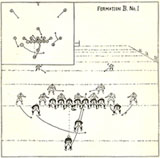
This letter is important because it helps clarify issues currently being debated, some of which I am to blame for raising the issue. Due to Alison Danzig’s writing it had long been thought that Warner had developed the single- and double-wing formations later than Warner states in this letter. I based my 2006 documentary celebrating the centennial of the birth of modern football on statements Warner made in his landmark 1927 book on football and some other sources. This letter supports my position. In their recent books on Jim Thorpe, Sally Jenkins and Lars Anderson generally support the position that Carlisle pioneered modern football when the rules changed drastically in 1906. But Warner’s letter partially debunks their positions that the double-wingback was first unleashed against Army in 1912. He also lists what he considered Carlisle’s most important victories. The 1912 Army game was not among them. More on that in a future post.
The question I have is: why is this important letter up for sale and not in an archive? Two repositories come quickly to mind; Cumberland County Historical Society (CCHS) or West Point – CCHS because it holds numerous records and artifacts from the Carlisle Indian School and West Point because it holds Weyand’s papers. I don’t know if West Point buys papers for its collection but CCHS certainly does. It recently purchased 28 letters written by Jim Thorpe in the 1920s that had nothing to do with Carlisle. The asking price for the Warner letter is about twice what CCHS paid for each of the Thorpe letters. One of the reasons historical documents are so expensive is that there are autograph collectors who are willing to pay large sums just for signatures of famous people. But Warner’s letter to Weyand is valuable for the information it contains.
Tags: Alexander Weyand, Alison Danzig, Army, Cumberland County Historical Society, double-wing, Lars Lars Anderson, Sally Jenkins, West Point
Posted in Carlisle Indian School, Football, Jim Thorpe, Pop Warner, Single-Wing | 2 Comments »
May 5, 2008
The best part of doing this research is the people you meet. The most recent are Iris Davis and Dick Boganwright. Driving back from a wedding in Madison, Wisconsin brought us near Mentone, Indiana where Iris and Dick live. Iris has a photo of their uncle, Louis Island, in his WWI uniform. The photo is mounted in an oval frame with curved glass, something that makes scanning difficult. Taking a photo of a photo that is under glass presents problems of its own, but they were dealt with. By now you may be wondering why I’m babbling on about this.
Louis Island played quarterback, mostly backup, at Carlisle and eventually became a star in the early pro game. He eventually settled in Fort Wayne, Indiana and married Phebe Harsh, who was raised on a farm near Mentone, which is not far from Fort Wayne. Iris Davis and Dick Boganwright’s mother was one of Phebe’s sisters. Iris and Dick remember Dr. Island from family gatherings when they were children. They also remember when he contracted tuberculosis and died. They also remember when his son died from what they thought might have been muscular dystrophy. Dick and Iris recalled that Louis had a grandson who was left the area with his mother when he was a child.
Meeting relatives of Carlisle players is always a pleasure. Sometimes people are surprised to learn that their grandfather or uncle was famous at one time or was a great athlete because their memories of him are often of an old man. The telephone conversations that preceded the visit got them thinking about their uncle and they later remembered things about him that they had forgotten long ago. The visit gave me the opportunity to share with them what I had learned about their uncle.
Tags: Haskell Institute, Louis Island; Fort Wayne Friars
Posted in Carlisle Indian School, Football, Louis Island, Single-Wing | Leave a Comment »
May 3, 2008
Yesterday, the College Football Hall of Fame announced its induction class of 2008 and Lone Star Dietz was again not selected for induction. It also announced that it has renamed the Division I-A class to the Football Bowl Subdivision class. How ironic. If it hadn’t been for Dietz’s showmanship and coaching acumen, the Rose Bowl may have not gotten off the ground. Countless bowl games might not exist if Lone Star’s Washington State team hadn’t upset Fritz Pollard’s Brown team in 1916. Had Dietz’s team performed as had Stanford did in 1902 against Michigan, they might still be holding chariot races and donkey polo games after the Rose Parade. Instead, he showed the country that Pacific Coast football (or at least his team) was the equal of eastern powers and with that New Year’s Day football became a tradition.
But Lone Star Dietz wasn’t a one-trick pony. He turned around a number of ailing programs and still ended his career with a Hall-of-Fame worthy won-loss record. Some would think that winning over 60% of his games at previously losing institutions would be miraculous. Pundits did when they dubbed him “Miracle Man” for turning around the Haskell program. Doing what he did is a lot harder than inheriting a football dynasty and maintaining a winning record. Many of those dynasties fatten up their records on teams like the ones Dietz turned into winners.
It’s not just about the numbers; it’s also about how they got the numbers and Dietz got them the hard way.
Tags: College Football Hall of Fame, Rose Bowl
Posted in Carlisle Indian School, Football, Lone Star Dietz, Washington State University | Leave a Comment »
April 30, 2008
When asked what was the key to his success at Carlisle Indian School, Pop Warner famously answered that it was the absence of alumni. While this statement is not literally true, it is correct in the context in which it was made. Of course Carlisle had alumni, but what it didn’t have were alumni associations, major alumni donors and influential alumni with the ability to influence the direction of the athletic department. Warner was thus able to run the football team the way he saw fit. He didn’t have to deal with alumni interference as he had at Cornell. He felt blessed by its absence.
One of the changes that took place after the 1914 congressional investigation of Carlisle was the formation of an Alumni Department. Reorganization may be a more accurate word, but any previous organization may have had so few resources that it was barely active. After the dust settled on the changes made following the investigation, the building that formerly housed the Native Art Department was given to the Alumni Department for its home. A curriculum change a couple of years prior had eliminated the Native Art Department but had not reassigned the building. Lone Star Dietz had been reassigned to teach mechanical drawing and Angel DeCora had a sinecure. The building that still stands on Carlisle Barracks opposite Pop Warner’s home just inside the former entrance to the school had become a hangout for students and was apparently not being put to a constructive use. The alumni Department quickly ordered a large pennant for each of the graduating classes to that time and hung them around the walls. Student crafts were removed from the building and replaced with souvenirs purchased in New York.
The Alumni Department was allocated a few pages in each issue of The Red Man, Carlisle’s monthly literary journal. The Masthead for that section is shown below. The reason I thought about the Alumni Department is that I recently received a phone call from a local collector who had just purchased a plate from the Carlisle Alumni Department at a sale. He wasn’t sure that it was legitimate but took a small gamble and bought it. I haven’t seen it yet but his verbal description sounds familiar to the artwork on the masthead.

Tags: Alumni Department, Indian School plate
Posted in Carlisle Indian School, Football, Pop Warner | Leave a Comment »
April 21, 2008
The May 18, 1905 edition of the Carlisle Indian School newspaper, The Arrow, listed the then current enrollments at over a dozen of the largest colleges and universities in the country at that time. Several of these large schools were and still are private schools whose enrollments haven’t grown anything like the state schools on the list. Perhaps the growth or lack thereof of student bodies gives us some insight as to why some of these schools are no longer football powers like they once were. It should give us a sense of what portion of the population went to college a hundred years ago – a very small portion. College students then consisted primarily of scions of wealthy families. Athletic scholarships didn’t exist then, at least officially. However, great athletes found their way into the elite schools and onto their teams, even if not always enrolled.
When Carlisle started playing football against the elite schools, including The Big Four, pundits were surprised to see the Indians play so well with so little formal training. They were not thought to be smart enough to play this game that originated at the major colleges and universities. Nor were they thought smart enough to compete successfully. Carlisle’s success on the gridiron showed the larger population that they could compete on a level playing field. If Indians could master something as difficult as football, they could surely become competent in other things. Critics viewed Richard Henry Pratt, founder of the school, as an “honest lunatic” because they thought Indians were not educable. The football team’s foes soon learned otherwise and, by the very early 20th century, some Carlisle alums were attending major colleges or universities and others were coaching high school or small college football teams. Not educable? Huh!

Tags: Richard Henry Pratt
Posted in Carlisle Indian School, Football | Leave a Comment »
April 17, 2008
This week Jim Thorpe’s biographer returned to Carlisle to pick up his new suit. Mose Blumenthal was a tailor at the Carlisle Indian School and also outfitted students in civilian clothes at his haberdashery, The Capital. Today that store is operated by Freddie Wardecker and sports Indian School memorabilia on its walls. My hope was that in the basement or attic Freddie would find a suit of the style worn by Jim Thorpe for Bob. But that wasn’t to be. Bob had to settle for a dark business suit that is appropriate for almost any occasion. He topped it off with a Lone Star Dietz signature tie that is perfect for wearing at book talks. It should also be a hit in his home state of Texas. Although photos were taken they can’t be posted because they turned out too dark, probably due to photographer error.
While in town Bob and Florence visited several sites related to Jim Thorpe. Their first stop was Carlisle Barracks to see the former Indian School buildings and, of course, Indian Field. It was too late in the day for taking photographs so Bob returned the next day before leaving town. Prior to visiting the graveyard we mistakenly thought the graves were all of students who died while attending the school. However, we noticed that a couple of rows of the graves appeared to be for soldiers who had been stationed at Carlisle Barracks. Surprisingly, some of the dates on a few of the tombstones were relatively recent, after the Indian School had closed. Sadly, most of the grave markers contained little information about the person. Having more information would helpful. For instance, one marker only provides the name, Paul Wheelock. From researching a cousin who played football and was a pallbearer for Paul, I know that he was the infant son of Bandmaster Dennison Wheelock. Did the baby’s death cause the father to leave Carlisle or was it coincidental with another opportunity arising? The shortage of information makes it difficult to answer that question.
Bob and Florence also visited Whistlestop Bookshop and Cumberland County Historical Society. It would be great if we could get Bob, Flo and our local folks to coordinate a talk the next time they are in town. I, for one, hope we don’t have to wait until next tennis season.
Tags: Florence Ridlon, Freddie Wardecker, Indian School graveyard, Mose Blumenthal, Robert W. Wheeler
Posted in Carlisle Indian School, Football, Jim Thorpe | Leave a Comment »



 Tom Benjey's Weblog
