July 9, 2008
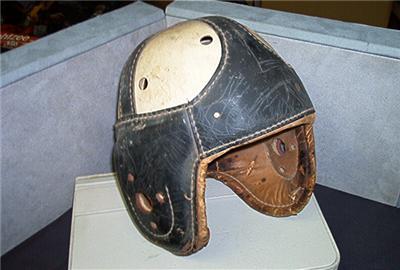
We returned from Tanzania (more on that later) to an email asking me if I knew anything about a black and white leather football helmet claimed to have been from Carlisle Indian School that is currently up for sale on eBay: http://cgi.ebay.com/Carlisle-PA-Indian-School-Old-Leather-Football-Helmet_W0QQitemZ380043129493QQihZ025QQcategoryZ150029QQssPageNameZWDVWQQrdZ1QQcmdZViewItem#ebayphotohosting
I don’t know anything about the helmet but thought I had seen something like it in some old photos of Lone Star Dietz’s teams later on, possibly in the 1920s. So, I did some quick searches and found a similar helmet in a different color scheme listed on another site: http://images.google.com/imgres?imgurl=http://www.mearsonline.com/images/forsale/thumbs/Flat%2520top%2520helmet%2520front%2520feb%252022.jpg&imgrefurl=http://www.mearsonline.com/forsale/results/%3Fcat%3D8%26subcat%3D70&h=139&w=113&sz=4&hl=en&start=98&um=1&tbnid=AHtbVxdr1iubbM:&tbnh=93&tbnw=76&prev=/images%3Fq%3Dgoldsmith%2Bhelmet%26start%3D80%26ndsp%3D20%26um%3D1%26hl%3Den%26rlz%3D1G1GGLQ_ENUS264%26sa%3DN
That site identifies the Goldsmith model 67 as a government-issue helmet used during WWII. Was it used for football? I think so. Was it also used in army tanks? Probably. Was it used by the Carlisle Indians? Probably not. Was it used by an army unit assigned later to Carlisle Barracks? Possibly. What is it worth? Something, surely, but I don’t have a clue to how much.
I’d like to hear from some sports equipment specialists to learn more.

Tags: football helmet, Goldsmith, Goldsmith helmet, Goldsmith model 67, leather helmet
Posted in Carlisle Indian School, Football | Leave a Comment »
July 4, 2008
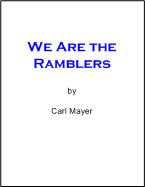
In 2006 while making a documentary on the single-wing formation I had the pleasure of visiting with the Windber Area High School football team because they are now running the single-wing – again. During the course of events I was made aware of a few parts of Windber’s storied history and, just before leaving town, met Carl Mayer who was then working on a history of Windber football. Last week I learned that his work is now available in book form and, while acquiring my copy, asked Carl for a physical description of the book because I haven’t seen it yet. In his words:
“The front and back covers of this soft cover book are in color, all photographs on the inside are black and white, just as you assumed. It is an 8.5 X 11 inch book with 304 pages. This book covers the history of Windber High School football from its beginning up to the 2007 season. Included are numerous stories pertaining to venues played and the role Camp Hamilton has played in its history. Team photographs are included from 1914 thru 2007 (Except for 1914, 1915, 1916, 1918, 1919, they could not be found) with these team photographs are records for that football year and starting line-ups. Also included are drawings and caricatures from the late 1950’s, each of which tell a story.”
If you are interested in knowing more about We Are the Ramblers, click on the book link at the right. BTW, Windber was the home of Johnny Weismiller but I don’t think he played football. Carl can set you straight if I’m wrong. He can be reached at fern1616@verizon.net.
Tags: Carl Mayer, DeMarco, Frank Kush, Ramblers, Weismiller, Windber
Posted in Football, Single-Wing | Leave a Comment »
July 1, 2008
Often while researching one topic I unexpectedly discover information about another. This happened again when I stumbled across a 1912 article that said a Carlisle Indian School alumnus was granted a patent and was the first American Indian to hold a patent. Nicholas Longfeather, Apache, studied forestry at Syracuse University after leaving Carlisle. The patent was said to cover “a preparation for doctoring trees.” The article also said that Nick was profitably engaged in his profession of forestry in a large southern city.
This discovery whetted my appetite for more information about Mr. Longfeather. A couple of quick searches located some more information about him. A 1911 Atlanta Georgian article announced that the firm of Longfeather & Shepard, experts in forestry and landscape, as well as doctors of diseased trees, was opening an office in the Argyle Bldg at 345 Peachtree St. He was working on a project at the Adair estate and liked Atlanta so well that he was going to live there. The article also said that he was born in a wigwam and had a most interesting history but did not share that history.
The Adair estate meant Forrest Adair’s 15,082 sq ft mansion, 2,800 sq ft carriage house and swimming pool (the second one in Atlanta) on 15 acres of gardens and lawns in the new Druid Hills subdivision, the last one designed by Frederick Olmstead before his death in 1903. A February 1911 Syracuse Herald ad for Longfeather & Shepard described themselves as “CARLISLE AND YALE, EXPERTS IN forestry, landscape architecture” located at Syracuse University.
According to Ford R. Bynum in Clara: Mrs. Henry Ford, Nick was brought up to analyze the condition of the trees at the Ford home, Fair Lane, in Dearborn, MI. Someone – a student perhaps – looking for an interesting project might want to research Nicholas Longfeather’s life.
Tags: Atlanta, Druid Hills, Henry Ford, landscape architect, Longfeather & Shepard, patent, Syracuse
Posted in Carlisle Indian School | Leave a Comment »
June 27, 2008
Carlisle Indian School has been of interest to Hollywood since the movie industry’s earliest days. In 1901, American Mutoscope and Biograph shot a documentary short at the school. Footage included both male and female students swinging clubs. Still photos of this type of exercise can often be found on ebay. Also included in the documentary were a military-style parade of the students including the renowned school band, girls doing a dumbbell drill, boys demonstrating gymnastics events, boys playing a basketball game, and members of the track team high jumping and pole vaulting. No, Jim Thorpe was not filmed because he was not at Carlisle at that time.
In 1913, Selig Polyscope filmed The Tie of the Blood at the school. Little is known about the film other than its main cast members. In 1915 Pathe Weekly filmed the installation of the first Indian Boy Scouts of America troop at the school. Also participating in the parade, exhibitions and ceremonies were local boy scouts and the Indian School’s Campfire Girls. And other films that I do not know about may have been filmed at the school.
Several alumni worked in motion pictures as actors, stuntmen and in other capacities. Lone Star Dietz even invested in the Washington Motion Picture Company and lost his investment. Jim Thorpe not only worked in pictures but had his life story told on film in the 1951 Warner Brothers release, Jim Thorpe – All-American. Interest in putting the Indian school on film waned but in recent years has grown.
In April 2002, Variety Film reported, “Fox 2000 has snapped up a pitch by Craig Sherman and Bob Jury on legendary football coach Glenn S. “Pop” Warner and his first season at the Carlisle Indian School.” In April 2004, Walden Media announced that John Sayles would be bringing Carlisle School to the big screen. In 2005 Steven Spielberg brought Carlisle Indian School to the little screen as part of his Into the West miniseries. And there’s more, so much more interest that Freddie Wardecker has lost count of how many filmmakers have come into his store to look at artifacts. Barb Landis at the Cumberland County Historical Society thinks that she gets at least a call a month from someone interested in doing a movie about the school or Pop Warner or Jim Thorpe or … I even ran into one of them in the Dickinson College archives last year.
The problem is that a historically-accurate film needs to be made but, despite all the talk, no one has stepped up to make it. Do you have any ideas?
Tags: Barb Landis, Cumberland County Historical Society, film, John Sayles, movie, Spielberg, Wardecker, Warner Brothers
Posted in Carlisle Indian School, Dickinson College, Football, Jim Thorpe, Lone Star Dietz, Pop Warner | 2 Comments »
June 23, 2008
This year marks the 250th anniversary of the building (perhaps hewing may be more accurate) of Forbes Road. The Seven Years War between France and Britain was raging around the globe. Pennsylvania found itself at the epicenter of the North American theater of what Americans generally call the French and Indian War. General Forbes set out from Carlisle in 1758 to take Fort Duquesne (present-day Pittsburgh) from the French. He followed Indian paths from Carlisle south along what is today Route 11 to Chambersburg and headed west along what later became Route 30. He widened and improved the crude existing roads and, beginning at Bedford hacked his way west to Pittsburgh. 157 years later, in 1915, Pop Warner likely followed the same route when he left Carlisle to take the reins at the University of Pittsburgh.
Warner took more than his belongings to Pitt; he also took his single- and double-wing offenses. But before football season started, he held a summer camp for his players at Camp Hamilton, a facility Pitt owned just outside the town of Windber. To get to Windber, Warner would have backtracked on Forbes Road past Ft. Ligonier and halfway to Bedford before heading north to Camp Hamilton. It was at Camp Hamilton that Pop schooled his new players in the intricacies of the single- and double-wing. Many Carlisle players headed west to Altoona and Pittsburgh to play for independent teams, but they would not have followed Forbes Road because they most likely traveled by train.
Camp Hamilton became an expensive luxury for Pitt during the Depression, so ownership of it passed to Windber Area School District. In 2003, after posting Windber’s 500th win, Coach Phil DeMarco was looking for something new. That something new turned out to be the single-wing. So, the single-wing returned to Camp Hamilton after a long absence, not so long, however, as Pop Warner’s absence from Pittsburgh. Windber ran the single-wing at Camp Hamilton back in the 1930s when they won two state championships with it by beating John Harris one year and Steelton another.
The 250th anniversary of Forbes Road celebrates more history than the victory of the British over the French, it also honors the opening of the Northwest Territory to settlement and other things that traveled along the road, wanted or not.
Tags: Camp Hamilton, Carlisle, Forbes Road, French and Indian War, Phil DeMarco, Seven Years War, Windber
Posted in Carlisle Indian School, Football, Pop Warner, Single-Wing | Leave a Comment »
June 20, 2008
A December 1914 newspaper article bemoaned the fact that 12 million soldiers involved in the Great War in Europe adorned their uniforms or marched behind flags with birds depicted in spread-eagle positions. Angel DeCora was interviewed for the article because she had studied the thunderbird at great length. By delving into Indian legends, she learned that the thunderbird or equivalent has been a mark of distinction and authority for many thousands years. She learned the Winnebago version of the thunderbird story and believed it to be as old as the legend of the last mammoth.
According to legend the spirits that dominated land, water and air were in a balanced state for ages with each spirit roughly equal to the others. Clans associated themselves with patron spirits for purposes of recognition and occupation. The thunderbird, apparently an air spirit, was observed in deadly combat with a water spirit by an exhausted warrior of the thunderbird clan as he lay next to a precipice looking down on the still waters below. When the spirits tired they each asked the warrior for help. The warrior, the only human ever to see the spirits, assisted the thunderbird and the water spirit sank, never to be seen again.
To Indians, the thunderbird represents authority, dignity, arbitration and, most important of all, peace. Many believed the emblem of a bird with wide-spread wings was misappropriated by Europeans from ancient America perverting a symbol of arbitration and peace to war and devastation.
Carlisle Indian School and the Society of American Indians both adopted the thunderbird as their emblem. The thunderbird designed by Angel DeCora for the school’s use is at the bottom of this message. The September 4, 1914 issue of The Carlisle Arrow announced that the Alumni Department would adorn various items with the thunderbird. The April 30 blog includes the Alumni Department’s masthead featuring a thunderbird that I mistakenly thought looked more like a bat.
I have a soft spot for Thunderbirds having owned them for over 40 years. I bought a rust-bucket ’56 in 1965, nursed it along for a decade and bought a solid ’57 in 1976 and have kept it all this time. I finally broke down and had it painted. So, it will be out on the road in all its glory soon.

Tags: 1957 Thunderbird, Classic Thunderbird, Thunderbird
Posted in Angel DeCora, Carlisle Indian School, Lone Star Dietz | Leave a Comment »
June 16, 2008
The floods in the midwest have seemed far away this spring, especially since I and most of my family no longer live there, but even the great distance doesn’t protect me from being affected by the floodwaters. By chance over the weekend I discovered that Peter Jordan, Carlisle ’14, enrolled in Keewatin Academy. That fact interested me because two of the subjects in my new book, Leon Boutwell and Joe Guyon, attended Keewatin about the same time. My interest piqued, I searched through issues of The Red Man magazine and found that Peter Jordan had not only enrolled in the prep school but had bartered his services as football coach in exchange for tuition. Wanting to find more about this, I attempted to search www.NewspaperArchive.com but was thwarted.
Unable to log in, I went to the site’s home page where I received the cold slap of reality. Their home page informed me that NewspaperArchive.com’s servers are located in downtown Cedar Rapids, Iowa in an area that is now flooded by the Cedar River. Fortunately, all files, equipment, old newpapers and microfilm are OK. The servers are several stories above the flood waters and newspapers and microfilms are stored in a different building that was built on higher ground. The servers won’t operate because there is no electrical service in the flooded area at this time. Their emergency generators long ago ran out of fuel and fuel trucks cannot make it through the water. This might be an argument for natural gas-powered emergency generators.
Such is the modern world in which distant catastrophes can impact you in unforeseen ways. I guess I will just have to wait to find out more regarding Peter Jordan’s stint as Keewatin’s football coach.
Tags: Cedar Rapids, Cedar River, Keewatin Academy, NewspaperArchive.com, Peter Jordan, The Red Man
Posted in Carlisle Indian School, Football, Joe Guyon, Leon Boutwell | 1 Comment »
June 12, 2008
Yesterday’s Sentinel contained an article of interest to those interested in the Carlisle Indian School and related topics: http://www.cumberlink.com/articles/2008/06/11/news/local/doc484fd5b21a214085579032.txt
Janet Zettlemoyer and Ilene Whitacre, daughters of John S. Steckbeck, donated their late father’s Carlisle collection to Cumberland County Historical Society. Steckbeck wrote Fabulous Redmen: the Carlisle Indians and their famous football teams in 1951 but the collection that fills 16 copier paper boxes is not limited to Carlisle football items. I’m told that it isn’t limited to Indian School-related items, that it contains a few things of interest to Carlisle (the town) history. However, there is so much stuff to sort through and catalog that it will be some time before collection items are made available to the public.
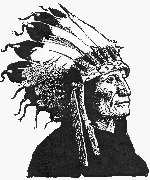
Photographs accompanying the newspaper article include parts of an oil painting and a pen and ink drawing that looks familiar. Discussions with my sources revealed that the oil painting was done by Frank Maze, Dickinson College head football coach 1950-51. It is based on the famous graphic done by Lone Star Dietz that is used as the frontispiece for Steckbeck’s book and on the masthead of this blog. However, Maze put a different head on his version. But whose head was it?
The pen and ink drawing – there turned out to be three in the collection – are Dietz originals of the artwork that adorned the cover of The Red Man magazine. Apparently the collection includes several Dietz items that Steckbeck purchase from the old warrior after he fell on hard times. I can’t wait to see this stuff.
Jim Thorpe historians will not be disappointed as the collection includes an audiotape of Steckbeck’s interview of Thorpe. I hope excerpts from this find their way into the audiobook version of Bob Wheeler’s landmark biography of Thorpe.
The collection also includes glass photo negatives of portraits of Indian School students. Who knows what else might be found in that collection?
Tags: Cumberland County Historical Society, Fabulous Redmen, Frank Maze, John S. Steckbeck, Whitacre, Zettlemoyer
Posted in Carlisle Indian School, Dickinson College, Football, Jim Thorpe, Lone Star Dietz | 1 Comment »
June 9, 2008
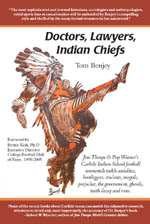
Authors are told that they must have book videos these days that are similar to movie trailers or previews. So, I created videos for both of my books and put them on-line where people have viewed them. This morning it dawned on me that because there is so much material in Doctors, Lawyers, Indian Chiefs it could have several videos.
The second video asks viewers if they can identify the school whose alumni did several things. If you’re reading this blog, you know the school, but do you the names of the people who did those things?
Check out the new video and let me if you think it is more effective than the other one.
Tags: book video
Posted in Carlisle Indian School | Leave a Comment »
June 6, 2008
The College Football Hall of Fame may have snubbed Lone Star Dietz but Albright College hasn’t. Rick Ferry, Albright’s athletic director, informed me that Lone Star Dietz is to be inducted into the Red and White’s Hall of Fame on October 17. One of Lone Star’s problems in being selected for induction into the College Football Hall of Fame is that few of the sports writers and athletic directors on the Honors Committee are familiar with him or his record. Fortunately, the situation is different at Albright College. Two of the paintings that Lone Star donated to the College, the Albright Lion and a portrait of All-American Dick Riffle, hang where the public can see them in the Bollman Center. Also, photos of Dietz’s teams hang in the equipment cage. If one wants to venture off to other parts of the campus his paintings can be found in other buildings as well.
Another advantage Albright has is that a few people who knew him are still alive and remember him well. One of my pleasures in giving book talks is that one of his old players would sometimes show up. Their stories are wonderful. They often show us a side of Dietz of which we were unaware. Sometimes a child of a deceased player contacts me and shares stories that his father told him about Coach. As great a coach as Dietz was I sometimes think he had more impact on his boys off the field. It will be great to attend the ceremony and see Lone Star receive his due. Now I must revise his chapter in Doctors, Lawyers, Indian Chiefs before it goes to press. But that will be a pleasure.

Tags: Albright College, Hall of Fame, Red & White
Posted in Football, Lone Star Dietz | 2 Comments »





 Tom Benjey's Weblog

