End of Carlisle-Detroit Connection

October 21, 2008

Last Friday night I had the pleasure of meeting Marcia and Sheldon Cohen, the wife and son of the late Gus Cohen, at Lone Star Dietz’s induction ceremony, but more on that in a later blog. Mrs. Cohen related that her mother left the Triangle Shirtwaist factory two weeks before the infamous fire in 1911. At the time she was making $2.50 a week. She made that much because she had the skill necessary to sew lace collars onto shirts. This puts Henry Ford’s pay increase into better perspective for me. $2.50 per week increased to $5.00 per day and the workday was shortened from 9 hours to 8. That was a ten-fold increase. However, autoworkers were already making more than many other workers. But still, this raise more than doubled their income if they met Ford’s criteria. No wonder the other industrialists were flummoxed.

Not every Ford worker qualified, starting with women. Ford believed that women rightfully should be married and taking care of their families, so he didn’t increase their wages. Worker’s under 22 were not qualified unless they had dependents. To further determine who was worthy, the company’s Sociological Department was expanded. The staff of 150 visited employees’ homes and asked them about everything from marital status to savings, health, hobbies, and child care. Excessive drinking, gambling, buying on credit, a dirty home, and an unwholesome diet were all grounds for probation; if a worker hadn’t cleaned up his act in six months, not only did he not get the $5 a day wage, he was fired.

The Carlisle students at Ford worked hard to qualify. In December 1915, 25 Carlisle boys were working at Ford. Three of the first to go to Detroit (Joseph Gilman, Everett Ranco, and Norman Thompson) had already qualified for the $5 a day wage and six others (Clement Hill, William Hall, Leslie James, Francis Kettle, Fred Skenandore and Benjamin Skenandore) expected to attain that status soon. Joseph Gilman, Chippewa, expected to be transferred to Ford’s Minneapolis plant soon. That move would return him to his home state.

In May 1916, The Arrow reported that, in 1916 alone, the school had received checks from Ford to be deposited in 25 students’ accounts $1,988.60, an amount that equals 25% of their earnings during this period, $7,954.40. Most were able to live on the 75% of their pay that they received directly but some withdrew money from their school accounts for living expenses.

While living and working in Detroit the boys formed their own football team, the Detroit Carlisles, and competed with the independent or semi-pro teams along the Great Lakes. By June 1918, a total of 68 Carlisle boys had worked at the Ford plant of which more than completed the student course. Twenty-five had enlisted in the armed forces by this time. The Ford-Carlisle was impacted first by the declaration of War in 1917 and finally by the closing of Carlisle Indian School in 1918.



Carlisle Indians Built Model Ts

October 17, 2008

In 2003 three of my brothers and I took our soon-to-be 90-year-old father for a tour of old car museums in the Midwest. At Greenfield Village in Dearborn, MI we took a ride in a Model T. That was all it took to whet his appetite for the Tin Lizzie. Before I knew it one appeared at my doorstep. Dan lives in Illinois but the 1915 brass radiator T he found was in New Jersey. The seller agreed to deliver it as far as my place in Pennsylvania. (See photo below)

This being the 100th anniversary of the Model T, one looks for connections between it and the Carlisle Indian School. Some employee surely had one but I haven’t bothered to explore that link because a much stronger tie exists.

Shortly after Henry Ford increased wages to $5 per day and reduced the workday from 9 hours to 8, a move that other industrialists thought would bankrupt him and possibly themselves as they tried to compete for workers, Superintendent Oscar Lipps arranged to have some Carlisle students enter the training program at Ford. In January 1915 6 boys left to put Americans on the road. At Ford they were placed in a training program which consisted of both classroom training and hands–on work in the various aspects of the Highland Park plant. Lipps received feedback on the boys’ performance and found it necessary to upgrade part of the academic program at Carlisle to better prepare students for positions in modern industrial concerns.

The boys performed well and received good evaluations from Ford. So good in fact, that additional students were sent to Ford. By mid-summer, 19 boys were in the Ford training program. In September most, including the football players, returned to Carlisle, but 9 remained at Ford. In December, after football season was over, 16 more, including several who had previously been in the Ford program returned to Detroit. By January 1916, Joe Gilman, Chippewa, set a Ford record by assembling a Model T in 2 hours and 50 minutes, breaking the previous record of 3 hours.

End of Part I

Ann cranks while Tom impatiently honks horn

Ann cranks while Tom impatiently honks horn

Puttin’ on my top hat …

October 13, 2008

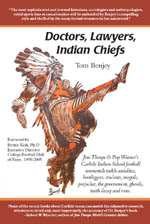
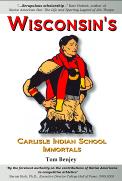
This week promotion for my new book, Doctors, Lawyers, Indian Chiefs, kicks off with a book talk and signing at Whistlestop Bookshop in Carlisle, PA. The timing is good because reviews are starting to come in. I can only hope they’re all as good as the one that ends:

 “Historians, sociologists and anthropologists will appreciate the exhaustive research, attention to detail, accuracy, authority, and integrity Benjey has put into completing this work. Sports fans and casual readers will be drawn into Benjey’s unique and compelling writing style. ‘Doctors, Lawyers, Indian Chiefs’ by Tom Benjey is destined to become a classic.”
 
My immediate challenge is to turn the reviewer’s last word into best seller.

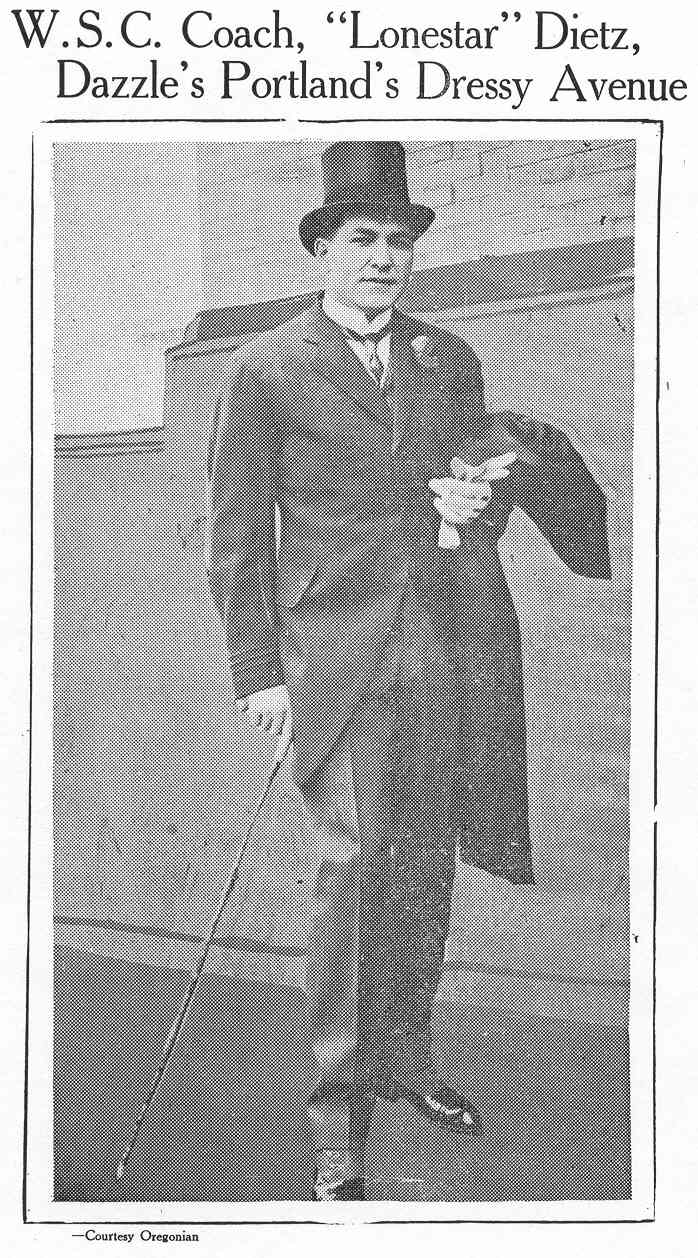
Friday night I am in Reading, PA to accept Lone Star Dietz’s induction into the Albright College Hall of Fame for his family. I will, of course, wear a tuxedo to pay homage to Lone Star but could never look as dapper as he did. This long-overdue honor should be followed by another, induction into the College Football Hall of Fame for his record as a coach. Unfortunately, that doesn’t look like it is in the cards, at least for now.

I have been doing radio interviews across the country as of late and some stations place recordings of these interviews on their web sites. I will link my author page on www.Tuxedo-Press.com to those that I can find. 


Lone Star decked out in Portland, 1915


The Greatest Reward Is Doing This

October 10, 2008

The greatest reward for writing these books and blogging about it has been meeting and communicating with people I would never have met before. In the last few months relatives of the men and women I write about have learned of me and have introduced themselves. I would never have known of their existence or how to contact them otherwise. Several have thanked me for making a permanent record of these people’s lives, but the pleasure is all mine.


Sometimes they know very little about their relative. Other times they know quite a bit and share information I was unaware of with me. Occasionally, make that frequently, they clarify something that was muddy for me. Often they provide information about a sibling of a person that I wrote about who also attended Carlisle.


The most unexpected thing that has happened is that, because of my books and/or blog, relatives that are unaware of the existence or location of other of their relatives utilize me as a conduit for making contact with each other. Family secrets have even been unwittingly uncovered as a result of putting people in contact with each other.


Lest someone be worried about their anonymity be divulged against their wishes, I have a policy to prevent that from happening. If I have contact information for Person A and Person B request that information, I send Person B’s contact information to Person A. That way, Person A can decide whether he or she desires to get in touch or not.


This coming Thursday, October 16 at 6:30 p.m., I am giving a talk about Doctors, Lawyers, Indian Chiefs at Whistlestop Bookshop which is located at 129 W. High Street in Carlisle, PA. Everyone is welcome. Surprise visitors show up at most of my talks. Could it be you?

Returning Indians to Prominence in Football

October 6, 2008

Coming across a 1937 newspaper article in which Gus Welch launched a movement to return Indians to prominence in football. He was quoted as saying:


“The Indian is disappearing from football just like he disappeared from the forests. There used to be a lot of good Indian athletes—Thorpe, Guyon Mount Pleasant, Sweet Corn, Jim Levi, Tiny Roebuck and Mayes McLain. Pop Warner developed a dozen great ones at Carlisle and Haskell Institute produced a number. But they are fast dwindling. Most of the Indians we see in athletics today are impostors, or at best half-breeds. And they might as well be cigar store Indians in so far as I’m concerned.”


The article went on to say that Gus and his wife had recently adopted a baby girl. He insisted that the next child would be a boy adopted from one of what he considered the two fiercest tribes.


“I’m going to visit the Sioux reservation first and look over their crop of babies. If they don’t have anything to my liking, I’m going to pay the Cheyennes a call. I’m determined to find a real all-American and restore the Indian to his proper place in football.”


You already know that didn’t work out, but did you know that Bacone College attempted to revive Indian football after it was de-emphasized at Haskell Institute during the Great Depression? It was a natural thing for the little Muskogee, OK college to do because the school’s original name when it was founded in 1880 at the Cherokee Baptist Mission in Tahlequah by Almon C. Bacone was Indian University. Oklahoma’s longest-running institution of higher education was renamed Bacone Indian University in 1910. Later, its board of trustees gave it its current name. An irony is that Bacone and Haskell, both now four-year schools, play each other.

Gus Welch between Possum Powell and Jim Thorpe

Rally in the Valley

October 3, 2008

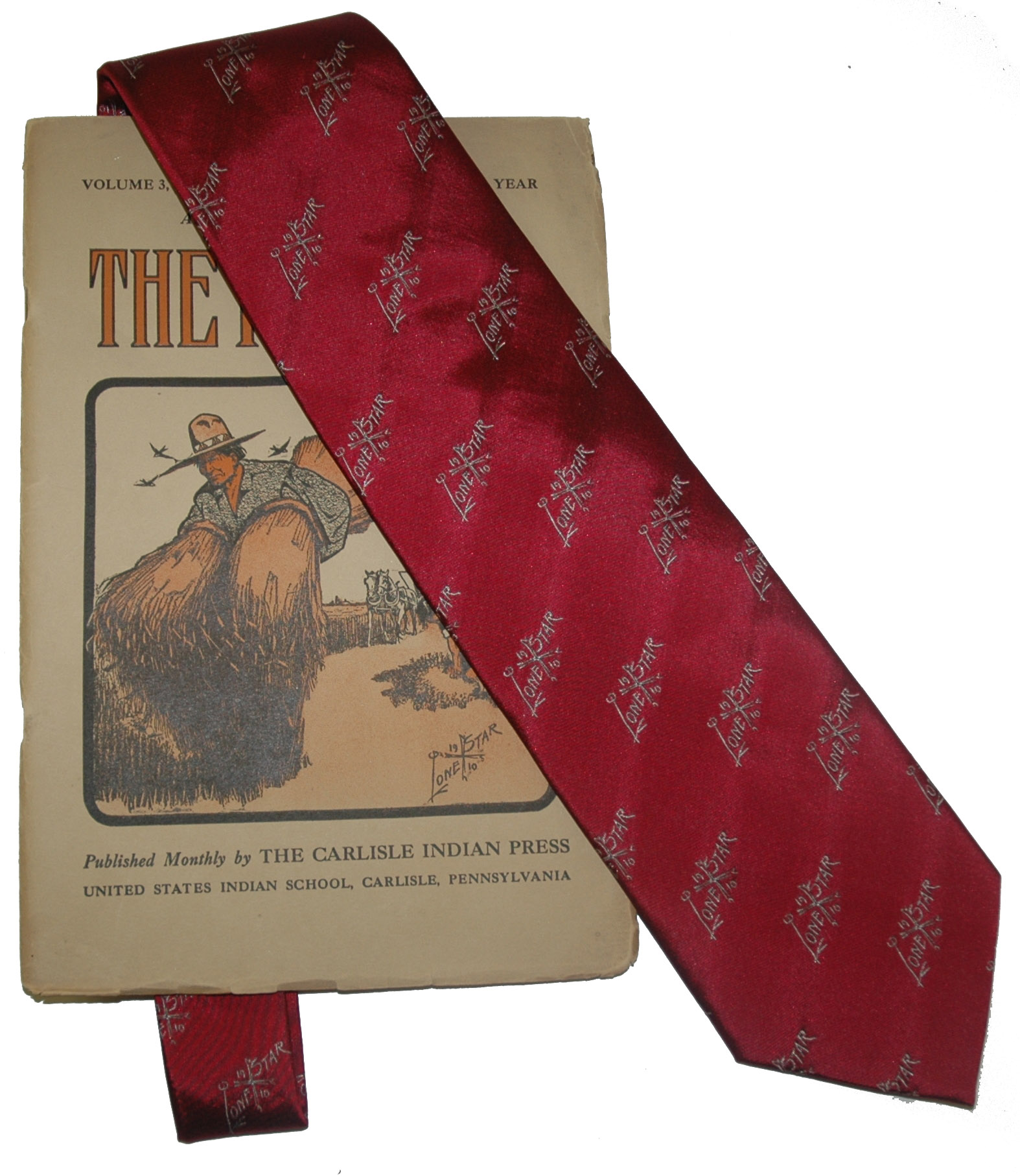
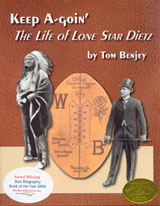
David “Cougman” Welch informs me that an autographed copy of Keep A-goin’: the life of Lone Star Dietz and a Lone Star Dietz custom silk necktie are being auctioned off to help fund scholarships for students attending Washington State University and to support the WSU Alumni Association. The Rally in the Valley is the Skagit Valley Cougars’ signature event each year. More information can be found about this year’s event at http://alumni.wsu.edu/site/c.llKYL9MQIsG/b.2123257/. A flyer for the event can be found here: www.Tuxedo-Press.com/RallyInTheValley.pdf.


For those unfamiliar with Lone Star Dietz, a little background is in order. William Henry Lone Star Dietz was a star tackle at Carlisle Indian School, assistant coach under Pop Warner for three years and also an art instructor. Dietz took the reins as head coach in Pullman in 1915. In his three years as head coach at Washington State (four if you count the 1918 Mare Island Marines composed heavily of his former college players), Dietz led them to two undefeated regular seasons (three if you count the Mare Island year) and Washington State’s only Rose Bowl win (also their first loss if you count the Mare Island team).


Keep A-goin’ tells Lone Star Dietz’s life story. The necktie as seen below incorporates the distinctive signature Lone Star put on his artwork. Also note that the tie is in Washington State colors (crimson and gray). I will be wearing one of these ties on the evening of October 17 when he is inducted into the Albright College Hall of Fame.


Warner didn’t own first car in Carlisle

September 30, 2008

I met county archivist Barbara Bartos at the Cumberland County Historical Society last night. She informed me that the archives from the Prothonotary’s Office contained automobile registration records prior to when the Commonwealth started issuing license plates.


In February, 1903 Senator Grim of Bucks County introduced a bill requiring the registration of automobiles. The legislature enacted an auto licensing law on April 23, 1903 that required motor vehicles to be registered with the county Prothonotary and a $2 fee be paid to the county Treasurer for a license tag to be affixed to the vehicle. Pop Warner may have owned an automobile before this act went into effect but, if he did, he did not register it in Carlisle. It is unlikely that, due to his notoriety, Warner would have been able to avoid licensing his automobile, if he had one. The Cumberland County Prothonotary issued ten automobile registrations between May 4, 1903 and March 11, 1904, the approximate date of Warner’s departure for Cornell. Seven of the vehicles registered were for owners who resided in Carlisle; the others resided elsewhere in the county. The automobiles registered in the first year of registration included recognizable names, both in makes of vehicles: Olds, Cadillac, Packard and Rambler as well as family of owners: Henderson, Biddle, Plank and Chronister. As one would expect, the list of early car owners includes wealthy families. Not included was Glenn S. Warner. So, it is highly likely that he did not own an automobile prior to May 4, 1903, the date on which W. H. Newsham of Carlisle registered his Olds. Not only wasn’t Warner the first man in town to own a car but he wasn’t among the first.


James C. McGowan provided no source for his information so one assumes that he concluded from the mention of Warner’s automobile on the Indian School campus in 1907 as a novelty that no one else in town had a car. That is simply not true. Errors of this nature would not be so egregious if they were not being foisted off on students and educators by McGowan and WorldandI.com as being true.


http://www.worldandi.com/subscribers/feature_detail.asp?num=25819

http://www.worldandi.com/subscribers/feature_detail.asp?num=25821


If such a simple part of McGowan’s article is wrong, what about the rest of it? Does WorldandI fact check what it posts on its site?


First Car in Carlisle

September 26, 2008

A piece posted on a website used by educators and students contains a number of significant errors concerning the Carlisle Indian School, so I was suspicious when it stated that Pop Warner was the first person in Carlisle to own a car. Carlisle is the seat of Cumberland County and was then a prosperous place. Logic suggests that the first car in Carlisle would have been purchased by someone in one of the wealthy families. Also, its placement in the article implies that Warner purchased it around 1912, a date that seems late for the first automobile to appear in a county seat.


Carlisle Indian School publications first mention Warner’s automobile in early 1907, shortly after he returned to Carlisle from a 3-year stint back at his alma mater, Cornell. He may have brought the car with him or he may have purchased it with his substantial pay raise. Neither make nor year of the car was mentioned in the school newspaper’s articles. A 1910 article in The Carlisle Arrow informed readers that Warner had bought another cat, a Chalmers-Detroit 30. I had licensed a photo of Warner tinkering with his $15 auto for the Lone Star Dietz biography so checked with the Chalmers Registry to determine if the car in the photo was the Chalmers-Detroit 30. Joe A responded quickly that the car in the photo was a Franklin but not enough of the car was shown to determine the year and model. Franklins were made in Syracuse, NY which was Warner’s home state.


A newspaper article from late 1906 stated that the Commonwealth of Pennsylvania had already licensed almost 13,000 cars. Seeing that led me to contact PennDOT which, surprisingly quickly, directed me to a person who might be able to tell me when the first Car was licensed in Carlisle. That person informed me that PennDOT keeps no records on “dead tags,” license plates no longer in use, so has no historical data. Bummer. Boiling Springs historian and photo curator at Cumberland County Historical Society, Richard Tritt, came to the rescue. He informed me that Barbara Bartos has the records for the licenses issued by the county before PennDOT began issuing them. Now I may be able to solve this mystery.

Best Subtitle of 2008

September 23, 2008

Today while conducting an email conversion regarding some advertising, I received an unexpected stroke. Maryann Batsakis, Sales Representative for ForeWord Magazine, informed me that the subtitle of my new book was the best she had seen in her seven years at ForeWord. She also informed me that she started in the mailroom where she opened every package that came in and saw every book. Since then she has seen all the award-winning books. So, she speaks with some authority. However, I may have a leg up because she appreciates my sense of humor. One time I mentioned a password I sometimes use and she responded that she liked it. I explained that it was too difficult to use Of all the gin joints in all the towns in the world she has to walk into mine. That cracked her up.


So if Doctors, Lawyers, Indian Chiefs doesn’t receive any other awards, I can feel good that my subtitle, Jim Thorpe & Pop Warner’s Carlisle Indian School football immortals tackle socialites, bootleggers, students, moguls, prejudice, the government, ghouls, tooth decay and rum, is the best.


Some may wonder why I was so verbose. Subtitles are used to help describe what the book is about and also to help search engines find the book for readers who might be interested in it. Doctors, Lawyers, Indian Chiefs covers so much ground that a long subtitle is needed. This might help explain why some books, especially very technical ones, have lengthy subtitles that contain a lot of jargon.


Getting GPSed

September 20, 2008

This is off topic – way off topic – but please indulge my little rant. This week three of my brothers and I took our soon-to-be-95-year-old father on our annual tour. It used to be old car museums but has since expanded to also include tractors, airplanes, trains and historical sites. Getting useable directions to these places is always a challenge so two of my brothers used technology to address this problem – two different technologies.


One searched the Internet for maps with driving directions that are all-too-often questionable if not downright wrong. The other had a $300 GPS unit. Having heard others besides  him sing the praises of these magical units, I had him ride shotgun and get the driving directions to the new Air and Space Museum by Dulles airport near Washington, DC. It worked perfectly. It put us on the right roads and told us where to turn right up to pulling in the gate. That’s where the problems began. Fortunately the guard had dealt with people using GPS units before and quickly got us turned around and on our way to the main entrance. It seems that GPS units take you to the closest entrance, whether it is open to the public or not. Sending us to the back gate wasn’t the only thing it did wrong.


I started to say that we got GPSed but, after wandering around in Baltimore and Philadelphia, getting GiPSied may be more accurate. It had trouble finding the Schuylkill Expressway where it was lower than the streets that ran alongside it and seemed to be oblivious to one-way streets. For awhile we felt like Charlie in the Kingston Trio song, “The MTA.”