Mystery Auto

March 13, 2009

Mike Balenti’s granddaughter sent me a photo of Mike and four of his Carlisle Indian School teammates in an automobile at Union Station in St. Louis. The photo was on the back of a postcard mailed in late November 1908. Checking the record confirmed that the team was on an extended road trip. The November 20, 1908 edition of The Arrow reported, “Our Varsity team will leave for the west on Wednesday, with our coach and the substitutes, to play with Minnesota University, St. Louis University, Nebraska University, and Denver University.” Newspaper accounts reflect that the Indians lost to Minnesota then won the other three games. This was the last time they played Minnesota. No coverage of the game was printed in The Arrow. All it said was, “We notice by the papers that our first football team lost to Minnesota University last Saturday by the score of 11-6. The news causes a surprise, for it was generally expected here that Minnesota was our easiest team on the western schedule. Judging from the report that our athletic relations with that-team-has been broken, we would infer that our boys failed to get the treatment there they had reason to expect.”

An Associated Press report stated, “Glen S. Warner, athletic director of the Carlisle Indian School tonight gave out a statement denying that, the University of Minnesota has cancelled athletic relations with Carlisle.” This report implies that Minnesota may have had a beef with Carlisle, but we are all too aware of how often newspapers get it wrong. Regardless, the two schools never played again. In fact, that was the last game Carlisle played against a Big Ten team.

Because I am interested in old cars, I tried to figure out the make and model of the car in the photo. It had an unusual hood that sloped downward on the sides and front. I recalled having seen photos of a Renault having a similar hood. On closer inspection, the Renault hood was a little different but I found a couple other French makes that had similar hoods. So, I posted questions on two old car sites, one on either side of the pond. Bozi Mohacek, webmaster of a site in Surrey, England posted a response to my question on the AACA site in Hershey, PA. His posting led to the correct identification. 1937hd45 posted a closeup of a 1903 Thomas Model 18 that looks very much like the car in the photo. Wondering if the car in question could have been of a later vintage, West Peterson informed me that the Thomas used a different engine and hood in 1904. Along the way I learned that a 1907 Thomas Flyer won the Great Race from New York to Paris in 1908, but that’s a story for a different blog.

1903-thomas

Hall of Fame for the Birds

March 9, 2009

While we wait for the College Football Hall of Fame to properly acknowledge Lone Star Dietz’s contributions to the game, his old teammate and 1911 team captain, Sampson Bird, was inducted into the Montana Indian Athletic Hall of Fame. On December 12, Sampson Bird was one of 16 inductees in just the second class of the Hall of Fame. Sam Bird, Blackfeet, was the captain of Carlisle’s greatest team. His 1911 squad went 11-1, defeating both Harvard and Penn, two of the day’s greatest football powers. Two future College Football Hall of Famers, Jim Thorpe and Gus Welch, played alongside Sam, but he was elected captain for his leadership abilities. Quiet but stalwart, he led the Indians to their greatest height. Sam starred in other sports but it was in football that he made the greatest impact. Because of his versatility he was inducted as an all-around athlete rather than for a specific sport.

Sampson Bird was previously inducted into the American Indian Athletic Hall of Fame. Some have asked about what happened to Indians’ athletic ability since 1930. Samson Bird’s life provides part of the answer. After finishing at Carlisle, Sam and his bride, a fellow Carlisle student, Margaret Burgess, Tlinget/Haida, returned to his family’s ranch in Montana where they raised their large family. Sam was a working cowboy as were his children. His grandchildren and great grandchildren, boys and girls alike, put their athletic abilities on display as modern-day rodeo stars. Sam’s athleticism can be seen as his descendants compete in the Indian Nation Finals Rodeo. Even their horses win prizes!

Also inducted into the Montana Indian Athletic Hall of Fame with Sampson Bird was Sam Bird Jr. The apples have indeed fallen closely to the tree.

Lone Star Dietz Belongs in Hall of Fame

March 5, 2009

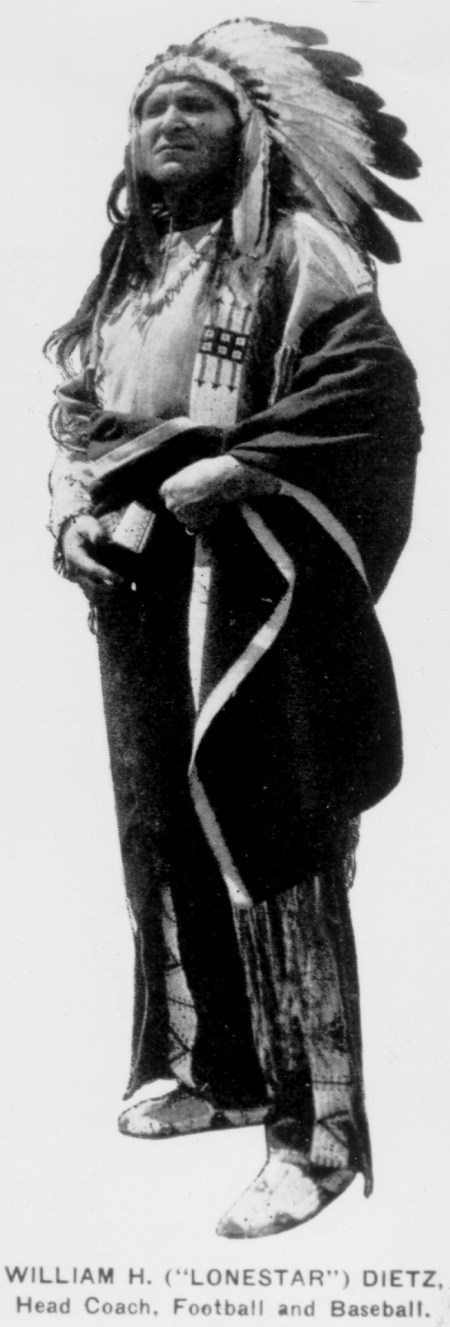
The National Football Foundation released the 2009 ballot for the College Football Hall of Fame and Lone Star Dietz’s name is on it again, but don’t get too excited. Lone Star Dietz should have been inducted into the College Football Hall of Fame decades ago but hasn’t been. In my opinion, Dietz shouldn’t need an HoF-worthy win-loss record (something he has) to gain admission to the Hall. His 1915 season culminated by the 1916 Rose Bowl in itself should be enough. He took over a Washington State team that had had a string of losing seasons and led them to the best record on the West Coast that year. As a reward, he was given the honor of defending the honor of the west in a New Year’s Day game to be played in Pasadena after the parade. At that time West Coast football was considered to be inferior to the Eastern brand. In 1899 the Carlisle Indians defeated the University of California in a Christmas Day game played in San Francisco and this was before the Indians hit their stride. A 1902 New Year’s game was played in Pasadena between Michigan and Stanford but it was a failure because Stanford threw in the towel in the second half while losing 49-0 because they could no longer field 11 players without broken bones. They waited until 1916 to give it another try.

Dietz and his team demonstrated to the entire country that West Coast football (at least Dietz’s team) was the equivalent of Eastern Football when they beat Coach Eddie Robinson’s fine Brown University team that featured Fritz Pollard. They also established the New Year’s Day football tradition, the Rose Bowl, and all the other bowls that would follow. Some Eastern sportswriters considered Washington State to be national champs that year. Dietz didn’t need to do anything more to deserve induction, but he did and did it well. Robinson and Pollard were inducted half a century ago but not Dietz. He was inducted into the Helms Foundation long ago but not the College Football Hall of Fame.

For years the HoF had incorrectly computed his win-loss record and deemed him unworthy of consideration. Their mistake was finally corrected in this century, so almost no one alive remembers him. Also, his selection would probably not result in as large a number of banquet tickets being sold as did Bowden’s and Paterno’s. Thus the HoF has little incentive to induct him.

lonestar-wyoming1

Indians Are Human Beings

March 2, 2009

About the same time in 1879 that Lt. Richard Henry Pratt was negotiating with the War and Interior Departments to establish an off-reservation boarding school at Carlisle Barracks, Pennsylvania, Standing Bear was defending himself in federal Court in present-day Omaha, Nebraska on the grounds that he was a human being.

While watching a C-SPAN2 Book TV segment on The Trial of Standing Bear by Frank keating, I learned something: Indians were not considered to be human beings by the U.S. Government prior to 1879. I’m not recommending Keating’s book, beautifully illustrated by Mike Wimmer, because it is a children’s book unless it is to be given to a child to read. However, the story told in it is important. As a chief of the Poncas, Standing Bear was arrested by federal troops under Brigadier General George Crook for leading a group of about 30 weak, starving tribe members from present-day Oklahoma back to their ancestral grounds in Nebraska along the Niobara River. Standing Bear’s intention was to bury there the bones of his oldest son, Bear Shield, who had died in Oklahoma. After the arrest Gen. Crook, appalled by the condition of the captives, allowed them to remain long enough to rest up for the return journey.

Supported by Crook, pro-bono attorneys John L. Webster and Andrew J. Poppleton, and Thomas Tibbles of the Omaha Daily Herald, Standing Bear filed a writ of habeas corpus in U.S. District Court in Omaha. Due in great part to Standing Bear’s powerful testimony: “That hand is not the color of yours, but if I pierce it, I shall feel pain. If you pierce your hand, you also feel pain. The blood that will flow from mine will be the same color as yours. I am a man. God made us both,” Judge Dundy ruled that, “…an Indian is a person within the meaning of the law” and, thus, Standing Bear had the inalienable right to “…life, liberty and the pursuit of happiness” providing that he obeyed the laws of the land.

This May 1879 ruling established that, in the eyes of the government and the courts, Indians were indeed human beings, a concept that Pratt had assumed some time before.

Snookered by Wauseka

February 26, 2009

I just found out that, like almost everyone else interested in the Carlisle Indian School, I had been snookered. The trickster is a major figure in American Indian lore and another one has been brought to my attention. I bought the idea that Wauseka was Emil Hauser’s Cheyenne name. Now I learn that he made it up as a joke.

Pete and Emil Hauser were friends of Mike Balenti as was Albert Exendine and they visited him in his home in Oklahoma after all left Carlisle. It was during one of these visits that the joke was shared and Balenti’s son heard it. It turns out that Emil Hauser made up the name on a lark and it stuck. Knowing this raises a lot of questions, the answers for which can only be speculated.

When and where he coined his name is not known, but something is known about a similar action taken by his old teammate Charles Guyon. When Guyon and Hauser were both attending, and playing football for, Haskell Institute, Guyon would play summer baseball in the Midwest. When interviewed by one-too-many a newspaper reporter who couldn’t pronounce his Chippewa name, Charlie gave him the name of the town in which he was playing at the time, Wahoo, Nebraska. When he played at Carlisle he went by both Wahoo and Charles Guyon. In later years he was often referred to as Charlie Wahoo or Chief Wahoo.

Emil Hauser may have taken a page from his old teammate’s book and appropriated a geographic name as his own. A quick search identified towns in Illinois and Wisconsin named Wauseka and a county in Minnesota named Waseca. The truth probably won’t ever be known but this is a plausible explanation, particularly because a friend of his had previously done something similar.

100th Post

February 23, 2009

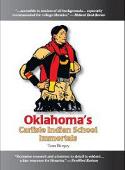
After posting the most recent message I noticed that it was the 100th one since the inception of the blog last March. That means that if you’ve read each and every message, you have read 30,000 words (100 messages X ~300 words each) in a little less than a year. On March 7th it will be a year. Something else just happened – minor brag alert – Doctors, Lawyers, Indian Chiefs was selected as a Finalist for the Reader Views 2008 Literary Awards in the Biography category. The most rewarding thing about blogging is that relatives of Carlisle Indian School students sometimes become aware that some information about their ancestors is available. For instance, last week someone asked about George Gardner, the brother of William Gardner. I didn’t have much on him but I was able to point the person to places that likely do have records and photos. Over the weekend I was looking for something in John S. Steckbeck’s Fabulous Redmen and opened the book to page 38. Opposite page 38 is a page full of player photos. In the upper right corner standing next to Wauseka is G. Gardner. That has to be George. I will tag this message with his name so that people searching for him stand a better chance of finding this. If you want to communicate with me privately, email me at Tom@Tuxedo-Press.com. I don’t post emails on the blog without prior permission. Sometimes I don’t post comments if they seem too personal in nature. This blog has helped some long-lost family members to get in touch with each other. That has been the most rewarding part of this endeavor. Now it’s back to working on my upcoming release, “Oklahoma’s Carlisle Indian School Immortals,” the first of a series that should be of interest to children as well as adults.

Carlisle Indian School Scrubs Beat Ohio State

February 19, 2009

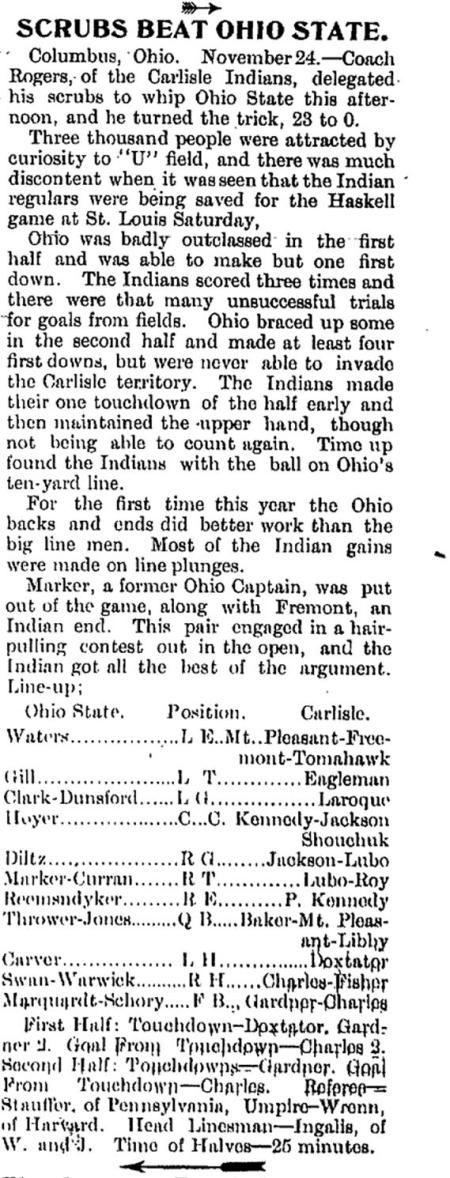
Frank Loney, a collector of Carlisle memorabilia, called to ask about a football player named T. A. Engleman. He had a letter written by a Carlisle Indian School football player who was visiting the St. Louis World’s Fair. The letter was written the morning of the big game against Haskell Institute on the Saturday after Thanksgiving in 1904. The letter was written to Mr. Ziegler in the harness shop at the Indian school.

Frank could find no student named Engleman listed in Linda Witmer’s book, so further research was necessary. Steckbeck listed an Eagleman. The author of the letter wrote, “The second team played the Ohio State University on the 24th, Thanksgiving-day. I played out the whole game, and felt as though of being eighty years old after the game. My man was more than two hundred pounder and so you can imagine I had something to buck up against.” I knew that the first team sat out the Ohio State to be rested for the big game with Haskell that President Roosevelt was expected to attend. Finding a newspaper write-up of the game that included line-ups, I noticed that a player named Eagleman played left tackle across from either Gill or Marker. Because Marker was ejected from the game along with Fremont for engaging in a hair-pulling contest, Gill must have been the 200-hundred pounder and Eagleman was Engleman or vice-versa. Ticket prices for the Carlisle-Ohio State contest, a deluxe game, ranged from 25 cents to a dollar. Ohio State’s only other deluxe game was with the University of Michigan.

Witmer’s book listed an Eagle Man but no Eagleman. However, various censuses listed Thomas A. Eagleman, Sioux. He married a white woman, Grace More, in 1909 and they had 3 sons and 5 daughters. They farmed near Crow Creek in South Dakota, probably on an allotment.

Mystery solved.

 carlisle-ohio-state

A-11 Formation – Illegal?

February 16, 2009

I just learned of another formation with roots in the single-wing and figured I better tell you about it before it is banned. Head Coach Kurt Bryan and Offensive Coordinator Steve Humphries of Piedmont High School near San Francisco, California. Like Pop Warner a century before them, Bryan and Humphries designed a formation to compensate for a weight disadvantage. Like Coach Phil DeMarco at little Windber Area High School in Pennsylvania, Piedmont suffered a size disadvantage when playing much larger schools. The size disadvantage wasn’t just a single-game experience, it continued to present itself as seasons wore on and injuries piled up. Large schools have so many players that they win wars of attrition. By the time playoffs come around, small schools can be pretty short on players. The new formation, the A-11, reduces injuries to players running that offense.

What is the A-11?

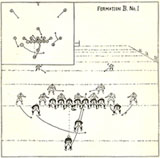
High school and college rules require that at least five players wearing numbers between 50 and 79, numbers worn by players not eligible to receive passes, line up on the line of scrimmage – except when in “scrimmage kick formation,” i.e. punt or place kick. Bryan and Humphries found a loophole. They have all their players wear numbers from 1 to 49 or 80 to 99 to become eligible pass receivers. They then line up in a formation, the A-11, that qualifies as a “scrimmage kick formation.”

A-11 Base Formation

A-11 Base Formation


The formation’s single-wing roots become obvious when one notices the direct snaps from the center to the 1 and 2 backs (tailback and fullback). Both of these players are ideally triple-threat guys but coaches have to live with what they have. What makes the A-11 unique is how the other two backs and six linemen are positioned (the center is on already on the line of scrimmage). Just before the snap, these eight players shift so that six of them are on the line of scrimmage and two are back of it. The players’ numbers allow all of them to be in either location. The defense has just a second to sort out the eligible receivers and frequently guess wrong. North Carolina has made it illegal and California is threatening to follow suit. Find out more at http://www.humphinternet.com/A11/

The A-11 was declared illegal after this blog was written but before it was published. For more info see: http://rivals.yahoo.com/ncaa/football/blog/dr_saturday


A Visit to Sports Immortals

February 12, 2009

Last week I was finally able to visit the Sports Immortals museum in Boca Raton, FL. Joel Platt has collected over a million items of memorabilia from the various major American Sports (read don’t expect to see a lot of soccer and cricket stuff). Do expect to see championship belts won by Joe Louis and John L. Sullivan, the most expensive baseball card, Jim Thorpe’s football helmet, and a plethora of other items squeezed into a small space. Platt has embarked upon a campaign to raise $100M to build the ultimate sports museum. To that end Platt is putting together a traveling exhibit to tour the country and raise seed money to get the fundraising started in earnest. A much larger facility is needed. Mayor Reed of Harrisburg would surely love to have the Sports Immortals for the All-Sports Museum he wants to build on City Island near the Senator’s field. However, the price tag for Platt’s collection would have to be out of Reed’s reach. Considered by many to be the most complete sports memorabilia collection to have ever been put together, only the federal government would have the resources to both acquire the collection and build a worthy building in which to house it. Until the Smithsonian decides to do something, Joel will keep following his dream. Of particular interest to me was a painting of old Pittsburgh that Lone Star Dietz painted in 1951. Below is a photo of Joel Platt holding that painting. Dietz entered the painting in the Advertising Artists of Pittsburgh Annual Show and won third prize. Lone Star lived in Pittsburgh after WWII and operated the Liberty Academy on Liberty Avenue. “Pittsburgh Just Grew” was done in a style different from others I have seen in Dietz’s work. The colors in this painting still jump off the canvas over 50 years later.

Pittsburgh Just Grew

Some Good Scholarship

February 9, 2009

A couple of years ago Angel DeCora’s biographer wrote, “I noticed Benjey did not seem to have access to several of my sources, including Ewers’ papers from the Smithsonian archives…” I didn’t understand her comment because I did have access to John C. Ewers’ Smithsonian file. However, I found some errors in his article on Dietz and saw no point in including those in my book. Now I know what she meant. In a chapter on Dietz that was removed from her recent book, Linda Waggoner makes the following statements:

When his sentence was over, Dietz returned to the east, taking a temporary job at the Philadelphia School of Industrial Art in “Design and Lettering” for the 1920-1921 academic year.[63] Perhaps, he wanted to revisit the past he spent with Angel, but football was still his first love. In 1922 he was hired to coach at Purdue University in Indiana. At the end of January 1923 he married Doris O. Pottlitzer, a “Jewish heiress,” just a week after he was fired from Purdue for illegal recruiting.

Like Ewers before her, Waggoner appears to have misinterpreted The Pennsylvania Museum and School of Industrial Art Circular for 1920-21. Beginning on page 41 of that circular is a list of former students and their last known occupations. They were probably not aware that Dietz was no longer teaching at Carlisle and hadn’t been doing that since 1915. Sara MacDonald, Public Service Librarian at The University of the Arts, successor organization to The Pennsylvania Museum and School of Industrial Art, explained this to me some years ago and reiterated that again last week.

uart1920-21

Waggoner’s explanation would have been convenient for me because I haven’t found out what Dietz was doing in the year between when he got out of jail in 1920 and the time he took the coaching job at Purdue in 1921. I have no explanation as to why Waggoner has him coaching the Boilermakers in 1922 and marrying Doris in 1923. He coached Purdue in only one year, 1921, and married Doris in early 1922. They then relocated to Ruston, LA where he coached Louisiana Tech in 1922 and 1923. Lone Star may have thought Doris was a cracker heiress, but it doesn’t look like she was. I suspect that his 1-6 record at Purdue had more to do with his firing than the accusations made against him.

The blog’s owner responded to the Waggoner post that included the above extract as follows:

I look forward to some real scholarship about Dietz’ true identity. I think it’s time to clear this up. Please keep a’goin with this. For those unaware, ‘Keep a’goin'” is the phrase that repeats in the chorus of the Carlisle Indian School song Pop Warner is credited with writing.

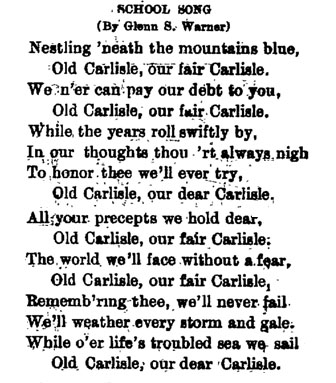
Here’s some real scholarship. “Keep a-goin’” was NOT a phrase that Warner repeated in the Carlisle school song. Follows is the school song as published in the January 25, 1907 edition of The Arrow. Also included is the poem from his 1927 book, Football for Coaches and Players, the place where the phrase can actually be found.

 carlisle-school-songkeep-a-goin-poem1


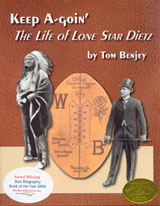
I picked this phrase for the title of Lone Star Dietz’s biography because of the way he kept going in spite of numerous setbacks and because he had it in his hand when he died. He also illustrated the book from which it came.