Old Sioux Chiefs Didn’t March In 1905 Inauguration

April 17, 2009

Previously, I wrote about the Carlisle Indian School contingent that marched in the 1905 Inauguration Parade to celebrate Theodore Roosevelt’s election as President. Six great chiefs, led by Geronimo, rode on horseback in front of the Carlisle Indian School Band. I didn’t write about the others who wanted to participate in the festivities.

Over a dozen old Sioux chiefs paid their own way to travel to Washington from the Rosebud and Standing Rock Reservations “…to march in their eagle feathers and war bonnets and paint down the avenue after the great Father who once lived out in their country.” Indian Commissioner Leupp would have none of it. He would not let the inauguration be a Wild West Show, that there was no place for these red men. He said, “The Indians will be represented by the chiefs of six famous nations at one time hostile to this country. …Directly behind these old chieftains, each of whom represents a nation once at war with this country and subdued only at great loss of life, will be 350 students of the Carlisle Indian School. My object is to contrast the old Indians of the warpath and the educated, manly Indians of today.”

Leupp would not budge and the old chiefs returned to Dakota without marching in the parade. They were not greeted by President Roosevelt who clapped his hands with delight and, like the others in his box, rose to his feet when the six chiefs passed.
Carlisle Indian School Floozies

April 14, 2009

Something that was brought out in the 1914 Joint Congressional Investigation of Carlisle Indian School is that, then as now, a few of the girls were floozies. Bertha D. Canfield, a teacher, raised the issues of morals during her testimony.

Mrs. Canfield. “…He [Superintendent Friedman] failed to assist and cooperate with Miss Gaither in most serious, cases of discipline with the girls. He ordered Miss Gaither to go with the girls to the gymnasium. She protested, saying there was no one on duty at girls’ quarters; that it was unsafe to leave the punished girls there alone. But at his request she was obliged to go; the result was that some boys got into girls’ quarters and spent the evening with the girls. __________ __________ whose immoral character was well known, was one of these girls. After all this was allowed to sing in public entertainments before the pupils and was taken to public places with the band, to Harrisburg to sing before the governor, and other public places, singing “Redwing” and dressing in Indian costume. This was done against the wish of the matron. Miss Gaither had requested before this that __________ _________ be sent home. If the matron’s wish had been complied with in the beginning, it would have been better for __________ __________ and her associates….”

An unnamed female student supported Mrs. Canfield’s testimony.

Miss _____________. You have heard the _____________ _____________ case brought up. She was a girl that was not of a very good character. She had a very good voice, and she was taken out several times with the band, and on one occasion she sang for the governor in Harrisburg and was put as a model for the school. And she was also the star here at commencement time, 1912, I think it was, when she sang. When they put up girls of that character that is only leading weaker girls to evil doings, because they think if a girl of that standing can rise up and be put as a model before the school they also can do those things.

Out of prurient interest and using the clues presented in the testimony, I researched Carlisle Indian School publications to determine who this hussy was. After I thought I had figured out who she was, I searched the document concerning the investigation for her name and found it. Interested readers can duplicate my research to learn for themselves exactly who this floozy was.

Thanks to Matt Bentley, we now know where to find the documentation concerning the 1914 Joint Congressional Investigation into Carlisle Indian School on-line. It can be found at: http://www.archive.org/details/hearingsbeforejo01unit

Bezdek NOT Only Man to Manage MLB & Coach NFL Teams

April 10, 2009

Baseball-Reference.com attributes states the following about former manager Hugo Bezdek to The Pittsburgh Pirates Encyclopedia:
“In 1937, he was hired by the NFL’s Cleveland Rams to be their head coach. This made him the only man ever to coach a NFL team and manage a MLB team. Cleveland only went 1-13 under his reign.”

HogNation.com made a similar claim. RizzoSports.com echoes that statement. Brendan Macgranachan stated it differently when writing about Bezdek: “The story of the only man to manage in the Major Leagues and coach a professional football team” on SeamHeads.com</as does his claim http://seamheads.com/blog/2008/11/29/the-legend-of-hugo-bezdek/.

They are all wrong. Not only were they wrong when they wrote, it was wrong when Bezdek coached the Rams. It was even wrong when he managed the Pirates. In the very early 1900s, the Philadelphia major league baseball teams were competing fiercely with each other, especially for players. Professional football was beginning to develop a following and, in 1902, David Berry, a football promoter from Western Pennsylvania, founded the National Football League. He succeeded in convincing both Philadelphia baseball teams to sponsor teams. The third member of the league was from Pittsburgh and may have been sponsored by that city’s big league baseball franchise. The Phillies’ manager also managed the football team but did not coach it. However, Connie Mack, the Athletics’ manager did coach the NFL team becoming the first man to manage a major league baseball team and to coach an NFL team. Hugo Bezdek did not manage the Pirates until 1918 and the Rams until 1937. Connie Mack also made his star lefthander, Rube Waddell, play on the football team, thus likely becoming the first person to play both major league baseball and pro football.

The NFL disbanded after its World Series that was played over the New Year holiday in Madison Square Garden. However, none of the three NFL teams participated. The winning team was a Syracuse squad that featured Carlisle Indians Bemus and Hawley Pierce on one side of the line and the Warner brothers, Pop and Bill, on the other.

Pete Hauser’s Demise Clarified

April 8, 2009

Today I received a fax of the front page of the July 22, 1935 edition of the Pawhuska Daily Journal Capital from the Oklahoma Historical Society. The combination news article/obituary clears up the questions regarding Pete Hauser’s untimely demise.

Pete spent the evening of Saturday, July 20, 1935 at a baseball game in Bartlesville, Oklahoma with two friends. Pete, Chauncey Archiquette and George Frass were about 4 miles out of Pawhuska on the Bartlesville Road when their car had a flat tire. For reasons unstated, they parked Archiquette’s car in the middle of the road. A good guess might be that at 3:00 a.m. on a Sunday morning in rural Oklahoma in 1935, they didn’t expect any traffic. As Pete was tightening the lug nuts, Archiquette stood in front of the car and waved at an oncoming vehicle to pass it on the left because there was more room. Miss Violet Stuart of Bartlesville was driving the oncoming car which was owned by her passenger, A. C. Applegate of Dewey. She attempted to pass the stopped car on its right and clipped its left front fender and killed Hauser by breaking his neck.

Pete and Chauncey were long-time friends as both had attended and played football at Haskell Institute and Carlisle Indian School. Pete was living with Chauncey at the time of the accident and was employed by a Depression-era government program, the Indian Emergency Conservation Work, a division of the Civilian Conservation Corps (CCC).

Pete was active in the American Legion after serving at Fort McArthur, Texas during WWI. His Legion Funeral Rites were held at Johnson Chapel. A Legion quartet sang at his funeral and a rifle squad fired a salute at graveside. Honorary pallbearers included old football chums Pop Warner, Jim Thorpe, Albert Exendine, Walter Mathews and Archiquette.

Carolyn Williams was essentially correct in her understanding of the accident.

Pete Hauser’s Demise

April 3, 2009

Last November I reported on an article that brought out some facts about Pete and Emil Hauser’s early lives. I recently reread it and noticed that I had overlooked something. The article from the The Kansan stated that he was killed in July 1935 while changing a tire near Bartlesville, Oklahoma. So far, I’ve come up mostly dry. I talked with Mark Schnabel, the reporter who wrote the piece, who told me he just reported what the speaker said. Now I’m trying to get in touch with the speaker, Carolyn Williams of the Halstead Historical Society. Like many historical societies in small towns, Halstead has very limited hours and I haven’t been able to make contact with her as yet.

I then browsed through the books I have in my possession and found mention of this event in the 2007 Sally Jenkins book. On page 307 she wrote, “He [Hauser] was killed in a roadside accident while changing a tire near Pawhuska in the 1940s.” Although her book has many endnotes, there is none for this item. I then began to look for a newspaper article about the accident and his obituary. I have found neither so far but haven’t completed the search. It will probably take a while.

While perusing the Cheyenne & Arapahoe censuses, I found his date of death. The 1934 tribal roll listed Pete Hauser as living on the Osage Indian Reservation. Perhaps he had married an Osage woman. That is something else to research. Pete’s listing was lined out but still readable. “Died 7/21/35” was handwritten above his last name. So, Carolyn Williams got it right about his date of death and Sally Jenkins got it wrong. Having the date of death established should help narrow down newspaper accounts of his death. Now for the location. The Osage Reservation is off US Route 60 more or less equidistant from Bartlesville and Pawhuska, which are 26 miles apart. Maybe I’ll get an email that solves the puzzle or I’ll locate a newspaper that covered it. Until then, it’s a loose end.

Indians Apply for Dickinson College Job

April 1, 2009

When looking through the Dickinson College archives for something else, the first paper I saw was a 1931 newspaper article announcing that Jim Thorpe had applied for the vacant head football coach position at that institution. Thorpe only wanted to coach there for a year because he was involved in business matters in the Oklahoma oil industry that were expected to occupy more of his time in the future. He was also negotiating with Mississippi A&M. Dickinson alum Gus Welch also applied for the position as did 50 others.

Neither of the Indians got the job as it was formally accepted by Joseph M. McCormick at the “D” banquet held on March 25th at the Molly Pitcher hotel. McCormick had been coaching at prep schools such as Mercersburg Academy and The Hill School. He had most recently coached at Roxbury School in Cheshire, CT. He led Dickinson’s Red Devils to their best season in six years. Thorpe took a job digging the foundation for a new hospital in Los Angeles. There was some truth to Thorpe’s story about the oil business, but it was in East Hawthorne, CA. The Jim Thorpe Petroleum Syndicate acquired 100 acres of land formerly owned by Gilbert Bessemyer. Jim was president of the syndicate and his cousin, Hawthorne’s chief of police, was one of the directors. In late April, the Putnam City school district announced that Thorpe had been hired as director of athletics for the rural school district located five miles west of Oklahoma City. In late June, he went into the movies to play, not surprisingly, Indian parts. He had small roles in a number of films. He spent New Year’s Day of 1932 watching the Rose Bowl, is first, as an Associate Press reporter.

Gus Welch became the head coach at Haskell Institute in 1933 after Lone Star Dietz departed for the NFL.

Rebirth of Chilocco Indian School

March 27, 2009

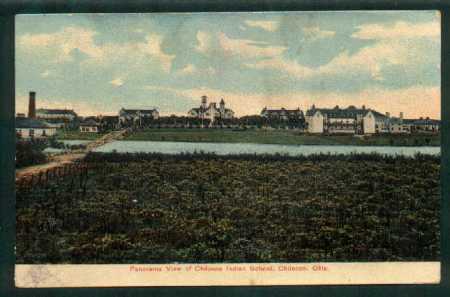
While conducting research on Lone Star Dietz in Kansas and Oklahoma, we drove past the long-closed Chilocco Indian School. Seeing that the gate was unlocked, we drove in the lane past cultivated fields, the school’s lake, and eventually into the center of the school’s campus. A caretaker noticed us wandering about and inquired about our presence there. She was puzzled because the gate was supposed to be locked as the grounds were not open to the public. She graciously allowed us to continue looking around.

The school closed its doors and, other than part of it being used by a drug rehabilitation program for some years, it has been fallow since 1980. Ivy has grown over some of the beautiful stone buildings. Decay would make renovating the campus an expensive undertaking, but well worth the investment. After bemoaning the sad state of this beautiful campus for some years, I came across something on the web that caught my eye.

Chilocco, “The Light On The Prairie,” has been deeded over to Council of Confederated Chilocco Tribes (CCCT) which consists of representatives from Kaw Nation, Otoe-Missouri Tribe, Pawnee Nation, Ponca Nation, and Tonkawa Tribe. The outer portions of the campus, consisting of large agricultural fields have been divided up among the five tribes for development . The 165 acres which comprise the central campus are held jointly. The Alumni Association, with a grant from Conoco-Phillips 66 Oil Company, is restoring the cemetery. The CCCT is raising money to be used to restore the buildings and create a museum. The Chilocco campus has been on the National Register of Historic Places for some time and is under consideration for nomination as a National Historic Landmark.

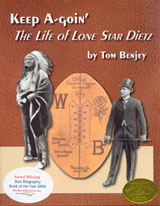
Some Carlisle students, such as Iva Miller (Jim Thorpe’s first wife), faculty and administrators also spent parts of their careers at Chilocco. I first became aware of Iva and Chilocco at the St. Louis World’s Fair of 1904. That story is told in Keep A-goin’: the life of Lone Star Dietz.

Chilocco Indian School campus

Chilocco Indian School campus

Talks at Retirement Centers

March 24, 2009

When the issue of giving book talks at retirement centers came up on a message board frequented by authors, some writers had found the experience not to be worthwhile. My experiences have been different – and that’s a good thing. Pennsylvania has the second oldest population of any state, behind Florida. As a result, Pennsylvania is home to quite a number of retirement centers that offer a variety of levels of care. Carlisle, being a county seat, has many of these homes with each one differing from the others in various ways. By giving talks at them, I have learned what they have in common. All are populated with significant numbers of people who are interested in history, particularly in local history.

I believe that my topic, the Carlisle Indian School, would be well-received by history buffs anywhere, it is of particular interest here where it was located. What I get out of the talks is the response from the attendees. Often, a person attends who knew people from the Indian School. One man swam with Jim Thorpe when he was a boy. Another had lunch with Thorpe a couple of times when Thorpe was passing through town and heard a friend of Thorpe’s lecture him on the evils of alcohol.

Sometimes I sell a few books, other times none at all. But that isn’t the point. These talks only take two hours of my time, door-to-door, so they cost me little to do. Some of the people who attend these talks cannot drive and have no practical way of getting to talks held at other places. These talks give shut-ins opportunities to interact with the outside world that they wouldn’t otherwise have. They also learn something because Carlisle Indian School is a fascinating and misunderstood topic.

I recommend that other authors seriously consider giving talks at retirement centers. It is rewarding and the retirees enjoy it.

Bogus Jim Thorpe Photo on ebay

March 19, 2009

Carlisle memorabilia collector Frank Loney asked my opinion about a photo that is currently up for sale on ebay. Immediately upon bringing up the item on ebay, I noticed that the photo could not be as advertised due to the seller’s description of it:


THIS IS AN INCREDIBLY RARE PIECE. IT IS AN ORIGINAL VINTAGE 1910 JIM THORPE FOOTBALL PHOTO. THIS WAS TAKEN AT THE CARLISLE INDIAN SCHOOL. THIS IS A 3×5″ PHOTO OF THE GREATEST ATHLETE OF ALL TIME WITH HIS TEAMMATES. INCREDIBLY AWESOME ! IF YOU HAVE ANY QUESTIONS ABOUT THE HISTORY OF THIS PHOTO, PLEASE DON’T HESITATE TO ASK.

As anyone who is at all familiar with Jim Thorpe knows, he was not at Carlisle in 1910. So, right off the bat, the date is wrong. One of the first things one sees when looking at the photo are his teammates’ names. The only problem is that those names aren’t the names of Carlisle Indian School football players. The uniforms the players are wearing are not Carlisle uniforms. This must be some other team. When one looks closely at Thorpe’s image on the photo, it is not Jim Thorpe, or at least not the Jim Thorpe who played at Carlisle. This is clearly not a photo of a Carlisle Indian School football team.


Frank contacted the seller before I looked at the photo and got this response:


this was purchased at sotheby’s auction. after examination by auction house. it was determined to be between 1908-1912. the picture came from his estate and is 100% legit. the other players were from the carlisle indian school which was a college. thank you.”


As we all know, Carlisle was never a college and never purported to be one. If Sotheby’s actually examined the photo, which I doubt, they blew it. All they needed was five minutes with Steckbeck’s book to determine this was neither Jim Thorpe nor the Carlisle Indians. This may well be an interesting photo but of different people and another team.


Be careful out there. Things aren’t always what they seem.

misindentified-carlisle-photo 

Jim Thorpe Fitness Center

March 16, 2009

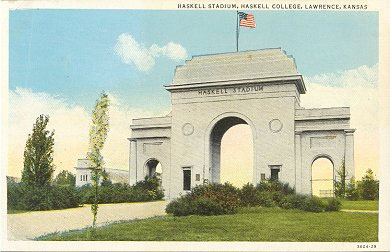
Not long ago it was my pleasure to inform readers that Carlisle, PA isn’t the only town to have Jim Thorpe on a mural. Now I can share that Carlisle Barracks isn’t the location of the only Jim Thorpe Fitness Center. Haskell Indian Nations University (HINU, Haskell Institute in Big Jim’s day) also has a Jim Thorpe Fitness Center. In fact, Haskell has had a Jim Thorpe Fitness Center for a couple of years – in a building constructed and named after the great athlete 50 years ago. A sign that formerly adorned the building’s exterior now hints to the building’s former use now hangs inside the building.

On Monday, March 9, 2009, Robert W. Wheeler, author of “Jim Thorpe: World’s Greatest Athlete,” gave a talk at the re-dedication of the Jim Thorpe Fitness Center as part of the commemoration of the 125th anniversary of Haskell’s founding. The building formerly known as the Jim Thorpe Power Plant now houses machines designed to help humans maintain their muscle tone rather than machines to eliminate the need for human muscle power.

In the audience was someone who also is familiar with Carlisle. Before joining the faculty of the University of Kansas, Bernie Kish was executive director for the College Football Hall of Fame for a decade. I met Dr. Kish there when researching Lone Star Dietz. Bernie recalled his time in Carlisle:

“I was a career military officer, serving in the US Army for over 29 years. In 1981, I attended the Army War College at Carlisle Barracks—the site of the Carlisle Indian School—in Carlisle, Pennsylvania. It was my privilege to play basketball in the same gymnasium and run laps on the same track as Thorpe, Lone Star, and Gus Welch. The biggest annual extra-curricular event at the War College is Jim Thorpe Sports Day. It is competition in ten sports among the military’s senior service schools, the Army, Navy and Air Force War Colleges plus the National War College and the Industrial College of the Armed Forces. For two days, these future generals forget their military studies and compete for the honor of taking home the Jim Thorpe Sports Day Trophy. I was the Athletic Director for the 1982 Sports Day and in that capacity came to know Carl Thorpe, Jim’s son, quite well. I still treasure the photo of Carl and me presenting the Sports Day awards.”

haskell-football-stadium