Guyon’s Groupie

August 17, 2009

Groupies are not a new phenomenon. Today I came across a 1903 article in the Lincoln Daily News with a Denver dateline with a sensational headline. FLED HER HAPPY HOME FOR INDIAN HALFBACK was followed by Beautiful Young Pueblo Girl Shows Her Infatuation for Guyan[sic], the Chippewa on Haskell Team. The article began, “In love with handsome Charles Guyan[sic], the full-blooded Chippewa halfback on the Haskell Indian football team, pretty Bertha Hodkinson of Pueblo, ran away from home and the team and Guyan were shadowed by relatives, with the result that the girl was caught today.”

The football hero in question is Charles Guyon (aka Wahoo) who enrolled at Carlisle in 1905. A detective was assigned to him the entire time he was in The Mile-High City for the game with Denver University. The reporter thought that the girl, “who is but 17 years old…had evidently been warned, for she did not join him then, nor attempted to do so until noon today.”

Guyon told Detective Emrich that he hadn’t seen Bertha since August when she wrote him to ask for his autograph. “He became acquainted with her in a casual way while travelling with the team last year, and her sixteen years were greatly impressed with his manly charms. ‘But I don’t want to be mixed up in any trouble,’ said Guyan. ‘I know these young girls, and if she comes here I’ll point her out to you. I don’t want trouble.’” When she appeared at the Metropole Hotel and asked for him, Guyon telephoned the detective who rushed to the hotel and arrested her.

Bertha told a different story, “No, I wasn’t stuck on the Indian. I only came to Denver to see the game and visit my friend, Mrs. Eisenhart of 1011 Thirteenth Street.” She claimed that it was always her intention to return home after the game. Mrs. Eisenhart said that she had no previous acquaintance with Miss Hodkinson, that the girl merely rented a room in her house while she was in town. The girl said that she was 18 years old and free to travel if she wishes. She had also bought a round-trip ticket.

Joe Little Twig, Another NFL Star

August 14, 2009

Last time, I mentioned a guy named Joe LittleTwig. It just so happens that Wini Caudell has a website dedicated to him. You see, if things had turned out differently, he might have been Wini’s grandfather. But they didn’t.

Joe is believed to be Mohawk born on or near the Cattaraugus Reservation in New York State. After attending school on the reservation, he enrolled at Carlisle Indian School. So far, I haven’t been able to locate any record of him at Carlisle, but this isn’t all that unusual. Sometimes, different names were used. School employees often spelled named creatively, something that makes searching difficult. There’s a good chance that LittleTwig was young and not fully developed physically, a factor that would likely have kept him from making the varsity team. It’s almost impossible to identify players on any of the other teams at the school.

After leaving Carlisle, he served in WWI, but I have no details on that yet. After the war, he turned his hand to professional football and had more success than most. Researching his pro football career may be easier than researching his earlier life because some records-and a book-exist about the Oorang Indians and newspapers covered the early NFL games to some extent. Because he settled in Canton, either the local historical society or the Pro Football Hall of Fame, which is located there, may have information on his life after football.

Wini Caudell’s site about Joe LittleTwig: http://www.rockislandindependents.com/Players/All%20Players/joejohnson.htm

Unexpected Carlisle Indians in the NFL

August 12, 2009

While researching Carlisle Indian School alums who played in the NFL, I came across an unexpected name—Frank Lonestar. Everyone is well aware that Lone Star Dietz coached the Redskins in 1933 and 1934 but I bet few know that Frank Lonestar played for the Columbus Panhandles in 1920, the league’s inaugural year. A website stated that he played three games at guard for the Panhandles that year. So far, I’ve found newspaper coverage for one game with his name in the lineup. That one was a losing effort against the Detroit Heralds.

I was well aware that Frank, a Chippewa from Wisconsin, was much involved in extracurricular activities such as the Invincible Debating Society and was an officer in his class (the same one as Gus Welch), but had no idea that he was a football player of note. He probably played for his shop team, the Printers, but many boys did that. I was unaware of him being on the varsity squad and doubt that he was. He apparently left Carlisle around 1911 to practice his trade after getting useful experience printing school publications. But that’s about all I know about him.

Also on the 1920 Columbus Panhandles, at least for awhile, was Littleboy, or someone with a similar name. The October 17, 1920 Fort Wayne Journal-Gazette included a photo of four stars the local team, the Friars, would be facing when taking on the Columbus Panhandles later that day. Included in the photo and expected lineup was someone named Littleboy. A little research should determine if this person was Carlisle’s Little Boy. This Littleboy played left halfback in the Columbus-Detroit game mentioned previously.

I’m also learning about another Carlisle student who played in the NFL but doesn’t appear to have starred on the legendary Indian teams. Joe “Little Twig” Johnson began his NFL career with the 1922 Oorang Indians, but, unlike the majority of his teammates, had a significant pro career after Oorang’s demise. It appears that the Carlisle Indians were more involved in the early NFL than I thought.

Not All Carlisle Indians Were Indians

August 6, 2009

Not all Carlisle Indian School Students were Indians, but you knew that from the previous posts about Iva Miller. Iva may have had a few drops of Indian blood but not enough to qualify her as an Indian for purposes of the school or a tribe. However, she wasn’t the first non-Indian to attend the school.

Much has been written about Sylvester Long who enrolled at the school as a half-blood Cherokee. His later claim of being the son of a Blackfoot chief led to the discovery that, although he had considerable Indian blood on both sides of his family, he was considered to be black at the time because of his African-American blood in the segregated south. The controversy over whether Lone Star Dietz had Indian blood or not is well known and will continue unless definitive evidence is found. Recently, I discovered another Carlisle student was not an Indian and Superintendent Pratt knew it.

In one of Richard Henry Pratt’s pieces about the early days of the school, he wrote about a white woman and her son who had been captured by the Sioux. While a captive, she married a Sioux man and had children with him. She later had the choice to return to her original community but chose to stay with the Sioux and considered herself Sioux. However, when Pratt came around recruiting students for his new school, she decided to send her white son to be educated by his own people. At Carlisle, he was given or chose the name Stephen. This was a case of a white boy with no Sioux blood who the tribe considered to be one of its own. Pratt didn’t say what he did after leaving Carlisle. It would be interesting to know which path he took.

Dillon-LaForge Wedding – part 2

August 3, 2009

The bridesmaids and maid of honor, in their white gowns, proceeded up the aisle between guidons and school colors held by cadet sergeants who were stationed at intervals. The bride was escorted up the aisle by Major Mercer. “As the party reached the stage, the bridegroom-to-be attired in a [cadet] captain’s uniform emerged from the first entrance to the left of the brilliantly lighted scene. He was closely followed by the groom’s party consisting of Messrs. Sheldon, Scholder, Venne, Exendine, and Denny, who also wore the full uniform of their rank. As the parties met on the stage, they formed a semi-circle in front of the chancel, before which was the Rev. Dr. Norcross who performed the ceremony.”

Major Mercer gave the bride away and the ceremony continued. At the end of the brief ceremony, “the orchestra again broke forth with the wedding march and the party proceded down the aisle under a canopy of crossed cavalry guidons.” After leaving the auditorium, the bridal party walked the short distance to the gymnasium that had been “elaborately decorated for the occasion,” along with a large number of specially invited guests.

Major and Mrs. Mercer presented the guests to the newly wedded couple. Wedding gifts filled several tables that had been positioned specifically for the purpose. No mention was made of the food served, the music that was played, or the rituals that were observed during the reception. It’s fair to assume that the chicken dance wasn’t one of them.

When the newlyweds departed to catch the ten o’clock train for Washington, they were showered with rice and old shoes. After their honeymoon, they returned to work at the school. He played football on the varsity team the following fall.

Although simple when compared to many contemporary weddings, this celebration was surely much more elaborate than those of all but the wealthiest girls at that time.

Carlisle Indian School Weddings

July 31, 2009

The subject of weddings at Carlisle Indian School recently came up in a conversation with the granddaughter of a Carlisle Indian School student. This subject hasn’t received much attention in the past. Sure, Jim Thorpe’s marriage to Iva Miller was a major national media event in its day, but weddings of non-celebrities or non-celebrities have received little attention since the actual events took place. Let’s take a look at one that might be more representative of student weddings.

Charles Dillon, who is probably best remembered as being the Sioux lineman under whose jersey the pigskin was concealed in the hidden-ball play, was the groom. Rosa LaForge, Crow, was the bride. Because the boys at the school were organized as military cadets, they wore their dress uniforms for the nuptials which were held in the school’s auditorium. The auditorium was full of students and “a large number of invited guests.” The stage was arranged as the alter area of a church, presumably similar to a Presbyterian church because the Rev. Dr. Norcross officiated the Presbyterian ceremony. “The scene already gorgeous beyond description was greatly enhanced by color-sergeant [Nicholas Bowen] taking position with the national and school colors [Mike Balenti] on each side of the stage.”

As the orchestra began playing the Wedding March from Tannhauser, the doors threw open and the bridal party consisting of maid of honor Louise French; bridesmaids Christine Childs, Savannah Beck, Minnie Nick and Annie Goyitney ; and the bride on the arm of Superintendent Major William A. Mercer proceeded up the aisle. “The tall and stately bride was attired in a beautiful white silk gown with a long train. She wore a long veil and carried a gorgeous boquet [sic] of bridal roses. Miss French the maid of honor carried a boquet [sic] of white carnations. Major Mercer appeared in the rich full dress of the army.”

<continued next time>

Single-Wing Revisited

July 28, 2009

When addressing the incorrect assertion that Pop Warner had developed the single-wing formation while he was coaching at Pitt and Stanford in the 1920s by www.footballhistorian.com, I neglected to include a piece of evidence that demonstrates this statement is patently false.

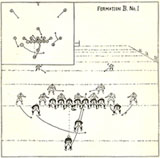
Below is a photograph of the 1915 Washington State College team lined up in an unbalanced-line single wing formation. The photo can be found on page 79 of Richard Fry’s beautiful book, The Crimson and the Gray: 100 Years with the WSU Cougars, which has unfortunately gone out of print. (Something needs to be done about that.) The identities of the players, uniforms and helmets accurately date the photo. Lone Star Dietz, a single-wing aficionado, coached WSC for the 1915-17 seasons, so it is logical that his team would run it and the double-wing.

Dietz played on the Carlisle Indian School teams from 1909-11, then assisted Pop Warner from 1912-14. After the end of the 1914 season, Warner and Dietz headed to greener pastures. Warner took the head coaching job at Pitt and Dietz caught the train to Pullman.

If Warner hadn’t developed the single-wing at Carlisle as he said, this photo would mean that Lone Star came up with it on his own and never took credit for it, which is highly unlikely. Some of the confusion may be of Warner’s making.

Pop’s correspondence course (1908-11) and his first coaching book (1912) do not include this formation; they show earlier evolutions with balanced lines. The formation in the photo is the one Warner calls Formation A in his 1927 book. He likely held back his best stuff in his earlier publications because it is doubtful that Dietz would have been running the unbalanced-line single-wing as a primary formation in 1915 had it not been perfected used at Carlisle some years before.

WSC Single-Wing 1915

Carlisle’s First All-America Selections

July 23, 2009

While researching the 1905 Carlisle-Massillon game for an article in an upcoming issue of the Professional Football Researchers Association’s (PFRA) journal, The Coffin Corner, I came across a statement in the late Robert W. Peterson’s Pigskin: the early years of pro football that caught my eye. Of course it has nothing to do with the article but it made me curious.

Peterson wrote, “It was not sectional chauvinism at work when 129 out of 132 All-American berths between 1889 and 1900 were filled by players from those four schools [Harvard, Yale, Princeton & Penn]. The best players were really there.” I recalled that Carlisle’s first Walter Camp first team All-American was Isaac Seneca in 1899. If Peterson was accurate, that would put Seneca and the Carlisle program at a lofty level.

The Walter Camp website lists all of his All-America teams beginning in 1892 when he created the concept of such a team. Sure enough, all the players named were from the Big Four until 1895 when Cornell’s Clinton R. Wyckoff was named to the team. The next non-Big Four player to be named was Clarence B. Herschberger of Chicago in 1898. Seneca became the third in 1899. The fourth was William Morley of Columbia in 1900. Whether Peterson was right depends on the meaning of between. Does between include the 1900 team?

Things changed a lot in 1901 when four outsiders were selected: two from Army, one from Cornell (Pop Warner’s younger brother) and one from Columbia. In 1902, Paul B. Bunker of Army, a repeat from the previous year, was the only non-Big Four player on the list. And in 1903, Carlisle had its second All-American in the person of James Johnson. H. J. Hopper of Dartmouth, Willie Heston of Michigan, and Richard Smith of Columbia were also on that team.

Here’s a question? Did Carlisle have a first Team All-American before any Big Ten school had one? (Disregard when schools entered and left the Big Ten for this question.)

Oklahoma’s Carlisle Indian School Immortals Now Available

July 21, 2009

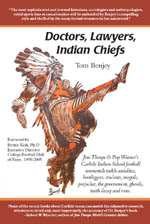
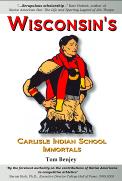
I received some great news over the weekend– Oklahoma’s Carlisle Indian School Immortals have shipped and should be available for sale and immediate shipment by mid-week at www.Tuxedo-Press.com and next week from other booksellers. This book is not recommended for people who already have Doctors, Lawyers, Indian Chiefs because most of the material in the new book can be found in it. This may not sound like it makes sense, so I’ll explain.

Doctors, Lawyers, Indian Chiefs, in my opinion, contains a lot of information that is of interest to young people. However, at 160,000 words, it is inaccessible to youngsters. As an aside, adults tell me they don’t necessarily read it in sequence because its organization allows readers to skip around, reading sections or chapters they find interesting at a particular time and others at other times. Still others use it as a reference book because most of these men’s life stories have been told nowhere else. By splitting this book into a series by state, each volume is short enough that children can read it. A benefit to me is that I was able to include two people who weren’t in Doctors, Lawyers, Indian Chiefs: Mike Balenti and Henry Roberts. Perhaps when I finish the series I will make a second edition of Doctors, Lawyers, Indian Chiefs that includes all the new people that were added in the series.

Also, Oklahoma’s Carlisle Indian School Immortals is in hardback with a glossy cover, something that should make it an attractive Christmas gift, particularly for children with roots in Oklahoma. If it sounds like I am on a soapbox, it is because I am. Our children and grandchildren should know about these people and much of what has been written about Carlisle Indian School is distorted at best.

Archiquette Played Against Carlisle

July 17, 2009

While researching the 1905 Carlisle-Massillon game for an article in an upcoming issue of The Coffin Corner, I noticed that Chauncey Archiquette played in that game. I hadn’t previously realized that he was back in a Carlisle uniform in 1905, but he most definitely was. That line-ups in newspaper coverage of games played that year generally include his name support that fact. In Steckbeck’s Fabulous Redmen, the line-ups for the 1904 Carlisle-Haskell game are on the page opposite the beginning of his discussion of the 1905 season. I noticed that Archiquette was in the line-up for that game as well. However, he wore a Haskell uniform. A look into Archiquette’s file showed that, after graduating from Carlisle in 1899, Chauncey had enrolled in a commercial course at Haskell. Newspaper accounts of Haskell games indicated that he had indeed played football for Haskell. This also explains how Archiquette happened to be at Haskell where, among other things, he became a young Jim Thorpe’s idol.

Few Carlisle players played against their old team after leaving the school. James Phillips, for example, refused to suit up for Northwestern in 1903 when they played the Indians. Instead, he watched the game from the stands. Joe Guyon is a notable exception in that he played in the humiliation of the hapless 1917 squad. He started the game but played just a little more than a quarter in which time he scored two touchdowns. Archiquette joined that small group in 1904 when the two Indian schools met for the only time.

Steckbeck marked nine Haskell players’ names with asterisks to denote that, after the 1904 thrashing, they “later enrolled at Carlisle.” It is worthwhile to note that Pop Warner was not at Carlisle for neither the 1904 season when the game was played, nor for the 1905 and 1906 seasons when many of the players transferred.