Gus Welch Was a Redskin

February 13, 2010

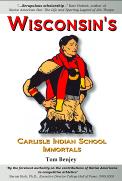
While working on Gus Welch’s chapter for the upcoming “Wisconsin’s Carlisle Indian School Immortals,” I read a letter in his Carlisle Indian School file that he wrote to Superintendent John Francis in June 1917 about his experiences in Reserve Officers Training Camp at Fort Niagara, New York. Most of the letter dealt with the severe headaches Welch was suffering at the rifle range. After fracturing both his cheekbone and the base of his skull in a collision with Ray “Iron Eich” Eichenlaub in the 1914 Notre Dame game, Gus disobeyed doctor’s orders and checked himself out of the hospital prematurely. His physician described his injury as one “…which requires absolute rest to insure a future without invalidism, such as epilepsy, paralysis, deafness or loss of sight, any one of which might develop in after years from recklessness or negligence at this time.” Fortunately for Gus, none of these things happened, but not by much.

Gus also wrote about the standards he held himself to: I have done my best, keeping always in mind that I was a Carlisle man. I also had to remember that I was the only Redskin in camp, and of course my errors would naturally look larger than the other fellows.” It is significant that he referred to himself as a Redskin, something he was proud of being. Welch was no shrinking violet or “Uncle Tom.” When the Federal Government appropriated some of his land for a highway, he didn’t take it lying down. He fought them as hard as he could, using his legal skills learned at Dickinson School of Law and in his years of practice.

This is evidence that, less than 100 years ago, Redskins was not a derogative term. It seems not to have been derogative until some activists “discovered” alternative meanings in the 1960s.

More on Oscar Hunt

February 10, 2010

Yesterday, I received an email from Bill Welge with some news about Oscar Hunt. He wrote that he or his staff at the Oklahoma Historical Society found information about the events leading up to Oscar Hunt’s death. Apparently, he found some newspaper articles that cover the death of someone else and his death. He was charged with murdering someone and, according to the newspaper coverage, may have possibly committed the crime. It will be interesting to see if the cause of his death was as reported in the Carlisle Indian School newspaper or was suicide as W. G. Thompson stated that it was. Major Mercer and W. G. Thompson appear to have been seriously at odds with each other at the time of Hunt’s death as Mercer had eliminated Thompson’s position, along with a few others, at the end of the previous fiscal year. Thompson’s 1907 letter to Dr. Carlos Montezuma, another person who had been supportive of the school when Richard Henry Pratt was in charge but became a critic during Mercer’s tenure, was quite critical of Mercer’s management of the school. So, Thompson’s charges cannot be accepted without confirming their accuracy. I am waiting with baited breath to see the newspaper articles Bill Welge found. After I receive them, I will share the information I find with the McDonald County Historical Society. Tiff City, Missouri, the location of Oscar Hunt’s reported death and one of the locations related with Mathias Splitlog, is in McDonald County. Unfortunately, their current curator wasn’t able to locate information on Oscar Hunt. His predecessor, Mrs. Pauline Carnell, had researched Splitlog but she died in 2007. I will also share the information here but don’t expect to see it much less than two weeks from now because of my personal schedule.

Oscar Hunt’s Mysterious Demise

February 4, 2010

While reading a letter from W. G. Thompson, who had been removed from his administrative position at Carlisle Indian School by Major Mercer, to Dr. Carlos Montezuma, Thompson claimed that former Carlisle football player Oscar Hunt had committed suicide in jail while awaiting trial for murder. An April 1907 issue of The Arrow reported that Hunt had died on March 22, 1907 in Tiff City, Missouri: “He was taken with a congestive chill and after four days of delirium, died….” Unraveling this controversy has been difficult but has uncovered some interesting information.

The always helpful Bill Welge of the Oklahoma Historical Society has read numerous old newspapers in an attempt to determine what actually happened to Mr. Hunt. He informed me that Oscar’s grandfather, Mathias Splitlog, was a very wealthy man. That explained why some newspaper articles during Hunt’s football career described him as a millionaire. Splitlog was more interesting for what he accomplished than for becoming wealthy.

Accounts of Splitlog’s origin vary. Some have him being born in Canada, others in New York. Some say he was Cayuga, others claim he was Wyandot. Somehow he later became a Seneca chief. Still others claim that he was stolen by Indians as a baby. According to one account, his mother named him Splitlog because his mother saw a split log nearby shortly after giving birth to him. How he acquired his Christian name is not known.

Although illiterate, Splitlog was extremely intelligent and was a visionary and a highly skilled mechanic. A story I find interesting is how, after looking at a steamboat, he constructed one of his own and operated it on the Great Lakes. Apparently, he was the only one able to figure out how to run its controls. That boat is depicted in a stained glass window in Kansas City City Hall: http://www.kckpl.lib.ks.us/kscoll/lochist/twach/window2.htm

More on Mathias Splitlog later.

A Fire at Wardecker’s

February 1, 2010

On Friday at noon, I checked the Carlisle Sentinel on-line to see what, if anything, was in the news. An article saying that North Hanover Street, one of the two main drags through town, was closed. On reading the article, which was time-stamped 11:30 a.m., I learned that a fire in the building that houses Wardecker’s Mens Wear, was the cause of the street closing. I wasn’t too worried about my friend Freddy Wardecker, the proprietor of the business because he would surely have been able to get out of the building quickly. However, I was worried that his collection of Carlisle artifacts might have burned.

Wardecker’s Mens Wear, formerly Blumenthals, was in operation when the Indian School was located nearby at Carlisle Barracks. Mose Blumenthal worked as a tailor at the school and operated his store downtown. As a result of his close association with the staff and students, he established a business relationship with the school’s athletic department. Pop Warner or the Superintendent would send chits to Blumenthals that authorized the boys listed on the chits to be given clothing in the amount stated on the chit. The boys would come in to the store, select the clothing items they wanted, and socialize. Blumenthal had a page or pages in a ledger for each of the boys on which he would record the clothing they had received and the amounts he received in payment. If the clothing cost more than the amount on the chit, the boy had to come up with the difference.

In later years when these men returned to Carlisle, these men dropped in at Wardecker’s to visit and sometimes signed their photographs. The store has Carlisle Indian School memorabilia as well as irreplaceable original documents. It would have been a catastrophe had these items burned. Fortunately, they didn’t.

A visit to Wardecker’s is necessary for anyone interested in Carlisle Indian School and especially so for researchers. It’s good that it is still possible.

Wallace Denny for Hall of Fame

January 28, 2010

While researching the life of Wallace Denny for “Wisconsin’s Carlisle Indian School Immortals,” I became curious of whether trainers can be inducted into the College Football Hall of Fame. The short answer is yes but not through the same process as coaches and players. A trainer can be nominated for the Outstanding Contribution to Amateur Football Award. It seems like a longshot but I may just nominate him.

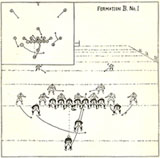
Wallace Denny, fullblood Oneida, started his football career as a player for the Carlisle Indian School. When Pop Warner arrived in 1899, he observed that Denny had more to offer off the field than on it, at least while play was in progress, and made Denny his “utility man.” Wallace became Warner’s right-hand man. He put the chalk lines on the field, repaired equipment and rubbed players’ aching muscles. Before long, he was tending to various injuries, aches and pains. He and Warner improvised appliances to protect wounded parts of players’ bodies to allow them to play. Over time, Denny became a bit of a psychiatrist as he counseled players who needed psychological boosts. When Warner was back at Cornell from 1904 through 1906, Wallace and Bemus Pierce devised a set of signals that used words from their native languages to identify the various plays Carlisle ran. The opposition was told exactly which play was to be run but they understood neither the words nor the plays they represented.

Warner and Denny rejoined again in 1907 when Warner returned to Carlisle and remained a team until they retired in 1940. Denny didn’t move to Pittsburgh with Warner in 1915 but may have joined him on football weekends because Charlie Moran served as trainer for Carlisle’s coach in 1915, Victor Kelley.

Wallace Denny became a trainer before such a position existed and pioneered it for four decades. By the time he retired, trainers were standard members of coaching staffs.

Pacific Northwest Trip Canceled

January 26, 2010

The October 24, 1908 edition of The Anaconda Standard reported, in an article titled “Carlisle Cancels Northwestern Trip,” on a wire sent from Portland, Ore. on October 20. The wire began, “The games between the Carlisle Indians and W. S. C. and Multnomah A. C. are off, a letter from the Indians to Manager Martin Pratt of Multnomah yesterday announcing that the proposed expedition had been canceled. The news was badly received at Multnomah, where the clubmen were counting on the Carlisle game as the big attraction of the year from an attendance standpoint.”

W. S. C. stands for Washington State College, which is known today as Washington State University. A strong tie with Carlisle Indian School and the Warner System was established in 1915 when Lone Star Dietz left Carlisle to turn around W. S. C.’s football team and lead them to an undefeated season and a victory on New Year’s Day in Pasadena to establish the Rose Bowl tradition. Dietz was followed as head football coach first by Gus Welch and later by Albert Exendine. Multnomah Athletic Club was founded in 1891 and still operates in Portland, Oregon. At that time, they fielded one of the better football teams on the West Coast.

Carlisle Indian School publications made no mention of this. In fact, the November 6 issue of The Carlisle Arrow made no mention of any games, real or imagined, after the Thanksgiving Day game with St. Louis University. The November 20 issue included this little item:

Our Varsity team will leave for the west on Wednesday, with our coach and the substitutes, to play with Minnesota University, St. Louis University, Nebraska University, and Denver University.

No mention was ever made of a possible extension of the trip to the Pacific Northwest. The Indians lost to Minnesota, 11-6, and athletic relations between the schools were severed for reasons left unstated. The Indians then won the remaining 3 games on their long schedule to finish the 1908 season 10-2-1. The other loss was a 17-0 defeat by Harvard. The other blemish on their record was a 6-6 tie with Penn.

A False Report

January 18, 2010

In August 1897, a newspaper article with a dateline of Chicago was widely reported:

With sly and careful steps David McFarland, halfback of the famous Carlisle Indian football team, came into the corridor of the Palmer House yesterday afternoon, glancing from side to side in a nervous manner. On reaching the hotel desk the Indian heaved a sigh of relief and said to Chief Clerk Grant:

“I am all right at last. I guess they won’t catch me after all,” and then the Indian asked for some paper, saying he wanted to write a letter.

After being held five days by members of his tribe, the Nez Perce Indians, in Idaho, near Spokane Falls, McFarland managed to escape and make his way to Chicago, and last evening he left for the school at Carlisle. According to the story he told a reporter the members of the tribe did not want him to return to his school, but to stay on the reservation and become a chief. At present the father of the young football player is chief of the tribe, but he is growing old. Young McFarland is the popular choice of the members of the once famous tribe and they want him to become their chief. But the influence of the school, along with the glory of football, according to his own confession, is more attractive than being chief of 1,000 Indians.

 About a week later, eastern papers contradicted the earlier report:

David McFarland, the half back of the Indian school football team, has arrived at Carlisle, Pa., from the West. He emphatically denies the telegraphic reports which stated that he was captured and held a prisoner for five days by the Nez Perce Indians, who desired to keep him away from Carlisle school and make him their chief.

This just goes to show that newspaper reporting has never been as accurate as some would have us believe.

School’s Closing Not Inevitable

January 14, 2010

Conventional wisdom has it that Carlisle Indian School declined after the 1914 congressional investigation until it died a natural death in 1918. I came across some items that raise doubt about that conclusion. The May 24, 1918 issue of The Carlisle Arrow and Red Man listed the schedule for the upcoming football season. The 9-games scheduled included such powerhouses as Pitt and Army but didn’t include many of the powers the Indians faced during their glory days. It seems unlikely that this schedule would have been arranged if the school was expected to close before the start of the next school year.

Newspaper coverage of the school’s commencement activities held on June 6 did not even hint that the school was about to close. Mid-June newspapers announced that the government was considering the lengthening of Carlisle’s enrollment by two years to allow students to complete a college preparatory program. In addition to the educational advantages, the school would be able to attract star athletes. It wasn’t reported if this bill was ever decided upon, probably because it was overtaken by events.

In mid-July the government announced that the school was to be closed and the army was taking Carlisle Barracks back to be used as a hospital to treat soldiers that were wounded in WWI. The transition took place in less than six weeks, so it is fair to assume that it was not as orderly as it would have been had it been planned for some period of time.

Enrollment was down to about 680 students at the time of closing, due in significant part to students and potential students enlisting in the armed forces. Carlisle and the Indian community at large were overrepresented in the military although non-citizen Indians were not subject to the draft. Some even went to Canada to join their forces before the U. S. entered the war. After the U. S. entered the fray, Carlisle school newspapers were filled with items about Carlisle alums who had joined up. Those who were commissioned officers, such as Gus Welch, Frank Mt. Pleasant and William Gardner, received extra coverage.

It would have been interesting to see what might have happened if the army had delayed its decision until November 11, 1918. It will also be interesting to read what Gen. Pratt had to say about the school’s closing.

1923 Louisiana Tech-Centenary College Game

January 12, 2010

A reader submitted the photo included at the bottom of this post. I’m sorry that it isn’t clearer but this is what I was sent. I have never seen or even heard of one of these buttons before. It is purported to be a button for the 1923 Louisiana Tech-Centenary College annual Thanksgiving Day game. I can’t make out the date from the button but believe that it is authentic because Louisiana Tech played Centenary on Thanksgiving Day in 1922 and 1923, both years that Dietz coached in the Pelican State. Also, it seems unlikely that a forger would pick a relatively obscure event rather than one that would generate more interest (read a higher price). Let’s talk a little about Lone Star’s time in Ruston, Louisiana.

Lone Star coached the Bulldogs for two years compiling an 11-3-1 record with two of the losses coming at the hands of the Centenary Gentlemen. Less than half of those games were played at home at a time when strong teams generally played most of their games at home. (Note that Carlisle Indian School and Haskell Institute were strong teams that played most of their games on the road, a factor that makes their records all the more astounding.) Louisiana Tech had done well before Dietz’s arrival but against weaker opposition. He was apparently hired to upgrade the program and he did.

No reason was given for Dietz’s departure for Wyoming but money cannot be discounted. Wyoming wanted to upgrade its program and hired Dietz to do that. Also, Dietz had remarried in early 1922 to a woman from Indiana and may have needed more income. Even when single, the dapper Dietz was never known as being a miser.

Dietz’s history of putting life into previously lifeless programs while compiling a Hall-of-Fame worthy record is a strong argument for his induction into the College Football Hall of Fame.

Correct Information Is Hard to Find

January 8, 2010

A November 27, 1949 newspaper article by Deke Houlgate discussed the problems Warner Brothers were having with a screenplay for Jim Thorpe’s biopic. Several scripts had been written and discarded but a new one, titled “All-American,” was expected from the screenwriters soon. However, he questioned how good it would be given the problems the writers faced. He wrote, “One of the present problems at the Burbank studio seems to be that the records for this famous team–records that must reach back prior to World War I—no longer exists or are easily obtainable. The Army of the United States took over the school or campus, without asking, for the use of its fledgling doctors in 1917 and scattered students plus pertinent data all the way from Lawrence, Kansas, to Riverside, California.”

Like most newspaper reporters, Houlgate had some details wrong but he did better than most. First, the Army took Carlisle Barracks back in 1918, not 1917. Second, the facility wasn’t used for “fledgling doctors” as that came later. In 1918 it was used as a hospital to treat soldiers wounded in WWI. Houlgate went on to attempt to set the record straight on some legends that unfortunately still persist:

First off, Carlisle never had an undefeated, untied season. The Indians came close to a perfect record many times but always managed to lose at least one game. Next Jim Thorpe was not the first or only All-American. Third, Pop Warner did not bring Carlisle from obscurity to fame because Bemus Pierce and Metoxen were recognized as All-Americans by Walter Camp in 1896 or years before Glenn Scobie ever coached there.

Houlgate is correct about everything in the last paragraph except that Walter Camp first recognized a Carlisle player as a first team All-American in 1899 when he selected Isaac Seneca as a halfback. He may have named Pierce and Metoxen to his second or third teams but I don’t have a reference at hand to verify that. Whether or not Camp named Carlisle Indians to his All-America teams does not mean that Houlgate’s point is incorrect. The team and its star players were indeed famous before Warner was hired to coach them.