October 25, 2011
My proton therapy treatment for prostate cancer was completed two months ago today. So far, so good. Last Thursday, I spoke at the annual training meeting of the New Jersey Association of Veteran Service officers in Atlantic City. It was a great meeting. I was received well by the VSOs in attendance and learned much from other speakers. I was pleasantly surprised by the interest the VSOs showed in helping the vets they serve. VSOs are generally government workers who are employees of the counties in which their offices are located. Government workers can sometimes be less than interested in helping the public. Not so with the VSOs I met. Most of the men and women I met at the meeting were veterans. That surely influences how they relate to vets seeking assistance. Some of the VSOs were also disabled. If memory serves, three of them used motorized chairs to get around and another one used a manual wheelchair.
My talk was fit in at the end of a packed schedule. Even though they were attending a banquet a little later that day, most stayed for my talk and listened attentively. Some asked good questions and afterwards some informed me of benefits that aren’t widely known. For example, a 100% rating is not always the maximum. Under certain conditions, disabled vets can be awarded considerably more than 100%. I doubt if I am eligible for Special Monthly Compensation (SMC), but the old sergeant I served with may be because he has a number of serious medical conditions, more than one of which is an Agent Orange disease.
Several people took copies of Prostate Cancer and the Veteran home with them because it contains some information that is new to them. Of course, they already knew all about dealing with the VA.
Tags: Proton Therapy, Veteran Service Officer
Posted in Prostate Cancer | Leave a Comment »
October 16, 2011
Several details regarding Carlisle’s dominance over the Big Ten teams they played need to be addressed. First off is when the games were played. The first of these games was played in 1896 and the last in 1909. 1908 is the last year for a post-season road trip as the Penn State games were regular season games played against an in-state team that wasn’t their equal. 1907 was the only one of the seasons in which these games were played that Carlisle had a one-loss season. None were played in Carlisle’s 1911-13 glory days. Warner complained that the bigger teams stopped scheduling games with Carlisle after they became strong. It appears that he was accurate in the case of Big Ten teams.
Eight of these games, a slight minority, were played when Warner wasn’t coaching Carlisle. He did coach the Indians against Chicago in 1907, Minnesota in 1907 and 1908, Northwestern in 1903, Nebraska in 1908 and Penn State in 1907-1909. Penn State was improving at the time but hadn’t reached the level of Carlisle’s major opponents. Pop Warner considered the victory over Amos Alonzo Stagg’s 1907 Chicago team to be one of his greatest because Stagg thought he had his strongest team to date that year. 1907 was the first year in which Carlisle was defeated but one time. It was also the first year the Indians defeated Harvard, one of the Big Three. The only loss was to another of the Big Three, Princeton. It was also the first year that Carlisle beat two of the Big Four, Penn and Harvard.
1908 marked the end of Carlisle’s post-season trips to play Big Ten teams. That year the Indians defeated Nebraska in the teams’ only meeting 37-6 and they lost to Minnesota 11-6, in their last meeting with the Gophers. Newspaper accounts alluded to something happening in the game to sour the two schools against playing each other, but I haven’t uncovered the details yet.
Tags: Chicago, Harvard, Minnesota, Nebraska, Princeton, Stagg
Posted in Carlisle Indian School, Football, Pop Warner | 2 Comments »
October 12, 2011
This year Nebraska joins the Big Ten bringing the number of schools in the Big Ten up to twelve and leaving the Big 12 with only 10. It came to mind that the Carlisle Indians once played Nebraska in 1908 because a history professor at Nebraska is using “Doctors, Lawyers, Indian Chiefs” as a textbook. Other than Penn State, these games were usually post-season road trips played against the Champions of the West or strong contenders for that title. That the Indians went 13-3-1 in road games against these much larger schools. This is more evidence that shows Carlisle’s record needs no embellishment.
| School |
Times
Played |
Wins |
Losses |
Ties |
Years |
| Chicago |
1 |
1 |
0 |
0 |
1907* |
| Illinois |
2 |
2 |
0 |
0 |
1897, 1898 |
| Michigan |
1 |
0 |
1 |
0 |
1901*+ |
| Minnesota |
3 |
2 |
1 |
0 |
1906*, 1907, 1908 |
| Nebraska |
1 |
1 |
0 |
0 |
1908 |
| Northwestern |
1 |
1 |
0 |
0 |
1903* |
| Ohio State |
1 |
1 |
0 |
0 |
1904 |
| Penn State |
6 |
4 |
1 |
1 |
1896, 1905-1909 |
| Wisconsin |
1 |
1 |
0 |
0 |
1896* |
| Total |
17 |
13 |
3 |
1 |
|
Notes.
1. * denotes Big Ten champions or co-champions.
2. + denotes national champions.
Tags: Big 12, Big Ten, Chicago, Nebraska, Penn State
Posted in Carlisle Indian School, Football | Leave a Comment »
October 7, 2011
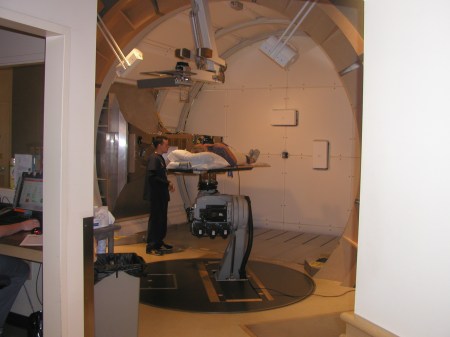
Early in the summer, I announced that posts to this blog would be irregular for a time without stating a reason for the disruption. The reason for my absence was that I was spending the summer in Bloomington, Indiana receiving treatments for prostate cancer at the Indiana University Health Proton Center. Choosing a treatment modality, proton therapy, that is not widely known was the result of extensive research. The research uncovered some things that were completely unexpected. The one that had the greatest impact was that I was probably exposed to Agent Orange while serving in Vietnam in 1967. Those who served in Vietnam during the time that Agent Orange was sprayed are eligible for disabilities and treatment from the Veterans Administration. Unfortunately, the government does not put the same emphasis on informing veterans who were harmed while serving their country that it does soliciting “clients” for its welfare programs.
Knowing that I was far from being an isolated case, I decided to write a small book that veterans can use to help them navigate the VA and healthcare systems. My treatment for prostate cancer is complete and, after only seven months since first applying, my VA disability was approved. Prostate Cancer and the Veteran should make their process a bit easier than mine was.
This blog won’t be back to its old regularity just yet because, the day before my last treatment, I had a bicycle accident that fractured a vertebra. I’m far from being 100% yet and it appears it will take some time for that to happen. I do have a blog article underway. Carlisle Indians vs the Big Ten may surprise some people.
Tags: Prostate Cancer, Proton Therapy
Posted in Prostate Cancer, Publishing | Leave a Comment »
August 22, 2011
It is always gratifying when descendants and relatives of Carlisle Indian School football players comment on this blog. Even more gratifying is when they provide information not known and is not easily found. Most gratifying of all is when relatives use this blog as a way to get in touch with each other. All of these things happened last week.
Henry Roberts, left end on the great 1911 team, was the son of Rush Roberts, a legendary figure in Pawnee history. I blogged about Rush Roberts a couple of times in March and April 2010 after discovering things about him I didn’t previously know. Since that time, descendants of Rush have posted comments regarding family genealogy on those blogs, with last week having the greatest concentration of new information.
Unfortunately, comments on older posts don’t show up on the first page of the blog. Readers must search to find them. The easiest way is to search for Rush Roberts and open the comments on the posts relating to him. You should find these to be interesting reading.
Tags: Fancy Eagle, Pawnee, Roaming Princess, Rush Roberts, Sitting Eagle
Posted in Carlisle Indian School, Henry Roberts | Leave a Comment »
August 19, 2011
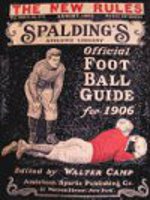
A. G. Spalding’s football guides from the early days of college football are excellent sources of information for football historians and researchers. Unfortunately, these books are now quite old and fragile, a factor that severely limits their use as research tools. To make matters worse, they have become rare enough that, when copies appear for sale, they are quite expensive.
Seeing the need for inexpensive copies of these highly useful books, Tuxedo Press is reprinting them in paperback form as they previously did for what they call Pop Warner’s Single-Wing Trilogy. Coaches, researchers and historians have found the Warner books so useful that Tuxedo Press is doing the same thing for Spalding’s Official Football Guides for the years 1883 to 1919 as copies of these books become available to them to reprint in paperback form.
Because the years from 1883 to 1893 were very small, they are bound as a single volume. Beginning with 1899, the next year Tuxedo press has found so far, each year is printed separately because those volumes are much larger. Besides the rule changes for the upcoming season, an annual volume includes Walter Camp’s three All-America team selections for the previous season, other critics picks for their All-America teams, assessments of the various teams’ successes for the previous season and outlook for the upcoming season. These books are filled with illustrated ads for Spalding equipment. The equipment illustrations could be very useful in researching the evolution of helmets and such.
More information can be found at http://www.tuxedo-press.com/index_files/Reprints.htm. The reprints of the Spalding’s Guides are also available through on-line resellers and can be ordered by your local bookstore.
Tags: A. G. Spalding, All-America team, Caspar Whitney, Spalding's Football Guide, Walter Camp
Posted in Football | Leave a Comment »
August 17, 2011
Yesterday, a little news snippet caught my ear: President Obama visited Decorah, Iowa where he stayed at the Hotel Winneshiek. While there is nothing about that that is earth shaking or will be of great historic significance, it was of interest to me. It wasn’t what the president was doing that got my attention; it was the names of the places he was that resonated with me.
Decorah (often spelled De Cora or Decora) is not just a geographical name but is also the name of an important Nebraska Winnebago family, many of whom were hereditary chiefs. The granddaughter of one of these chiefs, Little De Cora, was Angel DeCora who, after being educated at Smith College, rose to prominence in the late 19th century as the leading female Indian artist of her day and was well known in the leading eastern art circles. In 1906, she accepted the position as director of the Native Art Department at Carlisle Indian School. In late 1907, she married William Henry Lone Star Dietz who, at 25 was her student, but was still 13 years her junior. The two generated much positive press nationally for Carlisle.
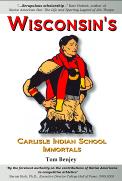
Winneshiek is the name of an important Wisconsin Winnebago, or Ho Chunk, family which has provided the tribe with many chiefs. The son of one of them was William Winneshiek who was noted more for his musical ability than his athletic prowess at Carlisle and went on to a career in music, even having his own all-Indian band. He did, however, find time to play football in the early NFL for the Oorang Indians. His biography can be found in Wisconsin’s Carlisle Indian School Immortals.
His brush with history finished, Obama left Hotel Winneshiek in Decorah for breakfast in Guttenberg.
Tags: Decorah, Guttenberg, Obama, William Winneshiek, Winneshiek, Wisconsin's Carlisle Indian School Immortals
Posted in Angel DeCora, Carlisle Indian School, Football, Lone Star Dietz | 2 Comments »
August 8, 2011
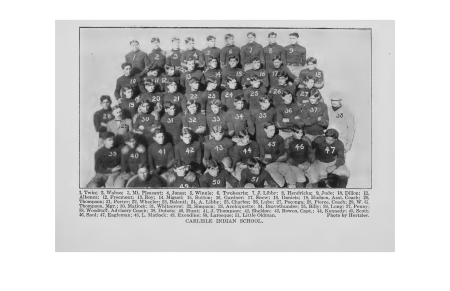
While preparing Spalding’s Official Football Guide for 1906 for reprinting, I noticed a few things about the Carlisle Indian School football team’s 1905 season. These things caught my eye because it was this very team under Advisory Coach George Woodruff that Sally Jenkins maligned in her 1907 book. Caspar Whitney ranked the Indians as the 10th best team in the country for 1905. He also placed Frank Mt. Pleasant as a substitute at quarterback on his All America team.
George Woodruff placed three Carlisle Indians to his All Eastern Eleven for 1905: Frank Mt. Pleasant at quarterback, Charles Dillon at guard, and Wahoo (Charles Guyon, older brother of Joe Guyon) at end. N. P. Stauffer placed Dillon at guard on his All Eastern Eleven as well.
That an authority of the stature of Caspar Whitney considered Carlisle as the 10th best college football team in the country means something and that something is that the Indians were viewed as having had a very good season. Not their best ever, mind you, but a successful one at that.
These selections, along with George Orton’s observations that were posted in the June 27, 2011 message, show that Jenkins’s assessment of the type of play and success of the 1905 Carlisle Indian football team is at odds with the opinions of the experts of the day who actually saw the teams play.
1905 Carlisle Indian School football team from Spalding’s Official Football Guide for 1906
Tags: Chauncey Archiquette, Frank Jude, George Orton, George Woodruff, Littleboy, N. P. Stauffer, Oscar Hunt, Sally Jenkins, Scott Porter, Wilson Charles
Posted in Albert Exendine, Archie Libby, Arthur Sheldon, Bemus Pierce, Carlisle Indian School, Charles Guyon, Football, Frank Hudson, Frank Mt. Pleasant, Joe Libby, Mike Balenti, Nicholas Bowen | Leave a Comment »
July 11, 2011
A few weeks ago, Alyssa Roenigk, Senior Writer for ESPN The Magazine, queried Tex Noel, Editor of The College Football Historian, a monthly publication of the Intercollegiate Football Researchers Association (IFRA), about a 1912 game between Harvard and Yale in which the quarterback sneak supposedly originated or, at least, was popularized. Tex forwarded her query to the researchers on his list, of which I am one. Alyssa’s question triggered a tremendous amount of activity on the part of a number of individuals in several different directions. The response was amazing, even to Alyssa.
One person researched the origin of the story, a Wikipedia article. Another researched the players that were supposed to have been involved. Others found coverage of the game in question in newspapers. Being skeptical of the claim, I focused on the rules in place in the years leading up to that game. Others probably looked in directions of which I’m not aware.
Alyssa interviewed me about what I found as she surely interviewed others as to what they discovered. She was quite taken with the activity, both in quantity and depth, that resulted from her question and she will likely look to the IFRA for assistance with future articles.
Ms. Roenigk is working on an article about the history of the quarterback sneak that will appear in the football pre-season edition of ESPN The Magazine that will likely include quotes from several IFRA researchers. I don’t know if a link will be available to the article if it is placed on ESPN’s website because a paid subscription to the magazine may be required to have access to the articles on the website. Anyway, look for the quarterback sneak article as you peruse the print magazine at your local newsstand.
Tags: 1912 Harvard Yale Game, Alyssa Roenigk, ESPN The Magazine, IFRA, Intercollegiate Football Researchers Association, Quarterback sneak, Tex Noel, The College Football Historian
Posted in Football | Leave a Comment »
June 27, 2011
While looking up the rules regarding the quarterback sneak in Spalding’s Official Football Guide for 1906, I came across more evidence to support the position James Sweeney took in There Were No Oysters, his critique of Sally Jenkins’ assertions in her 2007 book about Carlisle Indian School football. In his piece, Football in the Middle States, George Orton of the University of Pennsylvania wrote:
Carlisle fell a little below the high standard of former years, though the brilliant games they put up against Pennsylvania, Harvard and West Point proved that the Indians were yet very much to be feared in any company. They played the same style of game as in previous years in spite of their new coach; good punting, end running and tricky open play being their main source of strength.
Orton completely contradicts Jenkins’ claim that Carlisle abandoned its open style of play under Coach George Woodruff in 1905. It might have been that Woodruff preferred old-style play but that isn’t what the team actually did on the field games as documented by this observer. Orton even thought the Indians played brilliantly on the soft field against Harvard where Jenkins lambasted Woodruff for unimaginative play. She covered the 1905 season more extensively than most—through the Harvard game—but made no mention of the game with Army the following week or the late-season road trip west. This is most curious because, as Sweeney documented so well, the Indians beat Army in the two teams’ first meeting ever in a game that received wide coverage, particularly because of the large number of dignitaries present for the contest.
A writer with Jenkins’ pedigree and credentials could hardly have been unaware of the 1905 game given the research she did for her book. One wonders how she could have had so much wrong about the 1905 Carlisle Indians. After all, these were the young men who finally got to settle the score, metaphorically speaking, with the “long knives” on a field of battle. The 1912 Carlisle Indians were a great team, but it was their 1905 predecessors who actually did the deed.
Tags: Carlisle vs. Army, George Orton, George Woodruff, James Sweemey, Sally Jenkins
Posted in Carlisle Indian School, Football | Leave a Comment »



 Tom Benjey's Weblog
