Cornell Wore Plain Jerseys in 1903

January 10, 2012

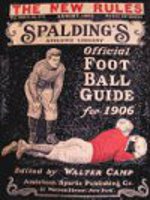
Among other things, today’s mail brought a copy of the 1904 Spalding guide and it provides some valuable information with regard to determining who first used football jerseys with stripes below the elbows.  A photograph of the Cornell team on page 30 captured most of the team members in their playing uniforms, not their letter sweaters.  The black and white photo has the players wearing dark-colored jerseys under what Spalding called sleeveless football jackets.  The v-necked jackets laced up the front and were cut back where sleeves would have been connected, had there been any, to provide freedom of movement for the players’ arms.  All of the sleeves, necks and a bit of the bodies of the jerseys were visible with the jackets on.  One assumes that the jerseys were solid carnelian, a brownish shade of red, because Cornell’s school colors are that color and white.  The school colors were chosen as a (possibly humorous) reference to the University’s founders, Ezra Cornell and Andrew Dickson White.  Those who are associated with the school are commonly referred to as “Cornellians” and the reddish-brown color is sometimes spelled cornelian.

From the photo of what was most likely the 1903 Cornell team because photos had to be submitted to Spalding well before the start of fall practice in order for the guide to be laid out, printed and distributed ahead of the beginning of 1904 football season.  The Carlisle team photo on page 22 of this book is definitely that of its 1903 team because Pop Warner is in it and James Johnson is holding the football.  Johnson was captain of the 1903 Carlisle team and played for Northwestern in 1904.  Warner returned to Cornell for the 1904, ’05 and ’06 seasons.  As reported previously, Cornell was wearing jerseys with stripes below the elbow in 1905 as shown in the 1906 Spalding guide.  I have to wait for the 1905 guide to arrive before seeing if they had shifted to the unusual stripe configuration for Warner’s first year back at his alma mater (unlikely unless Warner had nothing to do with it).

Were Carlisle’s Jerseys Unique?

January 6, 2012

As mentioned in this blog previously, I am in process of reprinting the Spalding Football Guides for the years that Carlisle Indian School fielded a team.  That process is progressing well but I have not yet found the 1901 and 1911 books as yet and don’t hold much hope of coming across books for the years from 1894 to 1898.  Be that as it may.  I am already discovering interesting things without having a full set.

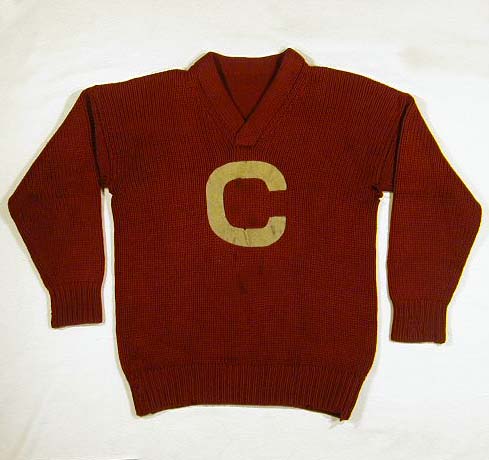
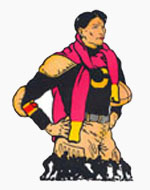
While flipping through the 1906 volume, I noticed that the Cornell team was wearing jerseys quite similar to those worn by the Carlisle Indians (a Carlisle jersey is depicted in the color drawing on the masthead of this blog).  I had seen photos of many other teams wearing jerseys with stripes but none with the stripes located just below the elbow on an otherwise solid-color shirt.  Of course, I haven’t done exhaustive research on this matter, so the possibility remains that this pattern was not unique, just not widely used.  All the period photos are in black and white, so nothing can be known for certain about the colors on these jerseys just from the photos.  Regarding the dates of photos in Spalding’s guides, most team photos seem to have been taken at the end of the previous season.  In Carlisle’s case, players were generally wearing their letter sweaters which were a solid red and were acquired from Spalding in various styles (see photo below).

So, the Cornell team of 1905 wore jerseys similar to those that Carlisle was noted for wearing.  But when did the Indians start wearing them and were they special ordered?  A circa 1902 photo of James Phillips shows the stripes clearly as does the team photo for that year.  More research is needed to determine exactly when Carlisle and Cornell started wearing those jerseys and who made them.  What is known is that in 1902 Carlisle, then coached by Pop Warner, wore them as did the 1905 Cornell team that was also coached by Pop Warner.  Were these stripes another Warner innovation?  Much more research is needed to answer these questions.


A Christmas Present from the VA

January 3, 2012

Disabled veterans got a Christmas present from the Veterans Administration in the form of a pay raise.  After receiving no increase the last two years, a 3.6% raise looks pretty good.  To put this in perspective, a 100% disabled veteran with a spouse and no dependent children or parents who was receiving $2,823 per month before the raise now receives $2,924 or $101 more.  It’s not a princely sum but it is better than we have been doing in recent years.  Because of the arcane way the VA assigns disability percentages, not everyone will get 3.4% more than they were getting.  In many cases, they will but others, with more complicated situations will get something a bit different.  Understanding the VA rate tables is essential to determining what one’s new compensation should be.  The VA rate tables can be found at: http://www.vba.va.gov/bln/21/Rates/comp01.htm

I think I may have figured out how the VA computes disability percentages for veterans with multiple disabilities.  It’s not simple.  If you have three disabilities– say a 60%, a 30% and a 10%–that total 10% under the normal rules of mathematics, you aren’t rated at 100% by the VA.  They determine disability percentages as being 100% minus an efficiency percentage.  If your first disability (in order of severity) is 60%, you are 40% efficient (100%-60%).  The second disability (30% in this case) leaves only 70% of the efficiency remaining after the first disability or 28% (40% times 70%).  The third disability (10%) leaves 90% of the efficiency remaining after the second disability was deducted or 25% (28% times 90%).  Subtracting the combined remaining efficiency from 100% yields 75% (100% minus 25%).  The VA rounds this percentage to the nearest 10% for a combined disability of 80%.  Eighty percent is a far cry from 100%, particularly the way the VA computes compensation.  An 8% disability does not get 80% of what a 100% disability gets.  For example, an 80% disabled vet with a spouse gets $1,602 per month, not $2,339 (80% of $2,924).  You can find the VA’s explanation of how they compute multiple disabilities at http://www.benefits.va.gov/warms/bookc.asp under section 4.25 Combined Ratings Table.

Christmas at Carlisle 1911

December 23, 2011

Mystery Solved

December 19, 2011

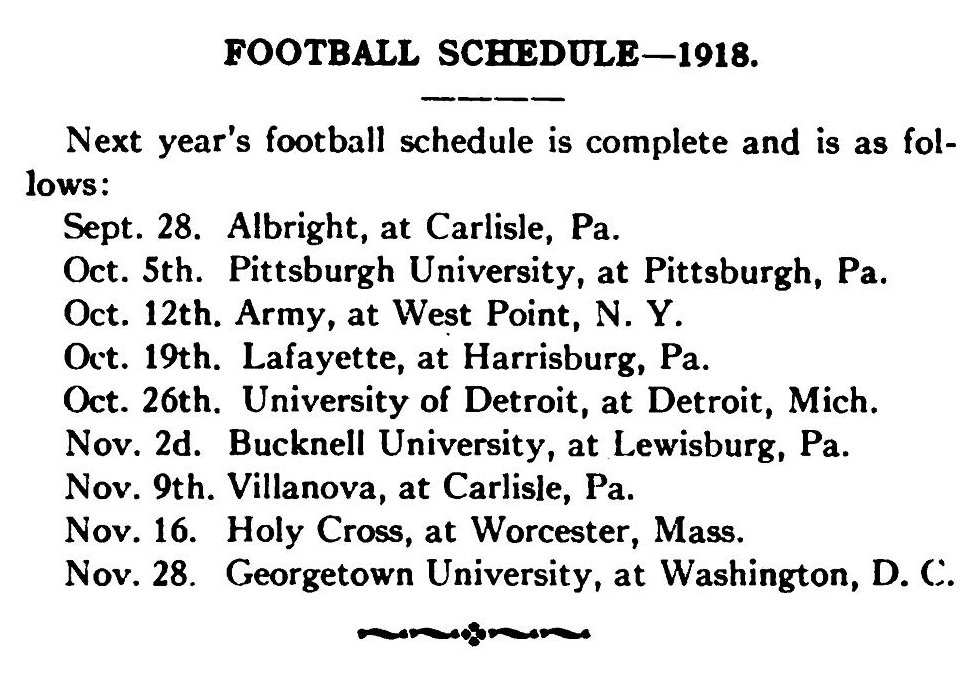
This summer, I began reprinting Spalding’s Football guides for the years relevant to the Carlisle Indian School football program through Tuxedo Press. Carlisle played intercollegiate football from 1893 to 1917 (a 1918 schedule was arranged but never played due to the closing of the school). These books contain a plethora of information useful to historians and rabid fans. Originals are expensive and fragile, factors which limit their utility. Inexpensive paperback reprints that can be abused are much more practical for non-collectors.

Reprinting these books has been more complicated than expected. When someone asked me if a particular book was the eastern or western edition, I couldn’t answer him. Not only didn’t I know, I couldn’t tell by looking at the book. Looking at other years’ editions didn’t help either. David DeLausses, administrator of cfbdatawarehouse.com, has a nearly complete collection of Spalding Football guides but didn’t know how to tell the eastern and western editions apart. He did know that Spalding started printing the two editions in 1906. Prior to that, Spalding published a single edition covering the entire country.

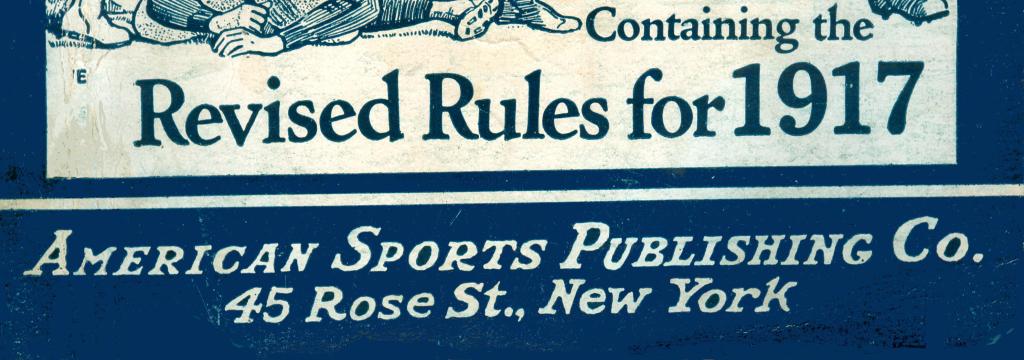
 I bought an original 1917 Spalding guide but couldn’t tell which edition it was and found no one who could. While preparing the 1917 book for publication, I noticed a small E on the front cover in a white block just below a drawing of players running a play (see below).


 Thinking the E might designate Eastern Edition, I emailed David DeLausses to get his opinion. As luck would have it, he was away from home on a business trip and, thus, couldn’t check against his copies. Upon his return, after looking at his guides, he responded,

“This is a great find.  From 1911-1918 Spalding Guides I can see either an “E” or a “W” on the front cover.  My 1917 Guide has a W.  I will be first in line to get a copy of your 1917 “E” version.  

I did not see similar markings for other years than 1911-1918.  I will have to spend some time looking closer.”

We still don’t know exactly what the differences in the two editions are, but comparing the two 1917 editions page by page should shed some light on this mystery.

Another Incubator of the Forward Pass

December 15, 2011

Periodically, one reads articles regarding the early development of the forward pass in football. It is now well known that Notre Dame did not invent the forward pass in their 1913 defeat of Army. It is also well known that Eddie Cochams, coach of the St. Louis University squad was an early implementer of the new strategy. Now, in a 1921 book, The Forward Pass in Football, written by Elmer Berry, Head Coach of Football and Baseball, Associate Director of Physical Education Department, Professor of Physiology and Physiology of Exercise at International Young Men’s Christian Association College, Springfield, Massachusetts, I hear of another proponent of the airborne pheroid.

It is doubtless fair to say that the early development of the forward pass was largely due to two teams, Springfield College of the Y. M. C. A. and the Carlisle Indians. Their game in 1912 at Springfield is said by competent experts to have been probably the greatest exhibition of open football ever staged. It is doubtful if two such finished exponents of the open game have ever met before or since. To Coach J. H. McCurdy of the Springfield team goes the honor, in the writer’s judgment, of the early recognition and development of the strategy of the forward pass, for in this respect at least, Springfield excelled even the wonderful Indian teams produced by Glen Warner. No one team can longer claim a leadership in this or any other department of the game, but it is fair to say that the Springfield team has continuously demonstrated an unusual aptitude for the forward pass and a high degree of leadership at least among the Eastern teams. It is not strange, in view of the fact that the great leaders of football have not taken more kindly to the forward pass, that its underlying principles have not been more thoroughly worked out and organized. It is the chief purpose of this work to state if possible some of these principles and fundamentals to the end that the open game of football, always in the past and still to some extent opposed by certain groups, may be better understood, more successfully coached and more firmly and thoroughly established.

Further research is required to determine how much salt to take with Berry’s claim.

Sam Bird’s Great Granddaughter

December 13, 2011

I’m often asked what life was like after Carlisle for former students. Doctors, Lawyers, Indian Chiefs discusses what life held for 50 star football players, most of whom had children and grandchildren. Now, I’m learning more about their descendants. Recently, I received word that Sam Bird’s great granddaughter, Denise Juneau, is running for re-election for the position of Superintendent of Public Instruction for the State of Montana. She is the first American Indian to hold a statewide executive position in Montana. Sam Bird promoted education for his children and grandchildren. Denise is a product of his efforts.

Sam Bird was captain on the great 1911 Carlisle Indian School football team. After leaving Carlisle, Sam returned home to Browning, Montana where he ran the family ranching operation, married a Carlise girl, and raised a family. Sam’s daughter, Margie, married a man named Juneau and had a son named Stan. Stan married Carol Cross. Denis is their daughter.

The other side of Denise’s family (Carol Cross Juneau’s family) is from the Three Affiliated Tribes of North Dakota.  Carol’s Grandfather, Denise’s Great Grandfather, name was Old Dog and he was the last traditional chief of the Hidatsa.  Carol’s father, Denise’s grandfather, name was Martin Old Dog Cross and he was a member of the elected tribal council for more than 20 years and its chairman for 10 of those years.  He led the fight against building the Garrison Dam that flooded their reservation, their homeland, and more acres that it was supposed to.  Carol’s Brother, Ramon, was the lawyer who fought the Army Corp of Engineers many years later and, with the Supreme Court ruling in his favor, received a nice settlement for the Tribe. Coyote Warrior by Paul Vandevelder is a history of the family and also of the Supreme Court decision. 

It’s not hard to see how Denise Juneau has achieved so much after seeing her bloodlines.

George Woodruff’s Record

December 7, 2011

An article by Bob Barton in the November 2011 issue of the CFHS newsletter, among other things, discusses the elevation of Penn’s football program under George Woodruff’s leadership. Given the treatment that Woodruff received from Sally Jenkins, it seems necessary to present a more balanced view of his career. George Washington Woodruff (1864-1934) attended Yale University in the late 1880s, graduating in 1889. While at Yale, he played on the football team, rowed crew and ran track.

In 1892, he enrolled in law school at the University of Pennsylvania and took on the duties of coaching football and rowing crews. (One assumes that he initially took on these jobs to support himself while in law school.) Yale supporters did not take Woodruff’s shift of allegiance well as Woodruff had been a guard for the Eli. They also didn’t like the change in competiveness. The eleven games played between Yale and Penn between 1879 and 1892 all ended in victories for the Eli, often in a rout. Scores in Yale’s favor of 60-0 and 48-0 were quickly reduced by Woodruff to 28-0 and 14-6 in 1893. Claiming that Woodruff had recruited ineligible players although the rules weren’t in place before the 1893 season started, Yale broke with Penn and didn’t play them for 32 years. That didn’t seem to bother George much as his 1894 team went undefeated with victories over Princeton and Harvard and was retrospectively named National Champions. He repeated the feat in 1895 without Princeton, who remained off the schedule until 1935. Not only did George Woodruff bring the quality of Penn’s football to the highest level, he maintained it at that level, going 124-15-2 for the ten years he coached the Quakers. After dropping out of coaching following the 1901 season, he returned to the arena twice: first in 1903 to lead the Illini to an 8-6 season and again in 1905 to go 7-2 with the Carlisle Indians. His charges beat Army, Penn State and Virginia but lost to Harvard and Penn.

Woodruff’s .885366 winning percentage was far above the minimum required for induction into the College Football Hall of Fame.

Like Father, Like Son

December 5, 2011

The title of this message is a bit misleading. Like parents, like son would be more accurate. Rob Wheeler is the son of Robert W. “Bob” Wheeler and Florence “Flo” Ridlon and, like the proverbial apple, didn’t fall far from the tree. Bob is perhaps best known as the author of the definitive biography of Jim Thorpe. Flo is not well known for her greatest discovery, but should be. It was Flo who found a long-lost copy of the rules for the 1912 Olympics misfiled behind a row of books on a shelf in the stacks of the Library of Congress. The rules made possible the restoration of Jim Thorpe’s Olympic medals. Bob and Flo should be better known for their efforts and ultimate success but probably won’t be. Their only child, Rob, has undertaken the task of getting Jim Thorpe’s remains moved to Oklahoma. Philadelphia lawyers are hereby on notice that Rob is on the case.

Rob Wheeler is a senior at MIT double-majoring in Aeronautics and Aerospace Engineering AND Physics, so cannot devote full time to the effort as his parents did for some years in their effort. Fortunately, he doesn’t have to do it all himself as Thorpe family members are heavily involved. It is because of one particular Thorpe that Rob is so dedicated to this task, but you will have to visit Rob’s website, www.JimThorpeRestInPeace.com, to learn the details of that relationship.

Rob conceived, designed and maintains the website. His Phi Sigma Kappa brothers, David Somach and Arkady Blyakher, assisted in creating the website. Michael Lehto  provided vital encouragement and technical expertise. Since the website was put on-line, Rob has been interviewed by Native News anchor for IndianCountryTV.com, Paul DeMain. That interview can be viewed at http://www.youtube.com/watch?v=DHPQ0jTwSmM&feature=channel_video_title.

Don’t be surprised if we read more about Rob Wheeler in the news.

Photos of Paintings on Deerskin

December 1, 2011

One of my earliest blogs, posted on April 4, 2008, was titled “Deerskin Paintings.” The post included a discussion of a pair of paintings done by Lone Star Dietz on deerskin but included no photos probably because I didn’t know how to post them at the time. Today, Barr Shriver, the son of the people for whom Dietz made the paintings, emailed me photos of the paintings to be posted on my blog. He does not want to sell the paintings, so don’t bother him with offers. If I owned them, I wouldn’t sell them, either. Photos of the two paintings can be found at the bottom of this post.

The original post can be found here: https://tombenjey.com/tag/painting-on-deerskin/