While researching the 1895 Carlisle Indian School season, I stumbled across an advertisement for a game that seemed odd to me.

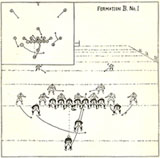
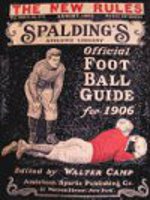
I was under the impression that Yale’s Walter Camp ruled the Intercollegiate Rules Committee as its Secretary, obstructing changes whenever possible. However, in 1894, he and Alex Moffat of Princeton as President of the Rules Committee, proposed a number of rule changes. The most contentious of which was the abolishment of momentum mass plays. No more than three men could be in motion when the ball is snapped. Critics objected, saying that mass plays be eliminated completely.
If things weren’t already bad enough, the Harvard-Yale game was particularly violent with four starters on each team seriously injured, some badly enough to be admitted to hospitals. Princeton and Penn’s game ended in a brawl, causing the schools to break football relations. Harvard and Yale severed relations. The military academies only played on their grounds after that Cornell’s faculty banned road games.
The Rules Committee became inactive in 1895, leaving Yale and Princeton, in the form of Camp and Moffat in charge. They succeeded in getting the committee to meet but they achieved no compromise on mass plays. Princeton and Yale wanted to abolish them completely. Penn and Harvard insisted on keeping them. No compromise could be reached. Two, and in some places, more rule groups existed. Cornell joined Harvard and Penn produced a set of rules with no restrictions on mass momentum plays. The Princeton and Yale rules allowed only one man to be in motion when the ball is snapped and no more than three in a group behind the line of scrimmage. In the East, teams had to choose between these two options. Elsewhere, teams could also choose to follow the 1894 rules. Teams, such as Carlisle, that traveled could play games under three different sets of rules.
For the Penn game, mass momentum plays were permitted.

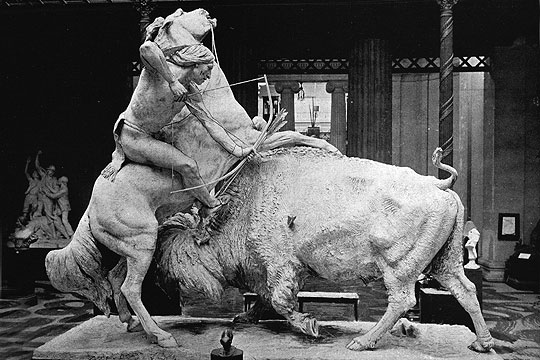 While researching the early Carlisle Indian School football teams, I came across a piece about Delos Lone Wolf, Kiowa name Gooě-pah-gah, that had nothing to do with football. He arrived at Carlisle on July 4, 1892 for a 5-year enrollment. That October, he went out on an unusual outing to Newburgh, New York but not to a farm or ordinary business. He was to be a model for Henry Kirke Bush-Brown, a sculptor known for historically accurate realist sculptures illustrating American history. He is perhaps best known for his bronze equestrian statues of George Meade, John F. Reynolds, and John Sedgwick. The latter statue incorporated fine details such as dents in the General’s scabbard and tiny stitching on the horse blanket. Also at Gettysburg is his bust of Abraham Lincoln commemorating Lincoln’s Gettysburg Address.

 Friday was sad day in Carlisle. Wardecker’s Men’s Wear closed for good. While recent fashion trends have hurt clothing sales, it was the Wuhan virus that did Wardecker’s in. Government reactions to the plague might be more accurate. In spite of diminishing demand for dress clothing, Freddie Wardecker had been able to keep the doors open by selling uniforms to health care workers, people involved in food preparation, police and others as well as by renting tuxedos. The state government’s shutdown decimated the need for new uniforms and eliminated proms. Brides-to-be reacted by scaling down or postponing their weddings. Without uniform sales and tuxedo rentals for proms and wedding, the store had little revenue with which to pay its bills, forcing it to close.




 Tom Benjey's Weblog
