Archive for the ‘Lone Star Dietz’ Category

Brown Was In 1916 Rose Bowl, Too!

December 18, 2008

I recently posted some footage of the 1916 Rose Bowl that was provided to me by the Washington State athletic department onto www.YouTube.com/TomBenjey. Washington State was of course running the single-wing, but Brown was running a derivative that eagle-eyed Ted Seay observed that “At the 5:48 mark, Brown shifts into a double-flexed formation with an end and tackle to the left, then they slot their wingback inside that tandem and sweep to the left…” I am now working on a short video of Brown’s offense that will include slow-motion clips for those of us who don’t have Ted’s powers of observation. See http://www.youtube.com/watch?v=yTA2w8aanPc&feature=channel_page That got me thinking about Brown’s players. Everyone is familiar with Fritz Pollard and, to use WSC’s descriptor, “the giant [Mark] Farnum,” but there are other players from that team who are in the Brown Hall of Fame. Let’s start with Josh Weeks because I have communicated with his son, Randall, who talked with him about the game.

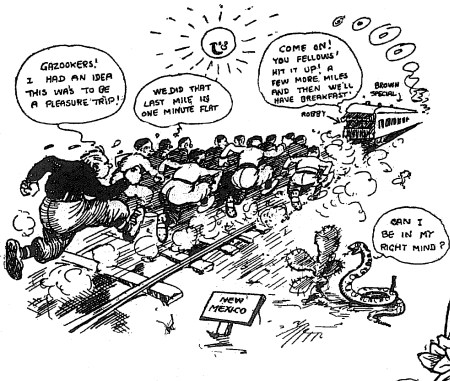
Joshua H. Weeks, number 42, played right end on the 1915 Brown University team that played against Washington State in the 1916 Rose Bowl. Later in life he shared some of his experiences with his sons. Randy has been good enough to pass some of his memories along to me. For starters, Brown got little exercise, contrary to what the cartoon at the bottom of this piece insinuated. Prior to the game the players encountered citrus trees loaded with ripe fruit and gorged themselves on oranges. What a mistake! The result was frequent bathroom runs during the game.

Seeing no need for cold or wet weather gear, Brown brought neither along with them. Two days before the game it snowed and it poured during the game. Lone Star Dietz only brought summer suits for himself but did bring mud cleats for his players. Fritz Pollard could get no footing and was held to a season-low in yards gained. He did notice that Lone Star’s white suit was covered with mud before the first quarter was over.

<to be continued>
 brown-practice

Lone Star Inducted into Albright College Hall of Fame

October 24, 2008

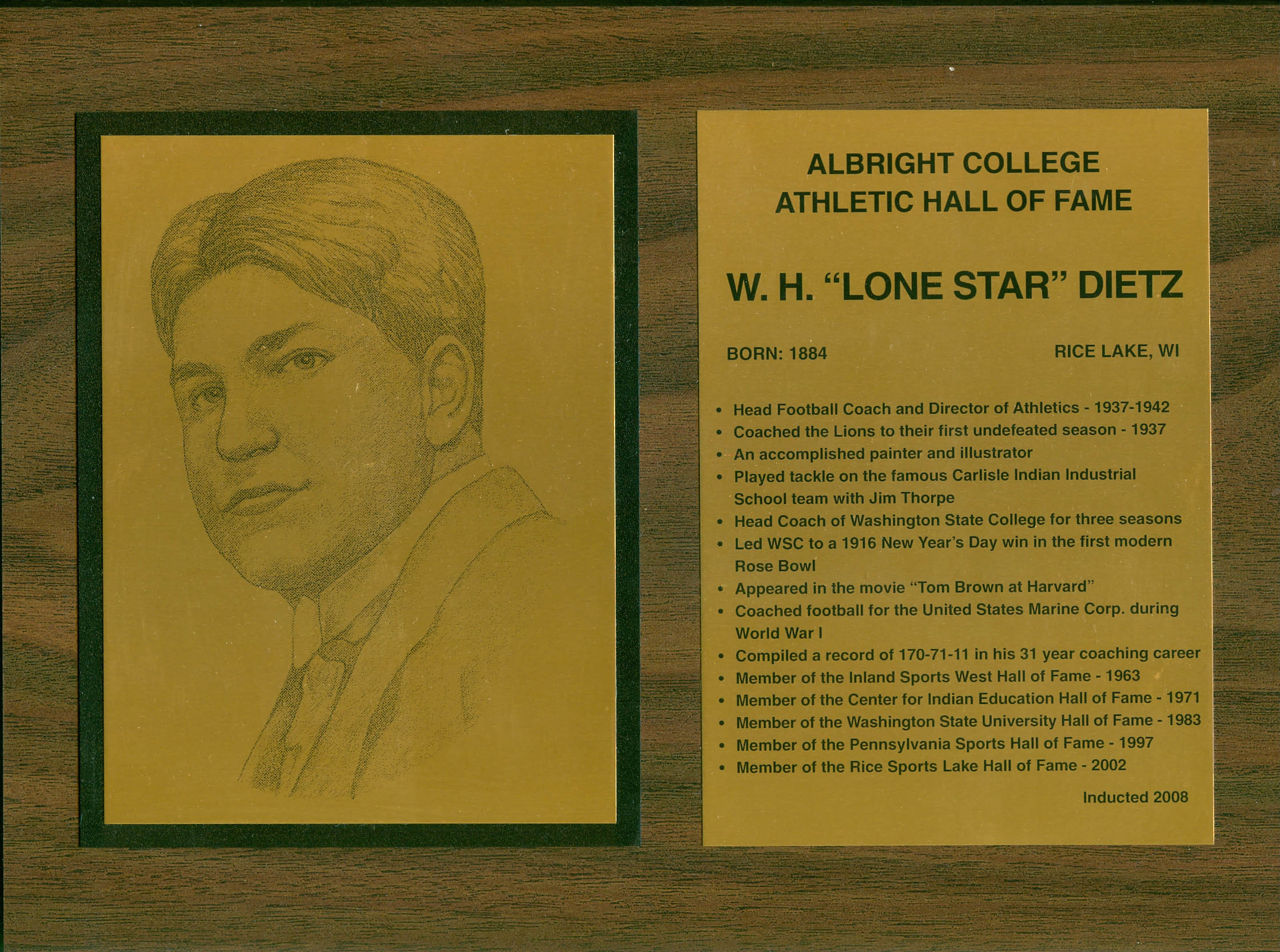
Last Friday night I was given the honor of standing in for Lone Star Dietz at his induction ceremony for the Albright College Hall of Fame. (Link to Albright website: http://www.albright.edu/athletics/) At the banquet I had the pleasure of sharing a table with Marcia and Sheldon Cohen, the wife and son of the late Gus Cohen, one of the stars of the 1937 undefeated team. Gus didn’t have it easy. He was orphaned as a child and had little money but was a good student and athlete. His high school coach took him to see various colleges when he was nearing graduation. Getting schools interested in him as both a student and an athlete was no problem. However, in those Depression days, getting financial support was a problem. Albright College came through with a scholarship so he became a Lion.

At Albright College his coach, Lone Star Dietz, became the father Gus didn’t have. Doris’s cooking probably didn’t hurt either. That Doris was also Jewish may have made communication with her easier. Gus got a lot from Albright but it wasn’t a one-way street because he gave back when he could. There is now a Gus Cohen scholarship at Albright and the school’s archives are much richer thanks to the generosity of the Cohen family.

Earlier Friday Marcia and Sheldon donated Gus’s considerable stack of memorabilia to the college. Included are Gus’s letter sweater and game programs. The item I am most interested in seeing is Gus’s playbook from 1938, I think. It will be great to see what Lone Star was running at that time. He had the reputation of being the best implementer of the single-wing, some say better than Warner himself. Who knows, it might even include the Dead Indian Play. I must set a day aside to sift through this stuff.


Albright College Hall of Fame Plaque

Albright College Hall of Fame Plaque

Puttin’ on my top hat …

October 13, 2008

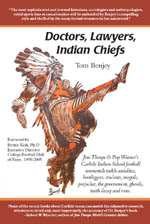
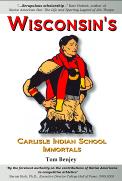
This week promotion for my new book, Doctors, Lawyers, Indian Chiefs, kicks off with a book talk and signing at Whistlestop Bookshop in Carlisle, PA. The timing is good because reviews are starting to come in. I can only hope they’re all as good as the one that ends:

 “Historians, sociologists and anthropologists will appreciate the exhaustive research, attention to detail, accuracy, authority, and integrity Benjey has put into completing this work. Sports fans and casual readers will be drawn into Benjey’s unique and compelling writing style. ‘Doctors, Lawyers, Indian Chiefs’ by Tom Benjey is destined to become a classic.”
 
My immediate challenge is to turn the reviewer’s last word into best seller.

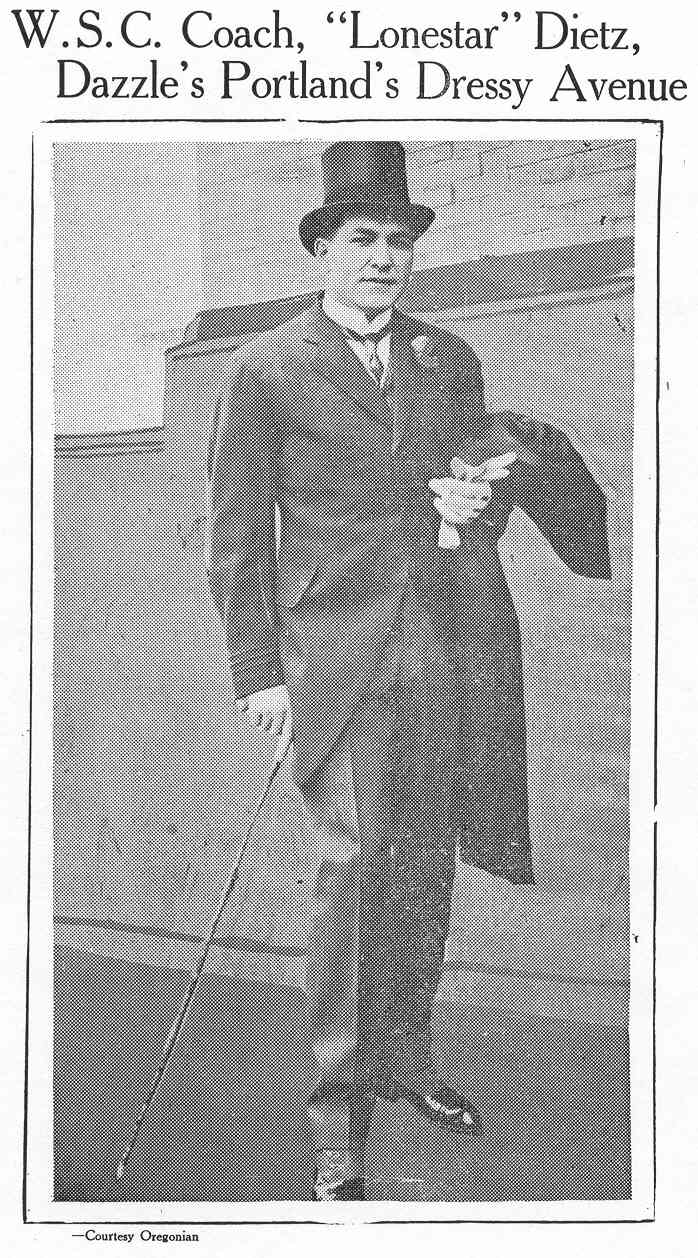
Friday night I am in Reading, PA to accept Lone Star Dietz’s induction into the Albright College Hall of Fame for his family. I will, of course, wear a tuxedo to pay homage to Lone Star but could never look as dapper as he did. This long-overdue honor should be followed by another, induction into the College Football Hall of Fame for his record as a coach. Unfortunately, that doesn’t look like it is in the cards, at least for now.

I have been doing radio interviews across the country as of late and some stations place recordings of these interviews on their web sites. I will link my author page on www.Tuxedo-Press.com to those that I can find. 


Lone Star decked out in Portland, 1915


Rally in the Valley

October 3, 2008

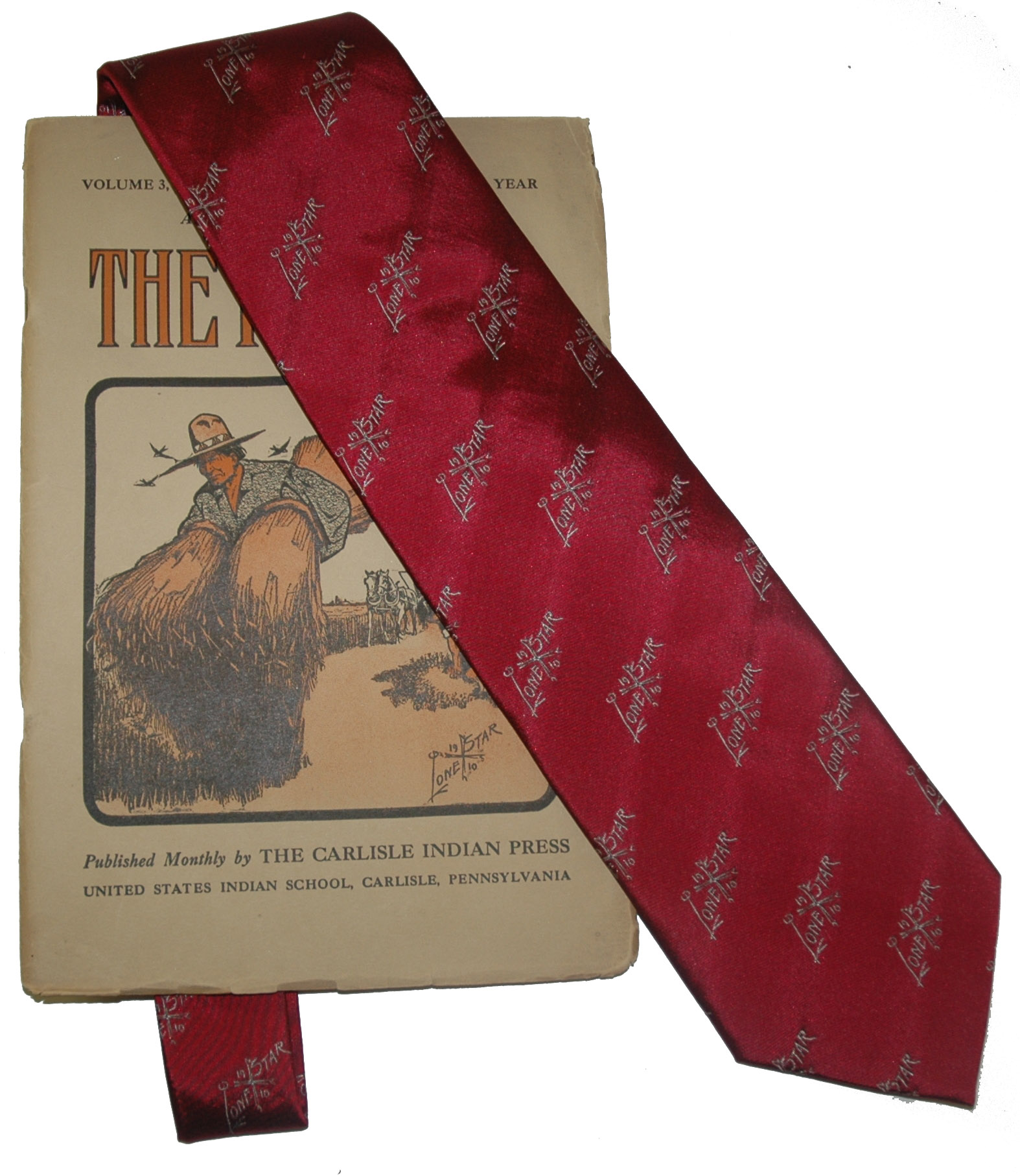
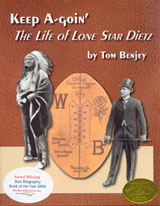
David “Cougman” Welch informs me that an autographed copy of Keep A-goin’: the life of Lone Star Dietz and a Lone Star Dietz custom silk necktie are being auctioned off to help fund scholarships for students attending Washington State University and to support the WSU Alumni Association. The Rally in the Valley is the Skagit Valley Cougars’ signature event each year. More information can be found about this year’s event at http://alumni.wsu.edu/site/c.llKYL9MQIsG/b.2123257/. A flyer for the event can be found here: www.Tuxedo-Press.com/RallyInTheValley.pdf.


For those unfamiliar with Lone Star Dietz, a little background is in order. William Henry Lone Star Dietz was a star tackle at Carlisle Indian School, assistant coach under Pop Warner for three years and also an art instructor. Dietz took the reins as head coach in Pullman in 1915. In his three years as head coach at Washington State (four if you count the 1918 Mare Island Marines composed heavily of his former college players), Dietz led them to two undefeated regular seasons (three if you count the Mare Island year) and Washington State’s only Rose Bowl win (also their first loss if you count the Mare Island team).


Keep A-goin’ tells Lone Star Dietz’s life story. The necktie as seen below incorporates the distinctive signature Lone Star put on his artwork. Also note that the tie is in Washington State colors (crimson and gray). I will be wearing one of these ties on the evening of October 17 when he is inducted into the Albright College Hall of Fame.


Reconnecting Families

September 15, 2008

Something serendipitous has happened since I started this blog. People from different parts of the same family who long ago lost touch with each other have been able to reconnect as a result of my writing Doctors, Lawyers, Indian Chiefs and starting this blog. Typically, the people who contact me are grandchildren or great grandchildren but, especially in the case where the person had no children, grand nieces and nephews are the ones who write. It has given me great pleasure to assist in some small way in helping families reconnect or, in some cases, connect for the first time.


Generally the family member who initiates the connection submits a comment to a blog message. Because I have to review each comment that is submitted before it is posted, these comments are not made public. What I do is to email a member of the family with whom I have had prior contact, if I was fortunate enough to have located a relative, and send the information to that person. If that person wants to reconnect, he or she can then contact the person who made the request. If not, he or she doesn’t.


This has been totally unexpected but playing a small part in making it possible for families get reconnected gives me great pleasure. Keep those comments coming.


My first book talk on Doctors, Lawyers, Indian Chiefs has been scheduled for 6:30 p.m. Thursday October 16 at Whistlestop Bookshop in Carlisle, PA. The next evening I will be attending Lone Star Dietz’s induction ceremony at Albright College in Reading, PA. He is being inducted into their hall of fame.

What happened to Dietz’s Russian Wolfhound?

September 9, 2008


Orloff Kennel logo from Lone Star Dietz's letterheard, 1915

Orloff Kennel logo from Lone Star Dietz

Over the weekend I was contacted by Lizzie with www.ArtHistorie.com concerning Lone Star Dietz’s champion Borzoi (then called Russian Wolfhound). Those of you who have read my biography of Dietz know that he and his first wife, Angel DeCora, raised and showed prize-winning Russian Wolfhounds and won several categories at Westminster Kennel Club’s 1915 dog show. Their Khotni even won best of breed. It appears that ArtHistorie.com is a gallery that sells fine art and history. Apparently Lizzie is handling the estate of Joseph B. Thomas’s son and the estate includes a number of items from Thomas’s father. So? The elder Thomas operated Valley Farms Kennels, a leading breeder of Russian Wolfhounds. A 1907 article in The Rider and Driver and Outdoor Sport told of him traveling 15,000 miles to a remote part of Russia just to acquire a brace of Russian Wolfhounds. He was very serious about these dogs.

Angel and Lone Star bought Khotni from Thomas around 1910 when they started Orloff Kennels behind their apartment at Carlisle Indian School on Carlisle Barracks. One can only imagine the complaints when their pack howled late at night. Lizzie wanted some information about Dietz and Thomas:

Can you tell me what kind of relationship Lone Star had with the Borzoi Breeder Joseph B. Thomas? Did Lone Star end up selling his beloved Khotni back to Thomas?

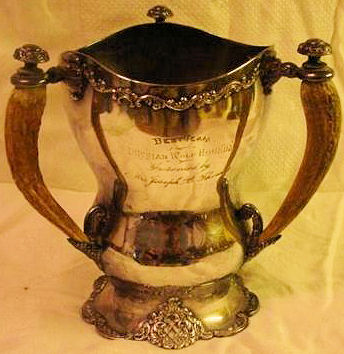
We believe we have the Westminster trophy won by Khotni (directly acquired from Joseph’s son’s estate) and would like to know as much about it’s history as we can!

Unfortunately, I couldn’t answer her questions as I know nothing of the relationship between Dietz and Thomas and don’t know what happened to Khotni. The last information I have on him is that, after Lone Star took the head coaching position at Washington State, Angel had Khotni with her and was trying to sell him for $1,000. Perhaps a reader knows more.


Best Team-Russian Wolfhounds-Presented by Mrs. Joseph B. Thomas

Best Team-Russian Wolfhounds-Presented by Mrs. Joseph B. Thomas

More on Indian Sports Leadership

September 5, 2008

Yesterday’s email brought a curious announcement. I am going to receive a free, signed copy of a new book to be released soon. The Toilet Paper Entrepreneur by Mike Michalowicz, about which I know nothing, was looking for humorous bathroom graffiti. I sent in my all-time favorite from the back of the men’s room door at The Blessed Oliver Plunket, a bar/restaurant featuring live entertainment located across the street from the Cumberland County Historical Society. The Plunket, as it was better known, has numerous stories to tell but I’m not the one to tell them. In the late 70s, as I was leaving the men’s room, I noticed a scribble on the door:

No sign of intelligent life…Kirk Out

Apparently that witticism has found its way into a book.

Back to Donna Newashe McAllister’s question…

I expected that more people would comment on this and would like to see more myself. So, I’ll share some of my thoughts.

My wife and I have discussed this issue to some degree and I think it is an issue with multiple facets. First, I’m not so sure that American Indian athletes have necessarily declined. Judging today’s athletes with those who were at the Carlisle Indian School may not be fair. Those guys were world-class athletes coached by one of the most innovative coaches of all time. Pop Warner is criticized much today but few question his knowledge or his ability to coach football. During its heyday, Haskell had fine athletes and was led by Dick Hanley, Lone Star Dietz and Gus Welch, all of whom were excellent coaches. Dietz belongs in the College Football Hall of Fame. Neither Haskell nor the tribal colleges can afford to hire coaches of their caliber today.

Bob Wheeler tells me that Bill Thorpe shoots better than his age, 80, in golf. To compare anyone with Jim Thorpe is unfair. He was the greatest athlete of all time and could do anything well. I can’t imagine how he could be competitive in the pole vault, but he was. Sam Bird’s grandchildren and great-grandchildren are big in the rodeo. Some of the others didn’t have children and many settled off the reservation. For example, Joe Guyon was a big star at Carlisle, Georgia Tech and in the NFL where Joe Guyon, Jr. played for Catholic University.

But you seem to be focused more on leadership than on athletic ability. It appears to me that many of the better leaders did not return to the reservation after finishing at Carlisle or Haskell. Several were officers in WWI and were leaders in the service but didn’t return to lead their tribes. Some kept one foot in each world and their children found more opportunity in white society. For example, Thomas St. Germain’s son, grandson and great-grandson were/are renowned research physicians at Tulane University School of Medicine.

It may be that Indians are playing leadership roles individually but not together as a group. MANY of the Carlisle players went into coaching but Dietz, Exendine and Welch were about the only ones who made it their life’s work. Coaching was an even more precarious occupation then than now and only the best schools paid well. So, most devoted their considerable talents to other occupations. Even Exendine and Welch practiced law in the off-season.

Surely, other people have some insight into this issue.

Players’ First Names Aren’t Easy to Find

August 28, 2008

One of the most difficult and time-consuming things my editor has me do is to provide players’ full names. Now James G. Sweeney, a lawyer from Goshen, New York and a 50-year West Point supporter, has requested that I help him identify a number of players. Sweeney is writing an article about the 1905 Carlisle-Army game that was approved by the War Department but can’t find players’ first names in newspaper reports. Apparently because I write about Carlisle Indian School football, he thought I’d know all the players’ names. I wish it were so.


Finding the biggest stars’ first names isn’t too difficult and, by now, I can give most of them off the top of my head, assuming that I don’t have a senior moment. Even identifying them wasn’t a piece of cake. One of the reasons for that was that some of them played under multiple names. For example, Emil Hauser was better known as Wauseka and his brother, Pete, was also a star player; Charles Guyon went by Wahoo and, to confuse things further, his younger brother, Joe, came along a few years later and made an even bigger name for himself; and William H. Dietz played as Lone Star. Linda Witmer’s The Indian Industrial School: Carlisle, Pennsylvania 1879-1918 includes a list of students that attended Carlisle. Although incomplete, it nonetheless is a useful tool. One of the problems in identifying players is that many siblings and cousins attended the school. Determining which one is the correct person is a challenge.


Carlisle Indian School publications are invaluable resources. In 1905 the school newspaper went by The Arrow. The school had no literary magazine at that time. Most of the big games were covered by The Arrow. Often articles from big-city papers were reprinted in it. From them we get our cast of characters, if only by their last names. Varsity football players were often active in the literary and debating societies because they were among the oldest on campus. Write ups of these societies’ activities often included full names. Football stars often got press for more mundane activities because they were famous. These pieces often included their first names. Players other than stars received less coverage.


Graduation coverage included full names for the graduating class and much coverage of the individuals in that class. Because most students had little proper schooling before coming to Carlisle and often at advanced ages, they were unwilling or unable to commit to lengthy courses of study that would lead to graduation.


My ace in the hole is the athletic or football (it varied) banquet. This time I hit pay dirt because the coverage of the 1905 football banquet (held in early 1906) included not only the menu for the banquet and the toasts given, but a complete roster of the players on the team with those who lettered identified with Xs. Well not exactly complete. Chauncey Archiquette’s name was omitted. Perhaps Jeffrey Powers-Beck has the reason for his omission from the list in Chief: The American Indian Integration of Baseball, 1897-1945 when he states that Archiquette, then 28, was an 1898 Carlisle grad who had played football and other sports during his days at the school and returned as staff in 1905 but played again. This was the same Archiquette a 1953 Los Angeles Mirror article claimed was Jim Thorpe’s boyhood idol.

1905 Carlisle vs. Army

Radio Tour Kicks off in Lawrence, Kansas

August 21, 2008

With the release of a new book starts another adventure – radio interviews. The first one I’m doing for Doctors, Lawyers, Indian Chiefs is with Warner Lewis on his Lewis at Large Smart Talk Radio show out of Lawrence, Kansas. The interview is being taped and will be aired the week of August 25 to 31 on KLWN Lawrence, KFRM Clay Center, KLKC Parsons and possibly other stations in eastern Kansas. Warner interviewed me two years ago on his sports talk show after Keep A-goin’: the life of Lone Star Dietz was released. It was a great experience. There are strong ties between Carlisle, PA and Lawrence, KS beside the fact that Lone Star Dietz played for Carlisle Indian School and coached Haskell Institute (now Haskell Indian Nations University) in Lawrence. When athletics were deemphasized at Carlisle, the leadership mantle was passed to Haskell where, during the 1920s and very early 1930s, the Fightin’ Indians were, as Ray Schmidt described, the lords of the prairie.


But more than the mantle passed from Carlisle to Haskell. Students also transferred to Haskell as well, Nick Lassaw for one. Nick was perhaps better known by the moniker given to him when he played for the Oorang Indians: Long Time Sleep. However, transferring between the two government Indian schools did not start at that time; it had a long tradition. The most notable example was after the 1904 Carlisle-Haskell game held at the St. Louis World’s Fair, the only time the schools played each other, when eight football players including the Guyon and Hauser brothers and several others came east to play for the stronger team.


There are other reasons that make Lawrence an appropriate to kick off my radio tour. Bernie Kish, Executive Director of the College Football Hall of Fame, 1995-2005, now lives in Lawrence. Bernie wrote a forward for Doctors, Lawyers, Indian Chiefs and I’m waiting for him to write a history of Haskell.


Native Americans in 1904 Olympics – Part I

July 16, 2008

News outlets are now getting interested in Native Americans’ participation in past Olympics, so I should share a little of that history in case the media should overlook important contributions. Everyone knows about the incomparable Jim Thorpe’s triumphs in the 1912 Stockholm Olympics, but Native Americans were involved much earlier than that. There was too much earlier involvement to cover in one message, so I’ll break this topic into installments beginning with the 1904 games held in St. Louis as part of the World’s Fair (more properly called the Louisiana Purchase Centennial Exposition). Pairing the Olympic Games with a world’s fair was not unusual at the time because the 1900 games were co-located with the Paris World’s Fair. Including events that we moderns wouldn’t consider appropriate as Olympic events wasn’t unusual either.

The 1904 Summer Olympics, officially known as the Games of the III Olympiad, conducted what must have been the most bizarre athletic contest ever. Some 3,000 native people from around the globe were brought to the fair for the Anthropology Exhibit. These people lived on the fair’s ground in traditional dwellings and wore traditional attire. Finding appropriate food for them presented a bit of a problem. Legend has it that the neighborhood known as Dogtown got its name as being the place Igorots captured a favorite meat. Included in the Anthropology Exhibit were a number of Native Americans who represented several tribes. Adjacent to their tipis was the Model Government Indian School which was populated by Chilocco Indian School students and faculty. Having all these different “primitive” ethnic groups at their disposal was just too tempting for Fair and Olympic organizers.

On August 12 and 13 Ethnology Days were held. The Indian School Journal, which was printed in the Model School, had this to say about those games:

Our Indians Easy Winners

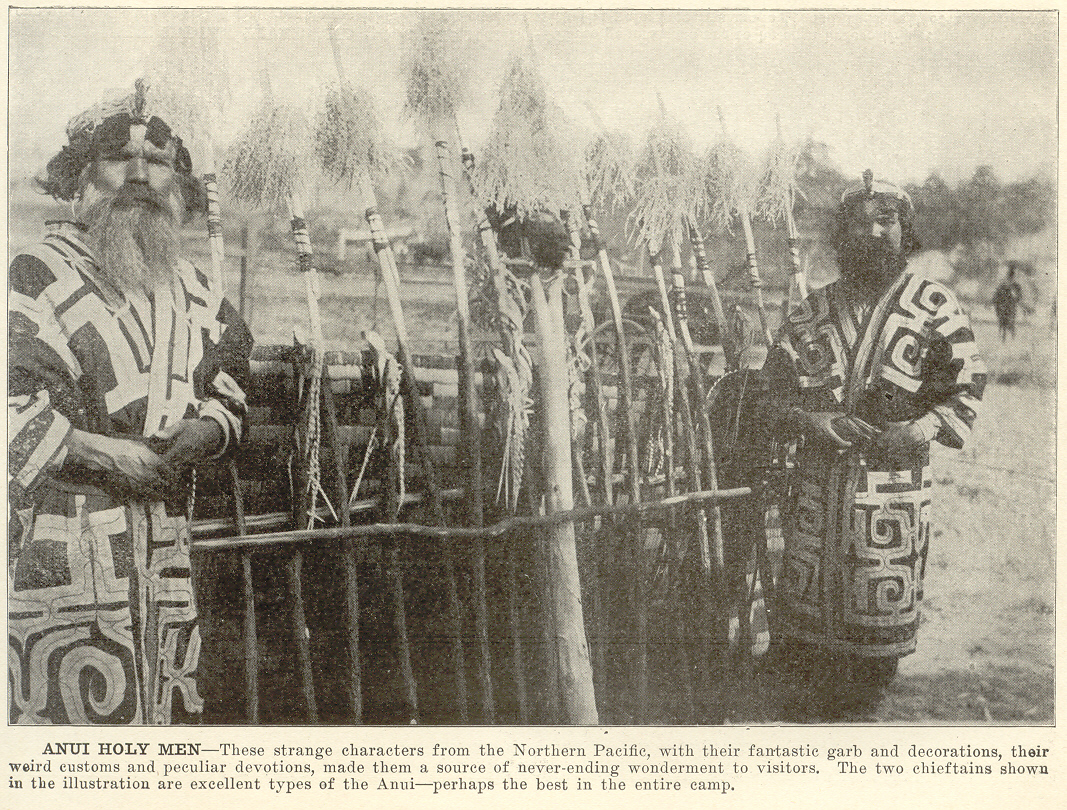
 The athletic games held yesterday for members of the various races in the Anthropology Exhibit furnished one of the most unique entertainments imaginable. A remarkable collection of peoples were gathered together in the Stadium to vie with one another in contests of speed and endurance. There were wild-eyed Ainus, heavy-bearded and gorgeously clad; great, tall lumbering Patagonians; stockily built Moros; slender, tawny-skinned Syrians; long-haired Cocopas, wild and savage of aspect; and last but by no means least, pupils of the Indian School, clad in the conventional athletic habiliments of the white man.

And the winners were:

100-yd dash – 1. George Mentz (Sioux)

120-yd low hurdles – 1. Leon Poitre (Chippewa), 2. George mentz

High jump – 1. George Ments, 2. Black Whitebear

440-yd run – 1. George Mentz, 2. Simon Marques (Pueblo)

Mile run – 1. Black Whitebear

Baseball throw – 2. Frank Moore (Pawnee)

Lone Star Dietz qualified for the finals in the shot put, but apparently did not win the event.

Prizes of $50 or more were given to the winners. Apparently, the Indians did not participate in the mud-throwing and pole climbing events. From the results of these events, AAU Secretary James E. Sullivan, concluded that the results “prove conclusively that the savage is not the natural athlete we have been led to believe.”

The distance-running Pierce brothers and the 1904 Olympics next time.

Ainu at 1904 St. Louis World's Fair

Ainu at 1904 St. Louis World's Fair