Archive for the ‘Jim Thorpe’ Category

Correct Information Is Hard to Find

January 8, 2010

A November 27, 1949 newspaper article by Deke Houlgate discussed the problems Warner Brothers were having with a screenplay for Jim Thorpe’s biopic. Several scripts had been written and discarded but a new one, titled “All-American,” was expected from the screenwriters soon. However, he questioned how good it would be given the problems the writers faced. He wrote, “One of the present problems at the Burbank studio seems to be that the records for this famous team–records that must reach back prior to World War I—no longer exists or are easily obtainable. The Army of the United States took over the school or campus, without asking, for the use of its fledgling doctors in 1917 and scattered students plus pertinent data all the way from Lawrence, Kansas, to Riverside, California.”

Like most newspaper reporters, Houlgate had some details wrong but he did better than most. First, the Army took Carlisle Barracks back in 1918, not 1917. Second, the facility wasn’t used for “fledgling doctors” as that came later. In 1918 it was used as a hospital to treat soldiers wounded in WWI. Houlgate went on to attempt to set the record straight on some legends that unfortunately still persist:

First off, Carlisle never had an undefeated, untied season. The Indians came close to a perfect record many times but always managed to lose at least one game. Next Jim Thorpe was not the first or only All-American. Third, Pop Warner did not bring Carlisle from obscurity to fame because Bemus Pierce and Metoxen were recognized as All-Americans by Walter Camp in 1896 or years before Glenn Scobie ever coached there.

Houlgate is correct about everything in the last paragraph except that Walter Camp first recognized a Carlisle player as a first team All-American in 1899 when he selected Isaac Seneca as a halfback. He may have named Pierce and Metoxen to his second or third teams but I don’t have a reference at hand to verify that. Whether or not Camp named Carlisle Indians to his All-America teams does not mean that Houlgate’s point is incorrect. The team and its star players were indeed famous before Warner was hired to coach them.
Be Careful What You Read

January 5, 2010

While reading a December 1928 newspaper, I came across an article by the great sportswriter Grantland Rice in which he credited the Carlisle Indians with doing more to popularize the game of football than anyone else:

“It was Pop Warner and his Carlisle Indians who did more to spread the gospel of football to crowds around the country than anything else. Wherever the Indians roved and roamed the multitude flocked. Those were the days of Bemus Pierce, Metoxen, Hudson, Mount Pleasant, and later such stars as Thorpe, Guyon and Calac. Old Boy Jim, meaning Thorpe, was the king of the lot, a great football player for 20 years….Warner’s teams are always interesting to watch. As a rule, they have something unexpected ready to reach for in case they need it. Even a rival lead of two touchdowns can be wiped out in one period if the other side isn’t abnormally cagy.”

Because of the Indian School’s fame, reporters often created links where they didn’t exist. Included in Jonas Metoxen’s death notice in a 1942 newspaper was the statement that he “…won fame as a blocking halfback for Jim Thorpe….” Little research is needed to determine that this statement is incorrect. Metoxen and Thorpe were not at Carlisle at the same time. Metoxen played in the late 1890s where Thorpe played dome, but not all, the years between 1907 and 1912. A smaller error is that Jonas generally played fullback.

One needs to be very careful when reading books and articles about the Carlisle Indians because many are loaded with errors. Relating a former player with Jim Thorpe is probably the most common of all. The school operated from 1879 to 1918 and Thorpe but Jim Thorpe was a student for only a small portion of those years. Also, very few of the boys were good enough to play on the varsity squad, so very few that were at Carlisle when Jim was played alongside him. Many, if not most, played on shop teams or the like, but only the very best played on the varsity. Newspaper clippings often list the starting line-ups and the substitutes that got into the games. If a person can’t be found in one of those, he probably didn’t play for Carlisle.

New Jim Thorpe Documentary

November 12, 2009

A new documentary about Jim Thorpe has been released and is playing on some PBS stations. Moira Productions announced that Jim Thorpe: The World’s Greatest Athlete has been finished and is available for viewing. The film appears to largely be the work of Tom Weidlinger (producer, director, writer) and Joesph Bruchac (producer, writer). There were rumors that James McGowan was involved with the film but his name is not listed in its credits on imdb.com:  http://www.imdb.com/title/tt1381609/fullcredits

Bruchac has written books about Jim Thorpe and is thus probably the lead writer on this documentary. He tends to write in the first person as if Thorpe, who he probably never met, is telling the story himself. A brief excerpt from the first chapter of Jim Thorpe: Original All-American states that young Jim was called stupid, something he disliked:

     Stupid. That was what the teacher called me. And not just one teacher, either.

     Stupid. I hated that name. That was one of the worst ones. Not the very worst, but close. It hurt so much because I wondered if it was true.

Stupid is not how Jim’s teacher in the Commercial Course at Carlisle, Marianne Moore, described him. Bill Crawford reported her as saying, “In the classroom he was a little laborious, but dependable; took time—head bent earnestly over the paper; wrote a fine, even clerical hand—every character legible; every terminal curving up—consistent and generous….The commercial students, about thirty, were an ideal group. Among them were James Thorpe, Gus Welch, and Iva Miller…They were my salvation, open-minded, also intelligent.”

 The Balenti brothers, who were among the brightest students at the school, sometimes made fun of Jim. However, being less intelligent than them doesn’t mean he was stupid.

Moira Productions’ website lists the TV schedule for the 1-hour documentary: http://www.jimthorpefilm.com/events/index.html

The listing implies that it shows at 5:30p.m. Sunday on WITF’s HD channel only, but Comcast’s website lists it as showing on both channels 004 and 240. That implies that it will also be broadcast on the regular WITF channel as well.

Removal of Jim Thorpe’s Remains

November 9, 2009

Both AP and UPI wire services report that Jim Thorpe’s sons plan on suing the Borough of Jim Thorpe, PA to have his remains removed from the town that now bears his name to the graveyard near Shawnee, OK in which Thorpe’s father and other relatives are buried. Jim’s youngest son, Jack, is quoted as saying, “According to Sac and Fox tradition, Dad’s soul will never be at peace until his body is laid to rest, after an appropriate ceremony, back here in his home. Until then, his soul is doomed to wander. We must have him back.”

According to the UPI, Thorpe wanted to be buried in the Oklahoma cemetery with his relatives but, at the time of his death, his family didn’t have the resources to build what his widow thought to be a proper monument to her late husband and the governor of Oklahoma declined to provide to necessary funding. Mrs. Thorpe then negotiated an arrangement in which the boroughs of Mauch Chunk and East Mauch Chunk, two towns in which Big Jim never set foot, would merge and be renamed after the football star. They were also to build an appropriate monument. According to all accounts both sides lived up to the agreement, but the expected tourist interest never materialized.

The attorney representing the Thorpe family plans to file a law suit in Federal Court in Philadelphia later this month under the 1990 Native American Graves Protection and Repatriation Act. That act requires that federal agencies and institutions that get federal funding return American Indian remains to their families or tribes. I suspect that this law was intended to deal with bones and artifacts that graverobbers sold or gave to museums, schools or government agencies, not for agreements freely entered into. This is a tough case because there are no bad guys. The question I have is: who would suffer most if his remains are not returned to the family? Perhaps Bob Wheeler, the author of the definitive Jim Thorpe biography, can shed more light on this.

Carlisle’s Most Important Game

October 30, 2009

The following question was posed to me this week:

I have to do a college speech on an event in the 20th century. I decided to do it on a Carlisle Indian School football game and how that particular game brought attention to the school, the players, and the whole story behind it. If you had to pick ONE game that, in your opinion, put the Carlisle Indian School and their football team on the map what game would you pick.

This is a very difficult question to answer because there are several possibilities:

1. In just their third full season of football, the Indians played The Big Four (Princeton, Yale, Harvard and Penn) in successive weeks and were competitive in all four games. A bad call cost them the Yale game and they held Harvard to just four points. National Champions 10-0-1 Princeton beat all of their opponents except Lehigh, Army and Harvard worse than they beat the 5-5 Indians. The Tigers were held to a scoreless tie by Lafayette. Carlisle smashed Penn State 48-5 and beat the previously unbeaten Champions of the West Wisconsin 18-8.

2. In Pop Warner’s first year at Carlisle, the Indians notched their first win over a BIG FOUR team, Penn, 16-5. They also beat California 2-0 in a game played on Christmas Day in San Francisco. Halfback Isaac Seneca was named to Walter Camp’s All America First Team, the first Carlisle player to be so honored.

3. The 10-1 1907 Indians beat a BIG THREE team for the first time when they took Harvard 23-15. They also beat Penn 26-6, Minnesota and Chicago. Their only loss was to Princeton. Warner considered the set of players on this team to be Carlisle’s best and Jim Thorpe was on the bench! The win over Amos Alonzo Stagg gave him much personal satisfaction.

4. The 11-1 1911 team also beat both Harvard and Penn. Warner considered this team to be Carlisle’s best but it lost to Syracuse by one point due to overconfidence and listless play. Clark Shaugnessy ranked the 1911 Carlisle-Harvard game as one of the twelve best games of all time. Jim Thorpe described it as his most favorite game of his long career.

5. The importance of the 1912 Carlisle-Army was debunked in “Jude and the Prince,” an article written by James G. Sweeney and published in the May 2009 journal of the College Football Historical Society.

I’d appreciate reading your opinions regarding Carlisle’s most important game.

The Start of Jim Thorpe’s Athletic Career

August 25, 2009

In a 1966 interview by reporter Virgil Gaither of The Lawton Constitution-Morning Press, Paul LaRoque (pronounced La Rock) shared some stories about his time at the Carlisle Indian School. At the time of the interview, the 72-year-old former star was living in Minneapolis but was in Oklahoma to attend his granddaughter’s wedding. One of his favorite stories was about Jim Thorpe:

 “I’ll never forget the first day we noticed him on the campus. It was in the spring and we were working out for track. Several athletes had been high jumping and the bar was at an even five feet. No one had cleared that height and we were taking a breather when Thorpe strolled by.

 “He was picking up paper around the field as part of his job to pay his way through school. Jim looked at the cross-bar, backed off about three steps and sailed over the bar without much effort.

 “Warner was standing several yards away talking with one of the athletes and didn’t see Thorpe’s jump. We all saw it, but kept quiet because we didn’t want him to take our place on the squad.

 “However, the trainer saw Jim’s leap and raced over to tell Pop. The coach went over and measured the bar, then hollered at Thorpe, who had already walked over to the other side of the field.

 “He asked Jim if he could jump that high again and Thorpe walked over and cleared the bar again with plenty of room to spare.

 “Pop told Thorpe to forget about picking up paper and report for track the next day. That’s the way he started his athletic career at Carlisle.”

Archiquette Played Against Carlisle

July 17, 2009

While researching the 1905 Carlisle-Massillon game for an article in an upcoming issue of The Coffin Corner, I noticed that Chauncey Archiquette played in that game. I hadn’t previously realized that he was back in a Carlisle uniform in 1905, but he most definitely was. That line-ups in newspaper coverage of games played that year generally include his name support that fact. In Steckbeck’s Fabulous Redmen, the line-ups for the 1904 Carlisle-Haskell game are on the page opposite the beginning of his discussion of the 1905 season. I noticed that Archiquette was in the line-up for that game as well. However, he wore a Haskell uniform. A look into Archiquette’s file showed that, after graduating from Carlisle in 1899, Chauncey had enrolled in a commercial course at Haskell. Newspaper accounts of Haskell games indicated that he had indeed played football for Haskell. This also explains how Archiquette happened to be at Haskell where, among other things, he became a young Jim Thorpe’s idol.

Few Carlisle players played against their old team after leaving the school. James Phillips, for example, refused to suit up for Northwestern in 1903 when they played the Indians. Instead, he watched the game from the stands. Joe Guyon is a notable exception in that he played in the humiliation of the hapless 1917 squad. He started the game but played just a little more than a quarter in which time he scored two touchdowns. Archiquette joined that small group in 1904 when the two Indian schools met for the only time.

Steckbeck marked nine Haskell players’ names with asterisks to denote that, after the 1904 thrashing, they “later enrolled at Carlisle.” It is worthwhile to note that Pop Warner was not at Carlisle for neither the 1904 season when the game was played, nor for the 1905 and 1906 seasons when many of the players transferred.

New Football History Website

July 13, 2009

Tex Noel just came across a new website that has an article about the single-wing on it. Being well aware of my interest, he sent me this link: (It may be necessary to copy this URL and paste it into your browser.) http://www.footballhistorian.com/football_heroes.cfm?page=18#Single-Wing%20Formation…1920s

The page is very attractively done and has links to sister sites for baseball and basketball. The problems start when you read what is written on the site. The title for the article is Single-Wing Formation…1920s. I found it curious that the single-wing was filed under the decade of the 1920s instead of when it originated. The first sentence of the article explains that: The single-wing formation was conceived by Glenn “Pop” Warner while coaching at Pittsburgh and Stanford Universities.

After reading this, there is little point in reading further. Apparently, the writer has not read Pop Warner’s letters, books and articles about when he originated the single-wing. As long-time readers know, I researched the birth of the single-wing a couple of years ago and found something quite different from what FootballHistorian.com wrote. To my knowledge, I am the only person to have located the different versions of the offense pamphlets from Warner’s correspondence course that pre-dated his 1912 book. www.Tuxedo-Press.com reprinted Warner’s single-wing trilogy which consists of the 1912 and 1927 books plus the various versions of the offense pamphlet that could be found with an introduction to explain them a bit. Anyone interested in learning the history of the single-wing would enjoy reading them.

I attempted to navigate the site but was unable to find an email address to contact. I did find a Jim Thorpe page. He states that Thorpe “…simply outran the opposing defense and chalked-up a phenomenal total of 1,869 yards in only 191 carries.” I don’t do stats; that’s Tex Noel’s department, so I will leave that up to him. Apparently, he didn’t read what opponents had to say about tackling Thorpe.

After discussing the 1912 football season, he wrote, Thorpe then was acclaimed “the best in the world” by winning Gold Medals in the 1912 Olympics in both the decathlon and the pentathlon in Stockholm, Sweden. This gives the reader the impression that the Olympics happened after the football season. Hmmm.

Problems with Proofs

July 4, 2009

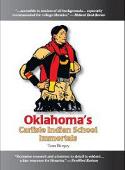
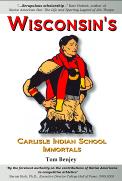
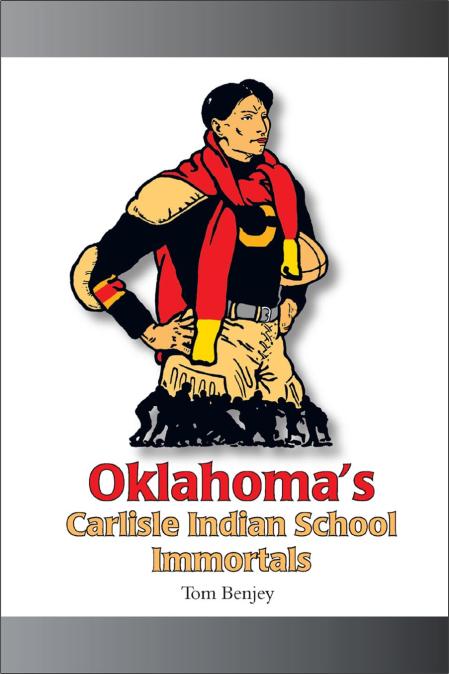
Proofs for the text and cover of Oklahoma’s Carlisle Indian School Immortals arrived Thursday. The purpose of the proof is to determine that everything is perfect before printing the batch of books. The cover looks great to me. The colors are vibrant and Bob Carroll’s drawings of the players’ faces provides an attractive background for the text on the back cover. There is a problem with the text, however.

Rather than taking up space in the narrative with dry demographic about the players, I put this information in boxes, one for each player. The boxes were shaded in light gray for visual interest. Herein lies the problem. Five of the fifteen demographic data boxes appear to have no shading. The boxes looked perfect in the advance reading copies (ARCs), but those were produced by a different printer. Panic set in immediately. The PDFs sent to the printer look perfect. The printer’s technician informed us that the shading was done at 9% and they accept nothing below 15%. That doesn’t answer the question as to why two-thirds of the boxes were shaded correctly.

As it turns out, the boxes that printed correctly have graphics with transparency on the same page but the bad ones don’t. It appears that the printer’s software or equipment does something different in these cases. Be that as it may, I have to submit new PDFs with 15% gray shading. That means that I will probably have to pay the graphic designer for his time and the printer fees for resubmitting a new PDF and for a new proof. I also have to wait several days to see if this solves the problem.

0977448681

What If Jim Thorpe Didn’t Return to Carlisle?

June 16, 2009

Ever consider what would have happened to Jim Thorpe had he not returned to Carlisle in 1911? Pop Warner and Moses Friedman have received a lot of criticism, much of it earned, for their handling of the Jim Thorpe scandal. But what if they hadn’t let him return? It appears that Friedman didn’t really want him back anyway. How differently would things have turned out if, after Albert Exendine bumped into Thorpe, in Anadarko, Oklahoma in the summer of 1911, Warner didn’t want him back?

It is curious that that Jim Thorpe, a 3rd string All American in 1908, sat out the 1909 and 1910 seasons without being recruited by a major football power or even a small Oklahoma college. My sense is that he had had all the schooling he wanted and wasn’t prepared academically for college. Other Carlislians who went on to play football at major colleges generally attended the Dickinson College Preparatory School prior to enrolling in college. Thorpe hadn’t done that. In the early 1920s, he mentioned that numerous colleges had approached him about enrolling in their institutions when he was playing college football. However, that likely happened after he returned to Carlisle in 1911.

It is highly unlikely that Jim Thorpe would have played in a high enough profile program to be named 1st string All America in football in 1911 if he didn’t return to Warner and Carlisle. Perhaps he would have made the Olympic team if found a trainer and a club of the caliber necessary to prepare him to make the team. It’s possible but seems unlikely, especially since he hadn’t taken steps to find a trainer or club before returning to Carlisle less than a year before the Olympic Games.

So, my conclusion is that Jim Thorpe profited from returning to Carlisle. Losing the medals was a price he paid for that decision, but he still made out better in the long run than he would have if he had stayed in Oklahoma. Conflicting opinions are welcomed.