Archive for the ‘Haskell Institute’ Category

Historian Demands Redskins Name Be reinstated

September 7, 2023
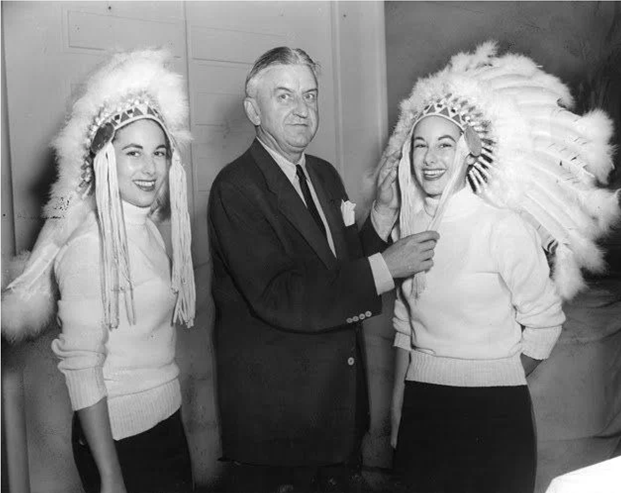
George Preston Marshall (center)

Andre Billeaudeaux, historian and co-founder of Native American Guardians Association (NAGA), thinks opponents of the Redskins name don’t know what they’re talking about. “These people are just ignorant. It’s toxic ignorance. It’s group think. It’s the psychology of a group that has no idea what they’re doing, but they won’t listen to us [NAGA], either.”

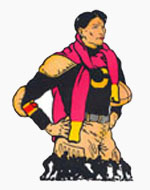
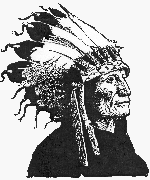
The origin of the Redskins name and logos go back to 1912 when James Gaffney, of New York’s Tammany Hall, purchased the Boston Rustlers National League baseball team. He renamed the team as the Braves and used an image inspired by Saint Tammany for the team’s logo. That image is prominent on the left sleeve of Babe Ruth in a photo taken in 1935.

When a group including Washington laundry magnate George Preston Marshall purchased an idle NFL franchise and established a team in Boston, they named the team the Braves. It was common for upstart NFL teams to name themselves after established baseball teams, particularly when they shared the same field. The new Braves’ uniforms didn’t include an Indian motif. Instead they wore jerseys of a simple design in Marshall’s company’s colors: blue and gold.

As a .500 first season, Marshall’s cohorts left, leaving him as sole owner of the team. He fired the coach, Lud Wray, and hired Lone Star Dietz, a Carlisle Indian School alum who had had success coaching at the college level. Dietz brought four of his Haskell Institute (today’s Haskell Indian Nations University) Fighting Indians star with him. The figure on the Braves’ letterhead and pin is different than the one used by the baseball team. On the baseball team logo, the man wore a headdress where the football logo image only had three feathers. I’m not qualified to determine if the football team used Saint Tammany’s profile or not. Having red on the letterhead suggests that the team’s colors changed shortly after Dietz became their head coach. The existence of the pin argues against Dietz changing the logo because he was only with the team a short amount of time before the team name was changed and it was during the off season. So, the logo on the button was probably created for the 1932 season.
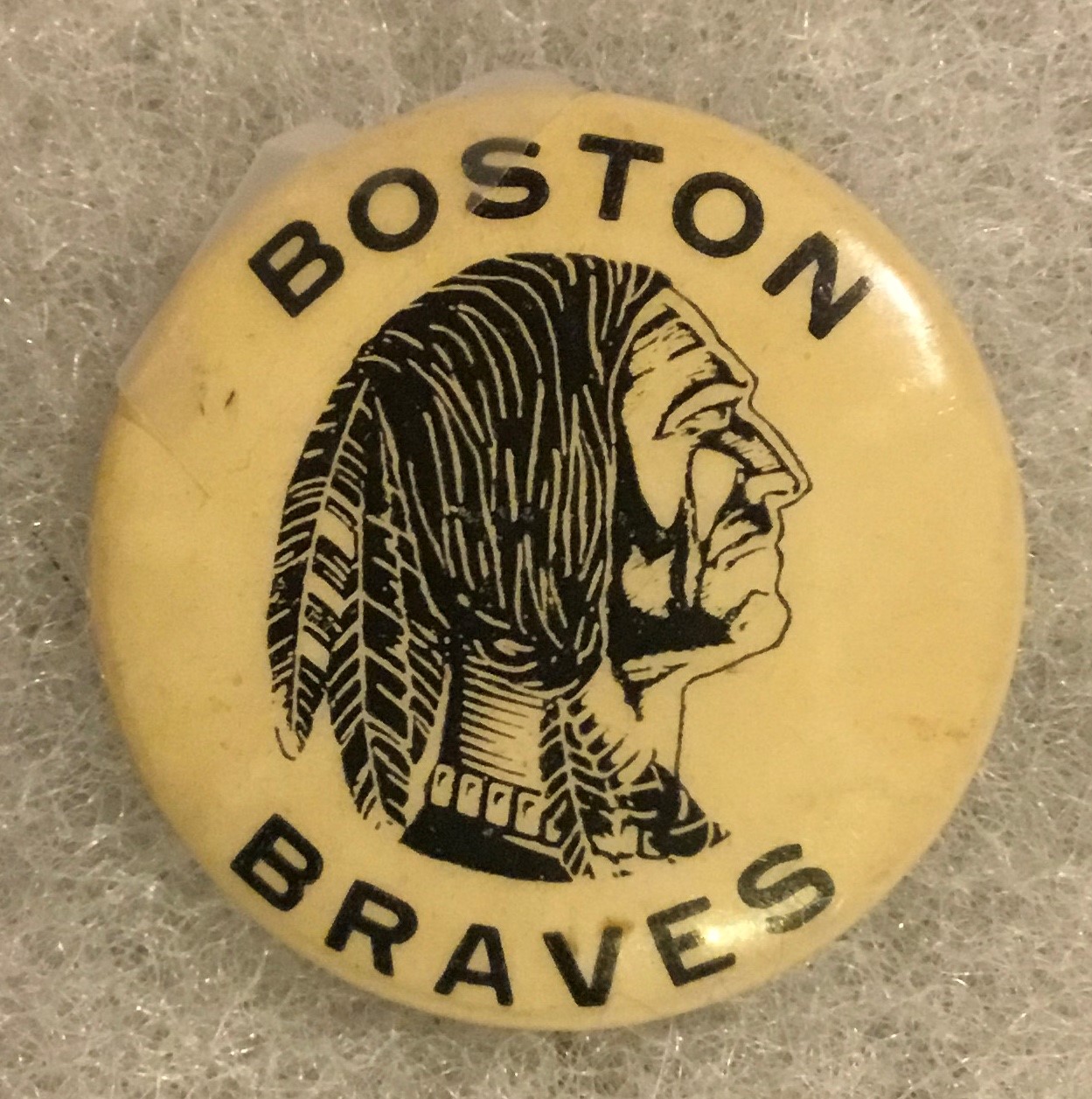
One question never asked is: Why did Marshall change the team’s colors? A 1933 jersey shown below has red as the primary color and is trimmed with gold and black bands. These colors are similar to Carlisle’s colors and the stripes on the cuffs are reminiscent of the below-the-elbow stripes on the Indians’ jerseys. Some have attributed the design of the Redskins’ logo to Lone Star Dietz. The image may have preceded him; it’s not clear when the team adopted it. Dietz likely borrowed the concept from the NHL Blackhawks’ design and placed the logo on the front of the jersey.
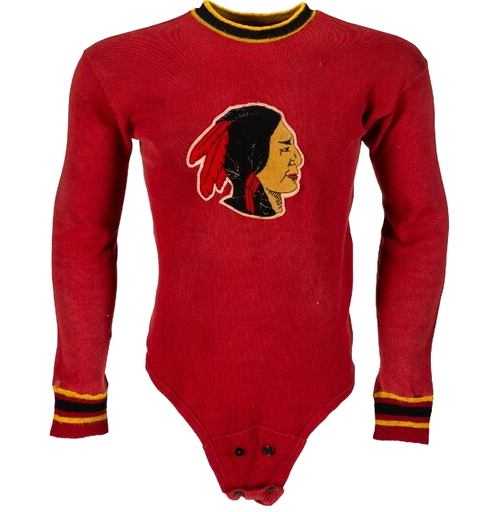
Probably to save money, Marshall moved the team from Braves Field to Fenway Park. To eliminate confusion with the baseball team, he felt he had to change the name. Some think red was chosen because they were then based on the Red Sox home field. A Boston newspaper writer claimed that Marshall chose the name to save money by not having to buy new uniforms. As shown in this piece, both colors and design of the team’s uniforms changed when the team’s name changed. However, the team had to wear the old uniforms in the first game of the 1933 season because the new ones hadn’t arrived yet.

Billeaudeaux thinks otherwise. “Redskins is not about race. It’s a warrior who’s gone through the bloodroot ceremony. “They shave their heads and surrender their souls to their Creator. They paint themselves red as if they were born new into the world.”

“The Redskins were the only minority representation in the entire NFL and it was a real person, not a mascot,” said Billeaudeaux. “The name Redskins is a national treasure and for that reason it should be protected. It’s a cultural treasure and deserves to be protected and understood. It’s not just about the football team. It’s about the DNA of the nation.”

NAGA members aren’t the only people who prefer Redskins for the team name. As of this writing, 130,790 people had signed NAGA’s petition demanding the team name be changed back to Redskins. “Redskins Fans Forever,” a Facebook group with 61,600 members, refers to the team only by its historic name. 

Ninety percent of Native Americans around the country supported the Redskins name in a Washington Post poll in 2016, as the woke assault on the traditional name grew stronger.

Red Mesa High School on a Navajo reservation in Arizona recently installed a new football field with the Washington Redskins logo on the 50-yard line.

Haskell Visits Carlisle part 2

April 22, 2021

On December 2, when asked about taking the Temple job, Warner was reported as saying, “Every time I go back East, they have me signing a contract with some other school.” Three days later, newspapers reported on his resignation from Stanford. The day after that, The Philadelphia Inquirer ran articles on Temple’s new coach, Warner, who had been hired for $15,000 a year. The $2,500 pay raise may have been less enticing than avoiding Stanford alumni who Warner thought were “after his scalp.”

On December 9, Temple published its football schedule for the upcoming year. The game with Haskell was expected to be a highlight of the early season, especially so because the Indians were led by Warner protégé Lone Star Dietz, a coach who generated headlines wherever he went.  Warner’s last game with Stanford was a 7-0 loss to another protégé, Jock Sutherland of Pitt. Bittersweet as it might have been, that game was not to be. Shortly after Warner’s announcement, Dietz’s future became the subject of speculation. Now in The Great Depression, the government had cut Haskell’s funding and had reduced its status to that of a high school. Dietz surely thought Haskell would no longer be able to field competitive teams and the media assumed he would be making a change. Names of various schools such as Holy Cross and Fordham popped up in print as possible new homes for him. On March 8, 1933, The Boston Globe ran an article headlined: “Lone Star Dietz to Coach Braves: Boston Football Team Signs Carlisle Star.” Dietz would be coaching in the NFL and not against Temple but who would lead Haskell then?

Dietz didn’t resign immediately. Instead, he stayed at Haskell until after spring practice because his NFL contract didn’t call for him to report until May 1. Haskell officials didn’t seem to be in a hurry to replace him. They said that no plans had been made regarding a successor and they wouldn’t select a coach for some time. That time came on August 4 when Henry Roe Cloud was named superintendent of Haskell Institute. The same day, Roe Cloud announced Gus Welch as Haskell’s head football coach and athletic director. It would have been nice to have been flies on Welch’s and Warner’s walls the day they realized they were scheduled to play each other and that it was late to cancel the game.

Welch had been critical of Warner at Carlisle and had submitted a petition that led to a government investigation of the school and reducing athletics’ importance at the school. Although later accused of interfering with Warner’s successor at Carlisle, Victor Kelley, Welch remained on good terms with the administration. Visiting the old school wouldn’t seem problematic for him. A crowd of thousands turned out to watch the Haskell players practice for two hours on Indian Field, where Jim Thorpe, Lone Star Dietz, Gus Welch and numerous others had played decades earlier. It had to be especially important to Haskell end Kendall, nephew of Carlisle great Bemus Pierce. Afterward, the players were then given a tour of Carlisle Barracks before departing for Philadelphia.

The game was anticlimactic. The Old Fox had no trouble defeating his former pupil 31 – 0.

On December 2, when asked about taking the Temple job, Warner was reported as saying, “Every time I go back East, they have me signing a contract with some other school.” Three days later, newspapers reported on his resignation from Stanford. The day after that, The Philadelphia Inquirer ran articles on Temple’s new coach, Warner, who had been hired for $15,000 a year. The $2,500 pay raise may have been less enticing than avoiding Stanford alumni who Warner thought were “after his scalp.”

On December 9, Temple published its football schedule for the upcoming year. The game with Haskell was expected to be a highlight of the early season, especially so because the Indians were led by Warner protégé Lone Star Dietz, a coach who generated headlines wherever he went.  Warner’s last game with Stanford was a 7-0 loss to another protégé, Jock Sutherland of Pitt. Bittersweet as it might have been, that game was not to be. Shortly after Warner’s announcement, Dietz’s future became the subject of speculation. Now in The Great Depression, the government had cut Haskell’s funding and had reduced its status to that of a high school. Dietz surely thought Haskell would no longer be able to field competitive teams and the media assumed he would be making a change. Names of various schools such as Holy Cross and Fordham popped up in print as possible new homes for him. On March 8, 1933, The Boston Globe ran an article headlined: “Lone Star Dietz to Coach Braves: Boston Football Team Signs Carlisle Star.” Dietz would be coaching in the NFL and not against Temple but who would lead Haskell then?

Dietz didn’t resign immediately. Instead, he stayed at Haskell until after spring practice because his NFL contract didn’t call for him to report until May 1. Haskell officials didn’t seem to be in a hurry to replace him. They said that no plans had been made regarding a successor and they wouldn’t select a coach for some time. That time came on August 4 when Henry Roe Cloud was named superintendent of Haskell Institute. The same day, Roe Cloud announced Gus Welch as Haskell’s head football coach and athletic director. It would have been nice to have been flies on Welch’s and Warner’s walls the day they realized they were scheduled to play each other and that it was late to cancel the game.

Welch had been critical of Warner at Carlisle and had submitted a petition that led to a government investigation of the school and reducing athletics’ importance at the school. Although later accused of interfering with Warner’s successor at Carlisle, Victor Kelley, Welch remained on good terms with the administration. Visiting the old school wouldn’t seem problematic for him. A crowd of thousands turned out to watch the Haskell players practice for two hours on Indian Field, where Jim Thorpe, Lone Star Dietz, Gus Welch and numerous others had played decades earlier. It had to be especially important to Haskell end Kendall, nephew of Carlisle great Bemus Pierce. Afterward, the players were then given a tour of Carlisle Barracks before departing for Philadelphia.

The game was anticlimactic. The Old Fox had no trouble defeating his former pupil 31 – 0.

Haskell Visits Carlisle

April 19, 2021

A few days ago a friend who collects Carlisle memorabilia showed me a photo of the 1933 Haskell Institute football team that was said to have been taken at Carlisle Barracks. The team’s coach, Gus Welch, was easily recognizable and, from past research, I knew that 1933 was his first year at Haskell. The background was clearly identifiable as Indian Field. The goalposts, which appeared to have been made of galvanized pipe, were surely replaced over the years and I already knew that the wooden grandstand had been rebuilt using concrete long ago. So, the photo was very likely legitimate. But why was Haskell visiting Carlisle?

A quick search through old newspapers uncovered a few articles about their visit. A photo accompanying one of the pieces is included in this post. They were here sure enough but why? The Harrisburg Evening News reporter answered that question when he wrote “[T]he Haskell Institute football team, which will meet Temple University in a night game tomorrow evening. This game has been an annual meeting for the past five years.” It made perfect sense for Haskell to visit Carlisle on the way to Philadelphia. It’s a wonder Lone Star Dietz didn’t bring one of his Haskell teams to Carlisle when he was coaching them and playing Temple. The reporter had one thing wrong. 1933 was only the third time Haskell played Temple. This time Welch would be taking on his mentor, Pop Warner. Given their relationship, why would either of them agree to play each other?

Not only was 1933 Welch’s first year at Haskell, it was Warner’s first year at Temple. But that doesn’t completely answer the question. On November 29, 1932, U.P. circulated a story that Temple University had offered Pop Warner the job of coaching the Owls. Stanford officials called the rumors that Warner would step down as their head coach “utterly impossible.”

<end of part 1>

1899 Cal Players Exploited

July 8, 2020

While researching the 1899 Christmas Day game between Carlisle Indian School and the University of California for an upcoming article, I learned that the Cal players had voted three times against playing in this post-season game. Initially, they gave fatigue from the season just finished and the need to study for final exams as the reasons for objecting to another game. What turned out to be the real reason was the money. Players complained that the Thanksgiving Day game against archrival Stanford had generated a lot of revenue but athletes received no benefits from it.

A major objection was that Cal’s athletes didn’t have a “clubhouse” in spite of generating lots of money and receiving nothing in return. Only after they’d wrested control of the finances from Manager Irwin J. “Jerry” Muma and transferred it to the athletic committee did the team agree to the tough, but potentially profitable, game with the Indians.

A major difference between then and now is that in the decades before the dawn of the NFL, athletic scholarships were not (officially) allowed. Student players generally paid full tuition and received nothing for their efforts, aside from the adulation of comely co-eds—unless alumni with deep pockets were generous with their money. The Cal players’ case for controlling the finances was considerably different than for today’s gladiators who get athletic scholarships, numerous perks not available to other students, and a shot at turning pro. Why should they have performed risky, unpaid labor for a college unwilling to use some of the profits for facilities that would improve athletes’ performance?

Who is the mystery player?

June 1, 2020

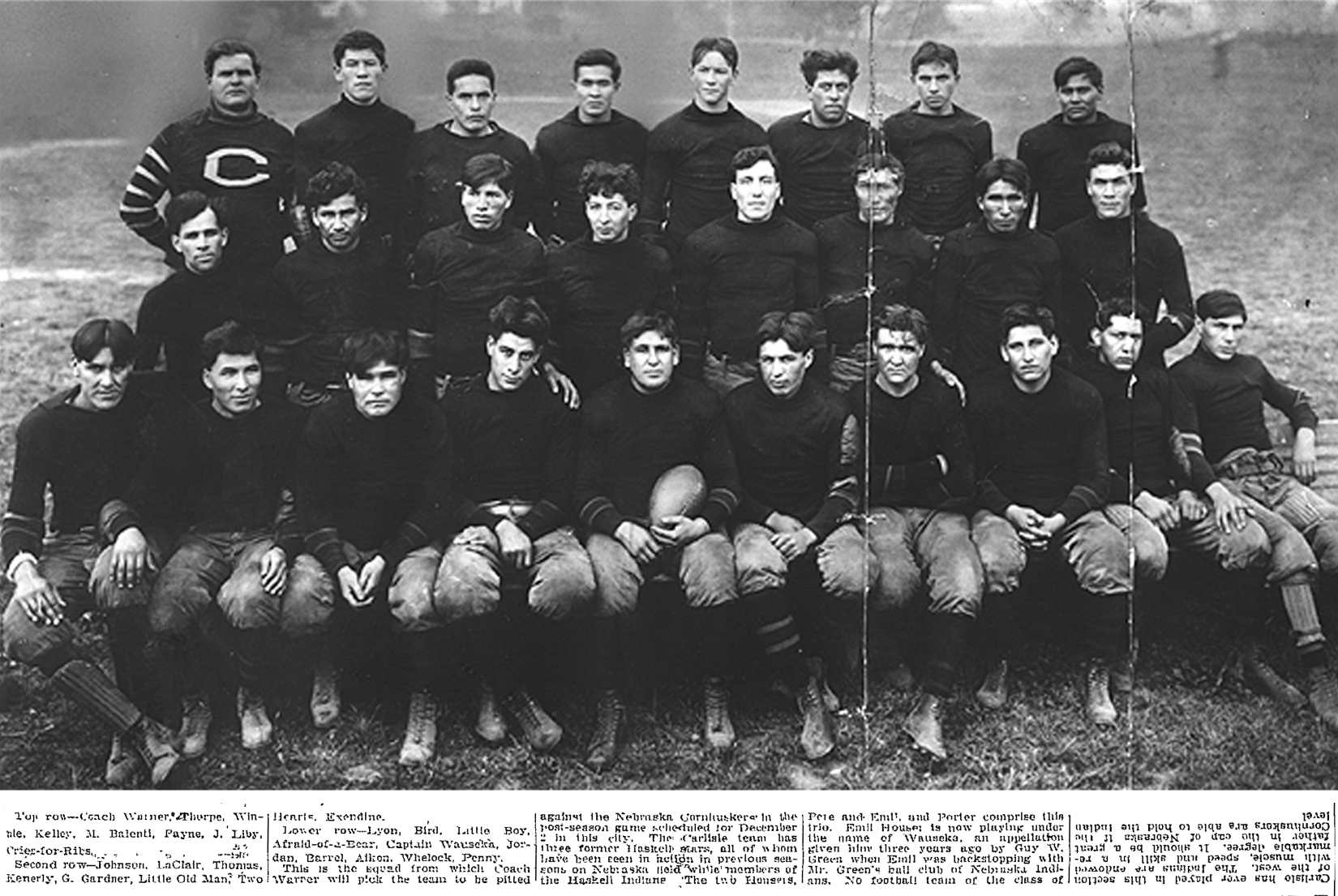
While trying to determine if Ina Eloise Young attended the Carlisle-Denver game in 1908, I came across a Nebraska newspaper article about the Indians’ trip west. Included were a group photo of the team complete with a legend hat identified all the players on the team. In addition, the caption related the story of how Emil Hauser changed his name. For a number of years, many thought Emil Hauser and Wauseka were two different people. Some years ago, Mike Balenti’s granddaughter shared that Emil took that name from the place he was playing a baseball game. This article attributes his renaming to Guy W. Green, owner and manager of a barnstorming baseball team called the Nebraska Indians when Emil caught for the team in 1905.

This photo and legend may also help with another identification problem. Mike Balenti’s granddaughter also shared a photo of him with four other Carlisle players posing on an automobile in Union Station in St. Louis on that 1908 trip west. She identified all the players except the one on the far right. Maybe you can help with that. The others are l-to-r Little Boy, Emil Hauser, Mike Balenti and Fritz Hendricks. Who can the other one be? Can you identify him from the team photo?

Yet Another Eagle Feather

July 9, 2016

Dennis Hildebrand 1924

After the dissolution of the Oorang Indians NFL team after the 1923 season, Eagle Feather’s name next appeared with Jim Thorpe’s in a December 18, 1927 article in The Sunday Repository out of Canton, Ohio.  This Eagle Feather was playing on Jim Thorpe’s World Famous Indians basketball team. The article discussed an upcoming game with the local Orphans team that consisted of former college and high school stars. Something different about this article was that it gave two names for the WFI players. Jim Thorpe was Bright Path, Nick Lassaw was Long Time Sleep, and Dennis Hildebrand was Eagle Feather. Could Dennis Hildebrand be the same Eagle Feather who played football with Thorpe on the Oorang Indians NFL team?

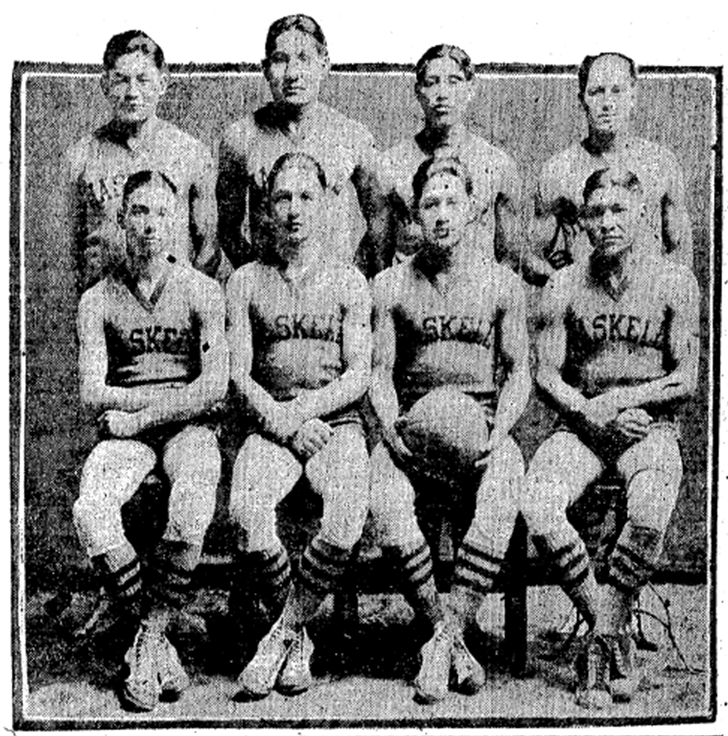
Since The Sunday Repository piece listed Hildebrand/Eagle Feather as having attended Haskell Institute, that institution would be a likely place to look for him.  The World-Herald of January 12, 1924 featured a photo of the Haskell basketball team. Dennis Hildebrand was one of the eight Haskell players dressed in the school’s basketball uniforms in the photo. Another was the famous football star John Levi, who played center on the basketball team. Articles written while Eagle Feather played for the Thorpe’s WFI said he was captain of the 1925 Haskell hoops squad and was a North Carolina Cherokee native of Oklahoma. (The 1905 census listed him as having been born in Oklahoma but living on a Navajo reservation in Arizona.) The December 21, 1927 edition of The Canton Daily News claimed that Hildebrand had attended Indiana University not Haskell. The Daily News was clearly wrong about him not attending Haskell because his playing on that team is clearly documented. But did he also play for IU at some point? Finding out if he did or not is my next task.

*** UPDATE ***

Mary Mellon of the Indiana University Archives responded to my inquiry about Dennis Hildebrand:

I’ve checked into your question about Dennis Hildebrand. The IU registrar’s office has no record of him attending IU, which would have been a requirement to play for the basketball team. There’s also a handy online IU basketball database: http://www.indystar.com/story/sports/college/indiana/2013/10/29/indiana-basketball-mens-database/3308409/

Although it covers the years Hildebrand might have played college basketball, neither version of his name appears.


Important Info About Eagle Feather, Maybe

June 3, 2016

Eagle Feather Carlisle fullback 19221011

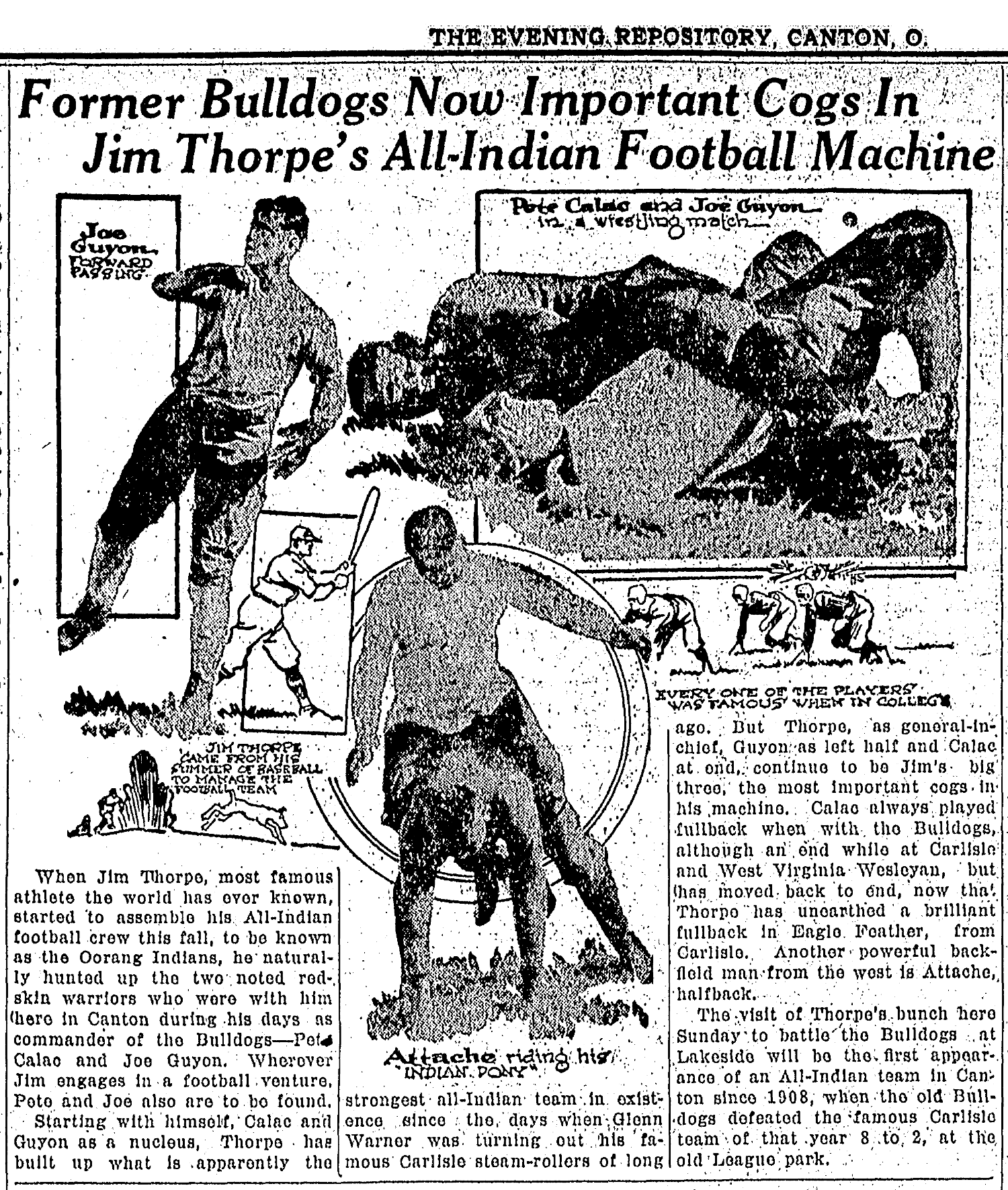
When my Eagle Feather research returned me to 1922, the Oorang Indians’ first year of operation, I took a second (or third) look at some newspaper articles I had previously collected. I was forced to search for an early article I for which had neglected to capture the date of and publication name. Mercifully, the easily recognizable article popped up early with the graphic at the top of the page. Rereading “Former Bulldogs Now Important Cogs In Jim Thorpe’s All-Indian Football Machine” brought me back to “Thorpe has unearthed a brilliant fullback in Eagle Feather, from Carlisle.” No new information there, I thought, “At least I know where this came from now.” My eye wandered to a piece immediately below the one I had sought, finding something I’d previously overlooked.

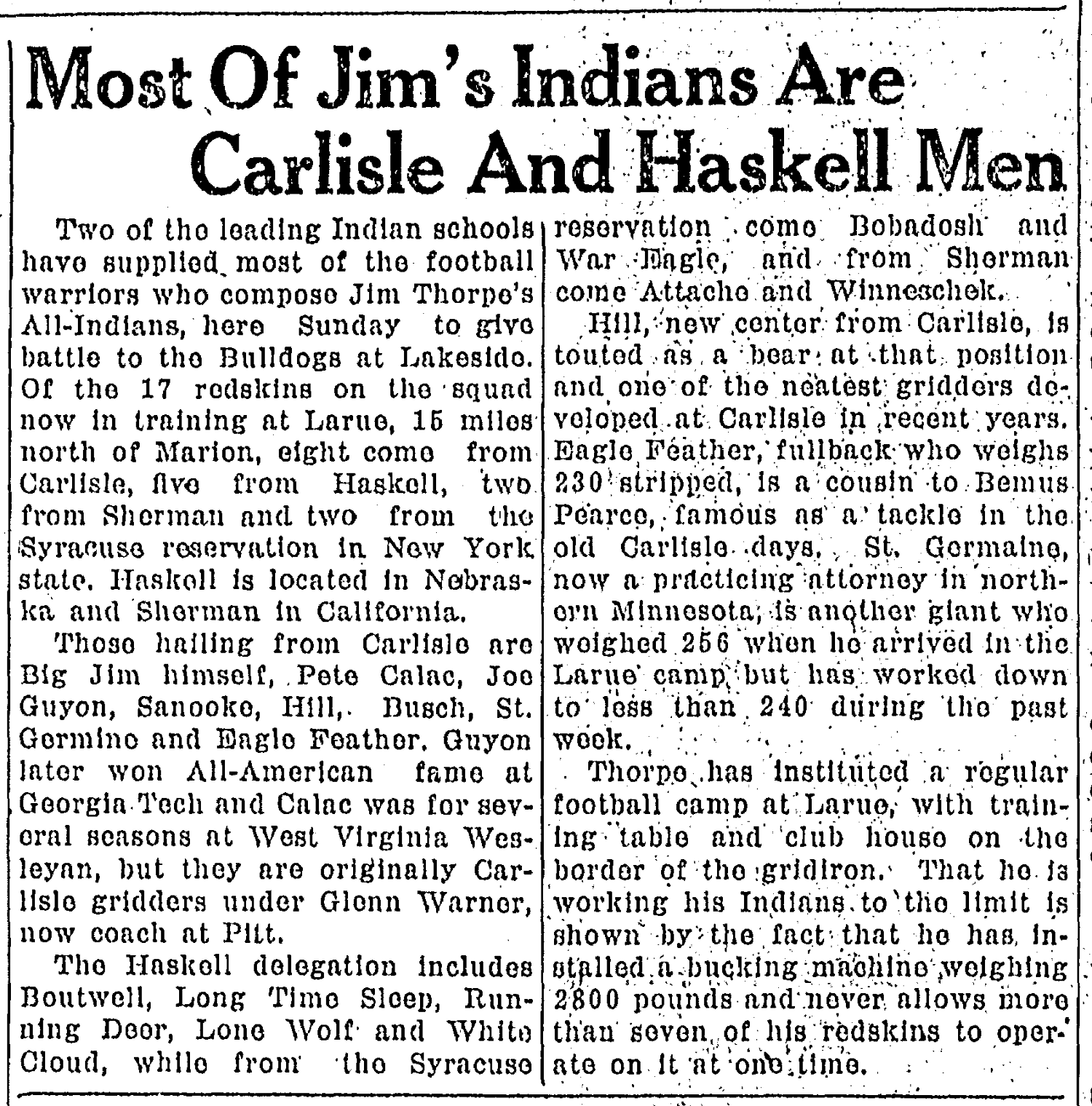
“Most Of Jim’s Indians Are Carlisle And Haskell Men” grabbed my attention. Perusing the piece unveiled “Eagle Feather, fullback who weighs 230 stripped, is a cousin to Bemus Pearce [sic], famous as a tackle in the old Carlisle days. This could lead us to who Eagle Feather really was or it could have been wrong as are so many things in newspapers.

Since we have so little else to go on, let’s assume it is correct. Let’s accept that Eagle Feather was a cousin of Bemus Pierce and that he attended Carlisle. To make our lives as easy as possible, let’s assume (for now) that his last name was Pierce and research Carlisle and tribal records for a person from that family who would have been between 18 and 25 in 1922, based on his youthful appearance in the Oorang photo. I’d also scan Carlisle football files and photographs for a player weighing over 200 pounds (he might have put on a few after Carlisle closed in 1918).

If we come up dry, we’ll have to do some genealogy work to identify Bemus Pierce’s cousins who might fit the criteria. This research will likely require considerable assistance from the tribal librarian. It’s not exactly looking for a needle in a haystack but only by an order of magnitude or two.

Eagle Feather Bemus Pierce cousin 19221011


Haskell Football Slashed Again

May 24, 2015

Haskell Fightin' Indians

Haskell Fightin’ Indians

Football statistician Tex Noel informs me that Haskell has canceled football for the upcoming season due to finances and provided this link for more detail:  http://www2.ljworld.com/news/2015/may/21/haskell-suspends-football-program-2015-season/

Financial problems are nothing new for the Haskell Indian Nations University’s Fighting Indians. In the Great Depression, when the school was called Haskell Institute, the federal government slashed their funding in half at a time when their program was flourishing. After Carlisle was closed by the government in 1918, the mantle of Indian athletic excellence was passed to Haskell Institute. For the decade starting with the end of WWI, Haskell had no losing seasons, peaking with a 12-0-1 season in 1926. That team’s only blemish was a 21-21 tie with Boston College in a game played in Boston. Wins included victories over Bucknell, Dayton, Loyola, Michigan State, Xavier, and Tulsa in games played largely on the road as had Carlisle.

Haskell’s success led to its coach, Lone Star Dietz’s protégé from Washington State Richard Hanley, leaving for a better job at Northwestern, where he also did well before changing to a more lucrative position in the insurance industry. Barely breaking .500 for the 1927 and ’28 seasons led to the school recruiting a new coach. A decade after his sensational trial, Lone Star Dietz was hired as the new head coach—with recommendations from Pop Warner and Knute Rockne. The Lawrence Daily Journal-World reported, “And when Lone Star assumes his duties tomorrow he will reward the efforts of athletic officials and administrative heads at Haskell who for several years have tried to secure a widely known coach with Indian blood.” He was dubbed “Miracle Man” after leading the 1929 team to a 9-2 season.

But his and their success was not to last. The coaching budget for 1933 was slashed in half by government fiat. Haskell’s storied football trail of glory ended with Dietz’s departure to coach the Boston NFL team, setting up another story still in the news today.

College Football and All America Review

May 28, 2014

The most recent edition of the College Football Historical Society Newsletter included a historical book review of Christy Walsh’s 1949 College Football and All America Review. What caught my eye most were two things the book included: “the score of every game [ever] played” and “listing of lettermen, by year, from each school.” Determining exactly who played on the Carlisle and Haskell teams is a difficult, if not impossible, project due to the records retained for those teams. So, I searched for a copy of the book and found one at Allegheny College through interlibrary loan. Eventually the sought-after book arrived.

I flipped through the pages of the book searching for the Carlisle lettermen and found none. I repeated the process for Haskell and was disappointed again. Perhaps because neither school was competing at the college level at that time, their records were omitted. Or, it may have been too hard to gather up the information from the available data sources. Regardless, I came up dry. But I did stumble across some things of interest.

The book was dedicated to Pop Warner “with affectionate esteem” and Warner wrote a one-page article, “Flash-back to Carlisle” in which he reminisced about his years with the Indians. His list of highlights included:

  • Numerous victories over the University of Pennsylvania
  • Defeat of Harvard 18 to 15 in 1911 against Walter Camp All Americans as Percy Wendy, Sam Felton and Bob Fisher, the game in which Jim Thorpe kicked three goals from the field
  • The 27 to 6 trouncing the red-skinned youngsters gave to West Point in 1912, when the Cadets boasted players like Arnold, Littlejohn, Hyatt and Devore
  • I happily recall the truly great Indian squad of 1913 which handily swamped undefeated Dartmouth by a score of 35 to 0
  • Perhaps no Carlisle victory was more important or satisfying than the historic post-season game of 1907 when Chicago, coached by that grand old man Amos Alonzo Stagg and quarterbacked by Wally Steffen, another Walter Camp All American, was soundly defeated by the Indians, after the Conference champions had won the Big 10 title in an undefeated season.

Not listed were the 1905 Carlisle victory over West Point during a season Warner wasn’t at Carlisle and the 1907 defeat of Harvard, possibly because Warner felt the defeat of Chicago overshadowed it.


Lone Star Dietz Designed Redskins’ Uniforms

January 8, 2014

A little bit of research made crystal clear that The Boston Globe writer hadn’t bothered to research the 1932-1933 Braves-Redskins uniform issue at all when he wrote, “It appears the name change was nothing other than a cheap, pragmatic way for the Redskins to play under a new name at a new venue with uniforms that were but a year old.”

The Boston Herald coverage for the 1933 Redskins first home game announced, “Furthermore, they have a new coach, Lone Star Dietz; have new uniforms and some new players.” Grainy black and white period newspaper photos don’t show off the new uniforms very well, so football trading cards will have to suffice. Turk Edwards’ card shows the front pretty well where Cliff Battles gives a side view. The colors are similar to those of Carlisle Indian School, which were red and old gold. A multi-color Indian head adorns the front of the jersey and stripes are placed at the wrists. (Carlisle’s stripes were just below the elbow.) Now that we know what the Redskins wore in 1933 and later, let’s find out what the Braves wore in 1932.

The September 19, 1932 edition of The Boston Herald reported that the Braves didn’t look like a well-polished professional team when they easily defeated the Quincy Trojans in a practice game at Fore River Field on September 18, 1932. One reason was the long off-season lay-off. The other was sartorial. Because their new uniforms hadn’t arrived, they wore plain blue jerseys without numbers. Fortunately, their dark blue jerseys with gold numerals arrived before their first home game. Although the black and white photos that accompany the article aren’t in color, they clearly show numerals on the front of the 1932 jerseys in the place where the Indian heads appear in 1933. This is further evidence, again easily found, that George Preston Marshall didn’t select Redskins for the team name as an economy move.

This uniform information brought to mind something that came up when researching Lone Star Dietz’s life. A Lafayette, Louisiana attorney I interviewed had represented the One Star family pro bono some years earlier in an attempt to receive compensation from a previous owner for the artwork Dietz created for the team in 1933. The statute of limitations had expired decades earlier so the family got nothing. Unable to find physical evidence that Dietz had designed the uniforms, such as sketches he had made, I didn’t include the topic in his biography. Now, I think it’s quite likely that Lone Star designed the 1933 Redskins uniforms. The team name changed months after he was hired. The Redskins’ new colors were similar to Carlisle’s. Dietz clearly had the artistic ability to design the Indian head for the jerseys. He had a long history of making art for teams and schools and participating in artistic endeavors seldom done by football coaches. And it wouldn’t have cost Marshall anything.

1932 Boston Braves

1932 Boston Braves

Cliff Battles chicklet Turk Edwards national chicle card