I initially thought this post would have been completed weeks ago due to little or no information being available regarding Eagle Feather. I was wrong. There is lots of information available, almost all irrelevant, that require much time to sort through. To make the task more manageable, I ignored everything about people named Eagle Feather far too old or long dead. But I did include anyone remotely possible of being the Eagle Feather in question.
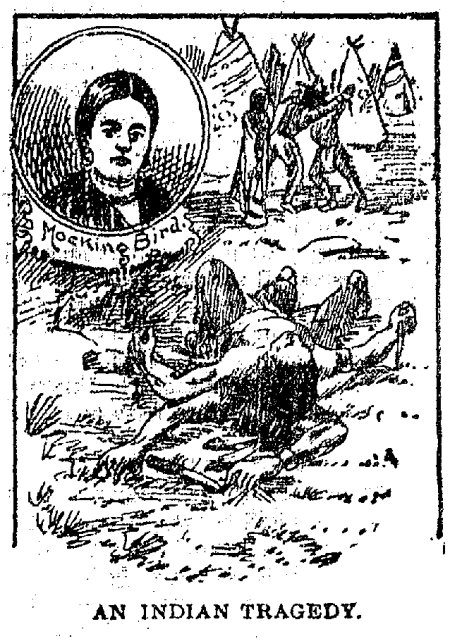 The first reference I investigated was of a 1901 Seminole love pentagon gone terribly wrong. Seventeen-year-old Mocking-Bird, daughter of the chief, was the belle of the tribe and had attracted four ardent suitors, including Eagle feather. The longer she took making her choice, the more hopeful—and jealous—each became. Smiling impartially at each of them, she remained steadfastly indifferent. Her suitors’ jealousy and ardor festered day by day as the day of the sun dance approached, thinking she would pick a husband during the festival.
When Eagle Feather danced with Mocking-Bird, they sped round and round until they needed to rest. Breathless, they passed out of the throng. The other three suitors saw her drop her eyes to Eagle Feather’s amorous glance, signaling surrender. Enraged with their loss, blows were struck and blades were drawn. Soon Eagle Feather and a rival fought were fighting with hunting knives. Two dark figures closed in, shielding the fighters from the dancers circling around them. Mocking-Bird pulled away, fell to her knees and prayed for the life of her young lover. The fight ended with two men dead, the other two dying. Gasping for breath, Eagle Feather was laid in Mocking-Bird’s arms. Dumb and dry-eyed, she watched his life drift away. She held him silently as if doing that would keep him from leaving her. That night, she slipped out of camp and walked to the low bank of the sluggish river that lapped the fringe of the forest. Under the light of the quarter moon, she quietly dropped into the water.
Next time we’ll investigate a newspaper report on another Eagle Feather.
 Receiving questions like this isn’t unusual for me since writing Doctors, Lawyers, Indian Chiefs: Jim Thorpe & Pop Warner’s Carlisle Indian School football immortals tackle socialites, bootleggers, students, moguls, prejudice, the government, ghouls, tooth decay and rum because I have probably researched Carlisle Indian School football players’ lives more than anyone has. This is normal and not discouraged because I also ask other authors questions about topics they have researched. Chris is researching the Oorang Indians NFL team that played in the 1922 and 1923 seasons for a future book, one that I’m looking forward to reading.
 Tex Noël, Executive Director of Intercollegiate Football Researchers Association, informed me of a recent article on Jim Thorpe’s January 1941 visit to Berks County, Pennsylvania. Accompanying the article was a photo of Jim Thorpe with Lone Star Dietz and Jimmy McGovern, then coach at Kutztown State Teacher’s College. Also present, but not in the photo, was Carlisle Indian School alumnus and Reading High School Orchestra Conductor and Music Director Fred Cardin. In his spare time, he led the Ringgold Band, composed music, directed the Reading Civic Opera Company. With Dietz coaching athletics at Albright College and Cardin leading most of the musical groups in town, Reading had quite an exposure to Carlisle Indian School alums.








 Tom Benjey's Weblog
