Archive for the ‘Football’ Category

More on Indian Sports Leadership

September 5, 2008

Yesterday’s email brought a curious announcement. I am going to receive a free, signed copy of a new book to be released soon. The Toilet Paper Entrepreneur by Mike Michalowicz, about which I know nothing, was looking for humorous bathroom graffiti. I sent in my all-time favorite from the back of the men’s room door at The Blessed Oliver Plunket, a bar/restaurant featuring live entertainment located across the street from the Cumberland County Historical Society. The Plunket, as it was better known, has numerous stories to tell but I’m not the one to tell them. In the late 70s, as I was leaving the men’s room, I noticed a scribble on the door:

No sign of intelligent life…Kirk Out

Apparently that witticism has found its way into a book.

Back to Donna Newashe McAllister’s question…

I expected that more people would comment on this and would like to see more myself. So, I’ll share some of my thoughts.

My wife and I have discussed this issue to some degree and I think it is an issue with multiple facets. First, I’m not so sure that American Indian athletes have necessarily declined. Judging today’s athletes with those who were at the Carlisle Indian School may not be fair. Those guys were world-class athletes coached by one of the most innovative coaches of all time. Pop Warner is criticized much today but few question his knowledge or his ability to coach football. During its heyday, Haskell had fine athletes and was led by Dick Hanley, Lone Star Dietz and Gus Welch, all of whom were excellent coaches. Dietz belongs in the College Football Hall of Fame. Neither Haskell nor the tribal colleges can afford to hire coaches of their caliber today.

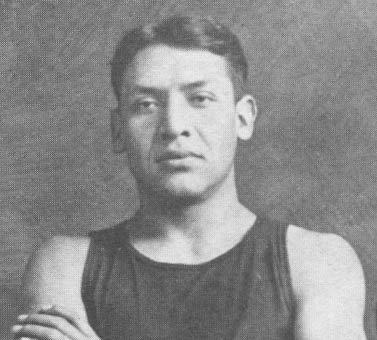
Bob Wheeler tells me that Bill Thorpe shoots better than his age, 80, in golf. To compare anyone with Jim Thorpe is unfair. He was the greatest athlete of all time and could do anything well. I can’t imagine how he could be competitive in the pole vault, but he was. Sam Bird’s grandchildren and great-grandchildren are big in the rodeo. Some of the others didn’t have children and many settled off the reservation. For example, Joe Guyon was a big star at Carlisle, Georgia Tech and in the NFL where Joe Guyon, Jr. played for Catholic University.

But you seem to be focused more on leadership than on athletic ability. It appears to me that many of the better leaders did not return to the reservation after finishing at Carlisle or Haskell. Several were officers in WWI and were leaders in the service but didn’t return to lead their tribes. Some kept one foot in each world and their children found more opportunity in white society. For example, Thomas St. Germain’s son, grandson and great-grandson were/are renowned research physicians at Tulane University School of Medicine.

It may be that Indians are playing leadership roles individually but not together as a group. MANY of the Carlisle players went into coaching but Dietz, Exendine and Welch were about the only ones who made it their life’s work. Coaching was an even more precarious occupation then than now and only the best schools paid well. So, most devoted their considerable talents to other occupations. Even Exendine and Welch practiced law in the off-season.

Surely, other people have some insight into this issue.

Decline of American Indians in Sports

September 1, 2008

Donna Newashe McAllister, granddaughter of Emma Newashe and grandniece of William Newashe, posed a question that has remained unanswered for some time. Your opinions are appreciated as they may shine some light on this issue. So, please comment. Note that a link has been provided for an article written by Emma Newashe that was published in Carlisle’s literary journal.

I have long been interested in the decline of American Indian athletes in every sport at every level

My academic background is in early childhood development. I was a producing potter at 15 who then married early and now intermittently work in sculpture and occasionally write – thus my interest in my grandmother…as almost all of her children are artistic…and some of the grandchildren.  Fortunately I was athletic enough to join in whatever sport was around…and having been on the golf course since I was barely old enough to walk…I have watched the world of sports as it has changed both locally and nationally.

Leadership has long been a topic of discussion among my professional friends and colleagues especially with regard to the American Indian.  I have asked everyone from Billy Mills to PhD specialists in education and Native American Studies to speculate on this phenomenon.  NO ONE has every given me a good answer…and very few even had a response…including Mills.

My father took me with him to the golf course as well as the softball games where he played with both Indian and non-Indian men regularly as soon as I could walk….so I have always been around the culture that I call sports – a microcosm of the world.  Also my nationally known art/pottery instructor in high school (the same high school that graduated the Olympian John Smith) was a nationally known wrestling coach, came from a wrestling family…and some of his wrestlers, my classmates, competed at the state and national level.  He left coaching when he went on to teach art at the college level and continue as a producing artist. 

During my second year of college a friend, an American Indian professor, asked me to name 5 Indian leaders – this was not in the classroom.  I looked at the wall for a length of time and then said, “I can’t.”  He then asked me to name five black leaders…and I rattled off 10-12…because I had been exposed to that community at an early age.  Here in Oklahoma…although it is not as highly profiled as in other areas…there has been an extraordinary amount of activity/success in the black community over an extended period of time. 

I spent the rest of the week pondering this concept…and the American Indian names I did come up with had TALENT…but were not leaders.  They were revered…but not listened to when it came to social issues – issues that could mold aspects of the larger society.  Because of my personal experiences and knowledge this subject has always interested me. 

But it is the decline of American Indians in sports at the local and national levels that has truly fascinated me as I look at sports decade by decade.  The lack of substantive response or even response when I have posed this question is even more interesting to me.  The black athlete has markedly increased both locally and nationally if one looks back and compares the two races…within the context of competition and sports.  Indians I have been around love sports, love to play, are very competitive…and in my lifetime would even create their own games, tournaments.

In my junior yearat OU [The University of Oklahoma]…I chose to write a paper on leadership in the history department for a man well renowned for his knowledge of the American Indian…and examine the comparisons in what I chose to loosely call “cultures”…and the lack of leadership in the American Indian culture as I saw it.  In the last two census rolls Oklahoma has been 1st and 2nd in the nation with the highest population of American Indians…so the numbers are there.  The possibilities in this state should be impacted by that alone.

Most team sports require leaders and followers…and in my observations these qualities are then taken into the world at large when one leaves sports.  Perhaps that is an over generalization…but not too far a stretch…and thus my connection with the two qualities. 

The instruction at Carlisle, however socially controversial, seemed to include [a broad range of extracurricular] activities.  Is it the broader education that included these activities that made these men exceptional? 

Donna Newashe McAllister

Players’ First Names Aren’t Easy to Find

August 28, 2008

One of the most difficult and time-consuming things my editor has me do is to provide players’ full names. Now James G. Sweeney, a lawyer from Goshen, New York and a 50-year West Point supporter, has requested that I help him identify a number of players. Sweeney is writing an article about the 1905 Carlisle-Army game that was approved by the War Department but can’t find players’ first names in newspaper reports. Apparently because I write about Carlisle Indian School football, he thought I’d know all the players’ names. I wish it were so.


Finding the biggest stars’ first names isn’t too difficult and, by now, I can give most of them off the top of my head, assuming that I don’t have a senior moment. Even identifying them wasn’t a piece of cake. One of the reasons for that was that some of them played under multiple names. For example, Emil Hauser was better known as Wauseka and his brother, Pete, was also a star player; Charles Guyon went by Wahoo and, to confuse things further, his younger brother, Joe, came along a few years later and made an even bigger name for himself; and William H. Dietz played as Lone Star. Linda Witmer’s The Indian Industrial School: Carlisle, Pennsylvania 1879-1918 includes a list of students that attended Carlisle. Although incomplete, it nonetheless is a useful tool. One of the problems in identifying players is that many siblings and cousins attended the school. Determining which one is the correct person is a challenge.


Carlisle Indian School publications are invaluable resources. In 1905 the school newspaper went by The Arrow. The school had no literary magazine at that time. Most of the big games were covered by The Arrow. Often articles from big-city papers were reprinted in it. From them we get our cast of characters, if only by their last names. Varsity football players were often active in the literary and debating societies because they were among the oldest on campus. Write ups of these societies’ activities often included full names. Football stars often got press for more mundane activities because they were famous. These pieces often included their first names. Players other than stars received less coverage.


Graduation coverage included full names for the graduating class and much coverage of the individuals in that class. Because most students had little proper schooling before coming to Carlisle and often at advanced ages, they were unwilling or unable to commit to lengthy courses of study that would lead to graduation.


My ace in the hole is the athletic or football (it varied) banquet. This time I hit pay dirt because the coverage of the 1905 football banquet (held in early 1906) included not only the menu for the banquet and the toasts given, but a complete roster of the players on the team with those who lettered identified with Xs. Well not exactly complete. Chauncey Archiquette’s name was omitted. Perhaps Jeffrey Powers-Beck has the reason for his omission from the list in Chief: The American Indian Integration of Baseball, 1897-1945 when he states that Archiquette, then 28, was an 1898 Carlisle grad who had played football and other sports during his days at the school and returned as staff in 1905 but played again. This was the same Archiquette a 1953 Los Angeles Mirror article claimed was Jim Thorpe’s boyhood idol.

1905 Carlisle vs. Army

Radio Tour Kicks off in Lawrence, Kansas

August 21, 2008

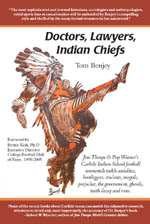
With the release of a new book starts another adventure – radio interviews. The first one I’m doing for Doctors, Lawyers, Indian Chiefs is with Warner Lewis on his Lewis at Large Smart Talk Radio show out of Lawrence, Kansas. The interview is being taped and will be aired the week of August 25 to 31 on KLWN Lawrence, KFRM Clay Center, KLKC Parsons and possibly other stations in eastern Kansas. Warner interviewed me two years ago on his sports talk show after Keep A-goin’: the life of Lone Star Dietz was released. It was a great experience. There are strong ties between Carlisle, PA and Lawrence, KS beside the fact that Lone Star Dietz played for Carlisle Indian School and coached Haskell Institute (now Haskell Indian Nations University) in Lawrence. When athletics were deemphasized at Carlisle, the leadership mantle was passed to Haskell where, during the 1920s and very early 1930s, the Fightin’ Indians were, as Ray Schmidt described, the lords of the prairie.


But more than the mantle passed from Carlisle to Haskell. Students also transferred to Haskell as well, Nick Lassaw for one. Nick was perhaps better known by the moniker given to him when he played for the Oorang Indians: Long Time Sleep. However, transferring between the two government Indian schools did not start at that time; it had a long tradition. The most notable example was after the 1904 Carlisle-Haskell game held at the St. Louis World’s Fair, the only time the schools played each other, when eight football players including the Guyon and Hauser brothers and several others came east to play for the stronger team.


There are other reasons that make Lawrence an appropriate to kick off my radio tour. Bernie Kish, Executive Director of the College Football Hall of Fame, 1995-2005, now lives in Lawrence. Bernie wrote a forward for Doctors, Lawyers, Indian Chiefs and I’m waiting for him to write a history of Haskell.


Henry Roberts Gets Married

July 28, 2008

While looking up information on Carlisle’s participation in the 1912 Olympics, I stumbled across an article from Carlisle in the Washington Post that had nothing to do with the Olympics. So, we’ll take a day off from our Olympic coverage for a little romance.


GROOM STAR END LAST SEASON


Hurt in Game Against Syracuse, First Thing He Remembers on Regaining Consciousness Is Face of Pretty Indian Maid—Football Eleven Gives Happy Couple Wedding Banquet.


Carlisle, Pa., Jan 17 —As the climax to a four months romance that began when the groom was Injured on the football field, and was nursed in the Carlisle Indian School Hospital here by the bride, Henry Roberts, 23 years old, of Pawnee, Okla and Miss Rose Denomie, 19 years old, of Ashland Wis, were married here at the home of M. Friedman, superintendent of the school, today.

Henry Roberts, Pawnee, played left end on the great Carlisle 1911 team and, before his injury, was Rose Denomie’s football hero. As she nursed him back to health he determined to win the Chippewa maiden’s hand. He studied for a civil service examination and passed with high marks for which he was rewarded with a $900 a year clerical job (not bad for any American in 1911) at Shoshone Indian School in Wyoming. Armed with a good-paying job and restored health, he proposed.


Because Rose was Catholic, they were married by Father Strock in Superintendent Moses Friedman’s residence and were feted by his teammates. Immediately after the celebration they caught a train for Wind River Agency, Wyoming. In November The Red Man reported that they were in Odanah, Wisconsin where he was employed by the government as a stenographer. Jack Newcombe described Roberts as the one who “epitomized the success story Carlisle cared to boast of: a business career with an oil firm in Oklahoma, a home on a hilltop in Pawnee not far from the reserve where he was born, a happy marriage with the girl he had met at Carlisle.” In a 1959 interview Roberts mentioned that before retiring he had helped build the atomic bomb at Los Alamos. From bows and arrows to atom bombs!


Next time it will be back to the Olympics – if nothing interferes.


 Henry Roberts shortly before his wedding

Native Americans in 1904 Olympics – Part III

July 21, 2008

The 1904 Olympics were not the first games to feature football. The 1900 Paris games included two football events neither of which were American football. Soccer and rugby were both played that year but in 1904 American football appeared in the Olympics for the first time. Football (soccer) was a demonstration sport in which three teams played a round-robin tournament between two American teams and a Canadian club. The Canadians won the gold. Several college football games were played on Francis Field at the fair. Washington University and St. Louis University each played a number of their games on the Olympic field. Missouri and Purdue even played there. Prior to the Fair, Washington U’s teams were known as the Purities but due to playing at the Fair were renamed the Pikers in 1905 as a comment on their association with the infamous world fair’s Pike. However, the most important college football game played at the 1904 Olympics wasn’t played by colleges.

President Theodore Roosevelt was to visit the Fair over Thanksgiving weekend making it an ideal time for a major football event (read moneymaker). The Fair organizers’ first choice was to have West Point and Annapolis relocate their annual contest to the fairgrounds but that didn’t happen. Haskell Institute’s Fightin’ Indians were tearing up the Midwest at that time and Carlisle was a top ten program. So, the first ever football game between the two government Indian schools was arranged for the Saturday after Thanksgiving. Carlisle already had a Thanksgiving Day game scheduled against Ohio State in Columbus. Major Mercer, the new Carlisle superintendent, very likely saw the opportunities such a high profile game would create for him and his school and added the game to the schedule. Playing two games in three days may have been taxing for Carlisle’s players, so Head Coach Ed Rogers (Pop Warner was back at Cornell for the 1904-6 seasons) drubbed the Buckeyes with his second team 23-0. Ohio State supporters were unhappy to miss seeing the Carlisle stars they had read so much about.

Rumors of Haskell bringing in ringers, some of them white, were rampant. To balance the scales, Ed Rogers suited up for the game as did Assistant Coach Bemus Pierce and his brother, another former Carlisle and pro star, Hawley Pierce. They needn’t have bothered. Carlisle obliterated Haskell 38 to 4. Seeing the superiority of the Carlisle program, eight Haskell players transferred to the eastern school where many became stars. If there was an Olympic gold medal to have been won Carlisle would have won it, but none was. However, the Carlisle Indians were the closest thing to an Olympic football champion that we’ve had – if you ignore the 1920 and 1924 U.S. rugby teams. But that’s a story for another time.

The Native American game of lacrosse was played at the 1904 Olympics but mostly by non-natives. Three teams, two from Canada and one from the U.S., vied for the championship. The Canadian Shamrocks won the gold, the St. Louis Amateur Athletic Association won silver, and, in a bit of irony, the Mohawk Indians from Canada got the bronze.

Next time we take a look at the 1908 games.

1904 Carlisle-Haskell game program cover

1904 Carlisle-Haskell game program cover


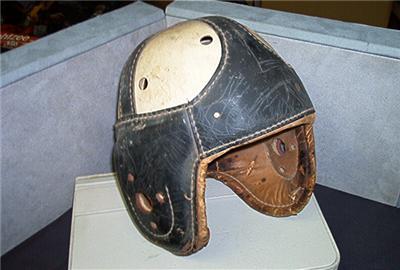
Goldsmith 67 Leather Helmet

July 9, 2008

We returned from Tanzania (more on that later) to an email asking me if I knew anything about a black and white leather football helmet claimed to have been from Carlisle Indian School that is currently up for sale on eBay: http://cgi.ebay.com/Carlisle-PA-Indian-School-Old-Leather-Football-Helmet_W0QQitemZ380043129493QQihZ025QQcategoryZ150029QQssPageNameZWDVWQQrdZ1QQcmdZViewItem#ebayphotohosting

I don’t know anything about the helmet but thought I had seen something like it in some old photos of Lone Star Dietz’s teams later on, possibly in the 1920s. So, I did some quick searches and found a similar helmet in a different color scheme listed on another site: http://images.google.com/imgres?imgurl=http://www.mearsonline.com/images/forsale/thumbs/Flat%2520top%2520helmet%2520front%2520feb%252022.jpg&imgrefurl=http://www.mearsonline.com/forsale/results/%3Fcat%3D8%26subcat%3D70&h=139&w=113&sz=4&hl=en&start=98&um=1&tbnid=AHtbVxdr1iubbM:&tbnh=93&tbnw=76&prev=/images%3Fq%3Dgoldsmith%2Bhelmet%26start%3D80%26ndsp%3D20%26um%3D1%26hl%3Den%26rlz%3D1G1GGLQ_ENUS264%26sa%3DN

That site identifies the Goldsmith model 67 as a government-issue helmet used during WWII. Was it used for football? I think so. Was it also used in army tanks? Probably. Was it used by the Carlisle Indians? Probably not. Was it used by an army unit assigned later to Carlisle Barracks? Possibly. What is it worth? Something, surely, but I don’t have a clue to how much.

I’d like to hear from some sports equipment specialists to learn more.


We Are the Ramblers

July 4, 2008

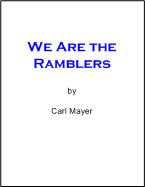
In 2006 while making a documentary on the single-wing formation I had the pleasure of visiting with the Windber Area High School football team because they are now running the single-wing – again. During the course of events I was made aware of a few parts of Windber’s storied history and, just before leaving town, met Carl Mayer who was then working on a history of Windber football. Last week I learned that his work is now available in book form and, while acquiring my copy, asked Carl for a physical description of the book because I haven’t seen it yet. In his words:

“The front and back covers of this soft cover book are in color, all photographs on the inside are black and white, just as you assumed. It is an 8.5 X 11 inch book with 304 pages. This book covers the history of Windber High School football from its beginning up to the 2007 season. Included are numerous stories pertaining to venues played and the role Camp Hamilton has played in its history. Team photographs are included from 1914 thru 2007 (Except for 1914, 1915, 1916, 1918, 1919, they could not be found) with these team photographs are records for that football year and starting line-ups. Also included are drawings and caricatures from the late 1950’s, each of which tell a story.”

If you are interested in knowing more about We Are the Ramblers, click on the book link at the right. BTW, Windber was the home of Johnny Weismiller but I don’t think he played football. Carl can set you straight if I’m wrong.  He can be reached at fern1616@verizon.net.


Indian School movies

June 27, 2008

Carlisle Indian School has been of interest to Hollywood since the movie industry’s earliest days. In 1901, American Mutoscope and Biograph shot a documentary short at the school. Footage included both male and female students swinging clubs. Still photos of this type of exercise can often be found on ebay. Also included in the documentary were a military-style parade of the students including the renowned school band, girls doing a dumbbell drill, boys demonstrating gymnastics events, boys playing a basketball game, and members of the track team high jumping and pole vaulting. No, Jim Thorpe was not filmed because he was not at Carlisle at that time.

In 1913, Selig Polyscope filmed The Tie of the Blood at the school. Little is known about the film other than its main cast members. In 1915 Pathe Weekly filmed the installation of the first Indian Boy Scouts of America troop at the school. Also participating in the parade, exhibitions and ceremonies were local boy scouts and the Indian School’s Campfire Girls. And other films that I do not know about may have been filmed at the school.

Several alumni worked in motion pictures as actors, stuntmen and in other capacities. Lone Star Dietz even invested in the Washington Motion Picture Company and lost his investment. Jim Thorpe not only worked in pictures but had his life story told on film in the 1951 Warner Brothers release, Jim Thorpe – All-American. Interest in putting the Indian school on film waned but in recent years has grown.

In April 2002, Variety Film reported, “Fox 2000 has snapped up a pitch by Craig Sherman and Bob Jury on legendary football coach Glenn S. “Pop” Warner and his first season at the Carlisle Indian School.” In April 2004, Walden Media announced that John Sayles would be bringing Carlisle School to the big screen. In 2005 Steven Spielberg brought Carlisle Indian School to the little screen as part of his Into the West miniseries. And there’s more, so much more interest that Freddie Wardecker has lost count of how many filmmakers have come into his store to look at artifacts. Barb Landis at the Cumberland County Historical Society thinks that she gets at least a call a month from someone interested in doing a movie about the school or Pop Warner or Jim Thorpe or … I even ran into one of them in the Dickinson College archives last year.

The problem is that a historically-accurate film needs to be made but, despite all the talk, no one has stepped up to make it. Do you have any ideas?

Forbes Road

June 23, 2008

This year marks the 250th anniversary of the building (perhaps hewing may be more accurate) of Forbes Road. The Seven Years War between France and Britain was raging around the globe. Pennsylvania found itself at the epicenter of the North American theater of what Americans generally call the French and Indian War. General Forbes set out from Carlisle in 1758 to take Fort Duquesne (present-day Pittsburgh) from the French. He followed Indian paths from Carlisle south along what is today Route 11 to Chambersburg and headed west along what later became Route 30. He widened and improved the crude existing roads and, beginning at Bedford hacked his way west to Pittsburgh. 157 years later, in 1915, Pop Warner likely followed the same route when he left Carlisle to take the reins at the University of Pittsburgh.

Warner took more than his belongings to Pitt; he also took his single- and double-wing offenses. But before football season started, he held a summer camp for his players at Camp Hamilton, a facility Pitt owned just outside the town of Windber. To get to Windber, Warner would have backtracked on Forbes Road past Ft. Ligonier and halfway to Bedford before heading north to Camp Hamilton. It was at Camp Hamilton that Pop schooled his new players in the intricacies of the single- and double-wing. Many Carlisle players headed west to Altoona and Pittsburgh to play for independent teams, but they would not have followed Forbes Road because they most likely traveled by train.

Camp Hamilton became an expensive luxury for Pitt during the Depression, so ownership of it passed to Windber Area School District. In 2003, after posting Windber’s 500th win, Coach Phil DeMarco was looking for something new. That something new turned out to be the single-wing. So, the single-wing returned to Camp Hamilton after a long absence, not so long, however, as Pop Warner’s absence from Pittsburgh. Windber ran the single-wing at Camp Hamilton back in the 1930s when they won two state championships with it by beating John Harris one year and Steelton another.

The 250th anniversary of Forbes Road celebrates more history than the victory of the British over the French, it also honors the opening of the Northwest Territory to settlement and other things that traveled along the road, wanted or not.