Archive for the ‘Football’ Category
February 19, 2009
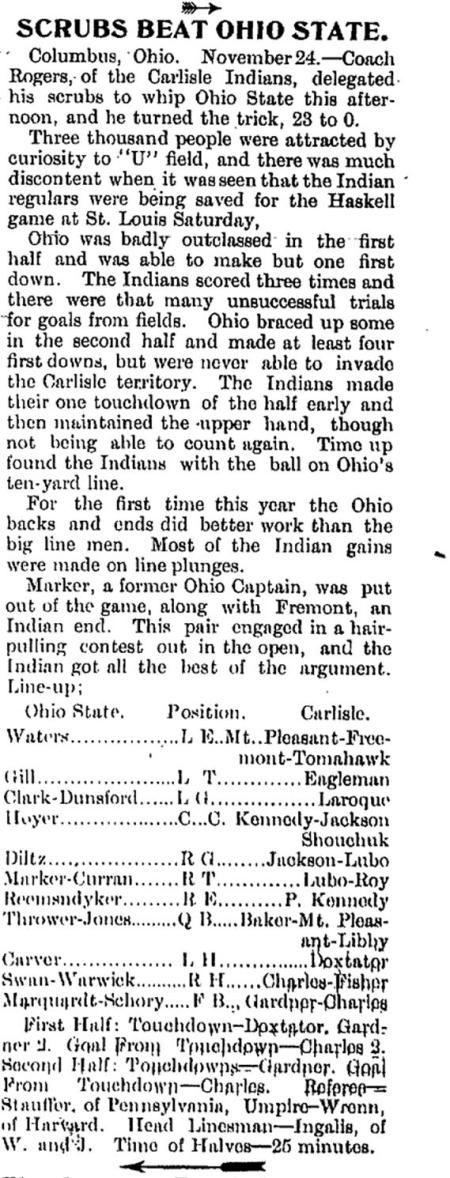
Frank Loney, a collector of Carlisle memorabilia, called to ask about a football player named T. A. Engleman. He had a letter written by a Carlisle Indian School football player who was visiting the St. Louis World’s Fair. The letter was written the morning of the big game against Haskell Institute on the Saturday after Thanksgiving in 1904. The letter was written to Mr. Ziegler in the harness shop at the Indian school.
Frank could find no student named Engleman listed in Linda Witmer’s book, so further research was necessary. Steckbeck listed an Eagleman. The author of the letter wrote, “The second team played the Ohio State University on the 24th, Thanksgiving-day. I played out the whole game, and felt as though of being eighty years old after the game. My man was more than two hundred pounder and so you can imagine I had something to buck up against.” I knew that the first team sat out the Ohio State to be rested for the big game with Haskell that President Roosevelt was expected to attend. Finding a newspaper write-up of the game that included line-ups, I noticed that a player named Eagleman played left tackle across from either Gill or Marker. Because Marker was ejected from the game along with Fremont for engaging in a hair-pulling contest, Gill must have been the 200-hundred pounder and Eagleman was Engleman or vice-versa. Ticket prices for the Carlisle-Ohio State contest, a deluxe game, ranged from 25 cents to a dollar. Ohio State’s only other deluxe game was with the University of Michigan.
Witmer’s book listed an Eagle Man but no Eagleman. However, various censuses listed Thomas A. Eagleman, Sioux. He married a white woman, Grace More, in 1909 and they had 3 sons and 5 daughters. They farmed near Crow Creek in South Dakota, probably on an allotment.
Mystery solved.
Tags:Grace More, Haskell, Ohio State, St. Louis World's Fair, Thomas Eagleman
Posted in Carlisle Indian School, Football | 8 Comments »
February 2, 2009
Carlisle Indian School football players retired from football decades before Super Bowl I in 1967. In fact, many, including Jim Thorpe and Lone Star Dietz, if not the majority, were already dead. The closest tie to either of this year’s competitors: the Cardinals and the Steelers, is that Jim Thorpe played for the Cardinals in 1928. Thorpe was over 40 then and came out of retirement, after hanging up his cleats at the end of the 1927 season as player-coach of the Portsmouth Shoe-Steels, for what was probably the last time to help the hapless 1-4 Cardinals in a Thanksgiving charity game against their cross-town rivals, the Bears. Big Jim was well past his prime and didn’t play much in this 34-0 pasting, their fifth shutout loss of the year and third in six days. Thanksgiving Day games didn’t replace a Sunday game in those days, they were just inserted into the schedules. The Cardinals lost to Frankfort 10-0 on Saturday, November 24, 19-0 to the New York Yankees the next day, and closed out their season on Thursday, November 29 against the Bears. Thorpe didn’t have enough left in his tank to help a team that gave up 63 unanswered points in these three games.
The Chicago Cardinals were a charter member of the NFL, which originally called itself the American Professional Football Association, but weren’t the Chicago Cardinals in 1920 when the league was first formed. The oldest and losingest team in the league traces its roots back to a sandlot team in Chicago before the turn of the last century. The team claimed its name in 1901 when, a derisive description of his team’s faded maroon jerseys that had been surplussed by the University of Chicago, caused team owner Chris O’Brien to spin that lighter color into cardinal red. They have been the Cardinals ever since. At the time the pro league was formed they were known as the Racine Cardinals because they were located on Racine Street. In 1960 they moved to St. Louis and in 1988 to Arizona. Along the way they won two championships, but one, for 1925, is disputed by the Pottsville Maroons faithful. Thorpe didn’t have much time to think about the loss because his All-Indian basketball team started its season on December 2 against the Detroit Tool Shop Club.

Tags:Basketball, Chicago Cardinals, Portsmouth Shoe-Steels, Super Bowl
Posted in Carlisle Indian School, Football, Jim Thorpe | Leave a Comment »
January 19, 2009
While researching the lives of Henry Roberts and Mike Balenti, I became aware that they, and some other Carlislians played against each other when enrolled in other schools. In response to criticism that Carlisle Indian School had been playing some of the same people for too many years, Pop Warner instituted a policy that limited players to four years on the varsity squad. Mike Balenti had used up his eligibility at Carlisle and Victor Kelley had one year of eligibility remaining at the Agricultural and Mechanical College of Texas. While there were no national eligibility standards, many colleges limited students to four years of eligibility, one for each of their four years of college – assuming that they finished on time. However, colleges often conveniently ignored the time former Carlisle players now at their institutions had played at the Indian school because it wasn’t a college academically. In fact, it wasn’t even a prep school. Putting these vaguaries of eligibility aside, Mike Balenti and Victor Kelley enrolled at A&M (reenrolled in Kelley’s case) to play under new head coach Charlie Moran. Moran, coincidentally, had assisted Pop Warner at Carlisle the previous year before embarking on a career as football coach. Previously, he had been a star player and a baseball coach, but hadn’t coached football. The Aggies, with Kelley at quarterback and Balenti at left halfback, had a powerhouse team. One of the obstacles in their path to the unofficial Southwestern Championship was Haskell Institute. The teams met on October 23 at College Station. Captain and left end of the Haskell squad was Henry Roberts who would later star of Carlisle’s great 1911 team. Not on the field that day for Haskell, but on the squad, were center Nikifer Schouchuk and quarterback Louis Island. It was like old home week at the game which the Aggies won 15-0. Aggie students celebrated wildly after the game because beating the team that had beaten the University of Texas meant a lot to them. At the end of the season Charlie Moran, as coach of the Southwestern Championship team, was given the honor of selecting an All Southwest team. He named Kelley for quarterback, Balenti for left halfback, and Roberts for punter. Carlisle was well represented on that team by alums both past and future.
Tags:Charlie Moran, Haskell Institute, Nikifer Schouchuk, Texas A&M
Posted in Carlisle Indian School, Football, Henry Roberts, Louis Island, Mike Balenti, Pop Warner, Victor Kelly | Leave a Comment »
January 5, 2009
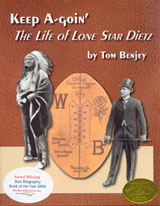
This weekend was productive – maybe. Walt Shiel offered some advice on converting print books to ebook format on a small publishers forum. The first step was to open an rtf file containing the book in question with Microsoft Word. Fortunately for me, Keevin Graham, the graphic designer who lays out my books, had already provided me with an rtf of Doctors, Lawyers, Indian Chiefs. The second step was to save the book as Web Page, Filtered, which produces an html file. So far, so good. The third step was to open the html file with Notepad and save it again, thus eliminating the “secret codes” Word embeds in documents. The resulting file was ready to import into Mobipocket’s ebook creator (available free on the Mobipocket site). There was one small glitch. Doctors, Lawyers, Indian Chiefs has a number of photos, illustrations and tables, items which ebooks don’t display well and which require considerable manual manipulation. FWIW, Keep A-goin’: the life of Lone Star Dietz has a lot more, a factor which will keep it from being converted into an ebook for some time. The illustrations are such an integral part of that book that I’m reluctant to publish an ebook of it without them.
My solution to the problem was to create a new book from Doctors, Lawyers, Indian Chiefs that includes only the background/overview chapters and none of the players’ biographies. Also, at 160,000 words some find the entire book too long and detailed for their taste. Carlisle Indian School Football Immortals: a brief introduction provides the key information about the history of the Carlisle football program and will be of interest to those who are not interested in reading about the individual players. Even this conversion required a lot of manual HTML coding because of all the illustrations and tables are a particular headache. After some “learning experiences” with the Mobibook creator, a prc file was created and uploaded to the Mobipocket site. The prc file was also converted by the Amazon.com Kindle converter and uploaded to its site. I’m waiting to hear back from Sony.
For those who become interested in the players or seeing better quality illustrations after reading the ebook, Tuxedo Press is giving ebook buyers free shipping on print books purchased from them. The net result is that the ebook cost is essentially being refunded because its list price is only $4.99 and Amazon.com is currently offering the Kindle version for $3.99.

Carlisle Indian School Football Immortals: a brief introduction
Tags:ebook conversion, Kindle, Mobipocket, Walt Shiel
Posted in Carlisle Indian School, Football, Jim Thorpe, Pop Warner | 3 Comments »
December 22, 2008
Brown threatened to score during the first half but failed. At halftime Washington State went into the clubhouse to dry off and change into dry uniforms but Brown didn’t bring extras to change into. They did, however, find a shed that contained some straw, so they coiled around it as best they could in an attempt to dry off. They weren’t in the best shape to play the second half.
In Weeks’ estimation, Brown was lucky to hold Washington State to a low score because they were like a junior team compared to the tougher WSC team. (Note that recent research uncovered writers’ opinions that WSC should have been selected as national champs in 1915.)
Back at Brown, Josh Weeks roomed with Fritz Pollard and operated a side business ironing men’s slacks to make money. Fritz played just one more year at Brown but Josh continued through the 1918 season when Walter Camp placed him on his All America second team at left end. Paul Robeson of Rutgers was named to that position on the first team.
After graduating from Brown, Josh Weeks attended medical school and eventually practiced in New Bedford, MA. There the high school coach asked him to attend the games in case his services were needed. Randy tells of a funny incident;
“My dad had attended New Bedford High and had played football for them. One game my dad was sitting on the bench, and New Bedford was getting creamed. A play came up where the other team stole the ball, and the runner was heading for a touchdown. My dad, dressed like a doctor…pants, jacket, white shirt with tie, and a hat on, jumped off the bench and ran after the kid until he finally tackled him. Needless to say the stadium roared with laughter and naturally the poor kid was given the touchdown.”
On a sadder note, Josh Weeks died on his way home from the reunion for the 40th anniversary of the 1916 Rose Bowl. His memory lives on in his children and the stories he told them about his Rose Bowl experience. Next time another Brown player and a captain of industry attend the premier of “Jim Thorpe–All American.”
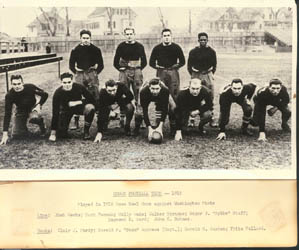
Brown’s 1916 Rose Bowl team
Tags:Brown University, Fritz Pollard, Joshua Weeks, New Bedford, Randall Weeks, Washington State
Posted in Football | Leave a Comment »
December 2, 2008
The December 1 issue of Sports Illustrated has an article on the single-wing. The writer, Tim Layden, first discusses the formation’s current use at Apopka High 15 miles northwest of Orlando and in the NFL by the Dolphins in their unexpected victory over the unsuspecting New England Patriots. Also mentioned is Todd Bross, organizer of the annual spring conclave at Kings College in Wilkes-Barre, PA. (It was Todd Bross and Ted Seay who urged me to research Pop Warner’s correspondence course in football that was first published in 1908). Layden discussed the renaissance the single-wing is undergoing but was apparently unaware that little Windber Area High School is running it as he was probably unaware of my documentary in which they were featured.
The article talks about viewing old films over Ed Racely’s garage on Cape Cod. Racely, now 80, has been studying the single-wing longer than anyone. Layden then goes into the single-wing’s history beginning with President Theodore Roosevelt’s 1905 threat to ban the game unless rule changes weren’t made to clean up the game. He goes on the mention that Pop Warner coached Carlisle Indian School from 1907 to 1914 and quotes Warner as having first used early incarnations of the single wing by the Carlisle Indians in response to the 1906 rule changes. He is apparently unaware of Pop’s earlier tenure at Carlisle (1899-1903) and of my research that uncovered Warner’s weeklong visit with the Carlisle coaches shortly before the start of the 1906 season. He made no mention of the revisions to Warner’s correspondence course between 1909 and 1911, nor did he mention my publication of the offense pamphlets from the correspondence course. The diagrams found those pamphlets represent the earliest known documentation of the single-wing. A 1924 newspaper interview of Warner was accompanied by a diagram of a formation that “The Old Fox” designed in 1902 to protect injured linemen Antonio Lubo, Martin Wheelock and Albert Exendine and to adjust for injured first-string center, Nikifer Schouchuk. It’s too bad that wingback diagram wasn’t made public a couple of decades earlier. The Sports Illustrated article can be found at:
http://vault.sportsillustrated.cnn.com/vault/article/magazine/MAG1149161/index.htm
Tags:Bill Belichick, Ed Racely, Miami Dolphins, New England Patriots, Nikifer Schouchuk, Sports Illustrated, Ted Seay, Tim Layden, Todd Bross, Wildcat formation, Windber
Posted in Albert Exendine, Antonio Lubo, Carlisle Indian School, Football, Martin Wheelock, Pop Warner, Single-Wing | 5 Comments »
November 10, 2008
Rusty Shunk recently informed me of the existence of “The History of Football at Dickinson College: 1885 – 1969” by Wilbur J. Gobrecht. Why might I be interested in this book? The reason is simple. Several Carlisle Indians attended Dickinson College, its prep school and Dickinson School of Law. Some of them also played on Dickinson’s football team. Today’s piece is about an off-field incident involving one of these men.
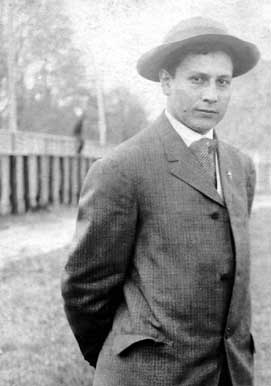
In 1898 Francis M. Cayou enrolled in Dickinson College as member of the class of 1902 and played halfback on the 1898 football team – after Carlisle finished its season and only in the game against Penn State. Gobrecht uncovered an interesting story regarding Cayou told in 1930 by Rev. William H. Decker, also a member of the class of 1902, after he discovered a long-forgotten search warrant that had been issued by George W. Bowers, a Carlisle justice of the peace. That warrant gave Constable H. M. Fishburn the right to search the premises of the Mountain House at Sterretts Gap for “one F. M. Cayou, forcibly taken from Carlisle on Jan. 22, 1899.”
Frank had been warned of possible nefarious actions being planned by the class of 1901 but paid no heed to them. Rev. Decker recalled how the handsome Cayou took his girlfriend to the Sunday evening service at First Presbyterian Church on the square and was abducted on departing the church after the service. Members of the class of 1901, knowing he was there, placed a black maria wagon in the adjoining alley and waited for their opportunity. As the Indian exited the church, they tore him away from his girl and threw him bodily into the paddy wagon or hearse, which was used is not clear. Once he was inside, the wagon tore off madly over the icy streets into the dark countryside. “Burlys” of the class of 1902 rushed up, grabbed the horses’ harness and tried to cut it with knives but were unsuccessful.
To be continued …
Tags:abduction, black maria, Dickinson College, Georege W. Bowers, H. M. Fishburn, Mountain House, Rev. William H. Decker, Rusty Shunk, Sterretts Gap, Wilbur Gobrecht
Posted in Carlisle Indian School, Football, Frank Cayou | 4 Comments »
October 6, 2008
Coming across a 1937 newspaper article in which Gus Welch launched a movement to return Indians to prominence in football. He was quoted as saying:
“The Indian is disappearing from football just like he disappeared from the forests. There used to be a lot of good Indian athletes—Thorpe, Guyon Mount Pleasant, Sweet Corn, Jim Levi, Tiny Roebuck and Mayes McLain. Pop Warner developed a dozen great ones at Carlisle and Haskell Institute produced a number. But they are fast dwindling. Most of the Indians we see in athletics today are impostors, or at best half-breeds. And they might as well be cigar store Indians in so far as I’m concerned.”
The article went on to say that Gus and his wife had recently adopted a baby girl. He insisted that the next child would be a boy adopted from one of what he considered the two fiercest tribes.
“I’m going to visit the Sioux reservation first and look over their crop of babies. If they don’t have anything to my liking, I’m going to pay the Cheyennes a call. I’m determined to find a real all-American and restore the Indian to his proper place in football.”
You already know that didn’t work out, but did you know that Bacone College attempted to revive Indian football after it was de-emphasized at Haskell Institute during the Great Depression? It was a natural thing for the little Muskogee, OK college to do because the school’s original name when it was founded in 1880 at the Cherokee Baptist Mission in Tahlequah by Almon C. Bacone was Indian University. Oklahoma’s longest-running institution of higher education was renamed Bacone Indian University in 1910. Later, its board of trustees gave it its current name. An irony is that Bacone and Haskell, both now four-year schools, play each other.

Tags:Bacone College, Haskell Indian Nations University, Haskell Institute
Posted in Carlisle Indian School, Football, Gus Welch, Jim Thorpe, Stancil Powell | Leave a Comment »
September 23, 2008
Today while conducting an email conversion regarding some advertising, I received an unexpected stroke. Maryann Batsakis, Sales Representative for ForeWord Magazine, informed me that the subtitle of my new book was the best she had seen in her seven years at ForeWord. She also informed me that she started in the mailroom where she opened every package that came in and saw every book. Since then she has seen all the award-winning books. So, she speaks with some authority. However, I may have a leg up because she appreciates my sense of humor. One time I mentioned a password I sometimes use and she responded that she liked it. I explained that it was too difficult to use Of all the gin joints in all the towns in the world she has to walk into mine. That cracked her up.
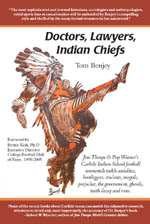
So if Doctors, Lawyers, Indian Chiefs doesn’t receive any other awards, I can feel good that my subtitle, Jim Thorpe & Pop Warner’s Carlisle Indian School football immortals tackle socialites, bootleggers, students, moguls, prejudice, the government, ghouls, tooth decay and rum, is the best.
Some may wonder why I was so verbose. Subtitles are used to help describe what the book is about and also to help search engines find the book for readers who might be interested in it. Doctors, Lawyers, Indian Chiefs covers so much ground that a long subtitle is needed. This might help explain why some books, especially very technical ones, have lengthy subtitles that contain a lot of jargon.
Tags:ForeWord Magazine, subtitle, Tuxedo Press
Posted in Carlisle Indian School, Doctors, Lawyers, Indian Chiefs, Football, Jim Thorpe, Pop Warner | Leave a Comment »
September 15, 2008
Something serendipitous has happened since I started this blog. People from different parts of the same family who long ago lost touch with each other have been able to reconnect as a result of my writing Doctors, Lawyers, Indian Chiefs and starting this blog. Typically, the people who contact me are grandchildren or great grandchildren but, especially in the case where the person had no children, grand nieces and nephews are the ones who write. It has given me great pleasure to assist in some small way in helping families reconnect or, in some cases, connect for the first time.
Generally the family member who initiates the connection submits a comment to a blog message. Because I have to review each comment that is submitted before it is posted, these comments are not made public. What I do is to email a member of the family with whom I have had prior contact, if I was fortunate enough to have located a relative, and send the information to that person. If that person wants to reconnect, he or she can then contact the person who made the request. If not, he or she doesn’t.
This has been totally unexpected but playing a small part in making it possible for families get reconnected gives me great pleasure. Keep those comments coming.
My first book talk on Doctors, Lawyers, Indian Chiefs has been scheduled for 6:30 p.m. Thursday October 16 at Whistlestop Bookshop in Carlisle, PA. The next evening I will be attending Lone Star Dietz’s induction ceremony at Albright College in Reading, PA. He is being inducted into their hall of fame.
Tags:Albright College, Reconnecting families, Whistlestop Bookshop
Posted in Carlisle Indian School, Doctors, Lawyers, Indian Chiefs, Football, Lone Star Dietz | Leave a Comment »





 Tom Benjey's Weblog
