Archive for the ‘Football’ Category
August 14, 2009
Last time, I mentioned a guy named Joe LittleTwig. It just so happens that Wini Caudell has a website dedicated to him. You see, if things had turned out differently, he might have been Wini’s grandfather. But they didn’t.
Joe is believed to be Mohawk born on or near the Cattaraugus Reservation in New York State. After attending school on the reservation, he enrolled at Carlisle Indian School. So far, I haven’t been able to locate any record of him at Carlisle, but this isn’t all that unusual. Sometimes, different names were used. School employees often spelled named creatively, something that makes searching difficult. There’s a good chance that LittleTwig was young and not fully developed physically, a factor that would likely have kept him from making the varsity team. It’s almost impossible to identify players on any of the other teams at the school.
After leaving Carlisle, he served in WWI, but I have no details on that yet. After the war, he turned his hand to professional football and had more success than most. Researching his pro football career may be easier than researching his earlier life because some records-and a book-exist about the Oorang Indians and newspapers covered the early NFL games to some extent. Because he settled in Canton, either the local historical society or the Pro Football Hall of Fame, which is located there, may have information on his life after football.
Wini Caudell’s site about Joe LittleTwig: http://www.rockislandindependents.com/Players/All%20Players/joejohnson.htm
Tags:Canton Bulldogs, Joe LittleTwig, Oorang Indians, Rock Island Independents, Wini Caudell
Posted in Carlisle Indian School, Football | Leave a Comment »
August 12, 2009
While researching Carlisle Indian School alums who played in the NFL, I came across an unexpected name—Frank Lonestar. Everyone is well aware that Lone Star Dietz coached the Redskins in 1933 and 1934 but I bet few know that Frank Lonestar played for the Columbus Panhandles in 1920, the league’s inaugural year. A website stated that he played three games at guard for the Panhandles that year. So far, I’ve found newspaper coverage for one game with his name in the lineup. That one was a losing effort against the Detroit Heralds.
I was well aware that Frank, a Chippewa from Wisconsin, was much involved in extracurricular activities such as the Invincible Debating Society and was an officer in his class (the same one as Gus Welch), but had no idea that he was a football player of note. He probably played for his shop team, the Printers, but many boys did that. I was unaware of him being on the varsity squad and doubt that he was. He apparently left Carlisle around 1911 to practice his trade after getting useful experience printing school publications. But that’s about all I know about him.
Also on the 1920 Columbus Panhandles, at least for awhile, was Littleboy, or someone with a similar name. The October 17, 1920 Fort Wayne Journal-Gazette included a photo of four stars the local team, the Friars, would be facing when taking on the Columbus Panhandles later that day. Included in the photo and expected lineup was someone named Littleboy. A little research should determine if this person was Carlisle’s Little Boy. This Littleboy played left halfback in the Columbus-Detroit game mentioned previously.
I’m also learning about another Carlisle student who played in the NFL but doesn’t appear to have starred on the legendary Indian teams. Joe “Little Twig” Johnson began his NFL career with the 1922 Oorang Indians, but, unlike the majority of his teammates, had a significant pro career after Oorang’s demise. It appears that the Carlisle Indians were more involved in the early NFL than I thought.
Tags:Columbus Panhandles, Detroit Heralds, early NFL history, Fort Wayne Friars, Frank Lonestar, Indians in the NFL, Joe Little Twig, Littleboy, Oorang Indians
Posted in Carlisle Indian School, Football, Gus Welch, Lone Star Dietz | Leave a Comment »
July 23, 2009
While researching the 1905 Carlisle-Massillon game for an article in an upcoming issue of the Professional Football Researchers Association’s (PFRA) journal, The Coffin Corner, I came across a statement in the late Robert W. Peterson’s Pigskin: the early years of pro football that caught my eye. Of course it has nothing to do with the article but it made me curious.
Peterson wrote, “It was not sectional chauvinism at work when 129 out of 132 All-American berths between 1889 and 1900 were filled by players from those four schools [Harvard, Yale, Princeton & Penn]. The best players were really there.” I recalled that Carlisle’s first Walter Camp first team All-American was Isaac Seneca in 1899. If Peterson was accurate, that would put Seneca and the Carlisle program at a lofty level.
The Walter Camp website lists all of his All-America teams beginning in 1892 when he created the concept of such a team. Sure enough, all the players named were from the Big Four until 1895 when Cornell’s Clinton R. Wyckoff was named to the team. The next non-Big Four player to be named was Clarence B. Herschberger of Chicago in 1898. Seneca became the third in 1899. The fourth was William Morley of Columbia in 1900. Whether Peterson was right depends on the meaning of between. Does between include the 1900 team?
Things changed a lot in 1901 when four outsiders were selected: two from Army, one from Cornell (Pop Warner’s younger brother) and one from Columbia. In 1902, Paul B. Bunker of Army, a repeat from the previous year, was the only non-Big Four player on the list. And in 1903, Carlisle had its second All-American in the person of James Johnson. H. J. Hopper of Dartmouth, Willie Heston of Michigan, and Richard Smith of Columbia were also on that team.
Here’s a question? Did Carlisle have a first Team All-American before any Big Ten school had one? (Disregard when schools entered and left the Big Ten for this question.)
Tags:All-America team, Big Four, Michigan, Pigskin: the early years of pro football, Robert W. Peterson, Walter Camp, Willie Heston
Posted in Carlisle Indian School, Football, Isaac Seneca, James Johnson | Leave a Comment »
July 21, 2009
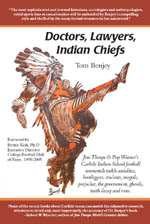
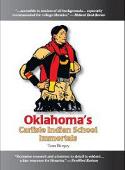
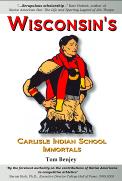
I received some great news over the weekend– Oklahoma’s Carlisle Indian School Immortals have shipped and should be available for sale and immediate shipment by mid-week at www.Tuxedo-Press.com and next week from other booksellers. This book is not recommended for people who already have Doctors, Lawyers, Indian Chiefs because most of the material in the new book can be found in it. This may not sound like it makes sense, so I’ll explain.
Doctors, Lawyers, Indian Chiefs, in my opinion, contains a lot of information that is of interest to young people. However, at 160,000 words, it is inaccessible to youngsters. As an aside, adults tell me they don’t necessarily read it in sequence because its organization allows readers to skip around, reading sections or chapters they find interesting at a particular time and others at other times. Still others use it as a reference book because most of these men’s life stories have been told nowhere else. By splitting this book into a series by state, each volume is short enough that children can read it. A benefit to me is that I was able to include two people who weren’t in Doctors, Lawyers, Indian Chiefs: Mike Balenti and Henry Roberts. Perhaps when I finish the series I will make a second edition of Doctors, Lawyers, Indian Chiefs that includes all the new people that were added in the series.
Also, Oklahoma’s Carlisle Indian School Immortals is in hardback with a glossy cover, something that should make it an attractive Christmas gift, particularly for children with roots in Oklahoma. If it sounds like I am on a soapbox, it is because I am. Our children and grandchildren should know about these people and much of what has been written about Carlisle Indian School is distorted at best.
Tags:Oklahoma's Carlisle Indian School Immortals
Posted in Carlisle Indian School, Doctors, Lawyers, Indian Chiefs, Football, Henry Roberts, Mike Balenti, Publishing | Leave a Comment »
July 8, 2009
George Gardner’s granddaughter sent me a scan of a photo of the 1908 Carlisle Indian School band. George’s brother, William, was better known than George due to his exploits on the football field, the sidelines and alongside Eliot Ness. However, George was quite active at Carlisle and also played on the football team. In the photo below, he is in the second row from the top, third from the left.
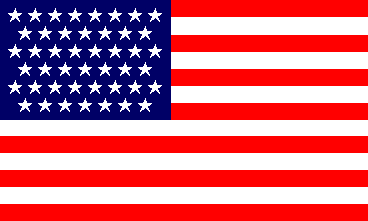
George’s great-grandson doesn’t think the flag in the photo is a 1908 flag. My eyes aren’t good enough to determine whether it is or not. On Saturday, November 16, 1908 the areas that had previously been known as Oklahoma Territory and Indian Territory were admitted into the union as our 46th state. The flag necessarily changed as a result because a star was added.
Below are images of the 45-star flag that was used from 1896 to 1908 and the flag that was used from 1908 to 1912. My eyes aren’t good enough to determine which is in the photo, so I did a little detective work. This photo appeared on the front page of the January 31, 1908 edition of Carlisle’s school newspaper, The Arrow. The photo does not appear to have been taken in the winter. The photo had to have been taken before January 31, 1908 and in good weather. Therefore, it was likely taken when the flag had only 45 stars.
Perhaps someone with sharper eyes or a higher resolution photo can prove me wrong. Keep in mind that US flags never expire. It is always proper to display an older version of the flag provided it is in good shape.

US Flag 1896-1908
US Flag 1908-1912

Tags:1896 Flag, 1908 flag, Carlisle Indian School Band, Eliot Ness, George Gardner, Oklahoma statehood
Posted in Carlisle Indian School, Football, William Gardner | Leave a Comment »
July 4, 2009
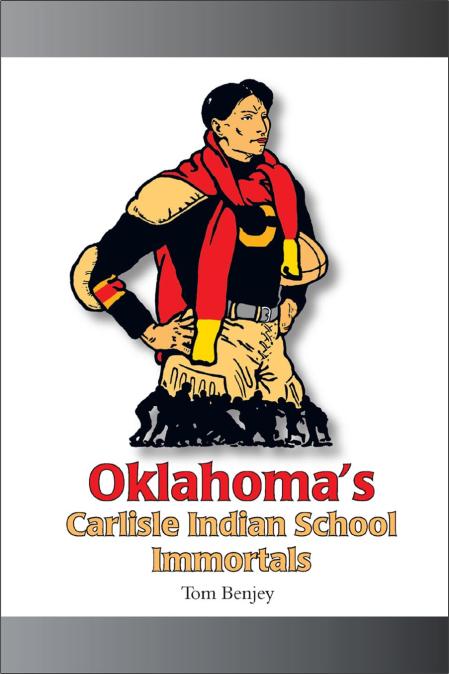
Proofs for the text and cover of Oklahoma’s Carlisle Indian School Immortals arrived Thursday. The purpose of the proof is to determine that everything is perfect before printing the batch of books. The cover looks great to me. The colors are vibrant and Bob Carroll’s drawings of the players’ faces provides an attractive background for the text on the back cover. There is a problem with the text, however.
Rather than taking up space in the narrative with dry demographic about the players, I put this information in boxes, one for each player. The boxes were shaded in light gray for visual interest. Herein lies the problem. Five of the fifteen demographic data boxes appear to have no shading. The boxes looked perfect in the advance reading copies (ARCs), but those were produced by a different printer. Panic set in immediately. The PDFs sent to the printer look perfect. The printer’s technician informed us that the shading was done at 9% and they accept nothing below 15%. That doesn’t answer the question as to why two-thirds of the boxes were shaded correctly.
As it turns out, the boxes that printed correctly have graphics with transparency on the same page but the bad ones don’t. It appears that the printer’s software or equipment does something different in these cases. Be that as it may, I have to submit new PDFs with 15% gray shading. That means that I will probably have to pay the graphic designer for his time and the printer fees for resubmitting a new PDF and for a new proof. I also have to wait several days to see if this solves the problem.
Tags:Bob Carroll, Oklahoma, PDF problems
Posted in Albert Exendine, Carlisle Indian School, Football, George May, Henry Roberts, Isaac Seneca, Jim Thorpe, John B. Flinchum, Mike Balenti, Pete Hauser, Pop Warner, Publishing, Richard Henry Pratt, Stacy Matlock, Victor Kelly, Wauseka, William Newashe | Leave a Comment »
June 22, 2009
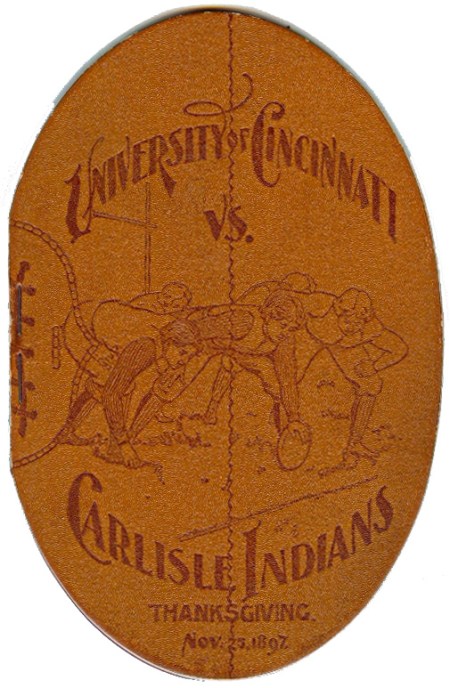
Saturday night, Frank Loney contacted me about a new item he had just acquired. Never before had he been so excited about an acquisition. Yesterday, I went over to look at it. It is simply beautiful. I’ve seen a few old football programs before but none were in the condition of this one for the 1897 Thanksgiving Day game between the University of Cincinnati and the Carlisle Indians. Never before have I seen a 100-year-old program in perfect condition. This one must have been stored out of the sunlight most of its long life. Could it have been a reprint? Frank called the University of Cincinnati archives for an answer to that question. No, no reprint had ever been issued. That Cincinnati didn’t win may have had something to do with that.
In addition to being a historical artifact, it is beautiful. The program is decorated in an Indian motif, likely due to Carlisle being the opponents. This program may not have been in the hands of a spectator because the game was played in a drenching rain. The Indians won 10-0 less than five days after playing a night game against the University of Illinois in the Chicago Coliseum. Carlisle scored all of its points in the first half. According to one newspaper report, “Most of the time of the last half was taken up with fighting.” Isaac Seneca played right tackle. Two years later he would be a first team Walter Camp All-American at halfback. Two days later, missing quarterback Frank Hudson and center Edwin Smith due to injuries, the Indians beat The Ohio State University Medical College for their third victory in a week. The Indians were the only team to defeat Cincinnati, a team that beat Ohio State, Miami, Center College and LSU that year. Chicago was the only other team to beat Illinois.
The program includes a team photo I haven’t seen before and demographic data for the starters. It also includes a photo of W. G. Thompson, the unsung hero of early Carlisle football.
Tags:1897 football program, Artie Miller, Chauncey Archiquette, David McFarland, Edwin Smith, Jacob Jimason, Jonas Metoxen, University of Cincinnati
Posted in Bemus Pierce, Carlisle Indian School, Ed Rogers, Football, Frank Cayou, Frank Hudson, Hawley Pierce, Isaac Seneca, Martin Wheelock | 5 Comments »
June 16, 2009
Ever consider what would have happened to Jim Thorpe had he not returned to Carlisle in 1911? Pop Warner and Moses Friedman have received a lot of criticism, much of it earned, for their handling of the Jim Thorpe scandal. But what if they hadn’t let him return? It appears that Friedman didn’t really want him back anyway. How differently would things have turned out if, after Albert Exendine bumped into Thorpe, in Anadarko, Oklahoma in the summer of 1911, Warner didn’t want him back?
It is curious that that Jim Thorpe, a 3rd string All American in 1908, sat out the 1909 and 1910 seasons without being recruited by a major football power or even a small Oklahoma college. My sense is that he had had all the schooling he wanted and wasn’t prepared academically for college. Other Carlislians who went on to play football at major colleges generally attended the Dickinson College Preparatory School prior to enrolling in college. Thorpe hadn’t done that. In the early 1920s, he mentioned that numerous colleges had approached him about enrolling in their institutions when he was playing college football. However, that likely happened after he returned to Carlisle in 1911.
It is highly unlikely that Jim Thorpe would have played in a high enough profile program to be named 1st string All America in football in 1911 if he didn’t return to Warner and Carlisle. Perhaps he would have made the Olympic team if found a trainer and a club of the caliber necessary to prepare him to make the team. It’s possible but seems unlikely, especially since he hadn’t taken steps to find a trainer or club before returning to Carlisle less than a year before the Olympic Games.
So, my conclusion is that Jim Thorpe profited from returning to Carlisle. Losing the medals was a price he paid for that decision, but he still made out better in the long run than he would have if he had stayed in Oklahoma. Conflicting opinions are welcomed.
Posted in Albert Exendine, Carlisle Indian School, Football, Jim Thorpe, Pop Warner | Leave a Comment »
June 2, 2009
Lest some think the following story about Pop Warner’s toughness is apocryphal, I will share a similar story about another coach of that era. Warner was not happy with his new prospect’s development as a player and pulled him out of his place at a practice. Pop told James that he was not playing nearly aggressively enough and said, “Now get down there and show me how it should be done.” Warner lined up opposite Phillips as he did when trying to demonstrate a technique to a player. When the signal was given, Phillips charged so hard that he knocked Pop unconscious. When he came to and cleared his head, Warner just said, “Now, that’s the way it’s done!”
In Dutchman on the Brazos, Caesar “Dutch” Hohn shared an experience he had with his coach at Texas A & M, Charlie Moran. Moran was teaching the offense a new play but it wasn’t working due to Hohn’s interference. Hohn was lined up across from a guard named “Fatty” Lilliard and on every snap of the ball, “I’d hit Fatty in the face with the heel of my hand, knock him off balance, and break up the play.”
Moran snorted, “Who’s letting that damn Dutchman through here?” Lilliard responded, “There’s nothing you can do when a man hits you in the face with his hands.” “Is that so?” said Moran just before pushing Lilliard aside and taking his position. He then told the quarterback to call the same play.
Seeing that Moran was cocked live a Colt 45 ready to hammer him, Hohn remembered what his Coach told the team earlier: “Don’t spare me, because I expect to knock the hell out of you.”
Hohn recalled, “I had the reach on him, and he wasn’t any heavier than I was. Remember, also, that I was able to use my hands. There was one more fact Moran must have forgotten; I knew the starting signal. I timed myself, and when the ball was snapped I got the jump on him, bowling him over, and broke up the play. That was the day I made the team.”
Tags:Caesar "Dutch" Hohn, Charlie Moran, Fatty Lilliard, Texas A & M
Posted in Carlisle Indian School, Football, James Phillips, Pop Warner | Leave a Comment »
May 31, 2009
Like most of the interesting things I find, I unexpectedly stumbled across a November 19, 1908 Nebraska State Journal article that said the upcoming game between the Carlisle Indians and the University of Denver had been canceled. Post-season (about anything after Thanksgiving in those days) road trips were not unusual for the Indians. As early as 1896, they played a night game in the Chicago Coliseum on December 19 against that year’s Champions of the West, Wisconsin. And 1908’s trip wasn’t as long or as elaborate as some. It started early with a November 21 game against Minnesota in Minneapolis. Five days later, the opponent was St. Louis University in St. Louis. Six days after that it was Nebraska in Lincoln. Three days after that was to be the Denver game in Denver. According to the article, Denver officials were informed by Carlisle officials that the game was called off because, “…that leave of absence could not be secured for so long a journey.” The article didn’t say if it was Superintendent Friedman, who was new at his post, Commissioner of Indian Affairs Francis Leupp, or someone else. There had been recent communications with Pop Warner and he had said nothing about a cancelation. Denver didn’t take it lying down.
According to the paper, they went straight to the top: “President Roosevelt has been asked to use his influence in having a contract between representatives of Denver University and the Carlisle Indian school for a football game between the elevens of the two schools lived up to.…they at once asked the president through former United States Senator Patterson, to request that the Indians be given the leave necessary. A portion of Senator Patterson’s message reads: ‘The Denver boys want a square deal and turn to you to get It for them.’ Governor Buchtel, who is chancellor of Denver University, also wired Congressman Bonynge and Senator Teller to secure, if possible, the Intervention of Commissioner of Indian Affairs Leupp.”
I don’t know what happened next but do know that the Indians won three and lost one on the road trip. The loss was to Minnesota. The wins were over St. Louis, Nebraska and Denver.

Carlisle Quarterback Mike Balenti
Tags:Francis Leupp, Governor Buchtel, Moses Friedman, Senator Patterson, Theodore Roosevelt
Posted in Carlisle Indian School, Football, Mike Balenti, Pop Warner | 1 Comment »
 Tom Benjey's Weblog
