Archive for the ‘Carlisle Indian School’ Category

Joe Gilman Last Installment

December 17, 2009

Joe Gilman was still in Minneapolis in 1917 when he registered for the draft on June 5. He and his family lived at 3218 Bryant Street and he worked as a salesman for Minneapolis Auto Laundry Company. He gave his date and place of birth as February 8, 1892 in Emily, Minnesota. He registered as an Indian but claimed no exemptions from the draft. Under prior military service, he claimed 4 years as an infantry 1st Sergeant at Carlysle [sic]. It may be that he was trying to get drafted. It seems unlikely that he did because his second child, Isabelle, was born in 1918 in Minnesota.

Although Minneapolis Auto Laundry Company is an odd name for a company that sells automobiles, it might have been who Joe was working for when he wrote Carlisle in November 1916.

The 1920 census listed Joe Gilman as working for Ford Motor Company in Minneapolis as a salesman. It might be that his work ended when the 300-car contract was finished, causing him to return to the Ford branch. Family lore has it that he owned a Ford dealership, Gilman Motors Company, in Minneapolis that went bankrupt in 1922. He could have started that right after the 1920 census.

According to family lore, after his bankruptcy Joe Gilman moved his family back to Detroit where he again worked for Ford as a salesman. At least for a time. The 1930 federal census listed him as living in Detroit but working for an unnamed soap company. His position was illegible but might have been salesman but probably wasn’t. The 1937 tribal role listed him as still living in Detroit.

He left his family in 1943 and his daughter, Roberta, never saw him again after her wedding day. Needless to say, his grandchildren never saw him. He died in 1960 while in an Addicted Adult Program, which probably meant that he suffered from alcoholism.

Joe Gilman Part V

December 14, 2009

Joe Gilman was apparently transferred to Minneapolis by Ford because his daughter, Roberta Carlysle, was born there and his wife, Lydia, was from Michigan. The November 3, 1916 issue of The Carlisle Arrow contained this item about Joe:

End of Part V

Joe Gilman Part IV

December 10, 2009

In July, The Carlisle Arrow announced that Joe Gilman and 18 other boys were receiving excellent reports for their work at Ford. On Sept 11 1915, Joe married Lydia Douglas 1 week before Lydia’s 17th birthday. In November the school reported on his marriage, stating the young couple, “..is getting on very well. Joseph has an excellent record at Carlisle, and great success is wished him by his friends.” The fact that this item appeared in the Alumni Department Notes column implied that Joe was no longer a Carlisle student. Lydia was a white girl who was born in Michigan to a father from Canada and a mother from Michigan.

The December 3 edition told of Joe’s promotion and transfer:

Joseph Gilman, Everett Ranco, and Norman Thompson, who went to Detroit last January, were promoted in July and are now receiving $5.00 a day.…Joseph Gilman expects to be transferred to Minneapolis, Minn., before long to do the same kind of work in the Ford plant there.

In January 1916, The Arrow reprinted an article from the Philadelphia Public Ledger titled “Indian Youths Set Records in Factory.” The lead paragraph featured Joe:

Out of the score of nations represented in an automobile factory in Detroit it remained for an Indian, Joseph Gilman, a Chippewa, whose home is in Minnesota and who is at present enrolled at the Carlisle Indian School, to set the world’s record for assembling a car of that make. He had the machine ready for the road in two hours and fifty minutes after beginning work. The previous record was three hours.

Roberta Carlisle Gilman was born on March 3, 1916 in Minnesota.

End of Part IV

Joe Gilman Part III

December 7, 2009

The January 1, 1915 edition of The Carlisle Arrow announced that Joe Gilman and Pete Calac, both Freshmen, would be leaving soon to work for Ford Automobile Company in Detroit. By the time he left, less than a week later, four more boys: Gus Lookaround, Norman Thompson, Everett Ranco and Charles Pratt, were added to the list. The Freshmen class held a reception in their honor in the Mercer’s Hall to celebrate their leaving. Joe and some of the others were called upon to say some words at the event. Later in the month, in an article entitled “What Carlisle Means to Her Graduates,” lauded Joe’s initiative:

Last summer when work was scarce and hard times had struck our country, Joseph Gilman, without any other credentials than his honest face and the fact that he was a Carlisle Indian, applied for a job at the Bethlehem Steel Works. He was one in a long line of men waiting for work. Hundreds had been laid off, but Joe was given a job and was told by the superintendent when he left that if at any time he wanted work he could find it there.

On February 5, the first report on the boys’ progress at Ford. Joseph Gilman and Gus Lookaround are in rear axle department. They have been through the rear axle operations and are now on transmission, but Lookaround still has the repair job on rear axle to learn, as there was no room for him there. Their foreman says they are good and willing workmen, Gilman being especially apt. At school they have taken up work in English, arithmetic, and penmanship, and will later take up spelling and drawing. Gilman and Ranco have attended regularly, the others having missed some sessions. At their boarding place they are behaving themselves admirably and are general favorites. They are much interested in basketball, and their instructor says they show the best form for a winning team of any group he ever saw. They never seem to lose their tempers, even when the other team is purposely rough, simply laughing it off. They have the reputation for conducting themselves as gentlemen wherever they appear.

End of Part III

Joe Gilman Part II

December 2, 2009

How long Joe Gilman stayed in Minneapolis isn’t known nor is exactly what he did during this time period. Perhaps his Carlisle student file would shed a bit of light on it. We know that he eventually showed up at Carlisle because his name began to appear in the school’s newspaper. His first mention was for playing tackle in the first game of the 1913 football season against Albright College. He didn’t get further mention during the football season, probably because a more experienced player returned from summer break. Even though several star players left the team after each of the 1911 and 1912 seasons, the Indians sustained only one loss in each season from 1911-13. Joe Gilman was contending against some strong players.

 In December, he was listed as being in the receiving line with Mary Bailey at a reception held by the Susan Longstreth Society. Joe had either been at school for several years without receiving prior mention or had some education, particularly with English, prior to coming to Carlisle. Because he doesn’t seem to be listed on the 1910 Federal Census as being enrolled at Carlisle at that time, Joe probably hadn’t arrived many years before 1913.

 The Carlisle Arrow listed him as placing third in both 220-yard and 440-yard dashes in the handicap track meet held among students as part of 1914 Commencement activities during which Joe Gilman received an industrial certificate in blacksmithing. This implies that he was at Carlisle for at least two years prior to this. So, he likely came to Carlisle in 1911. However, he wasn’t finished yet.

Joe returned for the 1914-15 school year and was promoted to the Freshman class. He also played football but, again, wasn’t a starter. He did get into the Penn game and probably more but the line-ups weren’t generally included in the school paper’s coverage of that year’s games.

Joe Gilman was to be the starting center for the Freshman basketball team that winter but an opportunity in Detroit was of higher priority.

End of Part II

Joe Gilman Part I

November 29, 2009

I recently received an email from Joe Gilman’s great granddaughter in response to my October 17, 2008 blog about Carlisle Indian School students working as apprentices at Ford Motor Company learning to assemble Model Ts. Those unfamiliar with Model T Fords and their assembly line might enjoy viewing this video about them: http://www.youtube.com/watch?v=S4KrIMZpwCY  In the early days of the Model T, one mechanic assembled an entire car by himself; in later days workmen specialized in putting on specific parts of the car. Apprentices were probably taught how to assemble the entire car to allow them to work at any position on the assembly line.

Because Joe wasn’t a football star at Carlisle, his biography doesn’t neatly fit into one of my books. However, it is interesting and deserves to be told. So, I am serializing a shortened version of his story beginning with today’s blog.

Joe Gilman’s name first appears on the 1901 census of the Leech Lake Pillager band of the Chippewa as the 9-year-old son of Pah Dway We Dung. That fact that no father was listed implies that his father was dead or not of that tribe. His having an English name and his mother having a Chippewa name implies that his father was a white man. Later censuses classified Joe as being half-blood but that is inconclusive because the other half need not be a white man. It could also be a man from another tribe. Searching on his mother’s name revealed entries for 1895-97 that listed Pah Dway We Dung as having a son named Joe with no family name. The 1898 census listed her as having a son named May Quom. After that her son was listed as Joe Gilman. It seems reasonable that Joe’s Chippewa name was May Quom.

Joe began being listed by himself in 1907 at age fifteen. His mother may have died at that time. Family tradition has it that she remarried sometime in Joe’s youth. His stepfather shot his dog when he was 12 or 14 causing his to run away to Minneapolis where, according to his older daughter, he danced on the streets for money.

End of Part I


Video of Chilocco Indian School

November 28, 2009

Justin Tyler Moore informs us in his comment on Chilocco Indian School that he shot a video of the school, including interiors of some buildings, and posted it on the web. You can find his video at: http://www.abandonedok.com/chilocco-indian-school-revisited

From the video you can see that the buildings could be converted into a museum, resort or other worthwhile use. Thank you for posting this, Justin.

The Origin of Race

November 25, 2009

The March 1881 edition, only the ninth, of Carlisle Indian School’s first newspaper, Eadle Keatah Toh, contained the following article on the origin of race:


An Indian Tradition.

Among one of the south-western tribes of Indians there is a tradition that long ago there were in the world only three men, who were all black. Once as they journeyed together they came to a deep pool of beautifully clear water. Here they halted, and one of them plunged into the water, from which he came out no longer black, but white. Seeing this the second man followed his example but the pool was so clouded that he emerged neither black nor white but a brownish red. The last man feared more than ever when he saw how dark the water had become so he timidly touched it only with the palms of his hands and the soles of his feet, which were thus made a little lighter color. So from this time on there were three races, the white man, the Indian and the Negro.

After this the three men journeyed still farther until they reached a place where three packages were lying. The white man caught up the first which contained books and paper and pens. The Indian was quite satisfied with the bows and arrows of the second, while for the poor black man who held back timorously as before, nothing was left but the hoe and the ax, and thus concludes the tradition, did the white man become a scholar, the Indian a hunter, and the Negro a slave.

This piece raises a lot of questions. It would be useful to know more about its origin.


Correction

November 21, 2009

The Carlisle Indians played the Manhattan YMCA in football on November 28, 1895 not 1891 as reported in the blog of November 16. The reason for the error is that Newspaper Archive indexed the New York Times for November 28, 1895 as being for November 28, 1891. I blindly accepted their data as being accurate without checking for myself. I discovered the error when trying to find an article covering the game. Unable to find one, I noticed that the date on the paper did not agree with the index. I will be more careful in the future.

Carlisle Indians Played Football in 1891!

November 16, 2009

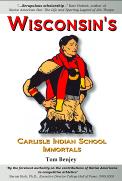
While researching Frank Lone Star for my upcoming book, Wisconsin’s Carlisle Indian School Immortals, I came across a piece in the November 4, 1892 issue of The Indian Helper, in which Frank’s older brother, John Lone Star, had joined a newly organized football team called the Rovers. This, of course, piqued my interest, so I looked further. The November 25 issue reported that the Rovers had lost to the Pirates. The Pirates were described as the “Champion Foot-ball Team of the school.” From that I gathered that the Rovers and Pirates were intra-mural teams of some sort. It also mentioned that the Pirates’ trainer (coach in modern parlance) was Benjamin Caswell. In 1894, Caswell would captain the school’s football team, the first one to play a full schedule.

The article also reported that the Pirates also defeated the “School Team on Saturday, by a score of 16 to 10.” In his memoir, Superintendent Pratt wrote that interscholastic football at Carlisle had been banned in 1890 and not reinstated until 1893. So, why would there have been a school team?

But the Rovers weren’t through for the year. They beat Martin Archiquette’s team 22 to 8 on Thanksgiving Day. One can only assume that Archiquette’s team was another intra-mural team. The Pirates weren’t through either. On the following Saturday, they lost to the Regulars. What did that name mean? Were they just regular guys or were they the team that represented the school?

Curious, I delved a little deeper. On November 13, 1891, The Indian Helper stated, “They say we are to have a foot-ball team. The ball is already here.” That could have been just some gossip. Of course the school had a ball because the boys were already playing among themselves. A little ad in the November 28 New York Times told me that there was more to it.

1891-11-28 Carlisle vs NY YMCA

Was Pratt’s memory faulty? Was this a one-off game against a foe who promised to play cleanly? After all, it was a Christian organization. More research will be needed to discover the truth.