I previously mentioned receiving communications from descendants of the Carlisle Indians. This week an email came from Joe Bergie’s oldest surviving granddaughter discussing his induction into the Montana American Indian Athletic Hall of Fame in 2020. Because of Covid, like many other things, his enshrinement was delayed until 2021. She credited her cousin, Carol Gilham, with doing the considerable amount of work necessary to get a star athlete who played his last game a century ago recognized.
Joe Bergie was not a minor football player at Carlisle, an entire chapter of Doctors, Lawyers, Indian Chiefs is devoted to him. Space doesn’t permit including all of that here. I’ll just hit the high spots. Joe arrived at Carlisle in 1910 and played on the scrubs as he learned the rudiments of the game. He played center, an important position for teams employing the single- and double-wing formations, on the great 1911 and 1912 teams. He excelled at defense and carried the ball well when given the opportunity at fullback. Pop Warner considered him to be the greatest center to ever don a Carlisle uniform. In the spring, he also starred at lacrosse when it replaced baseball at Carlisle.
After leaving Carlisle, Joe played on several pre-NFL semi-pro teams, even serving as the coach while playing for one of them. World War I, in which he served in the Army and was shipped overseas, where he remained until January of 1919. After his discharge, a hand injury ended both his football career and his brief turn as a professional wrestler.
Author’s note. A guy in my outfit in the service was named Bergie. We pronounced it Bergee. Recently, I was informed the proper pronunciation is Berjee.
Joe Bergie in Carlisle Indian School football uniform.
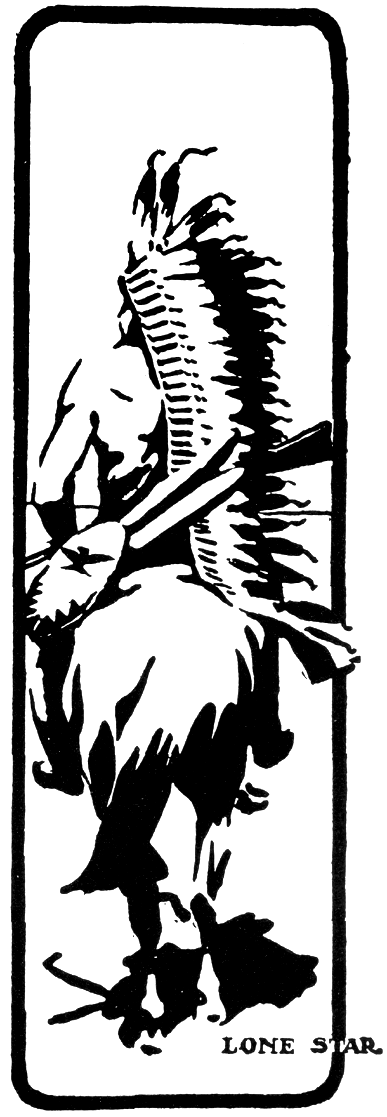
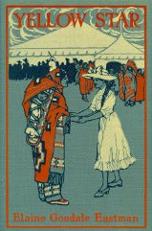
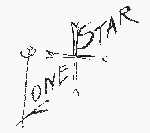
On Tuesday evening I attended a presentation by the Dickinson College Archives’ Carlisle Indian School Resource Center about their digital scanning project. The handout for this program included cover images of two Carlisle Indian School publications: The Indian Craftsman and The Red Man. They caught my eye because Lone Star Dietz and his bride—he and Angel DeCora had been married a little over a year when the first edition appeared—created and produced the school’s literary magazine. Dietz contributed the artwork and almost all of the cover images. The title of the magazine was changed starting with the second year because of confusion with Stickley’s popular journal The Craftsman.
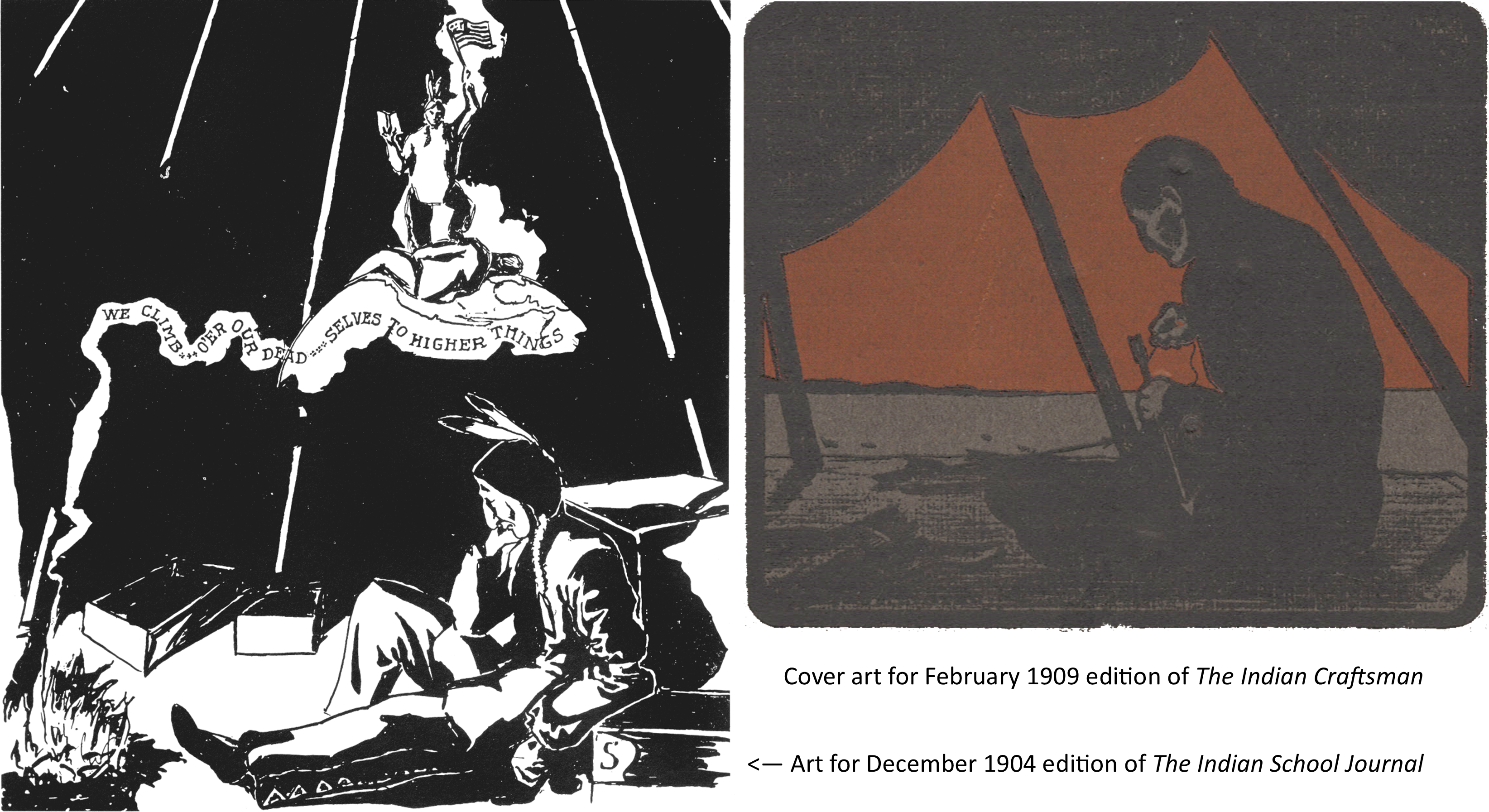
The differences between the first cover art and that Dietz made for later works was striking. It was similar to a drawing he made for the December 1904 edition Chilocco Indian School’s The Indian School Journal. Although that school claimed him as a student and arranged his transportation to Chilocco, there is no evidence that he actually arrived there. The piece used on the February 1909 magazine might have originally been intended for a Chilocco publication.
The first piece of Dietz’s art to appear in a Carlisle document was on page 3 of the June 19,1908 edition of the school’s newspaper The Arrow. This design was published about the time the school acknowledged Dietz’s elopement with the head of the Native Art Department. The shift in style was likely due to DeCora’s influence. Dietz would never return to the previous style.
The other cover image used of the handout came from a later edition of The Red Man magazine—cover art was often used multiples times across several years. Dietz’s style would evolve but never back to how it was for Chilocco publications.
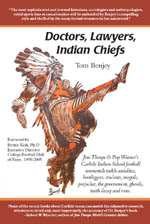
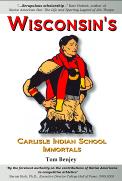
In all of the years that I have been reading and studying about college football, the team representing the Carlisle Indian School has always taken on somewhat legendary proportions. Much of this probably came from reading about Jim Thorpe and his association with the school, or in reading about other schools that had to play the dreaded Carlisle Indians. Over the years I have read several books that deal at least in part with the Carlisle football team. However, I have never come across any publication that tells the entire story of that team, until now. Therefore, when I was asked to review this significant new book I leapt at the opportunity.
The active time for the Carlisle team was from 1893-1917, with 1894 being the first year to feature a complete schedule of about 10 games. When you consider that this was well over 100 years ago, and that for at least it’s first few years the Carlisle team was hardly known around Pennsylvania, much less the rest of the country, the amount of material that the author has uncovered from this time period is truly amazing. There is no bibliography included in the book; but, the notes listed for each chapter (no less than 25 pages of them) in essence serve as the book’s bibliography. If anyone cares to research a game or a season further, the references are right there.
Although the author acknowledges many people for their help with this project, the story could have used some better editing in two areas. The first is to clear up the player identification ambiguities that are often encountered in the game accounts. Virtually every game that Carlisle ever played is covered in detail based on the available newspaper accounts. With all of this material to decipher and organize, the telling of the story of each season’s games at times suffers. The names of the players from both teams in a game are often used without clearly identifying the team to which they belong; especially confusing when the Carlisle players have non-Indian names. This leads to some confusion for the reader and the need to reread the account to make sure of each player’s team affiliation.
Secondly, the author does a great job in trying to recreate the game action based on what the newspapers reported. However, these recreations stick too closely to the often dry reporting of an early 20th century newspaper sports reporter, a reporter from an era before the reporting of football really took off. Using more exciting prose, without changing any of the facts of the play or the game, would have definitely livened up these accounts and resulted in a more exciting read.
There are two sections of the book which I also feel are placed incorrectly. Appendix A, Origin of the School, tells the story of the Carlisle Indian School from its founding to just before the organizing of the school’s first football team. When I was first perusing the book and came across this Appendix, I decided to read it first. I was correct in doing so, as it is a natural introduction to the rest of the book and should have been used as either Chapter 1 or as the Introduction.
The other section that appears to be misplaced is Chapter 8, Captain Leadership, which relates in great detail something that took place during the 1902 season. Instead of including this material in Chapter 6, which covers the 1902 season, or making it Chapter 7, it is placed after the material covering 1903, which seems out of place to me.
Despite the imperfections mentioned above, they are minor when compared to the total amount of material presented and the research done, i.e., the overall excellence of this work. This is an incredibly detailed story of one of the most legendary of college football teams, one whose reputation is still strong more than 100 years after its final game was played. Few programs have been covered in such detail. If you are a student of college football, this book is a must for your football library.
Since this is a brand new book, there are no copies currently available from any of the used book sources. My suggestion would be to order directly from the source, www.Tuxedo-Press.com (See ad in this issue), or Amazon.
After making my last post, I did a little research on Mary Alicia “Alice” Nevins Lloyd Key Pendleton and found that she was quite a lady. Born in 1823, 1824, or 1825, she seemed to get younger as she got older, in or near Frederick, Maryland, possibly on her father’s 560-acre farm along Big Pipe Creek. Her parents were Francis Scott Key, a name known by all schoolchildren, and to his wife Mary Tayloe Lloyd Key. Her father owned six slaves when she was born. His sister, Anne Phoebe Charlton Key, married Roger B. Taney, making him Alice’s uncle. Taney became Chief Justice of the Supreme Court in 1835 and would later issue the infamous Dred Scott decision.
Alice had ten siblings but not for long. Her brother Daniel, a midshipman at Annapolis, was killed in a duel by a fellow cadet over a disagreement about steamboat speed.. The next year, John, a young lawyer working in their father’s firm, died of an unspecified illness. Philip Barton Key avoided a duel over a woman in 1843 but was murdered in 1859 by congressman Daniel E. Sickles over the affair Key had with Sickles’ wife. Sickles, who would later gain infamy as a Union general at Gettysburg, was the first person to be found not guilty for reason of temporary insanity. Francis Scott Key did not live to see his son killed because he died of natural causes in 1843.
In 1846, Alice married George Hunt Pendleton, a lawyer from Cincinnati, Ohio, who came from a political family. They had five children. Since her husband served in both the Congress and the Senate, she spent much of her married life in Washington, DC.
In 1858 she joined the Mount Vernon Ladies Association of the Union, the organization that purchased and preserved George Washington’s home, as a Vice Regent. In 1876, she purchased a “small estate,” a one-acre lot in Ochre Point overlooking the Atlantic Ocean at Newport, Rhode Island for $9,750. The next year, she bought a 10-feet-wide strip of land adjacent to her property. She named the cottage she had built “Cave Cliff.” Her nephew composed “The Cave Cliff Waltz” and dedicated it to her—“Aunt Alice.”
She spent the winter of 1876-77 in St. Augustine, Florida where she met Richard Henry Pratt and began supporting his efforts to educate the Indians. One of them took the name of David Pendleton Oakerhater to honor her for her financial support which allowed him to study for the Episcopal ministry. Oakerhater is a corruption of his Cheyenne name O-kuh-ha-tah, which meant Sun Dancer. She and her husband remained interested in Indian education.
She lived in Berlin while her husband was ambassador to Germany. She returned to the U.S. in March 1886 to be with her son Frank after his wife died. In May, she was killed when she suffered a compound skull fracture jumping from a runaway carriage.
While looking for a little more about the life of David Pendleton Oakereater, I came across an 1879 newspaper article that brought a little more light to the founding of Carlisle Indian School, although Oakereater was never enrolled there.
Mary Alicia Key Pendleton, wife of Senator George Hunt Pendleton of Cincinnati, Ohio and daughter of Francis Scott Key, spent much of the 1876-77 winter in St. Augustine, Florida. While there, she organized an archery club and applied to Richard Henry Pratt to detail two Indian prisoners at nearby Fort Marion to teach a class of ladies how to shoot bows and arrows. Pratt assigned the task to Making Medicine, Cheyenne aka Oakereater, and Playing Boy, Kiowa aka Etahdleuh Doanmore. So, after only a year and a half of confinement, the prisoners no longer scared the townspeople, at least some of them. One supposes that Mrs. Pendleton figured that if her father could survive the shelling of Fort McHenry, she could manage contact with a few Indians. The young men worked with the club throughout the winter. During this time, Mrs. Pendleton became much interested in the two young men and gave them presents. When their incarceration was over, she paid their expenses to travel to Syracuse to become educated by an Episcopal minister.
She became interested in the education of Indian children in general and used her influence, particularly with her husband, it seems. Sen. Pendleton was credited by using his position on the Indian Committee to move Congress to take action that resulted in the transfer of Carlisle Barracks to the Interior Department, which controlled the Bureau of Indian Affairs.
At this point in the article, The Wichita Weekly Beacon reporter inserted his or her opinion: “This is the entering wedge, and other useless barracks and forts will, no doubt, be poetical justice, though long deferred.” Further research will be required to determine how many army bases would house government Indian schools.
Sen. Pendleton is perhaps best remembered by the 1883 act bearing his name that required civil service exams for government positions. This bill was passed in reaction to James A. Garfield’s assassination by a disappointed office-seeker. With close ties to the Copperhead political faction, he ran on the Democratic ticket as George McClellan’s vice-presidential candidate against Lincoln’s reelection in 1864.
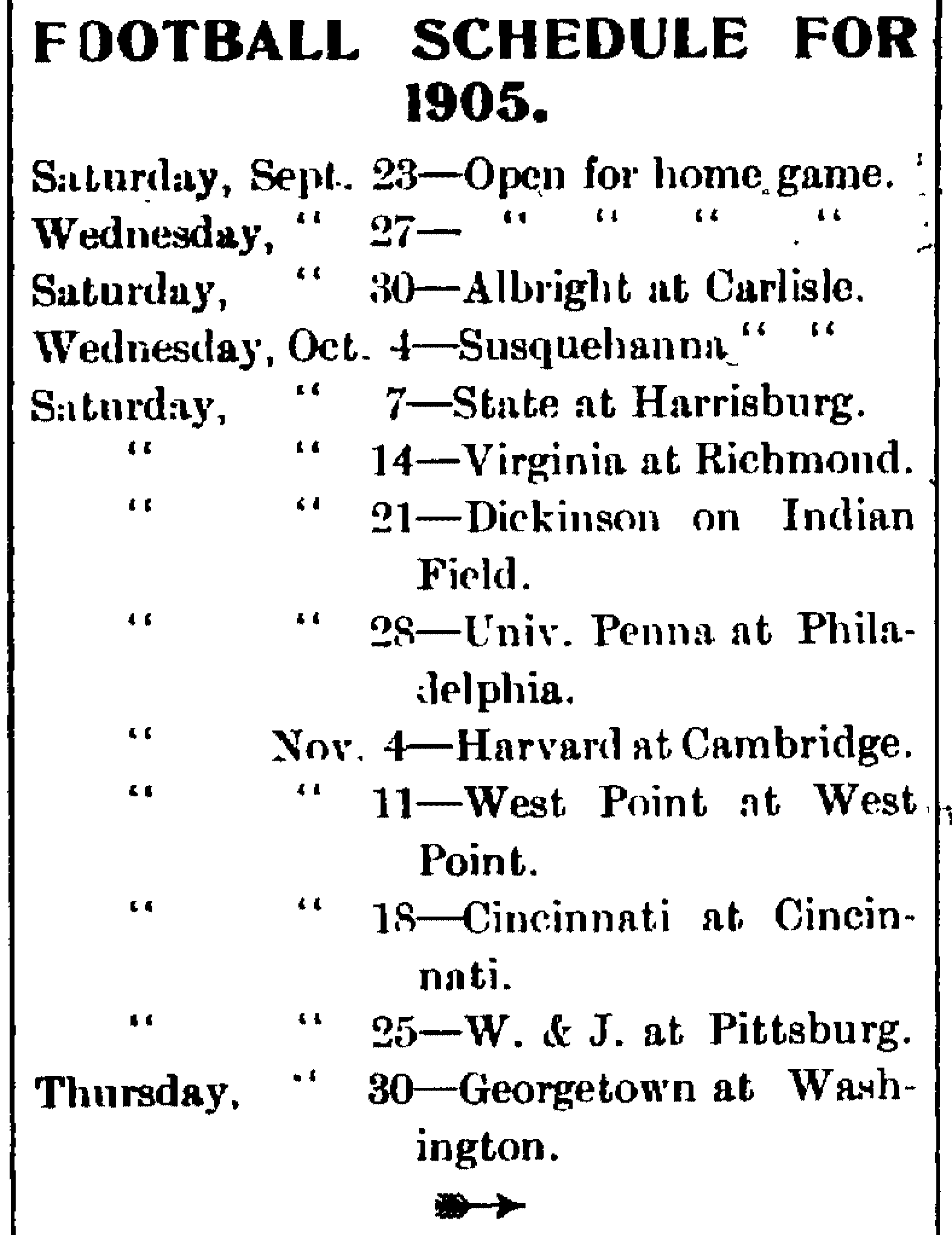
Sometimes something you haven’t thought about before jumps into your head. Yesterday, I had one of those thoughts, “Was the 1905 Carlisle game against Army on the original schedule or was it added during the season?” I definitely hadn’t considered that before. Perhaps the thought popped into my head because games against the Canton and Massillon semi-pro teams were added late in the season. Regardless of why it came into my head, I had to resolve it.
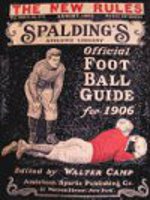
My first step was to check with the 1905 Spaldings Guide. Sure enough, it was listed there. Since these guides were distributed prior to the start of the season, it was clear that this game had been scheduled ahead of the season start. But how far ahead?
To find that out, I consulted with the school newspaper for the 1904-1905 school year. The June 29, 1905 edition of The Arrow included the first published schedule for the 1905 season. The game was scheduled for a date that held no particular significance at that time, November 11, at West Point. The week after that the team would start a westward road trip in which they were to play games in Cincinnati and Pittsburg before ending their season with a Thanksgiving Day game in Washington, DC against Georgetown. But that schedule didn’t hold.
Who negotiated the extra games isn’t clear. It’s possible that George Woodruff arranged them before leaving the team after the Army game to join the Roosevelt administration. The games with Canton and Massillon were first listed in the October 20 issue of The Arrow, a factor that makes Woodruff’s involvement more likely.
How the games were arranged is less important that they were played. Beginning on November 11, the last game for which Carlisle had a full week to prepare, the Indians played six games in the time other schools played three, two if they didn’t have a Thanksgiving game. Carlisle was known for playing brutal schedules. The 1905 season was just one example of this.
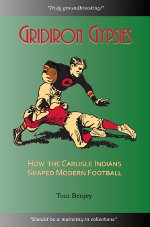
The details of the 1905 contest with Army can be found in Gridiron Gypsies: How the Carlisle Indians Shaped Modern Football.
I wonder if other newspapers are doing what my local paper, The Sentinel (Carlisle, PA), is doing. Rather than writing book reviews, they are publishing what they call 5Q articles. 5Q is shorthand for the five questions they provide the author to answer in writing, which they use, with “He said” interspersed randomly to give the appearance of an interview, to flesh out the body of the article. The on-line version includes photos and an image of the book’s front cover but the print version only includes the text. The column on the left was printed on the front page of the paper. The remainder was on page 7.A copy of the print version is provided. It may be necessary to view it in full-screen mode for the text to be large enough to read.
Reviews are coming in for Gridiron Gypsies and they’re very good. However, none of them say anything about what some consider a real bonus in this book: the list of the 495 young men who were on Carlisle’s varsity and the years they played. Creating this list was a difficult, time-consuming task that was sometimes frustrating. Several names that appeared in newspaper coverage of the games are still a mystery. Any help in sorting out those names would be most welcome. These names can be found on page 324 of the book.
In order to compile this list, I scoured team photo captions, newspaper coverage both pre- and post-game, school newspaper articles, Spalding’s Guides, and Carlisle Indian School student files. There were probably other sources but they don’t come quickly to my muddled mind. A sample page is included to give you an idea of what was produced from this toil.
The Great Depression immediately followed by World War II interrupted the mission work Oakerhater had started. It took new people moving into the area in the early 1960s to bring it back to life. An Episcopalian family advertised a religious meeting they were going to hold in their home. Seeing the ad were some Cheyennes who had known Oakerhater. They worked with the new family to revive his old mission.
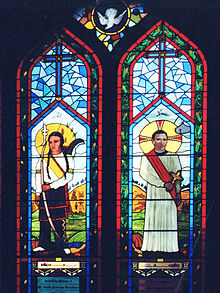
Muskogee Creek scholar Lois Carter Clark researched Oakerhater’s life and works, culminating in his being designated as a saint by the Episcopal Church in 1985. The next year on September 1, the first feast held in his honor was celebrated at the National Cathedral in Washington, DC. Saint George Church in Dayton, Ohio dedicated a large stained glass window to him in its chapel in 2000. The tall six-sided window with pointed ends depicted him as a deacon with Cheyennes looking toward him. A smaller window featured his glyph signature.
St. Paul’s Cathedral of Oklahoma City dedicated a chapel to Oakerhater and replaced a window that was blown out by the 1995 Oklahoma City bombing. Preston Singletary (Tlingit) created a stained glass window featuring his glyph. The church also organized The Oakerhater Guild of St. Paul’s in partnership with Whirlwind Mission of the Holy Family.
The Whirlwind Church gained a permanent site in Watonga in 2003 and dedicated the Oakerhater Episcopal Center in 2007, which provides a place for powwows, a sweat lodge, classes, and an annual Cherokee Dance in Oakerhater’s honor.
Now a national shrine to Saint O-kuh-ha-tuh, Grace Episcopal Church in Syracuse, New York held a Native-American celebration in 2005 to honor him, the first Native-American saint of the Episcopal Church. The new stained glass windows honoring him and designed by his great-granddaughter Roberta Whiteshield-Butler were dedicated in this event.
In October 1879, David Pendleton Oakerhater, as he was then known, left New York for a time to assist Pratt in enlisting children from Indian Territory (Oklahoma today) for his former jailer’s new school in Carlisle, Pennsylvania. In 1880 after returning from this mission, Oakerhater’s wife Nomee (Thunder Woman) died in childbirth in Paris Hill. The next year, their young son Pawwahnee died. Both were buried in the church cemetery. She had earlier bore him three daughters, all of whom had died. Along the way, he had taken a second wife Nanessan (Taking Off Dress) while married to Nomee but had divorced her by 1878. The daughter born to them had died as had his other children.
In May of 1881, Pratt petitioned the Office of Indian Affairs for the money to transport Oakerhater back to Indian Territory from where he had been taken prisoner. The government had paid the travel expenses of the other Fort Marion prisoners to return home after their incarceration was completed but the Episcopal sponsors had paid the travel expenses for the four who went to New York State. Now it was time for the government to return them to Indian Territory. Oakerhater’s reason for returning was to build Episcopal churches at the Indian agencies.
He married again in 1882 to Nahepo (Smoking Woman aka Susie Anna Bent) who took the name Susie Pendleton. Both of their children died young. She died in 1890 at 23 years of age.
In 1887, Oakerhater worked at the Episcopal mission in Bridgeport and in 1889 at the Whirlwind Mission near Fay, seventeen miles west of Watonga. Many of the Whirlwind students suffered from poverty, trachoma, and conjunctivitis. After tribal lands were broken up by the Dawes Act, families often tented near the reservation schools to be near their children and to provide a safer environment. His school and mission were under constant pressure. Locals wanting to exploit the Indians saw his mission and school as a threat and others at the national level deplored the poor conditions there.
He remarried again in 1898, this time to Minnie White Buffalo, who was 20 years younger than him. She brought with her a son from a previous marriage named Bear Raising Mischief.
Oakerhater retired with a pension in 1918 but continued to preach, serving as an Cheyenne chief and holy man. After a brief stop in Clinton, he moved to Watonga, where he lived until he died in 1931. Some of Oakerhater’s works would live on after him.







 Tom Benjey's Weblog
