Posts Tagged ‘WWI’

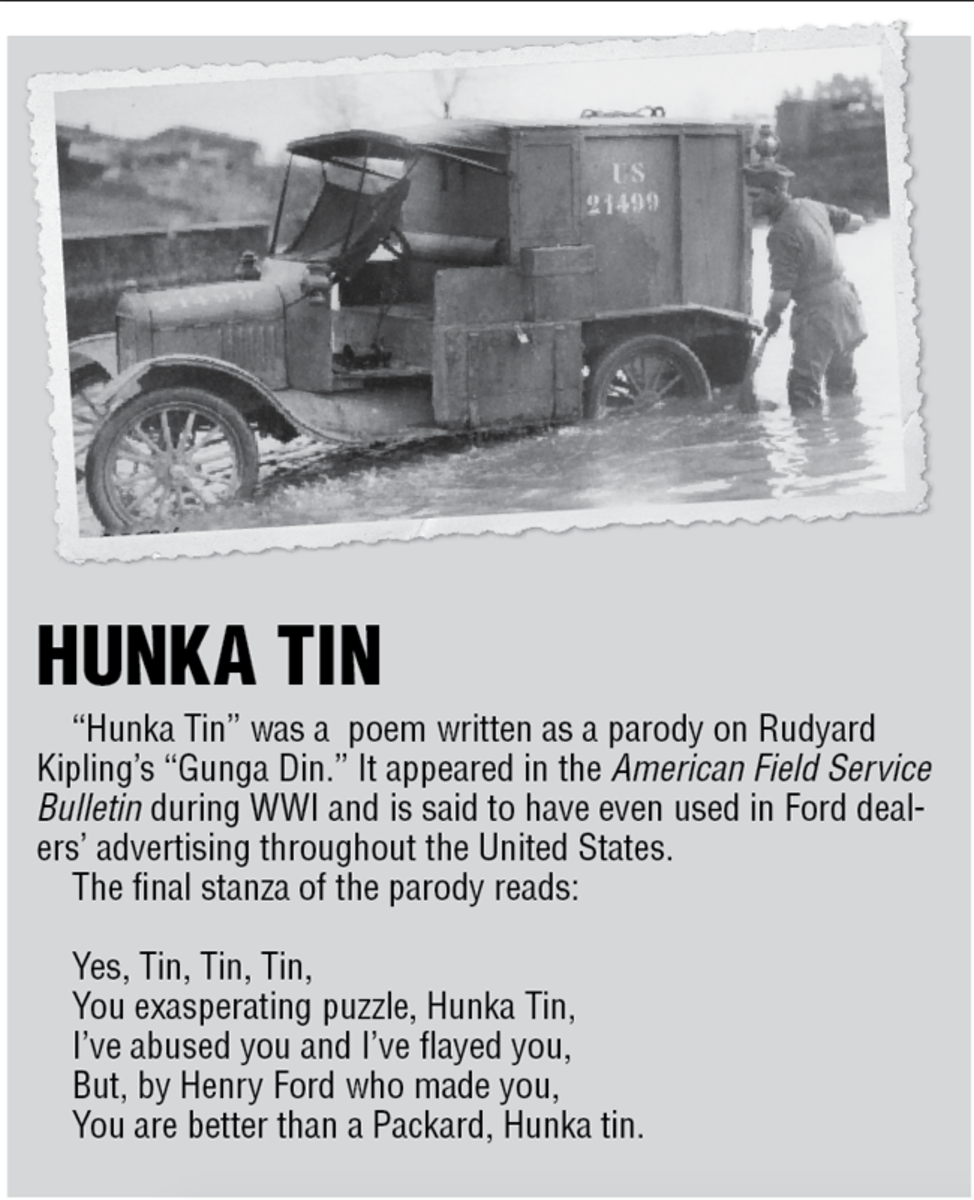
Hunka Tin

March 14, 2024

A scene in the 1927 Motion Picture Academy Best Picture Winner Wings brought something to mind that James McGrath Morris wrote in or about (I forget which) The Ambulance Drivers, a book about how writers Ernest Hemingway and John Dos Passos became friends while driving ambulances in WWI. What caught my eye several years ago was Morris’s assertion that ambulance drivers had to be from economically advantaged families because poor people wouldn’t know how to drive. That conflicted with what my father had said about growing up poor on a farm at that time.

Dad was too young to go to war but he recalled having some sort of car or truck on the farm even though they didn’t own any land. Used Model T Fords, which were released almost a decade before America’s entrance into WWI, were always on the market at heavily depreciated prices. I remember taking Dad and his older brother to an auction in 1976. The deceased farmer had been a tinkerer who attached Model T drive trains to horse-drawn implements to create useful machines before they were available from major manufacturers. Also at the sale were some complete Model Ts that hadn’t been adapted for other use. My uncle said, “I can remember when that car could be bought for ten dollars.” Dad piped in, “If it ran.”

The point to this is that even poor people had access to automobiles before WWI, although they weren’t Duesenbergs or Packards. Generally, they were Fords because the Model T was the least expensive automobile and it accounted for half of the automobile market at the time.

Clara Bow’s character saw an advertisement for volunteers, with the stipulation that they must be able to drive Fords. To the unfamiliar, that might sound odd. The reasons for it were that Ford built 5,745 ambulances for the Allied Powers and 107 for the Red Cross during WWI. These vehicles used the same Model T drivetrain that was used in passenger cars so many people owned. Other companies also supplied ambulances but Fords were the most common. But why did she need experience driving Fords?

Model T Fords drive like no other automobile. They have no accelerator pedal. Instead they have a throttle level attached to the steering column. Ts employ the handbrake as part of the gear shifting mechanism along with the three pedals on the floor. And they have no clutch pedal. Considerable practice is required to master driving a Model T. The Red Cross probably didn’t have the time for volunteers to learn how to drive the ambulances and couldn’t afford the damage that was sure to result while they were learning.
Carlisle Players in WWI — 1918

January 27, 2012

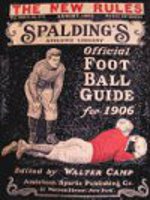
War years, at least those for WWI and WWII, affected college football greatly, so much, in fact, that Spalding’s guides for those years had to adapt to the changed environment.  The 1919 guide, for example, includes a large section, titled Part II Spalding’s Official Foot Ball Guide: Army and Navy Foot Ball.  A July 24, 1919 letter from President Woodrow Wilson to Hugh Miller extolling the virtues of football in training troops for combat served as a frontispiece for this section of the book.  Ironically, or not, Miller wrote publicity pieces for Pop Warner when Warner coached the Carlisle Indians.  Apparently, Hugh Miller was more than just a hack writer who did Warner’s bidding.

This focus on military teams was necessary because the 1917 and 1918 football seasons were disrupted, to put it mildly, by the large number of college football players who were inducted into the service during WWI.  Many colleges stopped fielding teams where others played with lesser talent than usual.  Most college teams included military teams on their schedules.  It’s fair to assume that the military academies were not impacted nearly as much as their civilian counterparts.  Carlisle Indian School canceled its 1918 season because the school was closed to allow Carlisle Barracks to be used as an army hospital.  However, many of the former students continued to play football—even after they enlisted.

Perusing the pages of the Army-Navy section revealed the names of several Carlisle students with whom I was not familiar. Follows is a list of those names and the teams on which they played:

Name                                    Unit

Sgt. Mickel                          Air Service Department, Garden City, NJ

Buffalohead                       Fort Ontario, Oswego, NY

M. Le Claire                        Camp Travis, Fort Sam Houston, TX

Ojibway                               Wissahickon Barracks, Cape May, NJ

Webster                              3rd Army Troops, Europe

Kalama*                               35th Division, Europe

*Selected as center for All-American Expeditionary Forces Eleven

If you know anything about any of these men, please get in touch with me.


School’s Closing Not Inevitable

January 14, 2010

Conventional wisdom has it that Carlisle Indian School declined after the 1914 congressional investigation until it died a natural death in 1918. I came across some items that raise doubt about that conclusion. The May 24, 1918 issue of The Carlisle Arrow and Red Man listed the schedule for the upcoming football season. The 9-games scheduled included such powerhouses as Pitt and Army but didn’t include many of the powers the Indians faced during their glory days. It seems unlikely that this schedule would have been arranged if the school was expected to close before the start of the next school year.

Newspaper coverage of the school’s commencement activities held on June 6 did not even hint that the school was about to close. Mid-June newspapers announced that the government was considering the lengthening of Carlisle’s enrollment by two years to allow students to complete a college preparatory program. In addition to the educational advantages, the school would be able to attract star athletes. It wasn’t reported if this bill was ever decided upon, probably because it was overtaken by events.

In mid-July the government announced that the school was to be closed and the army was taking Carlisle Barracks back to be used as a hospital to treat soldiers that were wounded in WWI. The transition took place in less than six weeks, so it is fair to assume that it was not as orderly as it would have been had it been planned for some period of time.

Enrollment was down to about 680 students at the time of closing, due in significant part to students and potential students enlisting in the armed forces. Carlisle and the Indian community at large were overrepresented in the military although non-citizen Indians were not subject to the draft. Some even went to Canada to join their forces before the U. S. entered the war. After the U. S. entered the fray, Carlisle school newspapers were filled with items about Carlisle alums who had joined up. Those who were commissioned officers, such as Gus Welch, Frank Mt. Pleasant and William Gardner, received extra coverage.

It would have been interesting to see what might have happened if the army had delayed its decision until November 11, 1918. It will also be interesting to read what Gen. Pratt had to say about the school’s closing.

Lt. Frank Mt. Pleasant

December 22, 2009

 I just came across a photo of Frank Mt. Pleasant in his WWI army uniform. Unfortunately, there are a few errors in the associated text. He competed in the 1908 Olympics, placing 6th in both the broad jump and triple jump although injured at the time. In Paris, after healing, he beat the Olympic broad jump champ in a big meet. His name is misspelled in the caption under the dog. He was the first Carlisle Indian to get a degree, a Ph. B., from Dickinson College. However, some others previously got LL B. degrees from Dickinson School of Law.

He has been inducted into the Dickson College and Indiana University of Pennsylvania halls of fame as an athlete and a coach, respectively. He was earlier inducted into the American Indian Athletic Hall of Fame. It is astounding that the Pennsylvania Sports Hall of Fame has not inducted him when you consider that the vast majority of his playing and coaching career was in Pennsylvania and he was a premiere athlete in two sports first at Carlisle Indian School and then at Dockinson College during his playing days.