A few weeks ago I wrote about Alice Pendleton, youngest daughter of Francis Scott Key. In passing I mentioned the murder of one of her older brothers, Philip Barton Key, by Daniel Sickles. There is a lot more to the story.
Daniel Sickles was a 32-year-old junior state assemblyman from New York City and notorious womanizer when he married Teresa Da Ponte Baglioli, a teenager half his age, in September 1852. The next year, President Franklin Pierce appointed Sickles to serve as secretary of the U. S. legation in London under the leadership of James Buchanan. He allegedly brought prostitute Fanny White with him, leaving his pregnant wife at home. He supposedly presented her to Queen Victoria with the alias of the family name of a political opponent instead of her own. Married just seven months Teresa gave birth to their only child, Laura Buchanan Sickles. After his return to the U. S. he was elected to the New York State Senate, which censured him for bringing Fanny White into its chambers. The Sickles moved to Washington in 1856 when he was elected to Congress as a Democratic representative for the 3rd district of New York.
In Washington, Teresa made the acquaintance of U. S. Attorney for the District of Columbia, Philip Barton Key II and began an affair with him in 1858. A “friend” wrote Sickles of his wife’s infidelity, enraging him. He forced his wife to confess and put her confession to paper. Sickles saw Key sitting on a bench outside his home signaling to Teresa, apparently unaware they had been found out. Sickles ran out screaming, “Key, you scoundrel, you have dishonored my home, you must die.” He repeatedly shot the unarmed Key, killing him in Lafayette Park. Defended by Edwin Stanton, Sickles pled temporary insanity and was the first person in the United States to be acquitted using that defense. Newspapers declared Sickles a hero for saving women from Key.
An unexpected article popped up on my phone this afternoon possibly because fighter planes have recently been shooting down airborne “items.” A little background is needed as to why this got my attention. From February 1967 through mid-August 1968 I maintained the FCS of F-102 aircraft in The Philippines, Vietnam, and Thailand. The Deuce, as F-102s were often called, wasn’t a sexy airplane at that time. The F-106 was faster and the F-4 carried a much larger variety of weapons. Being an old plane, half of the F-102s, maybe more, were then flown by National Guard units. In spite of its age, the Delta Dagger, the plane’s official nickname, was chosen for overseas duty because it was more reliable and more easily supported logistically than the newer interceptor, the F-106.
The article linked to below tells of one pilot’s experiences flying the plane against a very fast target, the B-58 bomber. In order to better understand the article some abbreviations and acronyms need to be defined.
FCS stands for Fire Control System. This has nothing to do with putting out fires. It has to do with aiming and firing the plane’s weapons. The F-102 used the MG-10 weapons control system built by Hughes Aircraft. It used radar and infrared to seek and track targets. Most of its circuits used vacuum tubes. Only a few functions utilized solid-state components.
ECM stands for Electronic Counter Measures, devices used to defeat or confuse the interceptor’s radar.
IRST stands for Infra Red Search & Track (or sighting & tracking). An IR seeker head resembling a chrome ball was located just forward of the cockpit. Targets could be located and tracked using either radar or IR or both together. Follows is an anecdote of both methods being used together:
One day at Bien Hoa Air Base in South Vietnam we had the radome off to do some work on the radar antenna . About the time we needed to test the system after finishing making the adjustment the adjustment an Air Policeman guarding the revetments in which our planes were stationed walked by smoking a cigarette (it was 1967). I locked the infrared onto his cigarette and shifted the mode to IR/Radar Slaved. Normally there is no external indication as to what the system is doing but, with the radome removed, the antenna is visible. With IR locked on to his cigarette and radar slaved to it, the radar antenna followed him as he walked past. He, not surprising, was unnerved by this.
If the Chinese balloon/items had floated by back in the day, F-102s very likely would have been assigned the job of shooting them down.
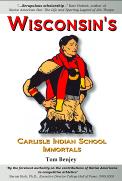
In all of the years that I have been reading and studying about college football, the team representing the Carlisle Indian School has always taken on somewhat legendary proportions. Much of this probably came from reading about Jim Thorpe and his association with the school, or in reading about other schools that had to play the dreaded Carlisle Indians. Over the years I have read several books that deal at least in part with the Carlisle football team. However, I have never come across any publication that tells the entire story of that team, until now. Therefore, when I was asked to review this significant new book I leapt at the opportunity.
The active time for the Carlisle team was from 1893-1917, with 1894 being the first year to feature a complete schedule of about 10 games. When you consider that this was well over 100 years ago, and that for at least it’s first few years the Carlisle team was hardly known around Pennsylvania, much less the rest of the country, the amount of material that the author has uncovered from this time period is truly amazing. There is no bibliography included in the book; but, the notes listed for each chapter (no less than 25 pages of them) in essence serve as the book’s bibliography. If anyone cares to research a game or a season further, the references are right there.
Although the author acknowledges many people for their help with this project, the story could have used some better editing in two areas. The first is to clear up the player identification ambiguities that are often encountered in the game accounts. Virtually every game that Carlisle ever played is covered in detail based on the available newspaper accounts. With all of this material to decipher and organize, the telling of the story of each season’s games at times suffers. The names of the players from both teams in a game are often used without clearly identifying the team to which they belong; especially confusing when the Carlisle players have non-Indian names. This leads to some confusion for the reader and the need to reread the account to make sure of each player’s team affiliation.
Secondly, the author does a great job in trying to recreate the game action based on what the newspapers reported. However, these recreations stick too closely to the often dry reporting of an early 20th century newspaper sports reporter, a reporter from an era before the reporting of football really took off. Using more exciting prose, without changing any of the facts of the play or the game, would have definitely livened up these accounts and resulted in a more exciting read.
There are two sections of the book which I also feel are placed incorrectly. Appendix A, Origin of the School, tells the story of the Carlisle Indian School from its founding to just before the organizing of the school’s first football team. When I was first perusing the book and came across this Appendix, I decided to read it first. I was correct in doing so, as it is a natural introduction to the rest of the book and should have been used as either Chapter 1 or as the Introduction.
The other section that appears to be misplaced is Chapter 8, Captain Leadership, which relates in great detail something that took place during the 1902 season. Instead of including this material in Chapter 6, which covers the 1902 season, or making it Chapter 7, it is placed after the material covering 1903, which seems out of place to me.
Despite the imperfections mentioned above, they are minor when compared to the total amount of material presented and the research done, i.e., the overall excellence of this work. This is an incredibly detailed story of one of the most legendary of college football teams, one whose reputation is still strong more than 100 years after its final game was played. Few programs have been covered in such detail. If you are a student of college football, this book is a must for your football library.
Since this is a brand new book, there are no copies currently available from any of the used book sources. My suggestion would be to order directly from the source, www.Tuxedo-Press.com (See ad in this issue), or Amazon.
After reading my postings on Junia Smart, a former classmate asked if I had researched MISS Rainey, the Latin teacher. I hadn’t, so I gave her a look.
Dorothy Genevieve Rainey was born on January 20, 1904 as the first child of William W. and Ethel Shaver Rainey. She would later be joined by three younger brothers. Her father worked as a clerk in the Litchfield, Illinois post office, so they were probably living there at the time. The 1910 US Census had them living at 1224 Franklin Street in Litchfield. Her parents owned their home and had an 18-year-old servant, Mina Aikman, living with them. Dorothy’s brothers hadn’t been born yet. Not quite six,Dorothy didn’t attend school and couldn’t read or write at that time.
In 1920, the family was living on a farm in Cahokia Township, Macoupin County, Illinois but William was still working as a mail clerk along with farming. His mother-in-law, Francis Shaver, was living with the family which had expanded to include the three boys. The farm was located west of Litchfield, north of Mt. Olive and east of Gillespie. Dorothy was attending school and could read and write. Her college yearbook entry indicated that she had graduated from Litchfield High School, probably in 1921. That seems about right considering that she had an October birthday and would graduate when still 17.
SIUE has digitized the Shurtleff College yearbooks and has made them available to peruse on-line. Miss Rainey’s senior page accompanies this piece. She was quite active at Shurtleff, particularly with the French club. One of the nice things about high school and college yearbooks of this period is that they are gossipy. A few interesting quips about her follow:
Who put the salt in Dorothy Rainey’s bed? (1923)
Dorothy Raney steps out in white slippers. (1923)
Meigs makes a date with Dorothy Rainey for John Wones and takes her to the show himself. (1923)
Miss Walker and Dorothy Rainey let the St. Louis car go by and have to sit in the depot all night. (1924)
Dorothy Rainey oversleeps and misses breakfast. (1924)
Dorothy Rainey has the mumps. (1924)
Case—Crum [probably George Crum Walbaugh] and Dorothy Rainey. (1925)
The fall after graduating with her Bachelor of Philosophy degree, she took a teaching job with the Mattoon, Illinois school district. She appears to have started by teaching junior high but had shifted to Latin by the time she resigned in January of 1927 due to ill health. She apparently returned home then.
In June of 1929 she attended a Shurtleff College reunion. In 1930, the family, except for Dorothy, was back in Litchfield but lived at 1119 Jackson Street, a house worth $3,500 that they owned. With the Great Depression in full force she may have had difficulty finding a job and decided to go to graduate school. She supposedly earned a masters degree from the University of Iowa at some time. The period between the Mattoon and Marine jobs would be the likely period during which she would have gone to grad school.
She wasn’t mentioned in the press again until 1934 when she attended the funeral for the Shurtleff librarian. Dorothy was living in Marine, Illinois at that time. The likely reason for her relocating to Marine was that she was working there. Otherwise, she would have stayed with her parents.
In April 1935 her name appears in the “Marine News” column of The Edwardsville Intelligencer for the first time. Her social and professional activities were reported on in this column from this date forward until her death many years later. This time the mention was for attending a lecture on foreign languages in St. Louis. In May she was reappointed as a teacher at Marine High School. This suggests that she had teaching there for at least one previous year. Dorothy became very active in Marine by joining the Marine Evangelical Church, the PTA she helped found and served as its first Vice-President, the Red Cross, and the Draft Board. She hosted Latin Club meetings at her home and was active in teachers’ organizations. Close to her family, she spent part of each Christmas break and summer vacation with her parents. That changed in 1945 when her parents retired and moved to California. She continued teaching at Marine High School through the spring of 1951 after which Marine merged with two other schools to become Triad High School in Troy, Illinois.
Miss Rainey started teaching at Civic Memorial High School in Bethalto, Illinois in fall of 1951. Now teaching journalism, she and Mrs. Smart started the school newspaper The Eaglet. At CMHS she became more involved in statewide and national organizations and took students to compete in various contests. She also became more adept at getting press. The two local newspapers, The Alton Evening Telegraph and The Edwardsville Intelligencer, frequently ran pieces covering her activities. Something else that changed, possibly due to her parents relocating to California, was that her travel radius expanded over time from places no father away than Chicago to across the U. S. and eventually to going abroad. Olga (and sometimes Agatha) Deibert was a frequent travel companion.
One thing that didn’t change was her involvement with Marine. The Marine newspaper column continued to run news of her. It wasn’t clear if she moved her residence to Bethalto or, if she did, how long she lived there. She kept her ties to Marine strong.
In 1955 she had a special boy for a student. 15-year-old Charles Brunk of Cottage Hills liked languages. He bought a Hebrew reader and learned the language by correlating the symbols. He learned Latin in school and Greek after school from Miss Rainey.
She continued her education by attending summer sessions at the University of Colorado in Boulder and Tufts in Massachusetts. In 1962 she fell and broke her wrist. This was about when I arrived at CMHS and may have seen her wearing a cast. Not taking any classes with her, our only interactions were admonitions from her about my associating with underachieving friends.
She bought a house in Marine in 1965 and used a Marine address in her letters to the editor which became more frequent during this phase of her life. She retired from CMHS in June 1970 but remained active in teachers organizations. She died on January 2, 1987 at age 82 and was buried alongside her parents in Elmwood Cemetery in Litchfield, Illinois.
Information found in later searches follow.
A February 2, 1934 Edwardsville Intellingencer article reported on a farewell party for Fred C. Durbin that had been held by students at Marine High School. He had substituted for Miss Rainey during the first semester of the 1933-34 school year. The reporter gave no reason for her absence.
To some extent this information fills in the gap in Miss Rainey’s life between completing her master’s degree in 1930 and teaching at Marine High School in 1935. The article makes clear that she was or at least was scheduled to teach at Marine High in the fall of 1933. While not stated, it seems logical that she would have been teaching there at least since the 1932-33 school year and possibly earlier. If not, why would she have been considered the regular teacher if she was absent for the first semester of her employment by the school? Left completely out was the reason for her absence.
Most recent find:
Late this afternoon I realized that I hadn’t done a search on Dorothy Rainey on Genealogybank.com, one of the tools I usually use when researching people’s lives. A quick search of her name for the 1930-1935 period returned a couple of pieces of new information. Illinois State Journal for May 2, 1932 reported that she had taken a job teaching Latin at Marine High School starting in the fall. It also reported that she had been taking a secretarial course at Greenville College prior to this. Now we know when she started at Marine High School—fall 1932—and what she was doing immediately before that. What we don’t know is when she started the secretarial course.
I emailed the library at Greenville University (the current name of the institution) requesting whatever information they have on her. I will share whatever they send me.
This article confirms that Miss Rainey wasn’t about to sit on her duff and wait for something that might never happen happen. She was proactive. If teaching jobs weren’t available she was preparing herself for an office job that might be. I wonder how much she put to work what she learned in the secretarial classes. One would think some of it could be applied to producing school newspapers, something she later did. What do her former students think?
Seeing Dragonseed on television earlier this week jolted me back to high school English class with Junia Smart. In her early sixties and having a physique similar to The Little King cartoon character, in our estimation, she was ancient. Whenever she wanted us to do something quickly she’d say, “Chop, chop.” She was said to have been born and grew up in China as a daughter of missionaries and a personal friend of Pearl S. Buck. She gave extra credit for book reports on Buck’s books but submitting one came with risks. You actually had to have read the book.
Dragonseed brought to mind her reactions to an airplane that frequently flew over. The high school was about a half mile from the local airport. Whenever the pilot who kept his P-51 Mustang there took off he was still at a low altitude when he roared over the school with the Rolls-Royce Merlin engine whining. It passed just above Mrs. Smart’s room on the second floor. A look of terror came across her face and she looked as if she was going to crawl under her desk. Sensitive teenage boys in the class responded by whistling to simulate the sound bombs made falling. I didn’t do it because I never learned how to whistle.
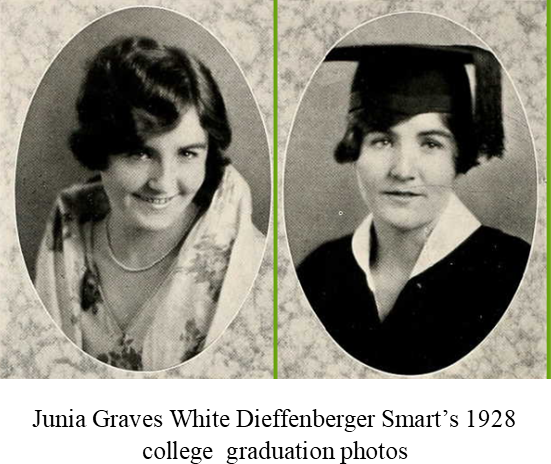
Having research tools available and with no pressing deadlines to meet, seeing Dragonseed brought Mrs. Smart to mind and I did a little research. What I found was that she was born Junia Graves White in 1903 to Presbyterian missionaries in China. The family would return to the U.S. every several years on furlough. She graduated from a Presbyterian girls school in North Carolina, Flora MacDonald College, with an A.B. degree in 1928. She and her sister Sarah were in the Sister Club and the Minister’s Daughter’s Club. Junia was also on the “championship” hockey team and President of Epsilon Chi Literary Society.
After working briefly as a social worker and teacher, she returned to China. There, she met a minister five years her junior named Arthur J. Dieffenbacher and married him in 1938. In 1940 with Japan waging war on China, Junia’s father died and the Dieffenbachers returned to the U.S. A rumor at school claimed she had seen Japanese soldiers murder her father but I have been unable to confirm that. Regardless, Junia surely had some horrifying experiences. Then alone, her mother joined her daughter in Pennsylvania.
The next year, Junia’s only child, Sarah Junia Dieffenbacher, was born. Rev. Dieffenbacher preached in Cincinnati until he joined the army as a chaplain in 1943. He was killed in battle in August 1944 in France, leaving Junia with a small child and elderly mother to care for. Her mother died the next year.
By 1947 the war widow had relocated to Alton, IL where she gave talks about China. She probably moved to take a teaching job because she was teaching English at East Junior High in 1948.
In 1950 she married Rexford Smart and relocated to Ontario to work his dairy farm. That apparently didn’t work out because they returned the next year and he took a job s a custodian.
In 1953 she took a position teaching English at Civic Memorial High School in nearby Bethalto, IL. There, she sponsored the school newspaper and coached the public speaking team with Miss Rainey, the English and Latin teacher who hadn’t changed her hair style since WWI and whom students claimed had helped Caesar put chains on his chariot in the winter.
Her daughter Sarah married in 1965 and lived in Stilwell, OK where she taught English at the public high school. Junia relocated there by 1968 and resided there the rest of her life. Rexford died in 1980 and she died ten years later at 87 years of age.
After making my last post, I did a little research on Mary Alicia “Alice” Nevins Lloyd Key Pendleton and found that she was quite a lady. Born in 1823, 1824, or 1825, she seemed to get younger as she got older, in or near Frederick, Maryland, possibly on her father’s 560-acre farm along Big Pipe Creek. Her parents were Francis Scott Key, a name known by all schoolchildren, and to his wife Mary Tayloe Lloyd Key. Her father owned six slaves when she was born. His sister, Anne Phoebe Charlton Key, married Roger B. Taney, making him Alice’s uncle. Taney became Chief Justice of the Supreme Court in 1835 and would later issue the infamous Dred Scott decision.
Alice had ten siblings but not for long. Her brother Daniel, a midshipman at Annapolis, was killed in a duel by a fellow cadet over a disagreement about steamboat speed.. The next year, John, a young lawyer working in their father’s firm, died of an unspecified illness. Philip Barton Key avoided a duel over a woman in 1843 but was murdered in 1859 by congressman Daniel E. Sickles over the affair Key had with Sickles’ wife. Sickles, who would later gain infamy as a Union general at Gettysburg, was the first person to be found not guilty for reason of temporary insanity. Francis Scott Key did not live to see his son killed because he died of natural causes in 1843.
In 1846, Alice married George Hunt Pendleton, a lawyer from Cincinnati, Ohio, who came from a political family. They had five children. Since her husband served in both the Congress and the Senate, she spent much of her married life in Washington, DC.
In 1858 she joined the Mount Vernon Ladies Association of the Union, the organization that purchased and preserved George Washington’s home, as a Vice Regent. In 1876, she purchased a “small estate,” a one-acre lot in Ochre Point overlooking the Atlantic Ocean at Newport, Rhode Island for $9,750. The next year, she bought a 10-feet-wide strip of land adjacent to her property. She named the cottage she had built “Cave Cliff.” Her nephew composed “The Cave Cliff Waltz” and dedicated it to her—“Aunt Alice.”
She spent the winter of 1876-77 in St. Augustine, Florida where she met Richard Henry Pratt and began supporting his efforts to educate the Indians. One of them took the name of David Pendleton Oakerhater to honor her for her financial support which allowed him to study for the Episcopal ministry. Oakerhater is a corruption of his Cheyenne name O-kuh-ha-tah, which meant Sun Dancer. She and her husband remained interested in Indian education.
She lived in Berlin while her husband was ambassador to Germany. She returned to the U.S. in March 1886 to be with her son Frank after his wife died. In May, she was killed when she suffered a compound skull fracture jumping from a runaway carriage.
While looking for a little more about the life of David Pendleton Oakereater, I came across an 1879 newspaper article that brought a little more light to the founding of Carlisle Indian School, although Oakereater was never enrolled there.
Mary Alicia Key Pendleton, wife of Senator George Hunt Pendleton of Cincinnati, Ohio and daughter of Francis Scott Key, spent much of the 1876-77 winter in St. Augustine, Florida. While there, she organized an archery club and applied to Richard Henry Pratt to detail two Indian prisoners at nearby Fort Marion to teach a class of ladies how to shoot bows and arrows. Pratt assigned the task to Making Medicine, Cheyenne aka Oakereater, and Playing Boy, Kiowa aka Etahdleuh Doanmore. So, after only a year and a half of confinement, the prisoners no longer scared the townspeople, at least some of them. One supposes that Mrs. Pendleton figured that if her father could survive the shelling of Fort McHenry, she could manage contact with a few Indians. The young men worked with the club throughout the winter. During this time, Mrs. Pendleton became much interested in the two young men and gave them presents. When their incarceration was over, she paid their expenses to travel to Syracuse to become educated by an Episcopal minister.
She became interested in the education of Indian children in general and used her influence, particularly with her husband, it seems. Sen. Pendleton was credited by using his position on the Indian Committee to move Congress to take action that resulted in the transfer of Carlisle Barracks to the Interior Department, which controlled the Bureau of Indian Affairs.
At this point in the article, The Wichita Weekly Beacon reporter inserted his or her opinion: “This is the entering wedge, and other useless barracks and forts will, no doubt, be poetical justice, though long deferred.” Further research will be required to determine how many army bases would house government Indian schools.
Sen. Pendleton is perhaps best remembered by the 1883 act bearing his name that required civil service exams for government positions. This bill was passed in reaction to James A. Garfield’s assassination by a disappointed office-seeker. With close ties to the Copperhead political faction, he ran on the Democratic ticket as George McClellan’s vice-presidential candidate against Lincoln’s reelection in 1864.
There was a time when there were no New Year’s Day football bowl games to watch or listen to on the radio. There weren’t even bowl-shaped stadiums to host them. In fact, what we call bowl games today weren’t called that. Records have been changed to “grandfather in” major New Year’s Day games that were played in this primordial period .
Needing a place to accommodate large crowds to its football games–the schools referred to as Ivy League today were football powers back then and attracted more spectators than just the players’ parents and alumni living locally—Yale University broke ground for a stadium with a seating capacity of 70,896 in 1913. It opened for the 1914 36-0 drubbing by rival Harvard. More than 68,000 spectators nearly filled the new stadium, named The Yale Bowl because of its bowl-like configuration.
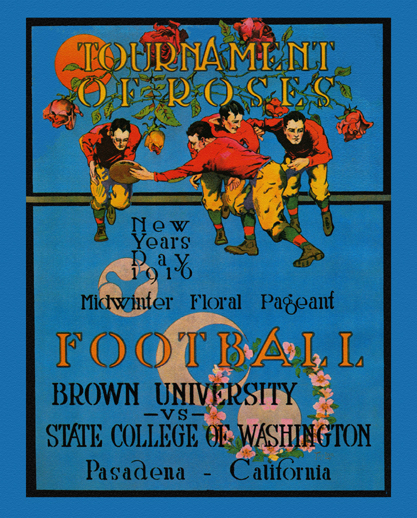
After Washington State’s upset of Brown in 1916, the New Year’s Day contest between eastern and western powers in Pasadena became an annual event. But it didn’t have a proper home. When the game’s future seemed certain, the City of Pasadena acquired land in Arroyo Seco on which to build a football stadium. They broke ground in February 1922. Construction was completed in October of that year. The horseshoe-shaped facility was called “Tournament of Roses Stadium” or “Tournament of Roses Bowl” prior to the 1923 New Year’s game. It was then officially named “Rose Bowl” as a reference to the Yale Bowl, although it wasn’t a bowl at that time. But it would accommodate 57.000 spectators.
The first game played in the new stadium was the regular-season meeting of the University of California (Cal) and University of Southern California (USC). Cal won 12-0 but declined the invitation to defend the honor of the West on the upcoming New Year’s Day. USC, having the Cal loss as the only blemish on her record, accepted the invitation to defend against the Eastern interloper, 6-2-1 Penn State. The Nittany Lions’ head coach, Hugo Bezdek, was no stranger to Pasadena. He had taken his Oregon team to victory there in 1917 and again in 1918 when some of his old players, then preparing for combat in WWI, got him to coach their Mare Island Marines team for that game. He wasn’t so successful in 1923 because USC prevailed 14-3.
Over the years, the Rose Bowl was expanded to become a complete bowl and seating was increased to 104,594 (later reduced to 92,542). The number of bowl games (few of which were played in actual bowl stadiums) expanded over the years to 26. However, the rise of the FCS playoffs has impacted the bowl games significantly. The 2024 expansion to twelve teams in the playoffs, with the Rose Bowl probably hosting a quarter-finals game, brings an end to the Rose Bowl’s prominence.
The 2023 game ends the 100-year-long sequence of significant games, broken only by World War II, in the Rose Bowl. It is only fitting that Penn State is again the eastern contender as it was in 1923. Their head coach, James Franklin, lost his first appearance in the Rose Bowl to USC in 2017, also on January 2nd. It is a sad, but fitting, end to a great run for Penn State to bookend the birth of the stadium and the end of its glory.
The Rose Bowl under construction. Note the horseshoe shape.
Lone Star Dietz would roll over in his grave if he heard about this.
Distracted by several pressing issues, I paid scant attention to the headlines about the Rose Bowl this fall. Stumbling across an article by Pasadena-based Joe Mathews yesterday, I learned what the hubbub was about. Dietz’s Washington State warriors upset Brown in the mud on January 1, 1916, putting West Coast football on an even footing with the East, establishing the Rose Bowl as an annual event, and instituting the New Year’s Day football tradition. A major game, generally pitting an eastern challenger against a western defender, has been featured on January 1st each year since then, unless it falls on a Sunday as it does this year. In that case it is played on Monday the 2nd. Because of its historic importance, Keith Jackson called the Rose Bowl “The Granddaddy of Them All.” That old man dies Monday night at the end of the Penn State-Utah contest.
How did this happen? Mathews blames it on the perceived need to have a single national champion as lobbied for by President Obama and many others. While only four teams were involved in the playoffs, the Rose Bowl continued to be a major event. But with the playoffs expanded to twelve teams, the Rose Bowl wouldn’t likely have attracted highly ranked teams if it wasn’t part of the playoff system. Adding to the dilemma was the shift of two California schools from the Pac-12 to the B1G. The possibility of a western team, say USC, being the eastern invader becomes a distinct possibility, destroying the East-West nature of the game.
Seeing no viable alternative, the Rose Bowl has now thrown in with the NCAA championship scheme. Mathews figures future Rose Bowls will be quarter-final games. That long drop from importance brings with it a financial deficit. The Tournament of Roses will need to make that up somehow or the Rose Parade will become another tradition of the past. An era has sadly passed.
Sometimes something you haven’t thought about before jumps into your head. Yesterday, I had one of those thoughts, “Was the 1905 Carlisle game against Army on the original schedule or was it added during the season?” I definitely hadn’t considered that before. Perhaps the thought popped into my head because games against the Canton and Massillon semi-pro teams were added late in the season. Regardless of why it came into my head, I had to resolve it.
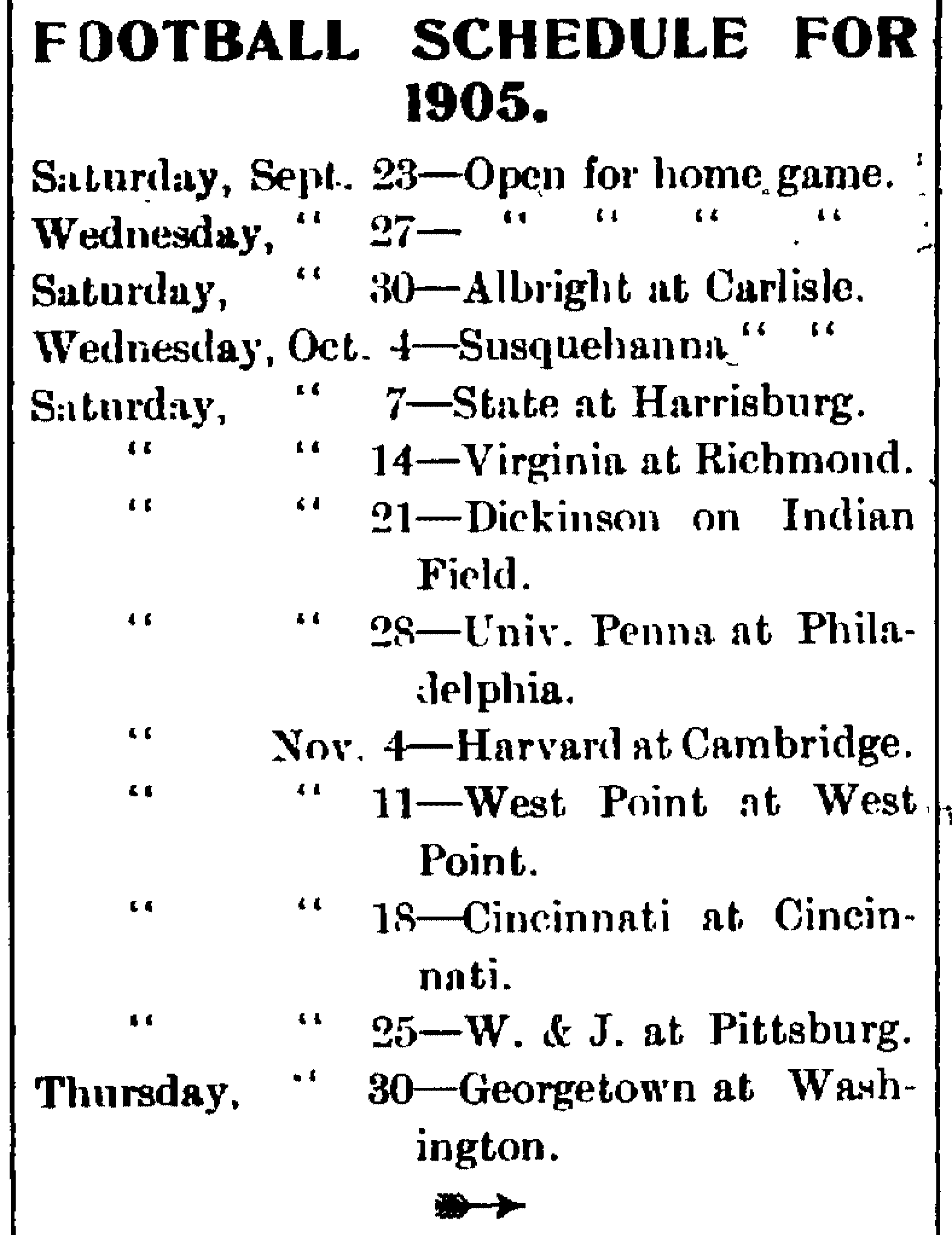
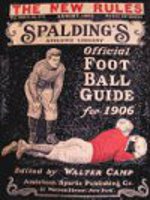
My first step was to check with the 1905 Spaldings Guide. Sure enough, it was listed there. Since these guides were distributed prior to the start of the season, it was clear that this game had been scheduled ahead of the season start. But how far ahead?
To find that out, I consulted with the school newspaper for the 1904-1905 school year. The June 29, 1905 edition of The Arrow included the first published schedule for the 1905 season. The game was scheduled for a date that held no particular significance at that time, November 11, at West Point. The week after that the team would start a westward road trip in which they were to play games in Cincinnati and Pittsburg before ending their season with a Thanksgiving Day game in Washington, DC against Georgetown. But that schedule didn’t hold.
Who negotiated the extra games isn’t clear. It’s possible that George Woodruff arranged them before leaving the team after the Army game to join the Roosevelt administration. The games with Canton and Massillon were first listed in the October 20 issue of The Arrow, a factor that makes Woodruff’s involvement more likely.
How the games were arranged is less important that they were played. Beginning on November 11, the last game for which Carlisle had a full week to prepare, the Indians played six games in the time other schools played three, two if they didn’t have a Thanksgiving game. Carlisle was known for playing brutal schedules. The 1905 season was just one example of this.
The details of the 1905 contest with Army can be found in Gridiron Gypsies: How the Carlisle Indians Shaped Modern Football.












 Tom Benjey's Weblog
