December 25, 2008
Another Brown end made the trip to Pasadena. Furber I. Marshall was born in New Hampshire to a Avard L., originally form Nova Scotia, and Mabelle, from New Hampshire. When Furber was quite young the family moved to Newport, RI where Avard managed the Newport Beef Company which was affiliated with Swift and Company. Furber played football only one year in high school but starred at basketball. He played center on Rogers High School state championship team in 1913. Later that year as President of the Rogers High School Athletic Association, he presided over a meeting in which it was decided to admit girls as members. In December he served as the chief press agent for the operetta “Bul-Bul” that was put on by the Rogers Glee Club. In February the basketball team lost its captain when Furber contracted blood poisoning in his foot. In September 1914, the man who had been president of the class of 1914 at Rogers High School became the freshman class president at the University of Pennsylvania. September 1915 found him enrolled at Brown University and playing end on its football team. Furber was in Pasadena but saw the game from the bench, most likely, as his name didn’t show up in game reports. In the 1916 season he became a star.
In August 1917, after the U.S. entered WWI, Furber Marshall joined the Army Aviation Corps and was commissioned as a 1st lieutenant after completing flight training in May of 1918. After the war, he completed his degree at Brown as a member of the class of 1919. He then worked in the petroleum industry for eight years, got married, and lived in Chicago for a time. After that he started his own company, Marshall Asbestos Corp, which he operated in Troy, NY. Later, he merged his company with Bendix Aviation Corporation as the Marshall-Eclipse Division and was president of Bendix Service Corp for many years. In 1943 he took over as president of Pharis Tire & Rubber in Newark, OH. The 1950s found him in central PA where he was president of Carlisle Corp., which was best known at that time for making bicycle tires and tubes.
Thus, this captain of industry was in Carlisle in 1951 for the premier of “Jim Thorpe–All American.” The Cumberland County Historical Society has a photo of him with Jim Thorpe and Governor John S. Fine at ceremonies before the premier. He surely talked with his old nemesis at that event, because Lone Star Dietz, coach of the Washington State team that beat Brown in the 1916 Rose Bowl, was also present.
Marshall died in 1957 in Carlisle, leaving behind his wife, the former Sarah Hall, and his mother. He was inducted into the Brown University Hall of Fame in 1975.
Tags: 1916 Rose Bowl, Bendix, Brown University, Carlisle Corporation, Furber I. Marshall, John S. Fine
Posted in Jim Thorpe, Lone Star Dietz | Leave a Comment »
December 22, 2008
Brown threatened to score during the first half but failed. At halftime Washington State went into the clubhouse to dry off and change into dry uniforms but Brown didn’t bring extras to change into. They did, however, find a shed that contained some straw, so they coiled around it as best they could in an attempt to dry off. They weren’t in the best shape to play the second half.
In Weeks’ estimation, Brown was lucky to hold Washington State to a low score because they were like a junior team compared to the tougher WSC team. (Note that recent research uncovered writers’ opinions that WSC should have been selected as national champs in 1915.)
Back at Brown, Josh Weeks roomed with Fritz Pollard and operated a side business ironing men’s slacks to make money. Fritz played just one more year at Brown but Josh continued through the 1918 season when Walter Camp placed him on his All America second team at left end. Paul Robeson of Rutgers was named to that position on the first team.
After graduating from Brown, Josh Weeks attended medical school and eventually practiced in New Bedford, MA. There the high school coach asked him to attend the games in case his services were needed. Randy tells of a funny incident;
“My dad had attended New Bedford High and had played football for them. One game my dad was sitting on the bench, and New Bedford was getting creamed. A play came up where the other team stole the ball, and the runner was heading for a touchdown. My dad, dressed like a doctor…pants, jacket, white shirt with tie, and a hat on, jumped off the bench and ran after the kid until he finally tackled him. Needless to say the stadium roared with laughter and naturally the poor kid was given the touchdown.”
On a sadder note, Josh Weeks died on his way home from the reunion for the 40th anniversary of the 1916 Rose Bowl. His memory lives on in his children and the stories he told them about his Rose Bowl experience. Next time another Brown player and a captain of industry attend the premier of “Jim Thorpe–All American.”
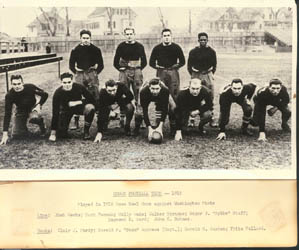
Brown’s 1916 Rose Bowl team
Tags: Brown University, Fritz Pollard, Joshua Weeks, New Bedford, Randall Weeks, Washington State
Posted in Football | Leave a Comment »
December 18, 2008
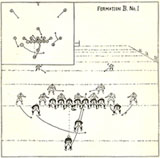
I recently posted some footage of the 1916 Rose Bowl that was provided to me by the Washington State athletic department onto www.YouTube.com/TomBenjey. Washington State was of course running the single-wing, but Brown was running a derivative that eagle-eyed Ted Seay observed that “At the 5:48 mark, Brown shifts into a double-flexed formation with an end and tackle to the left, then they slot their wingback inside that tandem and sweep to the left…” I am now working on a short video of Brown’s offense that will include slow-motion clips for those of us who don’t have Ted’s powers of observation. See http://www.youtube.com/watch?v=yTA2w8aanPc&feature=channel_page That got me thinking about Brown’s players. Everyone is familiar with Fritz Pollard and, to use WSC’s descriptor, “the giant [Mark] Farnum,” but there are other players from that team who are in the Brown Hall of Fame. Let’s start with Josh Weeks because I have communicated with his son, Randall, who talked with him about the game.
Joshua H. Weeks, number 42, played right end on the 1915 Brown University team that played against Washington State in the 1916 Rose Bowl. Later in life he shared some of his experiences with his sons. Randy has been good enough to pass some of his memories along to me. For starters, Brown got little exercise, contrary to what the cartoon at the bottom of this piece insinuated. Prior to the game the players encountered citrus trees loaded with ripe fruit and gorged themselves on oranges. What a mistake! The result was frequent bathroom runs during the game.
Seeing no need for cold or wet weather gear, Brown brought neither along with them. Two days before the game it snowed and it poured during the game. Lone Star Dietz only brought summer suits for himself but did bring mud cleats for his players. Fritz Pollard could get no footing and was held to a season-low in yards gained. He did notice that Lone Star’s white suit was covered with mud before the first quarter was over.
<to be continued>
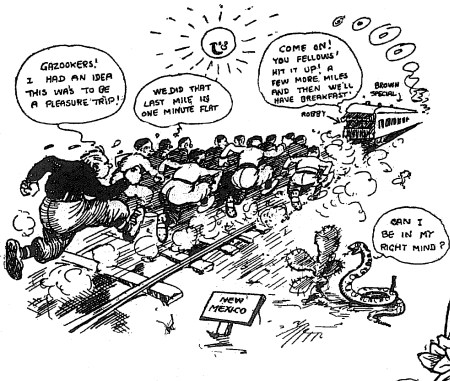
Tags: 1916 Rose Bowl, Brown University, Fritz Pollard, Josh Weeks, Mike Farnum, Ted Seay
Posted in Lone Star Dietz, Single-Wing, Washington State University | 3 Comments »
December 15, 2008
Recently a question was raised on this blog about American Indian leadership in athletics. Saturday’s action by the Downtown Athletic Club to award the Heisman Trophy to Sam Bradford may spread this discussion to a broader audience. The Oklahoma University quarterback, being 1/16th Cherokee, is enrolled in the tribe. Last year an ESPN announcer was unintentionally humorous when he stated that Bradford was “certified Cherokee.” The announcer was cut some slack because the enrollment process is very complicated.
Sam’s great-great-grandmother, Susie Walkingstick, was full-blood Cherokee. His father, former OU lineman Kent Bradford, is 1/8th blood Cherokee. It is appropriate that this Heisman winner plays for Oklahoma University because Oklahoma has the largest American Indian population of any state. Fellow Oklahoman Sac & Fox Jim Thorpe did not win the Heisman because that award wasn’t initiated until 1935 when the University of Chicago’s Jay Berwanger became the first recipient of the trophy with the famous pose. Jim Plunkett, being Mexican-American, was probably the first person with significant quantities of Indian blood to win the Heisman when he was named in 1970. Since then, it hasn’t been close. Not even fellow Cherokee Sonny Sixkiller who played quarterback for the Washington Huskies two decades later contended seriously.
A USA Today cover story http://www.usatoday.com/sports/college/football/big12/2008-12-09-bradford-cover_N.htm discusses the impact Bradford’s candidacy has already had on Indian children. Like Sixkiller, Bradford did not live on a reservation and grew up with little exposure to his Cherokee heritage. Anadarko, OK was home for College Football Hall of Famer Albert Exendine, star end at Carlisle. Anadarko is also the town in which Exendine, in the summer of 1911, encouraged Jim Thorpe to return to Carlisle. Alongside this history exists Riverside Indian School, a place where one would expect football to thrive. But that hasn’t been the case. Riverside dropped football a few years ago but, due to Bradford’s inspiration, fielded a team this year. Forty boys came out for the team – not bad for a school that has only 400 students who range in age from 4th grade to high school. The Braves only won one game but this was their inaugural season. The important question is: Are they running the single-wing?

USA Today photo of Sam Bradford with his Heisman Trophy
Tags: Cherokee, Heisman Trophy, Kent Bradford, Riverside Indian School, Sam Bradford, Susie Walkingstick
Posted in Albert Exendine, Carlisle Indian School, Jim Thorpe, Single-Wing | Leave a Comment »
December 12, 2008
Some time back I wrote about Nicholas Longfeather being granted a patent in 1912. Now I have stumbled across three more former Carlisle students accomplishing this feat. The Balenti brothers, John, George and Michael, attended Carlisle. The boys were the offspring of a soldier, Mike Balenti, who was originally from Austria. Balenti was stationed at Ft. Reno and married a 17-year-old Cheyenne girl who lived nearby. Before her marriage she went by Cheyenne Bell (sometimes Belle). She had six children, three of whom didn’t go to Carlisle. Those who did attend Carlisle were known as excellent students. Mike was also known as a very good football and baseball player. He had the misfortune of being a quarterback when Frank Mt. Pleasant and Louis Island also played that position. Back to the patents.
In 1915 Mike and George Balenti filed a patent application for an “Attachment for Jumping Standards.” Patent number 1,193,972 was awarded to the brothers on August 8, 1916. “This invention relates to standards used for determining the hight of high jumps, pole vaults, or analogous athletic endeavors, and the primary object of the invention is to provide an attachment for standards of this nature, which will accurately record substantially the exact height of the jump.” The patent application can be seen at http://www.google.com/patents?hl=en&lr=&vid=USPAT1193972&id=yLBGAAAAEBAJ&oi=fnd&dq=mike+balenti.
In 1919 Mike and John Balenti applied for a patent for a “Pancake Machine.” The purpose of the machine was described as follows: “This invention relates to an improved pancake machine and the principal object of the invention is to provide a machine in which pancake dough may be mixed and held while being used, improved valve means and actuating means for the valves being provided for controlling passage of the pancake dough out of the outlet opening in the bottom of the receptacle or container.” The patent, which was awarded on December 28, 1920 can be viewed at http://www.google.com/patents?id=mQlDAAAAEBAJ&dq=mike+balenti&jtp=1.
The high jump standard attachment looks too complicated to be of practical use but I swear I’ve seen the pancake machine in use in restaurants.
Tags: Bell Balenti, Cheyenne Bell, George Balenti, John Balenti, Mike Balenti, Nicholas Longfeather, patent
Posted in Carlisle Indian School | Leave a Comment »
December 8, 2008
On Friday Antonio Banderas conducted the U.S. premier of his film, El Camino de los Ingleses (The English Road), titled Summer Rain in the U.S., at Carlisle Theatre. This was not the first movie to be premiered at this 1939 Art Deco picture palace. In August of 1951, Jim Thorpe returned to Carlisle to premier his film biography, Jim Thorpe: All American, in which he was portrayed by a young actor by the name of Burt Lancaster. Unfortunately, that film is now dated and needs to be remade, or better yet, an entirely new film needs to be made. Perhaps that will happen.
It seems that a filmmaker interested in shooting a film about Jim Thorpe, Pop Warner or the Carlisle Indian School breezes through town every couple of months gathering information for his or her next production. The most notable, perhaps, of those in recent years was announced in 2004 John Sayles was writing the script for Carlisle School for Walden Media. Nothing further has been seen about that film and that may be for the better. The Hollywood Reporter wrote that Carlisle School, “follows a ragtag group of young Native Americans who achieve prolific victories on the football field that lead them to national prominence. The players, among them future sports legend Thorpe, attended the boarding school in Pennsylvania that, from 1879-1918, housed Native Americans from childhood through college.”
Anyone who knows anything at all about Carlisle Indian School is well aware that its teams were anything but ragtag. To the contrary, Carlisle was frequently criticized for being just the opposite. The recent books about Thorpe and Carlisle have not been the most accurate either. But better things may be in the offing. Kate Buford’s biography of Jim Thorpe is to be released in 2008 and there aren’t many days left in the year. Bob Wheeler is finishing up his audiobook on Jim Thorpe. This is something to look forward to. Thorpe’s Boswell is not just reading his landmark book on Thorpe, he is also including clips from the interviews he made decades ago of people, many of whom are now long dead. It will be great to hear Ike talk about playing against Thorpe in his own voice. I can’t wait.
Tags: Antonio Banderas, Bob Wheeler, Burt Lancaster, Carlisle Theatre, John Sayles, Kate Buford
Posted in Carlisle Indian School, Jim Thorpe, Pop Warner | Leave a Comment »
December 5, 2008
Jim Sweeney, the life-long Army fan who told me about the Sports Illustrated article, shared with me that on Thanksgiving Day he was able to watch, on ESPN2 no less, two Jesuit high schools from New York City play each other in an 85-year long Thanksgiving tradition. Xavier High played Fordham Prep at Fordham Field in the Bronx. Sweeney’s (also JoePa’s) alma mater, Brooklyn Prep, was, until it closed in 1973, the third Jesuit high school in the City. You probably already know that Joe Paterno played tailback in Brooklyn Prep’s double-wing and that his brother, George, was fullback. Something few of us know is that both Xavier and Fordham Prep are NOW running the single-wing. What a treat it must have been for Jim to watch these teams in the comfort of his living room.
Another result of the Sports Illustrated article or the fact that NFL teams are dabbling with the single-wing is that I was interviewed yesterday by the local NBC affiliate about the connection between the Wildcat formation and Carlisle Indian School. After interviewing me, reporter George Lettis visited Carlisle Barracks and shot part of his piece on Indian Field. WGAL’s website has an article on its website that can be found at http://www.wgal.com/sports/18199527/detail.html. The broadcast video can be found at http://www.youtube.com/watch?v=iP9FogxDRII. In addition to footage of Lettis and me, portions of the documentary Tom McCue and I made to celebrate the 100th anniversary of the single-wing are included. Narrator Lynn Myers’ voice comes through loud and clear.
It will be interesting to see how long NFL coaches run the Wildcat or other versions of the single-wing before they admit that the fundamental formation was developed a century ago by Pop Warner for the Carlisle Indians. Some think that NFL coaches will continue to obfuscate this point so as not to appear to be behind the times by 100 years.
Tags: Brooklyn Prep, Fordham Prep, George Lettis, James Sweeney, Joe Paterno, Lynn Myers, Miami Dolphins, Sports Illustrated, Tom McCue, WGAL, Wildcat formation, Xavier High
Posted in Carlisle Indian School, Pop Warner, Single-Wing | 4 Comments »
December 2, 2008
The December 1 issue of Sports Illustrated has an article on the single-wing. The writer, Tim Layden, first discusses the formation’s current use at Apopka High 15 miles northwest of Orlando and in the NFL by the Dolphins in their unexpected victory over the unsuspecting New England Patriots. Also mentioned is Todd Bross, organizer of the annual spring conclave at Kings College in Wilkes-Barre, PA. (It was Todd Bross and Ted Seay who urged me to research Pop Warner’s correspondence course in football that was first published in 1908). Layden discussed the renaissance the single-wing is undergoing but was apparently unaware that little Windber Area High School is running it as he was probably unaware of my documentary in which they were featured.
The article talks about viewing old films over Ed Racely’s garage on Cape Cod. Racely, now 80, has been studying the single-wing longer than anyone. Layden then goes into the single-wing’s history beginning with President Theodore Roosevelt’s 1905 threat to ban the game unless rule changes weren’t made to clean up the game. He goes on the mention that Pop Warner coached Carlisle Indian School from 1907 to 1914 and quotes Warner as having first used early incarnations of the single wing by the Carlisle Indians in response to the 1906 rule changes. He is apparently unaware of Pop’s earlier tenure at Carlisle (1899-1903) and of my research that uncovered Warner’s weeklong visit with the Carlisle coaches shortly before the start of the 1906 season. He made no mention of the revisions to Warner’s correspondence course between 1909 and 1911, nor did he mention my publication of the offense pamphlets from the correspondence course. The diagrams found those pamphlets represent the earliest known documentation of the single-wing. A 1924 newspaper interview of Warner was accompanied by a diagram of a formation that “The Old Fox” designed in 1902 to protect injured linemen Antonio Lubo, Martin Wheelock and Albert Exendine and to adjust for injured first-string center, Nikifer Schouchuk. It’s too bad that wingback diagram wasn’t made public a couple of decades earlier. The Sports Illustrated article can be found at:
http://vault.sportsillustrated.cnn.com/vault/article/magazine/MAG1149161/index.htm
Tags: Bill Belichick, Ed Racely, Miami Dolphins, New England Patriots, Nikifer Schouchuk, Sports Illustrated, Ted Seay, Tim Layden, Todd Bross, Wildcat formation, Windber
Posted in Albert Exendine, Antonio Lubo, Carlisle Indian School, Football, Martin Wheelock, Pop Warner, Single-Wing | 5 Comments »
November 27, 2008
These days authors are supposed to have video previews of their books posted on the web for all to see. I was also instructed to make a video of me reading from my new book. Knowing full well that few would want to look at me reading for any period of time, I took a different approach. I read the words Pop Warner said in a 1924 interview in which he told of an episode that clearly shows what kind of stuff the Carlisle Indians were made of. After getting the thing started, I mostly disappear from view and am replaced by other footage and still photographs. Warner’s story is fascinating and, as best I can tell, is true. Because he told it over twenty years after it happened, he may have had some details confused. But the major things check out.
The story is a bit long but, when I’ve read it in book talks, audiences enjoy it because it is such a good story and, to my knowledge, hasn’t been told since the 1920s. YouTube.com enforces a strict time limit on videos that may be posted on their site, so it was necessary to split the story into two pieces. The first, and longer, part has been created and posted. The second and more interesting conclusion will be posted next week. “Carlisle Indians Had The Right Stuff” can be found at www.YouTube.com/TomBenjey. This is a chance to learn more about people such as Albert Exendine, Nikifer Schouchuk, Antonio Lubo, Martin Wheelock, James Johnson, Charles Williams and Richard Henry Pratt.
Feel free to make comments, either positive or negative.
Tags: Carlisle vs. Cornell 1902, Nikifer Schouchuk
Posted in Albert Exendine, Antonio Lubo, Carlisle Indian School, Charles Williams, Doctors, Lawyers, Indian Chiefs, James Johnson, Martin Wheelock, Pop Warner, Richard Henry Pratt | Leave a Comment »
November 24, 2008
This is the last week of American Indian Heritage Month and I have seen nothing locally that would inform residents that this commemoration even exists let alone doing anything to honor it. For that matter I haven’t seen anything in the national media either. There may have been something but I didn’t see it. What with the Carlisle Indian School having been in our midst, one would think it would have at least been mentioned. If it wasn’t for the trusty internet, I wouldn’t know a thing about it.
One good thing I’ve learned is that the politically-correct terms have been sorted out. American Indian is preferred over Native American and the specific tribe or nation is preferred over that. Native American is too broad a term and, worse yet, sounds too bureaucratic. A pet peeve of mine is the frequent mention of something being a Native American song or a Native American custom. To start with, this is silliness. Would we say golf is a European game? Of course not. We know the Scots invented it. Would we lump Scots and Italians together as if they had a common heritage? I think not.
There may be reasons other than ignorance or laziness for attributing something to Native Americans. For example, Chief Seattle is often quoted as having spoken eloquently about the environment. To start with he was not a chief and his name was See-ahth, which was difficult for white people to say and was likely bastardized into Seattle, something they could pronounce. See-ahth was born in 1786 and died in 1866. In addition to being a great speaker, he was a diplomat. He gave a speech in 1854 but it wasn’t the one he is so often credited with having made. That speech was written in 1971 by screenwriter Ted Perry. Perry’s speech didn’t paraphrase See-ahth’s words. It couldn’t because there were no buffalo within 600 miles of his home to see rot and railroads didn’t come to his area until years after his death.
Rather than providing references, I will leave to the reader the task of verifying what I have written. Fortunately, it is an easy task.
Tags: Add new tag, Chief Seattle, See-ahth, Ted Perry
Posted in Carlisle Indian School | 3 Comments »




 Tom Benjey's Weblog
