Foul Weather Spoils Inauguration

January 20, 2009

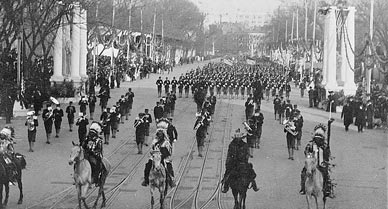
Good weather was expected for the inauguration of President Taft in 1909. Carlisle Indian School students had been a staple of inaugural parades for some time and began making preparations for the parade as early as late November of the previous year when The Carlisle Arrow announced that the tailoring department was to make 350 cadet capes for Taft’s inauguration in early March. (Yes, inaugurations were held about six weeks later in those days.) Later issues monitored the status of the cape production. But when the inauguration came and passed, The Carlisle Arrow had nothing to say about it. How could this be when the Carlisle contingent had been so prominent in Roosevelt’s 1905 inaugural parade?

The answer, it appears, has to do with the state-of-the-art of weather forecasting at that time. High winds and 10 inches of snow where what Washingtonians got instead of the fair weather that was predicted. Cold temperatures that accompanied the blizzard caused the swearing-in ceremony and the speechifying that are part of it to be relocated to the Senate, but didn’t cancel the parade. The parade was held but was smaller than expected. Newspaper coverage, like that of the Carlisle Indian School publications, contained no mention of the Carlisle contingency marching in the parade. News reports on the weather described how the snowstorm shutdown transportation in and out of the Capital. Trains from all four directions were blocked by the snow and couldn’t get into town. West Point cadets got a lot of press for actually marching in the parade, enthusiastically at that, after getting off their train in Baltimore and marching 40 miles to get to the parade route.

It seems likely that the 350 Carlisle boys were on one of those trains that didn’t make it into the city and missed the parade. The March 12 issue of The Carlisle Arrow related, “Several of our students had the satisfaction of seeing the inaugural parade at Washington.” Those students most likely weren’t part of the contingent who were to have marched.

1909-inauguration-button

Carlisle Players Play Each Other

January 19, 2009

While researching the lives of Henry Roberts and Mike Balenti, I became aware that they, and some other Carlislians played against each other when enrolled in other schools. In response to criticism that Carlisle Indian School had been playing some of the same people for too many years, Pop Warner instituted a policy that limited players to four years on the varsity squad. Mike Balenti had used up his eligibility at Carlisle and Victor Kelley had one year of eligibility remaining at the Agricultural and Mechanical College of Texas. While there were no national eligibility standards, many colleges limited students to four years of eligibility, one for each of their four years of college – assuming that they finished on time. However, colleges often conveniently ignored the time former Carlisle players now at their institutions had played at the Indian school because it wasn’t a college academically. In fact, it wasn’t even a prep school. Putting these vaguaries of eligibility aside, Mike Balenti and Victor Kelley enrolled at A&M (reenrolled in Kelley’s case) to play under new head coach Charlie Moran. Moran, coincidentally, had assisted Pop Warner at Carlisle the previous year before embarking on a career as football coach. Previously, he had been a star player and a baseball coach, but hadn’t coached football. The Aggies, with Kelley at quarterback and Balenti at left halfback, had a powerhouse team. One of the obstacles in their path to the unofficial Southwestern Championship was Haskell Institute. The teams met on October 23 at College Station. Captain and left end of the Haskell squad was Henry Roberts who would later star of Carlisle’s great 1911 team. Not on the field that day for Haskell, but on the squad, were center Nikifer Schouchuk and quarterback Louis Island. It was like old home week at the game which the Aggies won 15-0. Aggie students celebrated wildly after the game because beating the team that had beaten the University of Texas meant a lot to them. At the end of the season Charlie Moran, as coach of the Southwestern Championship team, was given the honor of selecting an All Southwest team. He named Kelley for quarterback, Balenti for left halfback, and Roberts for punter. Carlisle was well represented on that team by alums both past and future.

Untameable Shrew

January 15, 2009

Kit Carson was a widower with a small daughter, Adaline, to care for when his Arapaho wife, Waa-nibe, died. The only thing he could do was to acquire another wife. Little is known about their courtship or the negotiations with her family but, nonetheless, Making-Out-Road, Cheyenne, became his second wife. He was her first husband. Because Cheyenne women typically didn’t marry until their mid-20s, she was hardly a child bride. Carson could then return to his usual ways of being gone on expeditions most of the time. After little more than a year of marriage and a lot of violent quarrels with this mostly-gone mountain man, she divorced him according to Cheyenne customs. On the day he returned from one of his trips, she pitched his belongings, including Adaline, outside their tent. An alternative version of this story is that Carson escaped rather than being thrown out. He complained that she wanted too many “fafurraws.”

Not long after that, she married Flat Head and then Wolf Man, and divorced both of these Cheyenne men. She wasn’t married to either of them very long, just long enough to make a pair of twin boys, a girl and another boy. About that time a Charles Rath was in need of a wife.

Rath surmised that there were two ways to get along with the Indians: sell them liquor or marry into their tribe. He chose the latter course and married Owl Woman. After her death came her sister, Yellow Woman. When she died, he looked toward Making-Out-Road, perhaps because, when she was younger, she was vivacious and turned heads. Once her male relatives found the gifts Rath offered to be acceptable, the two were married. They soon had a daughter. Because Roadmaker, as Rath called this wife, had been considered the Belle of the Cheyenne, he called his daughter Cheyenne Belle. When Belle was about two years old, Rath left never to return. Cheyenne Belle would grow up to be the mother of the Balenti brothers mentioned in an earlier blog.

Charlie Rath presumed that Making-Out-Road meant that his bride was a good tracker. Some others thought it had a more contemporary meaning, such as my way or the highway or hit the road, Jack.

Indians Were Poor Marksmen

January 10, 2009

Over a century before Rush Limbaugh roamed the airwaves, Rush Roberts, whose Pawnee name translates to Fancy Eagle, roamed the Great Plains. While researching the life of Henry Roberts, left end on the great Carlisle Indian School football team of 1911, for my upcoming book, Oklahoma’s Carlisle Indian School Immortals, I came across the fact that Henry’s father was a quite colorful character.

In 1876, at age 16 or 17, Rush was recruited as a scout for the U. S. Cavalry, becoming the youngest man to fight under Gen. Crook in this campaign. It is documented that he participated in the November 25, 1876 Dull Knife-Mackenzie Fight (aka Battle of Bates Creek) as a member of the Pawnee Battalion. The Pawnees were credited for fighting with exceptional capability against one of their ancient enemies. He was awarded his father’s name, Fancy Eagle, for his bravery in battle. Almost a decade after the war ended, he enrolled as a student at Hampton Institute in Virginia. He stayed there for two years and later sent two of his children, one of whom was Henry Roberts. Rush eventually became a chief of the Skidi Pawnees and lived to an old age. His exploits ares mentioned in We Remember: the history of the U. S. Cavalry from 1776 to the present by Edward L. Daily.

In an interview about the plains wars, Rush stated that, in general, Indians weren’t good marksmen with rifles. The problem was that they didn’t understand how to use the rear sight and wind gauge to hit their targets at long distances. However, they were excellent at shooting from horseback, particularly at short range. Rush explained, “The group formations of the army made a bigger target, but army marksmanship was better and steadier.”

Ebook Created for Carlisle Indian School Football Immortals

January 5, 2009

This weekend was productive – maybe. Walt Shiel offered some advice on converting print books to ebook format on a small publishers forum. The first step was to open an rtf file containing the book in question with Microsoft Word. Fortunately for me, Keevin Graham, the graphic designer who lays out my books, had already provided me with an rtf of Doctors, Lawyers, Indian Chiefs. The second step was to save the book as Web Page, Filtered, which produces an html file. So far, so good. The third step was to open the html file with Notepad and save it again, thus eliminating the “secret codes” Word embeds in documents. The resulting file was ready to import into Mobipocket’s ebook creator (available free on the Mobipocket site). There was one small glitch. Doctors, Lawyers, Indian Chiefs has a number of photos, illustrations and tables, items which ebooks don’t display well and which require considerable manual manipulation. FWIW, Keep A-goin’: the life of Lone Star Dietz has a lot more, a factor which will keep it from being converted into an ebook for some time. The illustrations are such an integral part of that book that I’m reluctant to publish an ebook of it without them.

My solution to the problem was to create a new book from Doctors, Lawyers, Indian Chiefs that includes only the background/overview chapters and none of the players’ biographies. Also, at 160,000 words some find the entire book too long and detailed for their taste. Carlisle Indian School Football Immortals: a brief introduction provides the key information about the history of the Carlisle football program and will be of interest to those who are not interested in reading about the individual players. Even this conversion required a lot of manual HTML coding because of all the illustrations and tables are a particular headache. After some “learning experiences” with the Mobibook creator, a prc file was created and uploaded to the Mobipocket site. The prc file was also converted by the Amazon.com Kindle converter and uploaded to its site. I’m waiting to hear back from Sony.

For those who become interested in the players or seeing better quality illustrations after reading the ebook, Tuxedo Press is giving ebook buyers free shipping on print books purchased from them. The net result is that the ebook cost is essentially being refunded because its list price is only $4.99 and Amazon.com is currently offering the Kindle version for $3.99.

a brief introduction

Carlisle Indian School Football Immortals: a brief introduction

A Brave, New Technology for the New Year

January 2, 2009

My New Year starts off with learning a new technology. ebooks are all the rage now, or so we’re told. What is an ebook you say? It’s an electronic book. Instead of lugging pounds of paper around with us, we’re now able to carry a lightweight electronic appliance that stores words as binary digits instead of in ink on paper. I say words because the first generation of these devices does not handle graphics well and color not at all. The advantages of ebooks are many: lower cost per book ($10 is the price on many new releases), ability to search the book as easily as other computer documents, font scaling to make larger type immediately available to these aging eyes, portability, and ease of acquisition. Amazon.com markets a device they call the Kindle, perhaps because they think it will light the fire for this new technology. Included with the device is Whispernet, a wireless broadband network that supports one-click purchase of new books – from Amazon, of course. Before thinking that the Kindle is the cheap razor for which Amazon sells the blades, consider the price. At $359 (down from $400), they ain’t cheap but are almost continually out of stock. New and refurbished units are available on eBay but few are bargains.

Leading competitors for Kindle include the Sony Reader Digital Book PRS-700 and Mobipocket eBook Reader. According to Sony, its device is the first one to use the EPUB international standard for ebook publication. The Mobipocket Reader runs on devices ranging from desktop computers to cell phones as well as things in between. The Mobipocket format purportedly runs on or can readily be converted to run on Amazon and Sony devices. I’ll find out more this weekend.

Next time I’ll share my experience preparing one of my writings for this brave, new world.

A Shot Is Not A Wing

December 29, 2008

coffin-corner-masthead

The resurgence of the single-wing in the NFL spawned another article. This one by John T. Reed can be found in the current issue of “The Coffin Corner,” the journal of the Professional Football Researchers Association (PFRA). BTW, professional refers to football not the researchers as we don’t get paid for our contributions to the journal. (We do it for the love of the game.) In “A Shot Is Not a Wing,” Reed wrote about the difference between a single- or double-wing center snap and what passes for one in a shotgun formation. I’ll leave the discussion of the difference to Mr. Reed.

John T. Reed has a website appropriately named www.Johntreed.com. On that website you will find numerous articles about single-wing football. You will also find one about turning around the football program at his alma mater, West Point: http://johntreed.com/Armyfootball.html. What you won’t find there, or anywhere else on the web, is “A Shot Is Not A Wing.” It’s title is listed on the PFRA site, http://www.profootballresearchers.org/, but you’ll have to join the PFRA to get the current issue. All it costs is $25 a year. A simple application can be found on the PFRA site. Just fill it out and set it to Bob Carroll along with your check. You will also be given the opportunity to write articles and participate on committees. They even review books. Look for a review of “Doctors, Lawyers, Indian Chiefs” in a future issue.

A similar journal exists for college football. That organization is called the College Football Historical Society (CFHS). Ray Schmidt edits their journal. Annual dues for the CFHS are only $17, but postage increases could force that to go up. Just send your check and mailing address to Ray Schmidt at PO Box 6460, Ventura, CA  93006.

This ends year one of my blog. See you next year.

cfhsmasthead

Captain of Industry at Thorpe Premier

December 25, 2008

Another Brown end made the trip to Pasadena. Furber I. Marshall was born in New Hampshire to a Avard L., originally form Nova Scotia, and Mabelle, from New Hampshire. When Furber was quite young the family moved to Newport, RI where Avard managed the Newport Beef Company which was affiliated with Swift and Company. Furber played football only one year in high school but starred at basketball. He played center on Rogers High School state championship team in 1913. Later that year as President of the Rogers High School Athletic Association, he presided over a meeting in which it was decided to admit girls as members. In December he served as the chief press agent for the operetta “Bul-Bul” that was put on by the Rogers Glee Club. In February the basketball team lost its captain when Furber contracted blood poisoning in his foot. In September 1914, the man who had been president of the class of 1914 at Rogers High School became the freshman class president at the University of Pennsylvania. September 1915 found him enrolled at Brown University and playing end on its football team. Furber was in Pasadena but saw the game from the bench, most likely, as his name didn’t show up in game reports. In the 1916 season he became a star.

In August 1917, after the U.S. entered WWI, Furber Marshall joined the Army Aviation Corps and was commissioned as a 1st lieutenant after completing flight training in May of 1918. After the war, he completed his degree at Brown as a member of the class of 1919. He then worked in the petroleum industry for eight years, got married, and lived in Chicago for a time. After that he started his own company, Marshall Asbestos Corp, which he operated in Troy, NY. Later, he merged his company with Bendix Aviation Corporation as the Marshall-Eclipse Division and was president of Bendix Service Corp for many years. In 1943 he took over as president of Pharis Tire & Rubber in Newark, OH. The 1950s found him in central PA where he was president of Carlisle Corp., which was best known at that time for making bicycle tires and tubes.

Thus, this captain of industry was in Carlisle in 1951 for the premier of “Jim Thorpe–All American.” The Cumberland County Historical Society has a photo of him with Jim Thorpe and Governor John S. Fine at ceremonies before the premier. He surely talked with his old nemesis at that event, because Lone Star Dietz, coach of the Washington State team that beat Brown in the 1916 Rose Bowl, was also present.

Marshall died in 1957 in Carlisle, leaving behind his wife, the former Sarah Hall, and his mother. He was inducted into the Brown University Hall of Fame in 1975.

Joshua Weeks played in the 1916 Rose Bowl

December 22, 2008

Brown threatened to score during the first half but failed. At halftime Washington State went into the clubhouse to dry off and change into dry uniforms but Brown didn’t bring extras to change into. They did, however, find a shed that contained some straw, so they coiled around it as best they could in an attempt to dry off. They weren’t in the best shape to play the second half.

In Weeks’ estimation, Brown was lucky to hold Washington State to a low score because they were like a junior team compared to the tougher WSC team. (Note that recent research uncovered writers’ opinions that WSC should have been selected as national champs in 1915.)

Back at Brown, Josh Weeks roomed with Fritz Pollard and operated a side business ironing men’s slacks to make money. Fritz played just one more year at Brown but Josh continued through the 1918 season when Walter Camp placed him on his All America second team at left end. Paul Robeson of Rutgers was named to that position on the first team.

After graduating from Brown, Josh Weeks attended medical school and eventually practiced in New Bedford, MA. There the high school coach asked him to attend the games in case his services were needed. Randy tells of a funny incident;

“My dad had attended New Bedford High and had played football for them. One game my dad was sitting on the bench, and New Bedford was getting creamed. A play came up where the other team stole the ball, and the runner was heading for a touchdown. My dad, dressed like a doctor…pants, jacket, white shirt with tie, and a hat on, jumped off the bench and ran after the kid until he finally tackled him. Needless to say the stadium roared with laughter and naturally the poor kid was given the touchdown.”

On a sadder note, Josh Weeks died on his way home from the reunion for the 40th anniversary of the 1916 Rose Bowl. His memory lives on in his children and the stories he told them about his Rose Bowl experience. Next time another Brown player and a captain of industry attend the premier of “Jim Thorpe–All American.”

Brown's 1916 Rose Bowl team

Brown’s 1916 Rose Bowl team

Brown Was In 1916 Rose Bowl, Too!

December 18, 2008

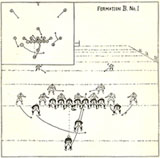
I recently posted some footage of the 1916 Rose Bowl that was provided to me by the Washington State athletic department onto www.YouTube.com/TomBenjey. Washington State was of course running the single-wing, but Brown was running a derivative that eagle-eyed Ted Seay observed that “At the 5:48 mark, Brown shifts into a double-flexed formation with an end and tackle to the left, then they slot their wingback inside that tandem and sweep to the left…” I am now working on a short video of Brown’s offense that will include slow-motion clips for those of us who don’t have Ted’s powers of observation. See http://www.youtube.com/watch?v=yTA2w8aanPc&feature=channel_page That got me thinking about Brown’s players. Everyone is familiar with Fritz Pollard and, to use WSC’s descriptor, “the giant [Mark] Farnum,” but there are other players from that team who are in the Brown Hall of Fame. Let’s start with Josh Weeks because I have communicated with his son, Randall, who talked with him about the game.

Joshua H. Weeks, number 42, played right end on the 1915 Brown University team that played against Washington State in the 1916 Rose Bowl. Later in life he shared some of his experiences with his sons. Randy has been good enough to pass some of his memories along to me. For starters, Brown got little exercise, contrary to what the cartoon at the bottom of this piece insinuated. Prior to the game the players encountered citrus trees loaded with ripe fruit and gorged themselves on oranges. What a mistake! The result was frequent bathroom runs during the game.

Seeing no need for cold or wet weather gear, Brown brought neither along with them. Two days before the game it snowed and it poured during the game. Lone Star Dietz only brought summer suits for himself but did bring mud cleats for his players. Fritz Pollard could get no footing and was held to a season-low in yards gained. He did notice that Lone Star’s white suit was covered with mud before the first quarter was over.

<to be continued>

 brown-practice