Oklahoma, Land of Red People

June 25, 2009

I just came across an explanation of the origin of the name “Oklahoma:”

Oklahoma is a word that was made up by the Native American missionary Allen Wright. He combined two Choctaw words, “ukla” meaning person and “humá” meaning red to form the word that first appears in a 1866 Choctaw treaty. Oklahoma means “red person.”

Doing a little research, I then learned that Allen Wright was 7/8 Choctaw, originally from Mississippi, and was a Presbyterian minister who had been educated at Union Theological Seminary. After fighting for the Confederacy during the Civil War, he was made principal chief in 1866 while away in Washington, where as one of the five delegates of the Choctaw Nation, he was negotiating a treaty to restore amicable relations with the United States.

During those negotiations, he referred to the Indian country as Oklahoma, meaning Territory of Red People. Oklahoma Territory wasn’t established by the treaty but the name stuck. Later, there would be an Oklahoma Territory and, later yet, the State of Oklahoma.

I also learned that decades earlier a nephew of the great Choctaw chief Pushmataha was named Oklahoma, but that was a happy coincidence. What we know as Oklahoma was not named after that man but was named by Rev. Allen Wright to mean land of red people. This is another example of Indians referring to themselves as red men long ago.

I verified the accuracy of this with Smithsonian Linguist Emeritus Ives Goddard and Bill Welge, Director of the Archives Division of the Oklahoma Historical Society. More information about this topic can be found in History and Civics of Oklahoma by L. J. Abbott, LL.B., M. A. and in “Chief Allen Wright” by John Bartlett Meserve in Chronicles of Oklahoma, Vol. 19, No. 4, December 1941. Both documents are available on-line. They can be found at

http://books.google.com/books?id=pg8WP78lkmoC&pg=PA88&lpg=PA88&dq=history+and+civics+of+

oklahoma+abbott&source=bl&ots=AY1OzEoSWg&sig=YUso_pD9MV7TyDCZ08vYdFXnpdg&hl=en&ei=

3mRDSuvRM4SONvK86Z8B&sa=X&oi=book_result&ct=result&resnum=1 and

http://digital.library.okstate.edu/chronicles/v019/v019p314.html

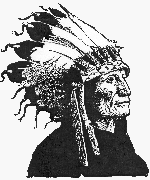
Chief Allen Wright

Rare, Pristine Football Program

June 22, 2009

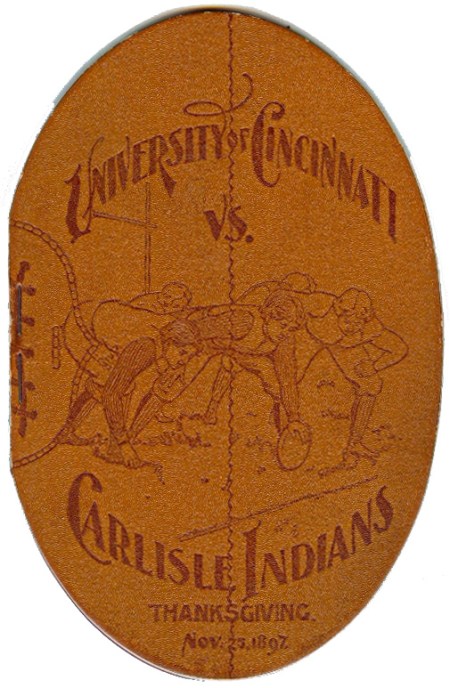
Saturday night, Frank Loney contacted me about a new item he had just acquired. Never before had he been so excited about an acquisition. Yesterday, I went over to look at it. It is simply beautiful. I’ve seen a few old football programs before but none were in the condition of this one for the 1897 Thanksgiving Day game between the University of Cincinnati and the Carlisle Indians. Never before have I seen a 100-year-old program in perfect condition. This one must have been stored out of the sunlight most of its long life. Could it have been a reprint? Frank called the University of Cincinnati archives for an answer to that question. No, no reprint had ever been issued. That Cincinnati didn’t win may have had something to do with that.

In addition to being a historical artifact, it is beautiful. The program is decorated in an Indian motif, likely due to Carlisle being the opponents. This program may not have been in the hands of a spectator because the game was played in a drenching rain. The Indians won 10-0 less than five days after playing a night game against the University of Illinois in the Chicago Coliseum. Carlisle scored all of its points in the first half. According to one newspaper report, “Most of the time of the last half was taken up with fighting.” Isaac Seneca played right tackle. Two years later he would be a first team Walter Camp All-American at halfback. Two days later, missing quarterback Frank Hudson and center Edwin Smith due to injuries, the Indians beat The Ohio State University Medical College for their third victory in a week. The Indians were the only team to defeat Cincinnati, a team that beat Ohio State, Miami, Center College and LSU that year. Chicago was the only other team to beat Illinois.

The program includes a team photo I haven’t seen before and demographic data for the starters. It also includes a photo of W. G. Thompson, the unsung hero of early Carlisle football.

1897 Cincinnati-Carlisle program

Producers Plot Borrowed from The Lone Ranger

June 19, 2009

Today’s blog wanders off-course a bit, but TV’s Tonto was a real-life Mohawk and some Silverheels children attended Carlisle Indian School. Last night my wife and I attended a local summer stock production of The Producers. This brought to mind a Christmas gift from my wife-a set of CDs of old radio shows. While listening to an episode of The Lone Ranger from October 6, 1941, “Loser Takes All,” I heard the villain explain his scheme to his henchman. That scheme was essentially the same one that Max Bialystock and Leo Bloom concocted to defraud little old ladies in Mel Brooks’ classic 1968 film.

Brooks adapted the plot from a gold mine out west to a Broadway play, wealthy eastern investors to sex-starved elderly women, and common criminals to pathetic producers. Instead of having a henchman blow up Nugget Mountain to destroy the unexpectedly profitable mine (which backfires, of course, to reveal a huge vein of gold), Brooks had playwright Franz Liebkind (German for love child and author of Springtime for Hitler) dynamite the theater to stop the unfortunately successful production. The plot’s the same; it’s just details that are changed. Being a G-rated radio show, there were no gay directors, hippie Hitlers or, most unfortunately, no Swedish go-go dancers.

Listen to a short clip of the villain explaining the scheme http://www.youtube.com/watch?v=1va86GOWIXw

What If Jim Thorpe Didn’t Return to Carlisle?

June 16, 2009

Ever consider what would have happened to Jim Thorpe had he not returned to Carlisle in 1911? Pop Warner and Moses Friedman have received a lot of criticism, much of it earned, for their handling of the Jim Thorpe scandal. But what if they hadn’t let him return? It appears that Friedman didn’t really want him back anyway. How differently would things have turned out if, after Albert Exendine bumped into Thorpe, in Anadarko, Oklahoma in the summer of 1911, Warner didn’t want him back?

It is curious that that Jim Thorpe, a 3rd string All American in 1908, sat out the 1909 and 1910 seasons without being recruited by a major football power or even a small Oklahoma college. My sense is that he had had all the schooling he wanted and wasn’t prepared academically for college. Other Carlislians who went on to play football at major colleges generally attended the Dickinson College Preparatory School prior to enrolling in college. Thorpe hadn’t done that. In the early 1920s, he mentioned that numerous colleges had approached him about enrolling in their institutions when he was playing college football. However, that likely happened after he returned to Carlisle in 1911.

It is highly unlikely that Jim Thorpe would have played in a high enough profile program to be named 1st string All America in football in 1911 if he didn’t return to Warner and Carlisle. Perhaps he would have made the Olympic team if found a trainer and a club of the caliber necessary to prepare him to make the team. It’s possible but seems unlikely, especially since he hadn’t taken steps to find a trainer or club before returning to Carlisle less than a year before the Olympic Games.

So, my conclusion is that Jim Thorpe profited from returning to Carlisle. Losing the medals was a price he paid for that decision, but he still made out better in the long run than he would have if he had stayed in Oklahoma. Conflicting opinions are welcomed.

Our Indians Not Yellow

June 11, 2009

Immediately below this headline in the December 28, 1914 edition of The New York Times was, “Cato Sells Banishes Books That Teach Them They Are Mongolians.” Judge Cato B. Sells was the Commissioner of Indian Affairs at the time and was putting publishers on notice that the Bureau of Indian Affairs was not going to purchase books for the government schools for Indians that stated that Indians were of the Mongolian race. Sells stated that he had been “advised by the best authority that the Indians are classed by the anthropologists as a distinct race, commonly designated as the red race, or as red men, in contradistinction to the white (Caucasian), yellow (Mongolian), brown (Malay), and black (Negro) races of people, and that he proposes to do everything in his power to oppose an arbitrary classification advanced by a few publishers of school books which classes the Indian as Mongolian.”

He reached that belief that the Indian was not a Mongolian “after personal investigation and consultation with F. W. Hodge of the Bureau of Ethnology in the Smithsonian Institution.”

Apparently, there was a movement afoot at that time to reduce the number of racial classifications and the elimination of American Indians was one of them. I am not an ethnologist, but from what I can tell from perusing the internet, Sells was ultimately unsuccessful in keeping Indians designated as a separate race. He likely did have a financial impact on some textbook publishers.

Cato B. Sells

Cato B. Sells

Indians Don’t Speak of the Dead

June 9, 2009

Whilst talking with the granddaughter of someone about whom I have written, she shared the difficulty she was having in getting information from family members about her grandmother. What makes it particularly difficult for her is that her grandmother died young, well before she was born. Something that further frustrates her is that her grandmother had an unmistakable influence on her large family. One would think that some of her nine children would reminisce about her, or at least the older ones who had stronger memories of their mother. But no, they said almost nothing about her.

The granddaughter’s clue that her grandmother had an interest in the arts appeared to her at an early age when she visited her grandfather who was a very quiet man. It struck her as odd that a piano sat in the living room of her grandparents’ simple Oklahoma farmhouse thought to be located on her Sac and Fox grandmother’s allotment. That piano was surely an extravagance for that large family in the Great Depression in the Dust Bowl. She later observed that her aunts, uncles, siblings and cousins had artistic talents ranging from music to drawing to writing. In recent years she has located some of her grandmother’s writings that shed a little light on the person who undoubtedly influenced her children greatly.

Along the way while asking questions to learn more about her family, she was told that “we don’t speak of the dead for a year after their death.” Obituaries are a great information source for biographers and historians. Without them, we would know less about our subjects. Not talking about a person for a year likely puts people in the habit of not thinking, talking or remembering things about them. While researching an entirely different person, I learned that the Pawnees do not talk about their dead. It may well be that this is true of many tribes. If so, much information will be lost forever. In a 2002 National Graphic article about an isolated Venezuelan tribe, Scott Wallace wrote that “the Yanomami consider it taboo to speak of the dead.” Perhaps this custom was widespread throughout the Americas.

Coaches Who Got in on the Action

June 2, 2009

Lest some think the following story about Pop Warner’s toughness is apocryphal, I will share a similar story about another coach of that era. Warner was not happy with his new prospect’s development as a player and pulled him out of his place at a practice. Pop told James that he was not playing nearly aggressively enough and said, “Now get down there and show me how it should be done.” Warner lined up opposite Phillips as he did when trying to demonstrate a technique to a player. When the signal was given, Phillips charged so hard that he knocked Pop unconscious. When he came to and cleared his head, Warner just said, “Now, that’s the way it’s done!”

In Dutchman on the Brazos, Caesar “Dutch” Hohn shared an experience he had with his coach at Texas A & M, Charlie Moran. Moran was teaching the offense a new play but it wasn’t working due to Hohn’s interference. Hohn was lined up across from a guard named “Fatty” Lilliard and on every snap of the ball, “I’d hit Fatty in the face with the heel of my hand, knock him off balance, and break up the play.”

Moran snorted, “Who’s letting that damn Dutchman through here?” Lilliard responded, “There’s nothing you can do when a man hits you in the face with his hands.” “Is that so?” said Moran just before pushing Lilliard aside and taking his position. He then told the quarterback to call the same play.

Seeing that Moran was cocked live a Colt 45 ready to hammer him, Hohn remembered what his Coach told the team earlier: “Don’t spare me, because I expect to knock the hell out of you.”

Hohn recalled, “I had the reach on him, and he wasn’t any heavier than I was. Remember, also, that I was able to use my hands. There was one more fact Moran must have forgotten; I knew the starting signal. I timed myself, and when the ball was snapped I got the jump on him, bowling him over, and broke up the play. That was the day I made the team.”

1908 Carlisle-Denver Game Canceled

May 31, 2009

Like most of the interesting things I find, I unexpectedly stumbled across a November 19, 1908 Nebraska State Journal article that said the upcoming game between the Carlisle Indians and the University of Denver had been canceled. Post-season (about anything after Thanksgiving in those days) road trips were not unusual for the Indians. As early as 1896, they played a night game in the Chicago Coliseum on December 19 against that year’s Champions of the West, Wisconsin. And 1908’s trip wasn’t as long or as elaborate as some. It started early with a November 21 game against Minnesota in Minneapolis. Five days later, the opponent was St. Louis University in St. Louis. Six days after that it was Nebraska in Lincoln. Three days after that was to be the Denver game in Denver. According to the article, Denver officials were informed by Carlisle officials that the game was called off because, “…that leave of absence could not be secured for so long a journey.” The article didn’t say if it was Superintendent Friedman, who was new at his post, Commissioner of Indian Affairs Francis Leupp, or someone else. There had been recent communications with Pop Warner and he had said nothing about a cancelation. Denver didn’t take it lying down.

According to the paper, they went straight to the top: “President Roosevelt has been asked to use his influence in having a contract between representatives of Denver University and the Carlisle Indian school for a football game between the elevens of the two schools lived up to.…they at once asked the president through former United States Senator  Patterson, to request that the Indians be given the leave necessary. A portion of Senator Patterson’s message reads: ‘The Denver boys want a square deal and turn to you to get It for them.’ Governor Buchtel, who is chancellor of Denver University, also wired Congressman Bonynge and Senator Teller to secure, if possible, the Intervention of Commissioner of Indian Affairs Leupp.”

I don’t know what happened next but do know that the Indians won three and lost one on the road trip. The loss was to Minnesota. The wins were over St. Louis, Nebraska and Denver.


Carlisle Quarterback Mike Balenti

Carlisle Quarterback Mike Balenti

1895 Carlisle-Army Game?

May 28, 2009

The other day, Frank Loney asked me to look at two 1895 letters written by W. G. Thompson, Carlisle Indian School Disciplinarian. It’s always a treat doing things like that because you never know what you will find. The letters were from July and October 1895. The first letter, the typed one, attempted to arrange a football game for the upcoming season. However, the party to whom the letter was addressed was not mentioned in the letter. That the second letter, the handwritten one, was written to a Chas. L. Poor in Annapolis, Md. This letter was written after the October 26, 1895 game with Navy and mentioned the previous year’s game. The first letter also mentioned the previous year’s game.

Carlisle first fielded a football team in 1893. Due to the late start, they played two November games against high schools. To the Disciplinarian fell many tasks and managing the football team was one of them, at least before Pop Warner arrived in 1899. The task of coaching the team fell to Vance McCormick in 1894 but Thompson was still responsible for arranging the games. Thompson arranged a complete schedule of games for 1894 for the Indians’ first real season. These letters document part of the process for arranging the 1895 schedule and managing the financial details of the game.

The only teams Carlisle played in both 1894 and 1895 were Navy, Bucknell and York YMCA. All the clues in the letters point to Navy; None point to Bucknell or York YMCA.

The next-to-last sentence was the prize in this package. It read, “I am holding decisions on dates with several universities that you and West Point may have preference of dates.” I interpret the “you” to mean the Naval Academy and West Point to be the Military Academy – Army. This means that Carlisle attempted to schedule Army a decade before the historic 1905 game. One need little imagination to think of reasons why Thompson was unsuccessful in scheduling a game with Army.

Jenkins and Anderson Omit 1905 Army Game

May 26, 2009

The May 2009 College Football Historical Society newsletter includes an article that debunks the basic premise for the 2007 books by Sally Jenkins and Lars Anderson, The Real All Americans: the team that changed a game, a people, a nation and Carlisle vs. Army: Jim Thorpe, Dwight Eisenhower, Pop Warner, and the forgotten story of football’s greatest battle, respectively. In “Jude and the Prince,” James G. Sweeney, a lawyer, former prosecutor and, most importantly, an Army fan for 50+ years, describes the epic Carlisle-Army game in detail. The difference between his article and their books is that Sweeney writes about the first time Carlisle met Army on a football field where Jenkins and Sweeney write about the second meeting – without acknowledging the first game. Their omission could be overlooked if the 1905 meeting was played by scrubs or special rules or something of the kind. In fact, the November 11, 1905 Carlisle-Army game was, as Sweeney put it, “was ‘the’ game of the day.” Sweeney also quoted The New York Tribune: “Never before has a football game at West Point been witnessed by a more distinguished gathering. Seated on the grandstand was Prince Louis of Brattenberg, surrounded by army officers, both British and American. The gold lace and trappings of military men, mingled with the gay dresses and flags of pretty girls, made a sight worth seeing.”

By the way, Carlisle won the game 6-5 to settle the score with the “long knives” seven years before the meeting Jenkins and Anderson touted in their books. In Anderson’s case, it may be a matter of ignorance. At the talk he gave in Carlisle, Lars Anderson mentioned that, in order to get his book in print at the same time as Jenkins, he employed a researcher. The researcher probably didn’t look at anything outside the narrow scope he was given. Sally Jenkins, on the other hand, appears to have been aware of the 1905 game. About the 1905 season, she wrote, “The Indians were a predictable disappointment under [Advisory Coach George] Woodruff….They were 10-5 and lost every significant game, and more important, they lost their uniqueness. Their only real fun came in a 36-0 defeat of crosstown rival Dickinson.” John S. Steckbeck, The Arrow and CFbDatawarehouse.com all reported a 10-4 record for the 1905 Indians, with losses to Penn, Harvard, Massillon A. C. and Canton A. C. Jenkins ends what game coverage she had for the 1905 season with the loss to Harvard on a soft field. She apparently doesn’t consider the wins over Penn State, Virginia, Army, Cincinnati, Washington and Jefferson, and Georgetown as significant. Nor does she consider beating Army, thumping Cincinnati 34-5, beating Washington and Jefferson 11-0, or embarrassing Georgetown 76-0 to be fun.

On page two of her book, Jenkins implies that she knew the 1905 game had taken place without mentioning the game or sport when she wrote, “…this was only the second time government authorities had allowed the two parties to meet on an athletic field.” Perhaps Ms. Jenkins will explain why Carlisle’s 1905 victory over Army was neither significant nor worthy of mention.

Prince Louis Battenberg, 1905

Prince Louis Battenberg, 1905