Indians Don’t Speak of the Dead

June 9, 2009

Whilst talking with the granddaughter of someone about whom I have written, she shared the difficulty she was having in getting information from family members about her grandmother. What makes it particularly difficult for her is that her grandmother died young, well before she was born. Something that further frustrates her is that her grandmother had an unmistakable influence on her large family. One would think that some of her nine children would reminisce about her, or at least the older ones who had stronger memories of their mother. But no, they said almost nothing about her.

The granddaughter’s clue that her grandmother had an interest in the arts appeared to her at an early age when she visited her grandfather who was a very quiet man. It struck her as odd that a piano sat in the living room of her grandparents’ simple Oklahoma farmhouse thought to be located on her Sac and Fox grandmother’s allotment. That piano was surely an extravagance for that large family in the Great Depression in the Dust Bowl. She later observed that her aunts, uncles, siblings and cousins had artistic talents ranging from music to drawing to writing. In recent years she has located some of her grandmother’s writings that shed a little light on the person who undoubtedly influenced her children greatly.

Along the way while asking questions to learn more about her family, she was told that “we don’t speak of the dead for a year after their death.” Obituaries are a great information source for biographers and historians. Without them, we would know less about our subjects. Not talking about a person for a year likely puts people in the habit of not thinking, talking or remembering things about them. While researching an entirely different person, I learned that the Pawnees do not talk about their dead. It may well be that this is true of many tribes. If so, much information will be lost forever. In a 2002 National Graphic article about an isolated Venezuelan tribe, Scott Wallace wrote that “the Yanomami consider it taboo to speak of the dead.” Perhaps this custom was widespread throughout the Americas.

Coaches Who Got in on the Action

June 2, 2009

Lest some think the following story about Pop Warner’s toughness is apocryphal, I will share a similar story about another coach of that era. Warner was not happy with his new prospect’s development as a player and pulled him out of his place at a practice. Pop told James that he was not playing nearly aggressively enough and said, “Now get down there and show me how it should be done.” Warner lined up opposite Phillips as he did when trying to demonstrate a technique to a player. When the signal was given, Phillips charged so hard that he knocked Pop unconscious. When he came to and cleared his head, Warner just said, “Now, that’s the way it’s done!”

In Dutchman on the Brazos, Caesar “Dutch” Hohn shared an experience he had with his coach at Texas A & M, Charlie Moran. Moran was teaching the offense a new play but it wasn’t working due to Hohn’s interference. Hohn was lined up across from a guard named “Fatty” Lilliard and on every snap of the ball, “I’d hit Fatty in the face with the heel of my hand, knock him off balance, and break up the play.”

Moran snorted, “Who’s letting that damn Dutchman through here?” Lilliard responded, “There’s nothing you can do when a man hits you in the face with his hands.” “Is that so?” said Moran just before pushing Lilliard aside and taking his position. He then told the quarterback to call the same play.

Seeing that Moran was cocked live a Colt 45 ready to hammer him, Hohn remembered what his Coach told the team earlier: “Don’t spare me, because I expect to knock the hell out of you.”

Hohn recalled, “I had the reach on him, and he wasn’t any heavier than I was. Remember, also, that I was able to use my hands. There was one more fact Moran must have forgotten; I knew the starting signal. I timed myself, and when the ball was snapped I got the jump on him, bowling him over, and broke up the play. That was the day I made the team.”

1908 Carlisle-Denver Game Canceled

May 31, 2009

Like most of the interesting things I find, I unexpectedly stumbled across a November 19, 1908 Nebraska State Journal article that said the upcoming game between the Carlisle Indians and the University of Denver had been canceled. Post-season (about anything after Thanksgiving in those days) road trips were not unusual for the Indians. As early as 1896, they played a night game in the Chicago Coliseum on December 19 against that year’s Champions of the West, Wisconsin. And 1908’s trip wasn’t as long or as elaborate as some. It started early with a November 21 game against Minnesota in Minneapolis. Five days later, the opponent was St. Louis University in St. Louis. Six days after that it was Nebraska in Lincoln. Three days after that was to be the Denver game in Denver. According to the article, Denver officials were informed by Carlisle officials that the game was called off because, “…that leave of absence could not be secured for so long a journey.” The article didn’t say if it was Superintendent Friedman, who was new at his post, Commissioner of Indian Affairs Francis Leupp, or someone else. There had been recent communications with Pop Warner and he had said nothing about a cancelation. Denver didn’t take it lying down.

According to the paper, they went straight to the top: “President Roosevelt has been asked to use his influence in having a contract between representatives of Denver University and the Carlisle Indian school for a football game between the elevens of the two schools lived up to.…they at once asked the president through former United States Senator  Patterson, to request that the Indians be given the leave necessary. A portion of Senator Patterson’s message reads: ‘The Denver boys want a square deal and turn to you to get It for them.’ Governor Buchtel, who is chancellor of Denver University, also wired Congressman Bonynge and Senator Teller to secure, if possible, the Intervention of Commissioner of Indian Affairs Leupp.”

I don’t know what happened next but do know that the Indians won three and lost one on the road trip. The loss was to Minnesota. The wins were over St. Louis, Nebraska and Denver.


Carlisle Quarterback Mike Balenti

Carlisle Quarterback Mike Balenti

1895 Carlisle-Army Game?

May 28, 2009

The other day, Frank Loney asked me to look at two 1895 letters written by W. G. Thompson, Carlisle Indian School Disciplinarian. It’s always a treat doing things like that because you never know what you will find. The letters were from July and October 1895. The first letter, the typed one, attempted to arrange a football game for the upcoming season. However, the party to whom the letter was addressed was not mentioned in the letter. That the second letter, the handwritten one, was written to a Chas. L. Poor in Annapolis, Md. This letter was written after the October 26, 1895 game with Navy and mentioned the previous year’s game. The first letter also mentioned the previous year’s game.

Carlisle first fielded a football team in 1893. Due to the late start, they played two November games against high schools. To the Disciplinarian fell many tasks and managing the football team was one of them, at least before Pop Warner arrived in 1899. The task of coaching the team fell to Vance McCormick in 1894 but Thompson was still responsible for arranging the games. Thompson arranged a complete schedule of games for 1894 for the Indians’ first real season. These letters document part of the process for arranging the 1895 schedule and managing the financial details of the game.

The only teams Carlisle played in both 1894 and 1895 were Navy, Bucknell and York YMCA. All the clues in the letters point to Navy; None point to Bucknell or York YMCA.

The next-to-last sentence was the prize in this package. It read, “I am holding decisions on dates with several universities that you and West Point may have preference of dates.” I interpret the “you” to mean the Naval Academy and West Point to be the Military Academy – Army. This means that Carlisle attempted to schedule Army a decade before the historic 1905 game. One need little imagination to think of reasons why Thompson was unsuccessful in scheduling a game with Army.

Jenkins and Anderson Omit 1905 Army Game

May 26, 2009

The May 2009 College Football Historical Society newsletter includes an article that debunks the basic premise for the 2007 books by Sally Jenkins and Lars Anderson, The Real All Americans: the team that changed a game, a people, a nation and Carlisle vs. Army: Jim Thorpe, Dwight Eisenhower, Pop Warner, and the forgotten story of football’s greatest battle, respectively. In “Jude and the Prince,” James G. Sweeney, a lawyer, former prosecutor and, most importantly, an Army fan for 50+ years, describes the epic Carlisle-Army game in detail. The difference between his article and their books is that Sweeney writes about the first time Carlisle met Army on a football field where Jenkins and Sweeney write about the second meeting – without acknowledging the first game. Their omission could be overlooked if the 1905 meeting was played by scrubs or special rules or something of the kind. In fact, the November 11, 1905 Carlisle-Army game was, as Sweeney put it, “was ‘the’ game of the day.” Sweeney also quoted The New York Tribune: “Never before has a football game at West Point been witnessed by a more distinguished gathering. Seated on the grandstand was Prince Louis of Brattenberg, surrounded by army officers, both British and American. The gold lace and trappings of military men, mingled with the gay dresses and flags of pretty girls, made a sight worth seeing.”

By the way, Carlisle won the game 6-5 to settle the score with the “long knives” seven years before the meeting Jenkins and Anderson touted in their books. In Anderson’s case, it may be a matter of ignorance. At the talk he gave in Carlisle, Lars Anderson mentioned that, in order to get his book in print at the same time as Jenkins, he employed a researcher. The researcher probably didn’t look at anything outside the narrow scope he was given. Sally Jenkins, on the other hand, appears to have been aware of the 1905 game. About the 1905 season, she wrote, “The Indians were a predictable disappointment under [Advisory Coach George] Woodruff….They were 10-5 and lost every significant game, and more important, they lost their uniqueness. Their only real fun came in a 36-0 defeat of crosstown rival Dickinson.” John S. Steckbeck, The Arrow and CFbDatawarehouse.com all reported a 10-4 record for the 1905 Indians, with losses to Penn, Harvard, Massillon A. C. and Canton A. C. Jenkins ends what game coverage she had for the 1905 season with the loss to Harvard on a soft field. She apparently doesn’t consider the wins over Penn State, Virginia, Army, Cincinnati, Washington and Jefferson, and Georgetown as significant. Nor does she consider beating Army, thumping Cincinnati 34-5, beating Washington and Jefferson 11-0, or embarrassing Georgetown 76-0 to be fun.

On page two of her book, Jenkins implies that she knew the 1905 game had taken place without mentioning the game or sport when she wrote, “…this was only the second time government authorities had allowed the two parties to meet on an athletic field.” Perhaps Ms. Jenkins will explain why Carlisle’s 1905 victory over Army was neither significant nor worthy of mention.

Prince Louis Battenberg, 1905

Prince Louis Battenberg, 1905

Redskins Trademark Safe for Now

May 21, 2009

Last Friday, a three-judge panel of the U. S. Court of Appeals in Washington upheld the D. C. Circuit Court’s decision that the plaintiffs had waited too long in filing a suit against the Redskins’ trademark which was originally registered in 1967. This time around (law suits were first filed against the Redskins in 1992), based on the much shorter delay (seven years and nine months) since Mateo Romero’s 18th birthday. Apparently minors are not allowed to file such suits. The other six plaintiffs are much older and waited far longer to file. The judge also ruled that the attack on the team’s cheerleaders, the Redskinettes, was also filed too late. However, these lawsuits are far from over. Suzan Shown Harjo, President of the Morning Star Institute and one of the plaintiffs, told reporters that a group of younger plaintiffs are ready to challenge the trademarks. Don’t expect this fight to end anytime soon. A franchise that isn’t so successful would probably relocate to greener pastures long before this thing is resolved.

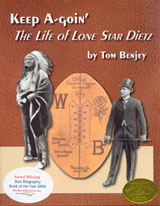
I follow this issue because owner George Preston Marshall named the Redskins in honor of Lone Star Dietz, his new head coach in 1933. Dietz has been at the epicenter of this controversy for years. Dietz’s heritage has been an issue since his draft evasion trial in 1919. *** Begin unabashed plug *** My 2006 book, Keep A-goin’: the life of Lone Star Dietz discusses the issue of his birth at great length. *** End unabashed plug ***

New Research Tool

May 18, 2009

Over the weekend, I stumbled across a new tool that could help those of us who research things long past. WolframAlpha.com is touted by some as the biggest challenger Google has faced. Others point out that it isn’t a search engine of the Google sort. WolframAlpha (W/A) is the brainchild of Steven Wolfram, founder of Wolfram Research, the company that brings us Mathematica. Not surprisingly, W/A uses Mathematica as its engine “…to make all systematic knowledge immediately computable and accessible to everyone.” W/A allows users to type in English language questions and receive answers reminiscent of the way computer interfaces in 1950s move computers.

Thinking this might be a useful tool for researching such things as the weather when Carlisle Indian School students arrived, I gave it a try. First, I threw it a softball by asking, “USA gross national product 1912.” W/A’s response was “(no data available).) Next, I tried “weather Carlisle, PA October 1879.” W/A returned “(no weather data available for October 1879).” Knowing that weather data is available for Philadelphia, I changed Carlisle to Philadelphia but got the same result. It seems that Wolfram hasn’t loaded all of the weather data that is available as of yet. Now for something simpler.

I entered “college football scoring record 1912” and confused W/A. It responded, “Wolfram\Alpha isn’t sure what to do with your input.” W/A seems to have some information for the NFL and major league baseball but is unaware of college sports. In the same box that tells us W/A is confused, they ask for experts. Perhaps this is an opportunity for Tex Noel, and David DeLasses.

A Bitter Night – NOT

May 15, 2009

“On Sacred Ground: commemorating survival and loss at the Carlisle Indian School,” an article written by the then Managing Editor of Central PA, the monthly magazine for PBS affiliate WITF, begins, “In the middle of a bitter night in October 1879….” Knowing that the train arrived in Carlisle at 12:30 a.m. on Monday, October 6, 1879 and living in the Carlisle area for more than three decades, I am well aware of the fact that the weather in the first week of October tends to be mild here. She cited no sources to support her assertion that the weather was bitter, so I did a little research.

I quickly found out that the National Weather Service wasn’t collecting meteorological data for Carlisle or even Harrisburg at that time. The NWS does consider data collected in Philadelphia from as far back as 1872 as reliable enough for its record keeping. Daily highs for October 5 and 6, 1879 were both a balmy 79 degrees. Lows for these dates were 56 and 62, respectively. But Philadelphia is not Carlisle. Neither is Wellsboro, a town about 150 miles north of Carlisle (less as the crow flies). Wellsboro resident H. D. Deming recorded temperatures three times each day at his home. The Agitator reported that Deming’s temperatures were 84 at 2 p.m. on the 5th, 64 at 9 p.m., 50 at 7 a.m. on the 6th, and 86 at 2 p.m. This was unseasonably warm weather in a place that is normally cooler than Carlisle.

Although local newspapers provided no weather data, they did provide some anecdotes that, when coupled with the above data, show that Carlisle’s weather was anything but bitter when the first group of students arrived. The Carlisle Herald wrote, “For a wonder the weather was not only all that could be desired, but a trifle too much so, if we are permitted to judge from the extremely warm weather, which would have done credit to midsummer.” A week later, Gettysburg’s The Star and Sentinel declared, “The weather continues phenomenally warm, dry and dusty.” One wonders who does the fact checking for WITF.

Film Footage of Jim Thorpe

May 12, 2009

Recently, a friend and I bemoaned the lack of film footage of Jim Thorpe. We conjectured that footage of the 1912 Stockholm Olympics must exist somewhere. Then I stumbled across an article about an auction of articles related to the great Thorpe. In an article titled “Jim Thorpe Mementoes in Demand at Sports Immortals Sale,” Rosemary McKittrick wrote about an auction conducted jointly by Guernsey and Hunt. Apparently, the auction was held last October in Atlantic, NJ. The source of the memorabilia wasn’t clear from the article. However, she used “Sports Immortals” in the article’s title, so these items may have come from their collection. The item that caught my eye was “Film and footage; Thorpe playing for the Canton Bulldogs; rare, early glimpse of Thorpe in action on football field; $1,155.” I don’t know if these items sold for the amounts listed or if they were just the auctioneer’s projections. As pleased as I was to discover that footage of Jim Thorpe still exists, it wasn’t of the Olympics. Oh well.

IMDB.com list a 1996 made-for-TV documentary, “100 Years of Olympic Glory,” directed by Bud Greenspan. The film includes archive footage of Jim Thorpe with King Gustav at the 1912 Olympics. Now to find a copy of that video.

A further look at IMDB.com uncovered a listing titled “The Giants-White Sox Tour.” The 1913 World Series was filmed. Perhaps that action prompted Jim Thorpe to sell the movie rights to his marriage to Iva Miller in Carlisle. Immediately after their wedding, the Thorpes joined the New York Giants for their around-the-world-tour with the Chicago White Sox. This film documented that tour. Perhaps it includes footage of the wedding. I can hope. Now to find a copy of it this, the first full-length documentary.

IMDB.com also lists archival footage of Jim Thorpe appearing in “Idols of the Game,” a 1995 video hosted by Dabney Coleman. That gives me three films to look for.

Jim Thorpe

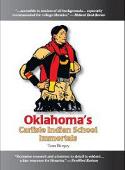
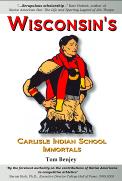
Oklahoma’s Carlisle Indian School Immortals

May 7, 2009

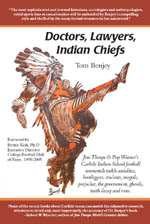
Galleys for Oklahoma’s Carlisle Indian School Immortals, the first book in my upcoming series on Native American Sports Heroes, have arrived. At about 160,000 words, Doctors, Lawyers, Indian Chiefs is too long for most middle school and many high school students to read. So, I am splitting it up into a series by state, the first of which is Oklahoma because it has the largest Indian population of any state. It also was home to many of the Carlisle stars. Splitting up the book into smaller volumes has another advantage; it makes room for some more players. Doctors, Lawyers, Indian Chiefs got to be so long that I had to stop adding players, but now I have places to tell their stories. For example, Henry Roberts and Mike Balenti  are in Oklahoma’s Carlisle Indian School Immortals but aren’t in Doctors, Lawyers, Indian Chiefs.

The new book will be in hardback so that it is attractive to libraries and is under 200 pages long, including the index and appendices. My hope is that school and public libraries across Oklahoma, and elsewhere, add this book to their collections. A book reviewer suggested that grandparents may be interested in giving this book to their grandchildren as gifts. I would like that because my readers to date tend to be over 40. Young people should know about the lives and achievements of Carlisle Indian School students.

Like my other books, Oklahoma’s Carlisle Indian School Immortals is heavily illustrated with rarely seen period photos and cartoons. Bob Carroll of the Professional Football Researchers Association even drew portraits of all the players for the book. This book will be released in September.

09774486812