American Indian on Antarctic Expedition

August 17, 2010

Yesterday, I received a letter from Laura Kissel, Polar Curator at The Ohio State University Archives. She found a letter dated September 1, 1932 from William Winneshiek to Richard Byrd in which Winneshiek requests to be considered for inclusion in Byrd’s Second Antarctic Expedition. That was a year and four days before the newspaper articles were published that said he had been selected. So, Byrd had ample time to select him for the trip. Although no documentation exists that he had been selected, the newspaper accounts may have been correct. But why was he selected?

Winneshiek points out [accurately], “The Boy Scouts of America and various other nations have been represented on your previous expeditions. Thus far, I have failed to see the American Indian represented on your expeditions, hence this letter.” He went on to describe his heritage (full-blood Winnebago) and his education (Carlisle Indian School, Lebanon Valley College, Penn State). For his qualifications, he included, “…my vocations as chemist and musician, I am capable of performing the duties of a ‘chef,’ having worked my way through school as an assistant ‘chef.’”

It’s doubtful that Byrd needed musicians or chefs, possibly a chemist, but he most definitely cooks. I say plural because his force was split for significant lengths of time and all would need to have been fed. It seems quite plausible that Byrd would have chosen him as a crew member because it would have made good press and would have created interest due to his being an Indian. He closed with, “…I feel positive that you will give my application your earnest consideration and give the Red-Man an even break.”

Bulldogs and Indians Play Footbrawl

August 13, 2010

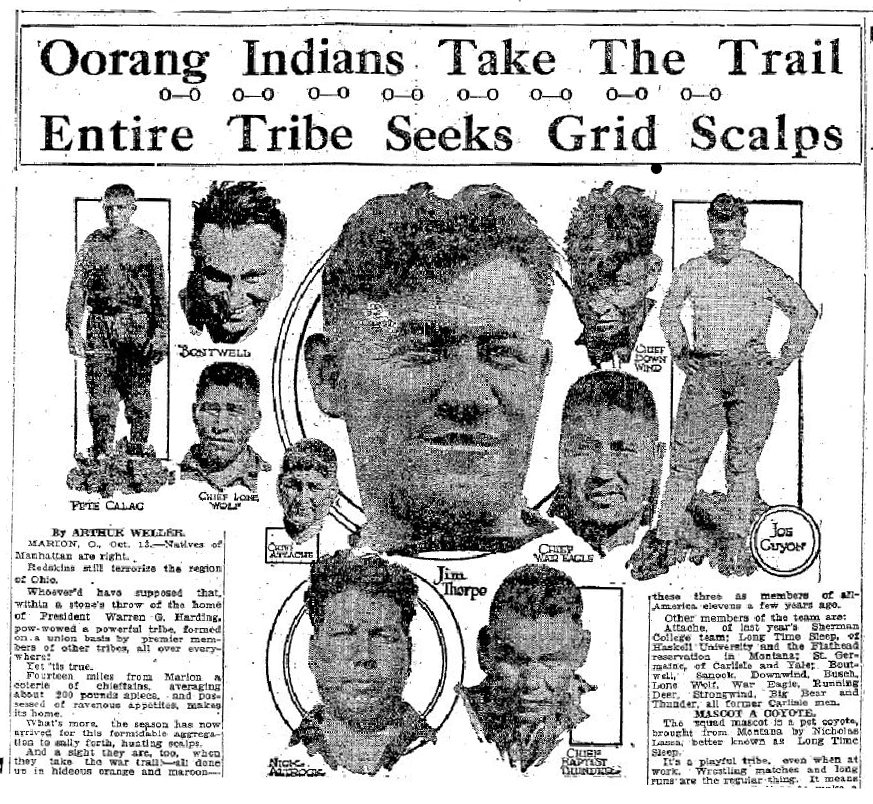
Large newspapers of the day recorded the October 15, 1922 game simply as Canton 14 – Oorang 0 but that doesn’t begin to tell the story. In the early days of the NFL, the Canton Bulldogs were a powerhouse team that featured Jim Thorpe and his Carlisle Indian School teammates, Joe Guyon and Pete Calac, in the backfield. But in 1922, Jim Thorpe and Walter Lingo formed the Oorang Indians franchise to, at least in theory, compete with Canton for championships. Oorang’s results were anything but competitive as Father Time’s inexorable crush was their greatest opponent. However, they more than rose to occasion when they battled the eventual league champions. And battle they did.

Few details of the game were covered by the national media but a Massillon, Ohio newspaper and the hometown paper of one of the players provided some unexpected coverage of the hard-fought battle. After a scoreless first half, the Bulldogs scored their two touchdowns in the third quarter. The Evening Independent told the story, “During that part of the contest the game almost developed into a free-for-all when the Indians gave battle to several Canton linemen who used their fists on an opponent, guilty of kneeing one of the Canton halfbacks. Throughout the game, Thorpe’s charges played in a most determined fashion, and bloody faces were not uncommon.”

A skeptic might conclude that this was slanted by a reporter from the Bulldogs’ rivals’ lair but The Lebanon Daily News provided some verification when it wrote, “William Winneshiek…was the recipient Sunday of an extraordinary compliment from the football players of the Canton Bulldog professional team. Winnie played center against them for the Oorang Indians and as an expression of appreciation of his wonderful playing and good sportsmanship, he was presented with the football used in the game and also a gold watch. The game developed into a slugging match, but evidently the Lebanon Indian played the game and kept out of the fights.”


Wisconsin’s Carlisle Indian School Immortals Finally Off to printer

August 11, 2010

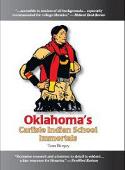
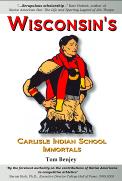
The files for Wisconsin’s Carlisle Indian School Immortals were just uploaded to the printer. Meeting the September 1 release date will be touch and go, but I think we will make it. The project was moving along smoothly until William Winneshiek threw a monkey wrench into things. First, he compiled a large photo album of Carlisle Indian School people that his granddaughter recently donated to the Cumberland County Historical Society. Some of these photos were added to the book and not all went into the chapter about him. For example, one was a photo of Joel Wheelock in his Oneida regalia that he wore when leading his band. While trying to correlate a photo with other information, I came across a newspaper article that claimed he was part of Byrd’s Second Antarctic Expedition. That took time to run down. But, at last, the book is on its way to being printed.

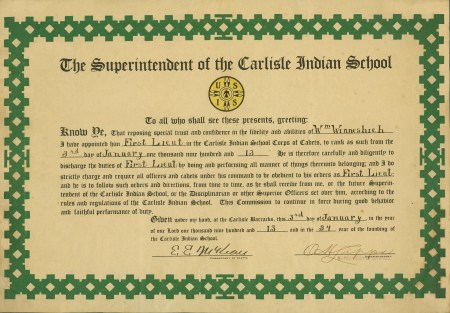
Something that didn’t find its way into the book was Winneshiek’s commission as 1st Lieutenant in the Carlisle Indian School Corps of Cadets. This commission, which is in the form of a diploma, is quite impressive. Some small details are important. Note that Oscar Lipps signed in the space indicated for the superintendent’s signature. The date of this commission, January 3, 1913, was a full year before the Joint Congressional Inquiry took place and Lipps was not at Carlisle at the time. Then, he was a bureaucrat located elsewhere, in the northwest most likely. His title was Supervisor U. S. Indian Service. A year later, he came to Carlisle as Acting Superintendent.

When the U. S. entered WWI, Carlisle students flocked to the recruiting stations. Several were commissioned as officers on large part due to their training at Carlisle Indian School. Others were quickly promoted to noncoms. The text of this commission sheds a little more light on the cadet program than we previously had.

The Carlisle Indian School March

August 5, 2010

Some time ago, I found the sheet music for “Carlisle Indian School March” at the Library of Congress and ordered a copy. What arrived was a piano score with no arrangement for band instruments. Not being able to play the piano or find someone willing to take the time to learn the tune, I was out of luck. I feared that I would never hear it played. But last week I discovered something that could make it possible to hear it. MuseScore is free software that allows you to key in music scores, print sheet music for them and, most important to me, play it back.

The software downloaded easily onto my computer, but not after having a scare. Because my machine was running short of disk space, I attempted to download it onto my wife’s laptop which has ample space available. Very early into the process, her computer uttered a brief whimper and emitted some smoke. That was followed by the all-too-familiar smell of burnt electronics. People on the MuseScore support forum assured me that it was a coincidence. Logically, I knew that but my wife’s computer had just died while I was using it. So, I intrepidly ventured forward and installed the software from www.MuseScore.org without a hitch.

Entering all the notes, etc. wasn’t easy, especially given that I don’t play the piano and my music education ended with playing the bass clarinet in the jr. high band very early in the Kennedy administration. But it was completed over the weekend. It can be heard at Carlisle Indian School March.

Now, the challenge is to get it arranged for the various instruments in a marching band. Since I know nothing about arranging music, I must rely on the kindness of others. A Dickinson College professor has expressed interest in the project. It would be great to hear this historic music played by a real band.

Carlisle’s Attempt to Land Jim Thorpe’s Remains

August 2, 2010

John Luciew (pronounced Lucy), a reporter for Harrisburg’s Patriot-News, contacted me last week about the court case in which Jack Thorpe is trying to have his father’s remains brought to Oklahoma in perpetuity. Luciew was most interested in what I knew about Carlisle’s attempts, if any, to have Thorpe’s remains placed here back in 1953. I hadn’t looked into that before, so I had to do a little research. Freddy Wardecker, proprietor of Wardecker’s Menswear (formerly Blumenthal’s), gave me some information to go on and I was off to the races.

Jim Thorpe renewed acquaintances in 1951 when he was in Carlisle for the premier of his biopic, Jim Thorpe– All American. When he died just two years later, Carlislians wanted to honor him by locating his memorial here. A committee was formed, headed by attorney John B. Fowler (now deceased). The committee negotiated a location for the grave and monument near Indian Field at Carlisle Barracks where the young athlete made a name for himself when that facility was Carlisle Indian School. When Mauch Chunk entered the picture, Carlisle demurred, not wanting to get in a bidding war. In 1982, Sports Illustrated quoted Fowler as saying, “Pat wanted too much money. We felt like we were getting in a bidding war. We tried even after he died, but her price was too high.” Whether the Mauch Chunk group outbid others isn’t clear. What is clear is that they were actually able to raise the money and built the monument that stands there today.

Carlisle eventually placed a historic marker on the square next to the old courthouse. Some people think he is buried there but his remains are in the borough currently known as Jim Thorpe. Here is a link to the article Luciew wrote: http://www.pennlive.com/midstate/index.ssf/2010/08/town_of_jim_thorpe_is_ready_to.html

Photo by William Fischer, Jr.

Winneshiek Selected for Byrd’s Expedition

July 30, 2010

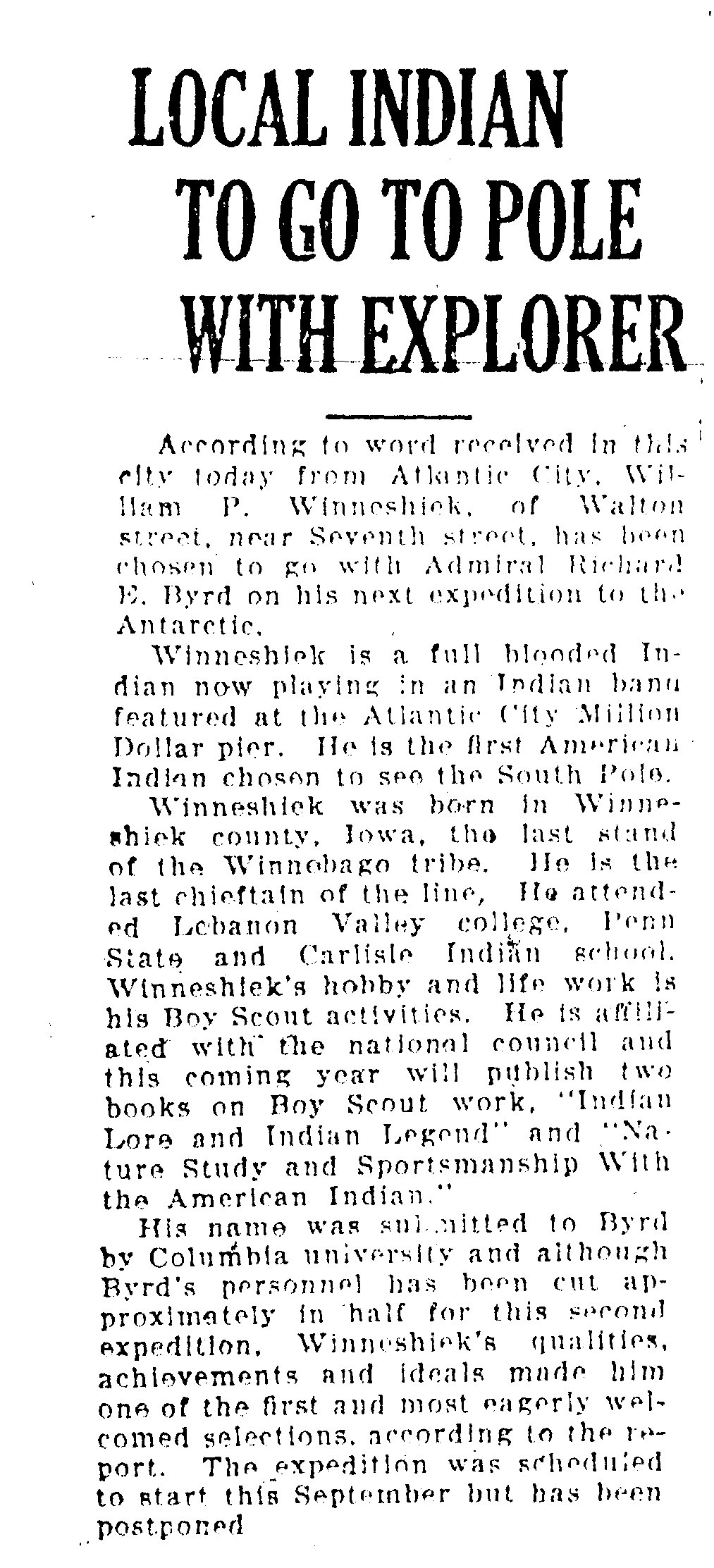
Chris Sholly of the Lebanon Daily News came to the rescue. Because she writes about local history for the newspaper, her editor assigned her the task of following up on my request for information regarding the September 5, 1933 article that I had been unable to find. She has a number of old columns in her files, but the one we are looking for wasn’t among them. When the Lebanon County Historical Society was open on Thursday, yesterday, Chris was right there diving into files and ruining her vision reading microfilms. But it was worth it, she found the missing article which is included below. As a bonus, she found a similar but different article in another paper. I will have to wait to see that one because of limitations with the scanner she uses at work.

The article stated that the information it received came from Atlantic City, presumably from Winneshiek himself. The article also stated that Winneshiek’s band was playing at the Million Dollar Pier in that city. As luck has it, evidence exists that Winneshiek’s band did, in fact, play at the Million Dollar Pier in the form of a photograph. That photograph can be seen on the website Winneshiek’s grandson maintains at http://hocak-nation.com/theband.html. This same photograph was used by Conn Instruments in advertising materials which featured Winneshiek’s band as endorsing their horns.

Now my task is to determine if William Winneshiek actually made the trip. Less than five years after the expedition returned home, he claimed repeatedly to newspaper reporters that he had gone to the South Pole, but we must verify if that actually happened. Local newspaper reports of school activities place Winneshiek’s children in Lebanon while the expedition was underway. If their father was home at all during that time, friends and neighbors would have noticed.

It’s more fun digging now that there is something to go on.

Winneshiek on Byrd’s South Pole Expedition

July 27, 2010

I don’t know how I overlooked this but I must have. Two newspaper articles both state that William Winneshiek was along with Richard Byrd on his Second Antarctic Expedition. One article, dated October 14, 1939 announced his marriage to Estella Winters of Reading, Pennsylvania. The article mentioned, among other things, that Winneshiek had been a member of Byrd’s expedition. The second article, dated October 7, 1940, was about a talk he gave in Circleville, Ohio on its annual History Day. Again, his involvement with Byrd’s trip to the South Pole was mentioned. This was something new to me as I had previously heard nothing about Winneshiek’s involvement in anything like this.

Hoping to learn more, I contacted the Byrd Polar Research Center Archival Program at The Ohio State University (don’t forget the The). Linda Kissel, the Polar Curator, dug through their files using several ingenious spellings of Winneshiek’s name—one of the problems researching him is that his name is often misspelled—and came up dry. I noted that the information about this was most likely given to both reporters by Winneshiek himself. She told me that she is constantly getting similar requests about other people who claimed to have been on the expedition. So, I figured that he just made it up.

Until I found something else. The September 5, 1973 edition of Lebanon Daily News, Winneshiek’s adopted home town’s newspaper, included a 40-years-ago column in which was stated, “William P. Winnishiek[sic], local Indian, was chosen a member of Admiral Richard Byrd’s expedition to the Antarctic.” Bill died 20 years before this was printed, so he could have had no involvement in a false memory and his son was estranged from him, so he didn’t do it. This was likely a direct quote from the September 5, 1933 paper. Unfortunately, I haven’t been able to find a copy of it—yet.

Treasure Trove of New Carlisle Indian School Photos

July 22, 2010

The current edition of the Cumberland County Historical Society’s newsletter arrived earlier this week. When I got around to reading it, something in Richard Tritt’s column jumped off the page at me. William Winneshiek’s granddaughter recently donated her father’s photo album. Even though it is time to get Wisconsin’s Carlisle Indian School Immortals to the printer, I couldn’t resist running in to see if there was a photo of Winneshiek I’d like to add to the book. To put it mildly, I was overwhelmed. I wasn’t prepared for the number of photos in that album or the scope of them.

William Winneshiek arrived at Carlisle on June 5, 1911 and withdrew on October 19, 1915. His relatively short time at Carlisle and having never played on the varsity football team inclines one to expect mostly personal photo to be in his album and few that are directly related to Carlisle Indian School. Boy, was I surprised. Not only were there many photos in the album of school activities and of other students, several were photos that neither Richard Tritt nor I had seen before. For example, I had not previously seen any documentation of Little Twig having been at Carlisle. He is thought to have been here but no documents or photos had been seen to place him here before. The album includes several photos of Joel Wheelock’s All-Indian Band from 1929 and a number of photos of the Oorang Indians, including a group photo of the players in street clothes with two of the players’ wives. Good stuff.

After seeing what he had, and knowing what I do about Winneshiek, it all makes sense. When he left Carlisle in 1915, he remained in the area, attending Lebanon Valley College for a bit, working for the railroad in Altoona, playing with various bands, and moving permanently to Lebanon, Pennsylvania, all the while playing in bands and keeping in touch with old friends. His 1936 letter to Hugh Miller recorded a then-recent visit to Carlisle and thanked Miller for letting him have some photos from some unspecified baskets. It all makes sense now.

Wing-Shift or Dead-Indian Play

July 19, 2010

One of the problems with dating Pop Warner’s innovations is that his memory 20 years after the fact was far from perfect, as are most people’s. The well-known difficulties in dating the births of the single-wing and double-wing with certitude are due, at least in part, to Warner’s inconsistent memories. A month and a half ago, I wrote a bit about the 1903 game with Utah in which Joe Baker led the Indians to a 22-0 win over the Mormonites by running the new wing-shift play several times for three second-half touchdowns (they counted 5 points in those days).

In his autobiography—actually a series of magazine articles written by Warner that were compiled into book form—Warner stated that during the 1912 Thanksgiving Day game against Brown, Harvard’s coach, Percy Haughton, was his guest on the sidelines to see Warner’s new surprise play—the wing-shift. Haughton disapproved, saying, “These series plays are never worth a darn. If such plays do work, it is usually in the first attempt, because they are trick plays and surprise is the feature that usually makes them successful.” After seeing Carlisle run them for long gains later in the game, Haughton grudgingly admitted, “Well, it did work that time.”

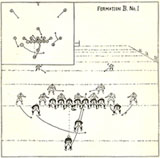
For a newspaper series of favorite plays from several coaches in the 1930s, Lone Star Dietz described the “Dead-Indian Play.” What he described was the old wing-shift that Carlisle ran so well. Because the wing-shift, or dead-Indian play, was a series of two plays it had to be called ahead of time. The player, generally a back, who carried the ball on the first play would linger on the ground long enough to give six of his teammates time to line up to one side of him. The rest would position themselves in the backfield. When the downed man could see that all were in place, he hopped up and snapped the ball to a backfield man to start the second play, catching the defense off guard.

Amateur Runners Competed for Prizes

July 16, 2010

The photo in the previous post turns out to be from the 12-mile “Modified Marathon” held in New York City on May 6, 1911. Lewis Tewanima (#375) finished first and  teammate Mitchell Arquette (#376) came in fifth out of a field of over 1,000 runners. Both received solid silver gold-lined loving cups as prizes from The Evening Mail, sponsor of the big race that was covered by all the New York City newspapers. The New York Times article titled, “Little Tewanima Wins Marathon,” began “Tewanina, a ward of the Nation and a student at the Carlisle Indian School, yesterday demonstrated the superiority of the red man as a foot runner over a cosmopolitan field which numbered nearly 1,000 athletes of all sorts and conditions in the so-called modified Marathon — the distance being twelve miles — under the auspices of The Evening Mail.” The crowd viewing the race was estimated at over 1,000,000 people.

Tewanima, along with the rest of the stronger runners, started at the back of the pack but soon worked his way to the front. He pulled away down the homestretch along Broadway, “…drawing away with each hundred yards covered. His teammate, Arquette, began to feel the ill-advised efforts to keep up with the lead man, and he slowly but surely fell back from the first bunch….When he [Tewanima] showed on the Mall, the City Hall plaza re-echoed with the plaudits in his favor. Seldom has an athlete received such a public ovation. He took the whole scene as a matter of course, and upon learning his time, grunted, shrugged his shoulders, and walked to the dressing rooms, weighed down somewhat by a massive cup, which was his winning portion.”

The New York Herald coverage featured a cartoon of Tewanima that was reproduced in the Carlisle Indian School newspaper. Shown in profile, Tewanima sports a diamond stickpin in his necktie, something he probably couldn’t afford from his earnings as a student. It isn’t clear yet if it was a prize for winning this race or a previous one. Regardless, he and the others clearly competed for prizes.