June 20, 2012
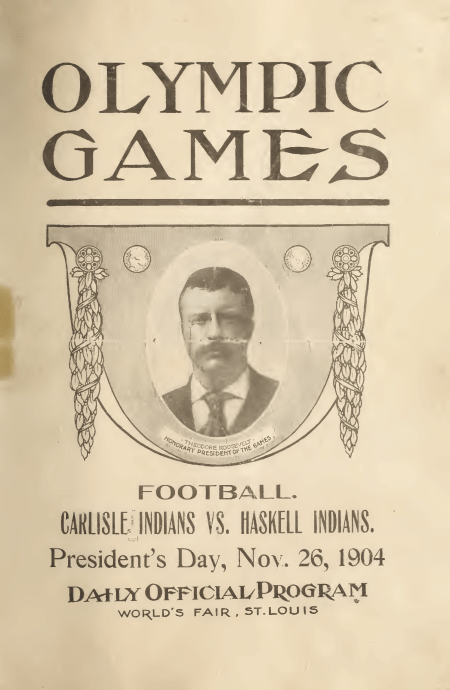
Tex Noel recently sent me a link to a list of numerous books, programs and other football memorabilia that have been digitized and are available on-line. Included in the list was the program for the 1904 Carlisle-Haskell game which was held at the St. Louis World’s Fair, in part, for the entertainment of President Roosevelt who visited the fair but did not attend the game.
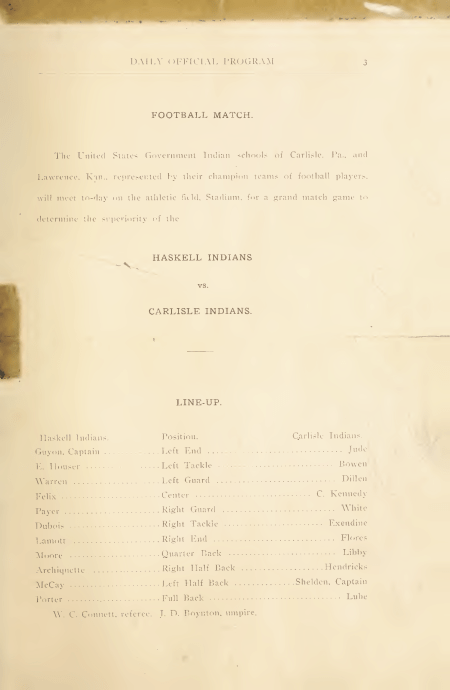
Page 3 of the program contains the proposed line ups for the two teams. At first glance, the Haskell line up looked similar to the one Steckbeck included in Fabulous Redmen,but the Carlisle line up was significantly different:
Program Steckbeck
Jude LE Rogers
Bowen LT Bowen, Gardner
Dillen LG Dillon
Kennedy C Shouchuk
White RG White
Exendine RT Exendine
Flores RE Tomahawk
Libby QB Libby
Hendricks RH B. Pierce, Hendricks
Shelden LH Sheldon, Lubo
Lube FB H. Pierce
Jude, Kennedy and Flores didn’t get in the game. Coaches Ed Rogers and Bemus Pierce suited up for the game. Hawley Pierce and long-time player Nikifer Shouchuk also played. The reason given for loading up the line up was that rumors swirled around that Haskell was even recruiting white ringers for the big game. That doesn’t seem to have happened. What did happen was that some of the best players ever to play at Carlisle could be found on both sides of the ball. Some, like Archiquette had previously played for Carlisle but were at Haskell in 1904 (and would return to Carlisle in 1905). Others like Charles Guyon (Wahoo), Pete Hauser and Emil Hauser (Wauseka), would star at Carlisle in the years that followed. The two line ups amounted to a who’s who in Indian football at that time.
Tags: Aiken, Charles Dillon, DuBois, Feliz, Fritz hendricks, Gokey, Lamott, McClean, McLean, Moore, Nikifer Shouchuk, Oliver, Payor, Scott Porter "Little Boy", Tomahawk, Warren, White
Posted in Albert Exendine, Antonio Lubo, Archie Libby, Arthur Sheldon, Bemus Pierce, Carlisle Indian School, Charles Guyon, Chauncey Archiquette, Doctors, Lawyers, Indian Chiefs, Ed Rogers, Emil Hauser, Football, Haskell Institute, Hawley Pierce, Joe Libby, Pete Hauser, Wauseka, William Gardner | Leave a Comment »
June 14, 2012
Tex Noel, Executive Director of Intercollegiate Football Researchers Association, just requested information on the “first season and ‘score’ and season for a forfeit game.” Not having previously dealt with forfeits, I took Tex’s challenge. The first place I looked was, of course, in Spalding’s Football Guides. The 1883 book is the earliest one I have but it says nothing at all about forfeitures. The next earliest year in my collection is 1888. That book mentions forfeitures of games beginning on the bottom of page 98: “Either side refusing to play after ordered to by the referee, shall forfeit the game. This shall also apply to refusing to commence the game when ordered to by the referee.” However, it says nothing about awarding points or creating a score for a forfeited game. Similar language is present in the 1892 and 1893 Spalding’s Guides.
The 1899 Spalding’s Guide, page 145, lists the Nov 24, 1898 Alabama Polytechnic Institute score as “A.P.I., 18; Univ. of Ga., 0. Forfeited. Real score 18 to 17.” On page 155 the November 12, 1898 University Medical College game with Kansas U. was forfeited but no score was given. Rule 12(a) on page 181 adds an additional reason for forfeiting a game: refusing to play after the referee shortens a game that has started too late to be completed by the time it gets too dark to play. Another reason added is delaying the game by committing fouls when the opponent has the ball close to your goal line. Committing a second infraction close to one’s own goal line triggers the forfeiture.
The 1908 Spalding’s Guide is the first one to mention awarding points for a forfeiture. Page 181 contains the section, Alterations in the Rules for 1908. The fifth paragraph states: “The score of a forfeited game is made 1-0, in order to distinguish it from any other possible scores.” In 1908 safeties were awarded 2 points, field goals 4 points, and touchdowns 5 points. A goal after touchdown was awarded 1 point but could not be earned without having already scored 5 points for a touchdown. Thus a score of one 1-0 would clearly indicate a forfeited game.
Ironically, page 139 of the 1909 Spalding’s Guide, the issue that includes scores for the 1908 games, lists Cook Academy winning by forfeit over Binghamton H. S. by a score of 2-0. And the forfeiture rule stayed the same pointwise as it was in the 1908 book!
Tags: Forfeit, Intercollegiate Football Researchers Association, points scored for forfeits, scores of forfeited games, Tex Noel
Posted in Football | Leave a Comment »
June 12, 2012
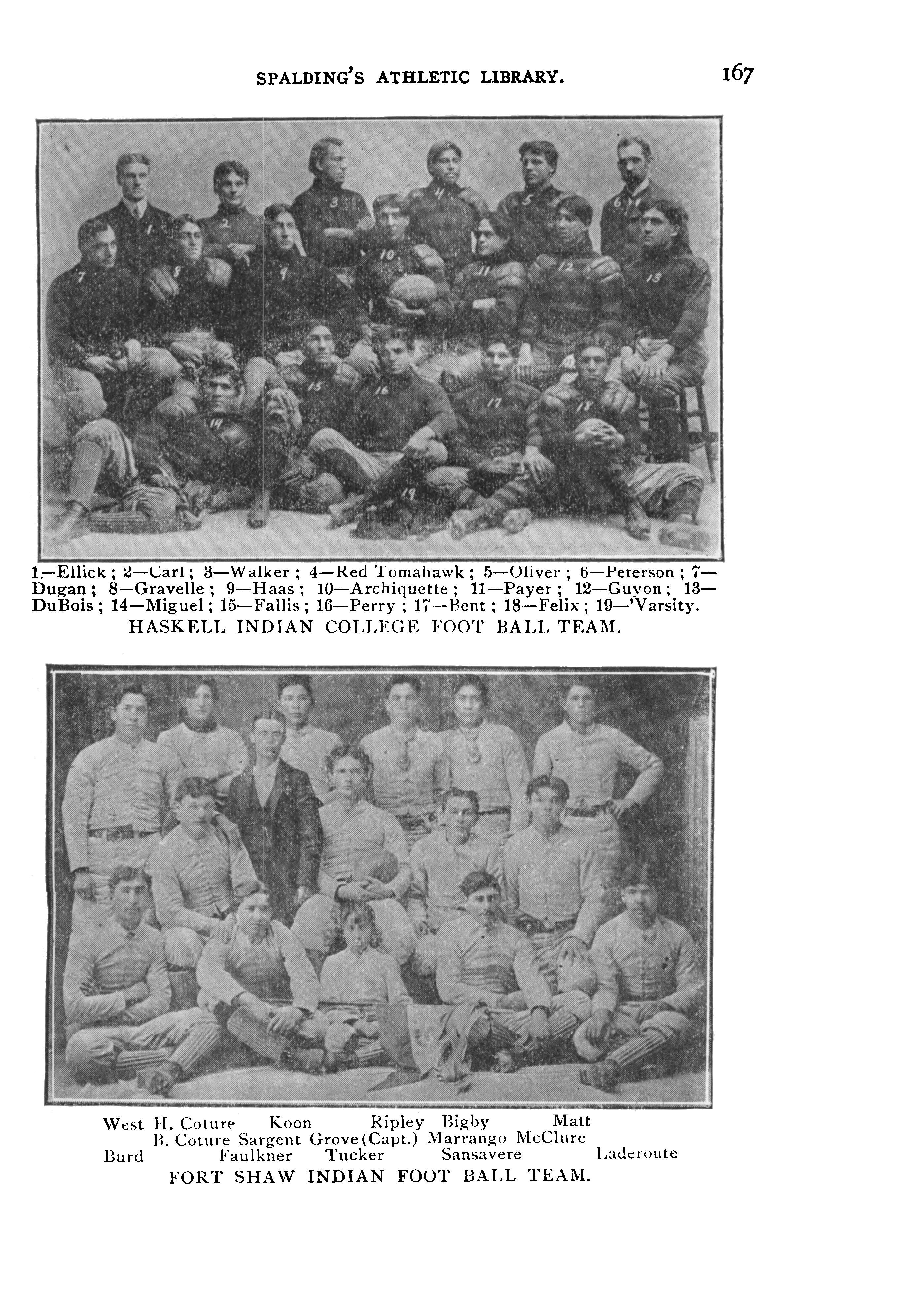
While preparing the 1901 Spalding’s Guide for printing, I noticed that some future Carlisle players could be found in two photos on page 167. The first photo was of the 1900 Haskell Institute team but was mislabeled as being “Haskell Indian College,” in much the same way as Carlisle Indian Industrial School was often referred to as Carlisle College. Perhaps the whites who elevated these government Indian schools to collegiate status felt embarrassed that the Carlisle and Haskell Indians routinely defeated teams from the elite schools with players who had less education, money or experience playing football.
The first names to register with me were Archiquette and Guyon. I already knew that Chauncey Archiquette, captain of the 1900 Haskell team had played for Carlisle prior to coming to Haskell. He again played for Carlisle after returning from Haskell a few years later. I also knew that Charles Guyon played for Carlisle after enrolling there in 1905. However, as a joke, he went by the name Wahoo.
The list of players’ names under the photo included some other familiar ones but they weren’t Carlisle stars; they were Haskell players who battled against Carlisle in the 1904 St. Louis World’s Fair game and later transferred to the eastern school. Steckbeck identified DuBois as another Haskell player who transferred to Carlisle along with several others who were on the 1904 team but not on the 1900 team. However, there were some players on the 1900 Haskell team that were also on the 1904 edition: Oliver, Felix, and Payer (or Payor).
Immediately below the Haskell photo is the Fort Shaw Indian School team photo. The person sitting in the first row, far left is Burd. Sampson Bird, captain of the great 1911 Carlisle team attended the Fort Shaw school before coming east, so this is probably him in the photo. An Indian agent probably spelled the name with a “U” instead of an “I” because the Burd family name was known to many.

Tags: DuBois, Felix, Fort Shaw Indian School, Oliver, Payor
Posted in Carlisle Indian School, Charles Guyon, Chauncey Archiquette, Football, Haskell Institute, Sampson Bird | Leave a Comment »
June 8, 2012
While preparing the 1911 Spalding’s Guide for printing, I noticed that some former Carlisle players could be seen in the numerous 1910 team photos to be found in that volume. That brought to mind an old newspaper article that I can’t lay my hands on now in which the writer opined as to why there were so few football coaches at a time when Carlisle Indian School players were grabbing headlines. I don’t recall his reasoning or conclusions but do remember having read the article.
The truth is that several Carlisle Indian School players tried their hands at coaching with varying success. The names that come quickly to mind are Bemus Pierce, Frank Cayou, Albert Exendine, Caleb Sickles, Lone Star Dietz, James Phillips, Joel Wheelock, Victor “Choc” Kelley, Mike Balenti, and Gus Welch (I keep adding names as they come to me while writing this article). I’m sure there were others. Given enough time to research this issue, I’m sure that I could come up with more. But I don’t have the time right now because I must get the 1901 Spalding’s Guide ready to print.
The lengths of their careers varied, but Exendine, Welch and Dietz all had long coaching careers. Of these, Lone Star Dietz had by far the most success and, as an acknowledgement of that success, was honored by the Helms Foundation many years ago. Next month, the College Football Hall of Fame will honor him. It is highly unlikely that any other Carlisle Indian will receive this honor because only a few had long careers and only Dietz, as far as we know, had a Hall of Fame worthy career as a coach. Also, Exendine and Welch were already inducted as players. My immediate concern is not about the Hall of Fame but with 1910 team photos that include former Carlisle players.
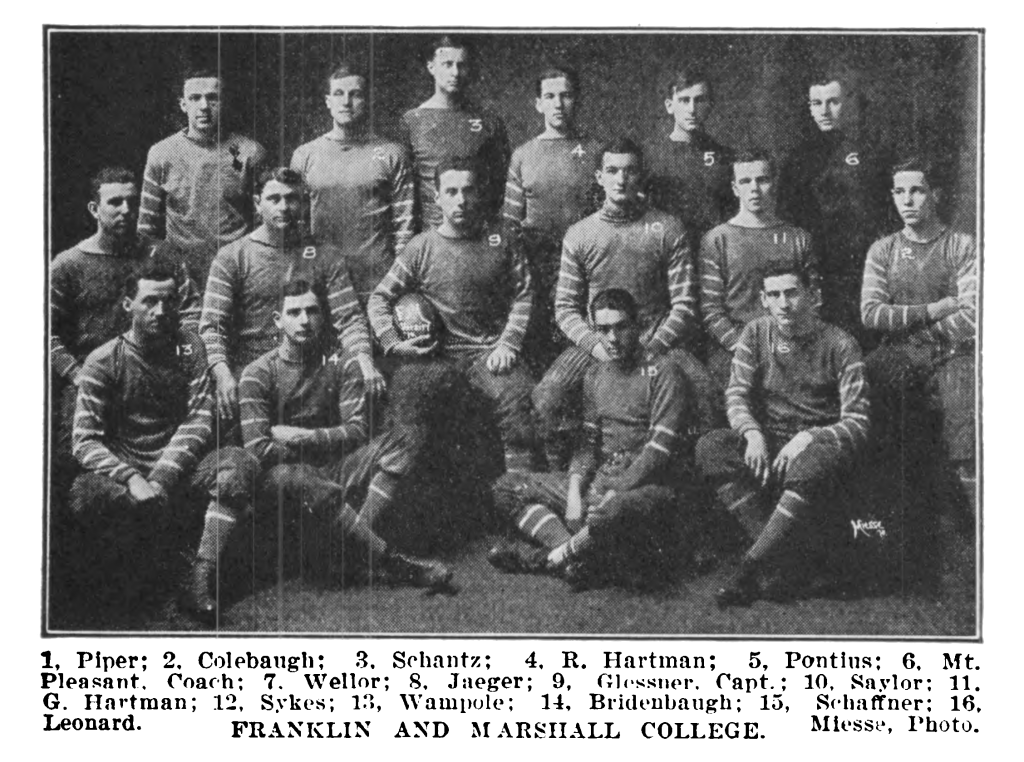
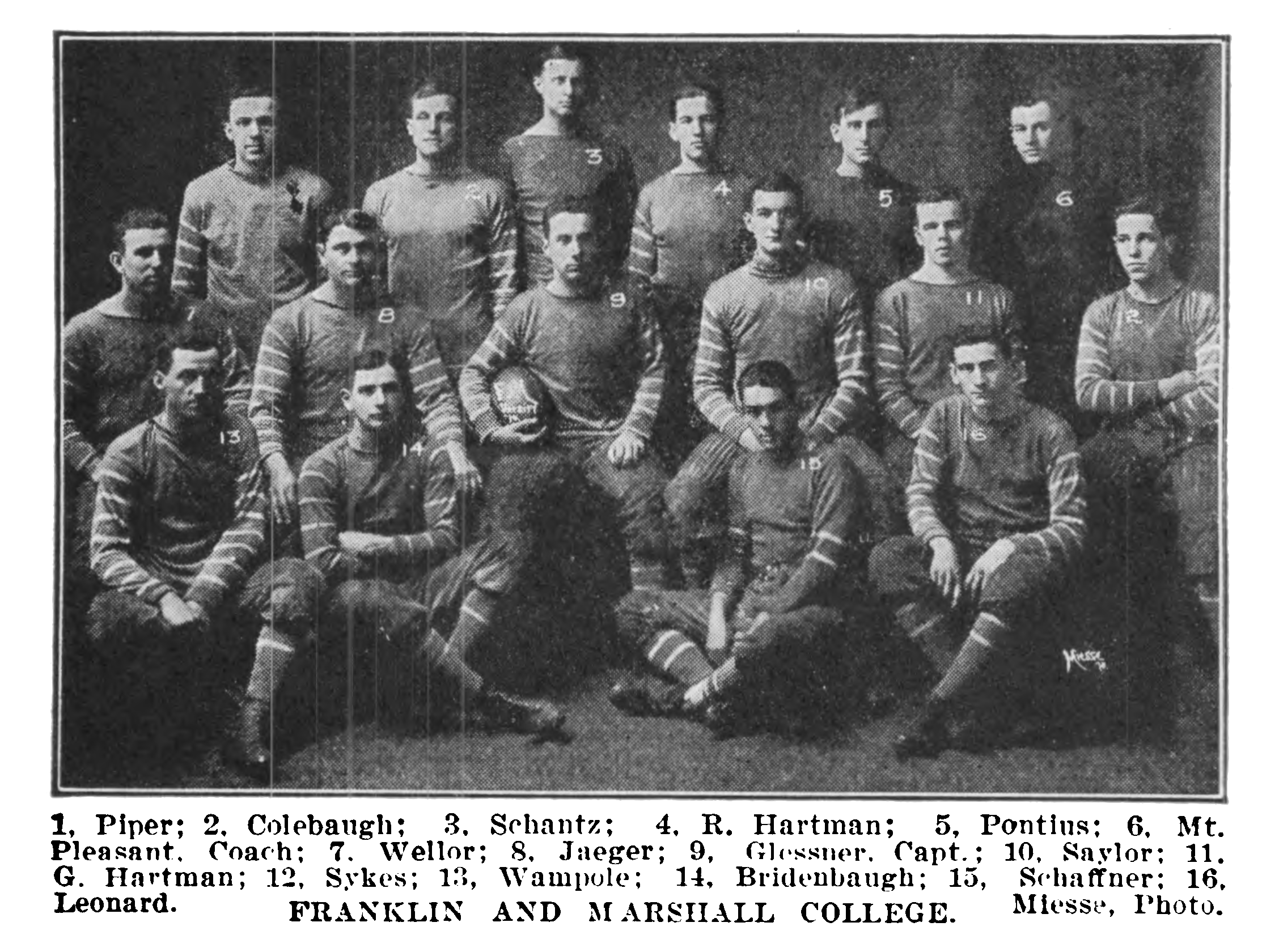
Follows are two of the 1910 team photos. I’ll leave it to the reader to find the Carlisle Indians in them, but here’s a hint: both wore their Carlisle letter sweaters. I take that as an indication of how proud they were of having been part of those great teams.

Tags: Carlisle Indian School Coaches, Franklin and Marshall College, Washington University
Posted in Albert Exendine, Bemus Pierce, Caleb Sickles, Carlisle Indian School, Doctors, Lawyers, Indian Chiefs, Ed Rogers, Football, Frank Cayou, Frank Mt. Pleasant, Gus Welch, James Phillips, Joel Wheelock, Lone Star Dietz, Mike Balenti, Victor Kelly, William Gardner | Leave a Comment »
June 5, 2012
While browsing through Two Hundred Years in Cumberland County for something unrelated to Carlisle Indian School, I stumbled across a short article that, although moderately interesting in itself, brought an entirely different article to mind. In 2008, I wrote about an article written by a James C. McGowan that is loaded with falsehoods. Honest errors are one thing but some of these seem to be made up from whole cloth. To make matters worse, this false information has been disseminated from WorldAndI.com, a paid “educational” web site that flogs subscriptions for schools, districts and individuals, since 2007.
The article that caught my attention today was titled, “Autoists Arrested.” In July, 1906, G. Wilson Swartz, Esq. and Albert E. Caufman were brought before Burgess Brindle for breaking Carlisle Borough’s five-mile-per-hour speed limit. None of the police officers who observed the drivers would testify that Swartz “goes faster than some of the drivers of the big machines….” This is further evidence to show that McGowan’s claims about Warner being the “first man in town to own an automobile” is patently false. One wonders about McGowan’s motives for promulgating such unfounded claims. Accuracy is something about which McGowan and, by extension, WorldAndI.com have little concern.
McGowan wrote the following in a section of the article that attacked Pop Warner:
As the Redmen beat one top team after another, including Pitt, Navy, Yale, Syracuse, and Rutgers, the Athletic Fund swelled with cash. Pop Warner took to wearing diamond jewelry, and he became the first man in town to own an automobile.
Anyone the least bit familiar with Carlisle Indian School football knows that the Indians never beat Yale. Even those who are familiar would be hard pressed to name a year in which Carlisle beat Rutgers because there is no record of the two teams playing each other. Warner wasn’t living in Carlisle in 1906 and didn’t return to live there until 1907, at which time he had an automobile. Little is known about that car but Warner was known for buying inexpensive old clunkers and tinkering with them until he got them running. Regardless, this piece further demonstrates that other Carlislians had autos well before Pop Warner.
http://www.worldandi.com/subscribers/feature_detail.asp?num=25821
Tags: 1906 speeding ticket, Albert E. Caufman, Burgesss Brindle, First automobile, G. Wilson Swartz, James C. McGowan, WorldandI.com
Posted in Carlisle Indian School, Pop Warner | Leave a Comment »
May 31, 2012
A question that has come up recently is where Lone Star Dietz’s artwork can be purchased, because he is in the news again for being selected for induction into the College Football Hall of Fame, I suppose. I know of no place that his original artwork can be purchased. (I would like to find some myself.) However, some of his works can be seen on public display and others have been reproduced and can be purchased.
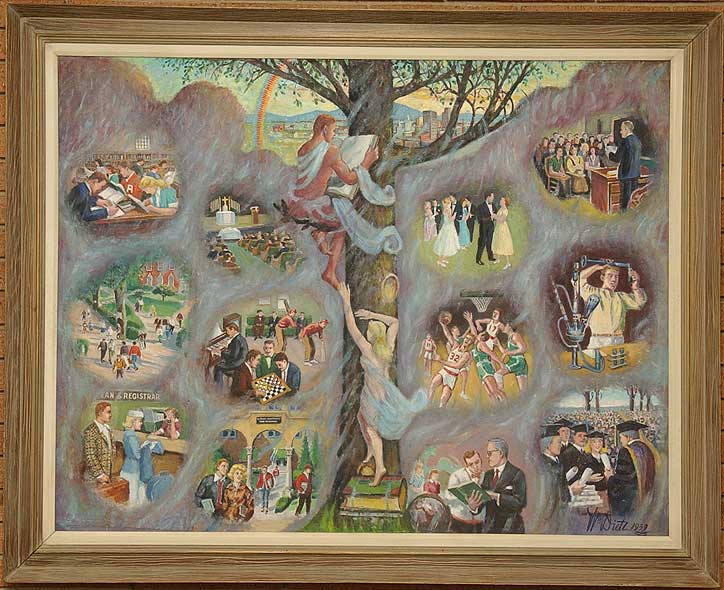
Albright College has four of his paintings on display: the Albright Lion, a portrait of Dick Riffle, a portrait of Lewis Smith, and an unusual collage of the Tree of Learning. Joel Platt has some of Dietz’s artwork in his Sports Immortals museum but they are not generally on display to the public. I was fortunate to find him in when I visited and he showed me a panoramic painting of Pittsburgh he had in his office. The back of the painting contained two titles, “My Pittsburgh” and “Pittsburgh Just Grew.” Apparently, Lone Star changed his mind as to what it should be called.
Most of Dietz’s artwork that I’m aware of is in private collections. A few of those found their way into an article done by Francine Scoboria for Albright College: http://www.albright.edu/reporter/spring2006/lonestar1.html. Occasionally, a reader will send me information on some as I have shared previously in this blog. Hopefully, more will surface in the future.
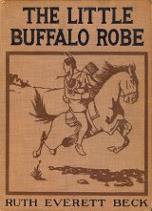
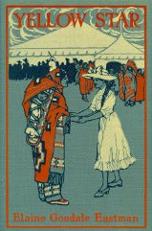
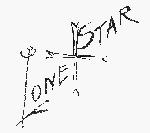
Fortunately, some of Dietz’s smaller pieces have been reproduced on items sold at History on High, Cumberland County Historical Society’s store in Carlisle and Tuxedo Press recently reprinted two books illustrated by Lone Star Dietz and his first wife, Angel DeCora. Yellow Star has four page-sized paintings done jointly by Dietz and DeCora reproduced in grayscale. The Little Buffalo Robe is chockfull of drawings done by Dietz and a few done by DeCora. It also has some full-page artwork done by DeCora. Tuxedo Press also created neckties using Dietz’s unique signature: http://www.tuxedo-press.com/index_files/OrderForm.htm

Tags: Albright College, Cumberland County Historical Society, Dick Riffle, Francine Scoboria, History on High, Joel Platt, Lewis Smith, Sports Immortals
Posted in Doctors, Lawyers, Indian Chiefs, Football, Lone Star Dietz | 8 Comments »
May 29, 2012
Thursday evening, I had the pleasure of attending the kick off reception at the National Museum of the American Indian (NMAI) in Washington, DC for their new exhibit, “Best in the World: Native Athletes in the Olympics.” This special exhibit, which runs through September 3, is timed to honor the 100th anniversary of the performance of two Carlisle Indians in the 1912 Stockholm Games but doesn’t limit itself to just their performances. In fact, the first thing one sees upon entering the exhibit is a blown-up photograph of Frank Mt. Pleasant broad jumping while wearing his Dickinson College jersey. He competed in the 1908 games in London. The exhibit also includes a photo of Frank Pierce, younger brother of Carlisle football stars Bemus and Hawley, competing in the marathon in the 1904 Games held in conjunction with the St. Louis World’s Fair. He is believed to have been the first Native American to compete for the United States in the Olympics. Enough about the exhibit, you can see that for yourself.
At the beginning of the reception, the dignities present were introduced. There is no mistaking Bill Thorpe due to his strong resemblance to his father. Bill is lending the use of his father’s Olympic medals to the NMAI for this event. Lewis Tewanima’s grandson was also present. He took the time to explain the importance of the kiva to Hopi culture. It was quite enlightening. Billy Mills, who broke Lewis Tewanima’s record for the 10,000 meters and won the gold medal in the 1964 Olympics spoke and was taped by a cameraman as he walked from exhibit to exhibit.
Some writers were also in attendance. Robert W. Wheeler, who wrote the definitive biography of Jim Thorpe, and his wife, Florence Ridlon, whose discovery of the 1912 Olympics Rule Book behind a Library of Congress stack made the restoration of Thorpe’s medals possible, was also present as was Kate Buford, the author of a recent Thorpe book. The apple didn’t fall far from the Wheeler-Ridlon tree as their son, Rob, whose website, http://www.jimthorperestinpeace.com, supports the effort to have Jim Thorpe’s remains relocated to Oklahoma.
More about the exhibit can be found at http://nmai.si.edu/explore/exhibitions/item/504/
Tags: 10000 meters, 1912 Olympics, Best in the World, Billy Mills, Bob Wheeler, Flo Ridlon, Frank Pierce, Kate Buford, Lewis Tewanima, marathon, Rob Wheeler, Stockholm
Posted in Bemus Pierce, Carlisle Indian School, Frank Mt. Pleasant, Hawley Pierce, Jim Thorpe | Leave a Comment »
May 24, 2012
Tonight, the National Museum of the American Indian (NMAI) in Washington, DC holds a reception to kick off its new exhibit, “Best in the World: Native Athletes in the Olympics,” to celebrate the athletic achievements of Native Americans on the 100th anniversary of the 1912 Stockholm Games that featured legendary performances by Jim Thorpe and Lewis Tewanima. I am attending because Bob Wheeler, Jim Thorpe’s Boswell, is to speak there. While making preparations for attending this event, I received some unexpected news.
The National Football Foundation (NFF) released its selections for induction in the College Football Hall of Fame Class of 2012 and Lone Star Dietz was finally on the list. As blog followers probably know, Greg and John Witter, first cousins and rabid Washington State football fans, and I campaigned to get Dietz placed on the Hall of Fame ballot some years ago. Getting his won-loss record corrected was the key to getting him nominated but there were larger obstacles yet to come.
Lone Star Dietz died in 1964 and there are few people still alive that knew him. Also, he coached at schools with smaller alumni bases and less clout than the major football factories. Washington State, for example, couldn’t muster the support for him that, say, Ohio State could for John Cooper or Michigan could for Lloyd Carr. While both these recent coaches had very good careers, neither had the impact on the history of the game as did Dietz. It’s one thing to inherit a strong program and be a good steward, but it is quite another to rebuild a floundering program from the ground up, something that Lone Star did multiple times.
The closest he came was in 2006 when the selectors chose Bobby Bowden and Joe Paterno instead of the people who were on the ballot. A couple of years ago, when Lone Star’s name was dropped from the ballot, I gave up all hope of him ever being selected. I didn’t even know that his name was on the Divisional ballot this year, so was shocked when I started receiving phone calls from reporters on Tuesday afternoon.
All I can say is that it’s long overdue. Although he’s being brought in through the back door, so to speak, he will finally be in. He’s the first Carlisle Indian to be inducted as a coach; the rest were as players. Whether this honor is enough to offset the many indignities Dietz suffered and mollify the Lone Star Curse is yet to be seen.
http://seattletimes.nwsource.com/html/cougarfootball/2018262997_dietz23.html
http://www.spokesman.com/stories/2012/may/23/blanchette-wsu-legend-dietz-gets-his-due/

Tags: 1912 Olympica, Bobby Bowden, College Football Hall of Fame, Greg Witter, Joe Paterno, John Witter, Lewis Tewanima, Lone Star Curse, National Football Foundation, National Museum of the American Indian
Posted in Carlisle Indian School, Doctors, Lawyers, Indian Chiefs, Football, Jim Thorpe, Lone Star Dietz, Washington Redskins, Washington State University | Leave a Comment »
May 22, 2012
Today, as expected, the U.S. Preventive Services Task Force (USPSTF) released its report on the efficacy of PSA screening for prostate cancer with little change over the draft version released last fall. The USPSTF recommends against routine PSA screening of asymptomatic men no longer be screened for prostate cancer. The committee, that includes no one who deals with prostate cancer patients on a daily basis and is headed by a female pediatrician, cited statistics that more men die within a month of prostate cancer surgery than would have died from the disease. Given that 28,000 American men are expected to die from prostate cancer this year, it is hard to believe that a larger number would die within a month of prostate cancer surgery. Of course, surgery is only one of a number of treatments available for prostate cancer but the others are less likely to kill someone in the short run. I suspect that the comparison would be much different if the(infinitely small) death rates from other treatments were considered. The study also cited side effects, erectile dysfunction and incontinence, from prostate cancer surgery as a reason to avoid PSA screening. Again, some alternative treatments come with lower rates of these nasty side effects. I chose proton therapy for myself because it gave me the best chance of coming out of treatment whole.
The study ignores the benefits of building a history of PSAs for each patient. For example, researchers have found that rapidly increasing PSAs, more than 0.2 increase for two successive years, not only indicates a greater likelihood of having prostate cancer but a greater likelihood of having an aggressive type that needs to be treated soon. With no history of PSAs, many cancers that need to be treated promptly won’t.
African-American males, Vietnam veterans, and men whose relatives have had prostate cancer are all at higher risk of developing the disease. Not screening these groups (two of which apply to me) will surely increase the death rate from prostate cancer. The American Cancer Society’s annual report for 2012 shows that the death rate due to prostate cancer began declining when PSA screening started and continues to fall. This fact argues strongly against the USPSTF’s position that PSA screening doesn’t save lives.
Waiting until a men presents with symptoms of prostate cancer greatly increases the likelihood that he will die or suffer nasty side effects because the disease is generally greatly advanced before the patient becomes symptomatic. Something not discussed in the report is the high level of pain those who die of prostate cancer experience. For all its numerous faults, PSA testing is still the best available option. Fortunately, researchers are working to find better indicators.
Tags: Prostate Cancer, PSA screening, U. S. Preventative Services Task Force, USPSTF
Posted in Prostate Cancer | Leave a Comment »
May 17, 2012
Jim Thorpe won the 1500 meter run, the last event of the pentathlon, with a time of 4 minutes 44.8 seconds. Avery Brundage did not finish but was awarded seven points, comparable to a last place finish. Whether he started and did not finish or just didn’t bother to run at all is unclear. Ironically, Thorpe could have finished dead last in the 1500 meters and still won the pentathlon but he probably never considered loafing to save his energy for the decathlon. Brundage finished in sixth place overall, ahead of Hugo Wieslander, who finished fourth in the 1500 meters. The best Brundage could hope for if he came in first, second or third was a bronze medal because, even if he finished dead last, Ferdinand Bie of Norway would have had only 22 points overall as he had only 15 points coming into the 1500 meters where Brundage already had 24. A first place finish would have given Brundage 25. A fourth place finish would have given him 28 points, still good enough for a bronze because James Donahue and Frank Lukeman both finished with 29 points in a tie for third place. The tie was broken by recalculating their results using the method used for the decathlon with the result that Donahue was awarded the bronze medal
According to Wikipedia, Brundage chose not to compete in the final event of the decathlon, again the 1500 meter run, and later regretted the decision. It may be that he also chose not to run the 1500 meters in the pentathlon as well. Perhaps his biographer, Allen Guttman, can shed some light on this but it has been decades since he wrote about Brundage and he may have forgotten the details.
Something that is clearer now is that the Brundage who came in second to Frank Cayou in a track meet held at the University of Illinois on April 28, 1900 probably was Avery. Although still in high school in Chicago, his times were already good enough to compete with college boys.
Tags: 1500 meters, 1912 Olympics, Allan Guttmann, Avery Brundage, Ferdinand Bie, Frank Lukeman, Hugo Wieslander, James Donahue, Pentathlon, Stockholm Olympics
Posted in Carlisle Indian School, Frank Cayou, Jim Thorpe | 1 Comment »






 Tom Benjey's Weblog
