Paul Laroque 1907

December 27, 2013

I neglected to mention that Paul LaRoque played hurt in the last game of the 1905 season against Georgetown. He started the game with a broken rib but probably didn’t play long in this 76-0 blow out. So, diseased or injured, he probably completed the 1906 season on the field for the Indians. His grandson informed me that, instead of sitting quietly at home, he played for the “North Dakota Bison” in 1907. That prompted me to do a little more research.
I quickly found newspaper clippings of a couple of North Dakota Agricultural College (today’s North Dakota State) games in which LaRoque was on the line—right tackle against South Dakota and right end against Haskell Institute. “Gloomy” Gil Dobie coached the North Dakota Aggies (as they were generally called) in 1906 and 1907 contrary to what Wikipedia states. One would think NDSU fans would want to see Dobie mentioned as one of their successful coaches. However, CFBDATAWAREHOUSE.com has that right. That site lists the Aggies having played only three games that year. They likely played more but I haven’t found them. One wonders if playing for “The Apostle of Grief” convinced Paul to return to Carlisle or if the announcement of Warner’s return swayed him or if that was his plan all along. We’ll probably never know for sure.
Something that readers may find confusing is that LaRoque played on the line but was mentioned in newspaper reports as having made good gains carrying the ball. In those days, linemen were sometimes positioned in the backfield and also were handed the ball on criss-cross plays. It was a much different game then, particularly before teams adapted to the 1906 rule changes.

Where was Paul Laroque in 1907?

December 24, 2013

The grandson of Paul LaRoque and the great grandson of Frank Jude both contacted me recently. LaRoque and Jude were both from Minnesota and played on the Carlisle football team together part of the time they were there. Something I learned about Frank Jude was that his family name was not pronounced as most assumed; it rhymes with today. And researching Paul LaRoque is made more difficult because his name was often spelled LaRocque. However, LaRoque is how he spelled it when he signed the Carlisle application in 1906. Today, we’ll address what he did while he was supposedly back home in 1907 healing his eye injury.

My first challenge was to determine if he had an injury or a disease (many Carlisle students had Trachoma, particularly those who came from the west). Paul’s discharge date for his 1904 enrollment was December 4, 1906. The discharge was “Bad Eyes.” That description implies a disease but Carlisle had long had an arrangement with an ophthalmologist who would likely have treated him if he had Trachoma. That his family believes he was home recuperating from an eye injury suggests that he may have been injured playing football at Carlisle. Laroque received praise in newspaper accounts for opening holes for Frank Mt. Pleasant in the November 17 game against Minnesota. Whether Paul played in Carlisle’s next game against Vanderbilt on November 22 is open to question since newspaper accounts are inconsistent. The most detailed coverage for the season-ending Thanksgiving Day game with the University of Virginia on November 29 lists him as playing his regular position of right guard. However, newspaper accounts of the day often included line-ups given to them a day or more before the game that didn’t reflect who actually played. Without names or numbers on their jerseys, reporters unfamiliar with the players didn’t know who was actually on the field unless they asked—and they often didn’t.

One report that summarized the season for Carlisle stated that the Indians had had no bad injuries during the season. That statement was most probably a matter of opinion and perspective that should be taken with a lot of salt. So, whether Paul Laroque had a football injury or an eye disease is still unclear.

<end of part I>

Warner Teams Scored the Most Points

December 15, 2013

While researching the 1906 Carlisle Indian School team, I came across something that might interest my sports statistician friend Tex Noel in the December 7, 1906 edition of The Arrow, Carlisle’s school newspaper. In addition to summing up Carlisle’s season, the article titled Football Resume closed with a list of points scored and points allowed by team for the top 34 college teams. Carlisle scored 244 points for the season where Cornell scored 237. The only team to outscore them was the University of Western Pennsylvania (known as Pitt today), which racked up 254 points. Pitt not only played an easier schedule that year than did Carlisle and Cornell, they lost to them 22-0 and 23-0, respectively. It is fair to say that Carlisle and Cornell far more points than did the other major football powers that first year under the revolutionary new rules. But why?

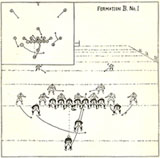
Sure, they had good players, but some teams had All Americans. I propose that it was the offensive schemes these teams ran that made the difference. Ironically, both teams ran formations developed by none other than Pop Warner. Warner stated that the Indians were the first team to run the earliest incarnation of his single-wingback formation and they first ran it 1906. But Warner didn’t coach Carlisle in 1906 because he was at Cornell then. However, he spent a week at Carlisle before the season started coaching the Indians’ coaches, Bemus Pierce and Frank Hudson, in his new offensive schemes designed to take advantage of what the new rules allowed, including the forward pass. It’s probably true that both Carlisle and Cornell ran Warner’s single-wing that year. Given that, even though they don’t use it themselves, some modern-day coaches acknowledge that the single-wing was the most effective running formation ever devised. In those days of run mostly, even an early version of the single-wing would have given teams running it an advantage that could show up on the scoreboard.

1906 points scored

Beer for “Brain Workers”

November 25, 2013

While perusing old newspapers for information on a member of the 1910 Harvard Law School All Star team for the player’s grandson, my attention shifted, as it often is to shiny objects, to an advertisement located near a tiny article about the man I was researching. The title of the ad blared “Gold Medal Duesseldorfer Beer for the ‘Brain Worker.’” Since beer isn’t often credited with having a positive relationship with intelligence, I became curious and read the text in the ad. In addition to “Being mildly stimulative, it clears and refreshes the brain, while the hops it contains have a soothing effect that banishes nervousness.”

While these claims are not nearly as radical as those made by Cliff Clavin, few would seriously consider taking them seriously. But then, 1907 was a long time ago. For those who can’t remember Cliff Clavin’s pronouncements, a little refresher may be in order.

Cliff likened brain cells to members of a buffalo herd in which the weaker and duller members were culled by predators, thus improving the gene pool of the buffaloes that survived to mate. In the case of brain cells, Cliff theorized that, when ingested into the human body, alcohol kills brain cells but not just any brain cells, it attacks the slower and weaker ones first. With the inferior cells removed, he opines, the brain is quicker and more efficient. That is why, he explains, one feels smarter after downing a few beers.

Beer good for Brain Worker

Dragged into the Redskins Naming Controversy

November 12, 2013

As followers of this blog know, Lone Star Dietz’s name pops into the news whenever the Redskins naming controversy heats up. After President Obama interjected himself into this matter, I started getting calls from reporters again. So far, my name has appeared in several places and has caused some embarrassment for me as well as some amusement.

The first mention I was made aware of was on the Redskins’ Official Site: http://blog.redskins.com/2013/11/01/jim-thorpe-the-greatest-athlete-in-the-world/

Unfortunately, the posting included a photo with the caption I unwittingly used in my book.  The Albright College player standing between Jim Thorpe and Lone Star Dietz in the photo was not Leo Disend as the 60-some-year-old yearbook stated. I became painfully aware of that mistake during the Q&A session at the end of my very first book talk when Leo Disend’s brother informed me that the player in the photo was identified correctly. Accepting that he must know what his brother looked like, I informed Albright College of the error. After conducting some research, they determined that the player in question was in fact John Killiany.

The Washington Post published a large spread on Dietz that mentioned me briefly: http://www.washingtonpost.com/lifestyle/style/the-legend-of-lone-star-dietz/2013/11/07/00569fa2-471d-11e3-bf0c-cebf37c6f484_gallery.html#photo=1

The Post also posted a video of Barry Zientek on its web site: http://www.washingtonpost.com/posttv/local/the-story-of-the-man-for-whom-the-redskins-are-named/2013/11/06/a4760340-4743-11e3-bf0c-cebf37c6f484_video.html Barry Zientek’s parents befriended Lone Star & Doris Dietz in their old age and helped them in many ways when they lived in poverty.

Reading PA The Morning Call published an article from Lone Star’s grave written by the same Washington Post reporter: http://www.mcall.com/sports/mc-redskins-dietz-1107-20131107,0,656374.story?track=rss

For the first time I’m aware of, I was mentioned in a foreign newspaper, the Daily Mail of London, England in an error-riddled article: http://www.dailymail.co.uk/news/article-2492195/Was-native-American-figurehead-justification-Washington-Redskins-fraud-faked-ethnicity-gain-publicity.html  However, I wasn’t mentioned for saying anything about Dietz; I was credited with having given the Mail permission to use the image of the 1908 St. Louis Globe-Democrat article on Dietz of which I own the only surviving copy. (I’d like to have one in better condition but haven’t been able to find one.) Oddly, I have no memory of being contacted by the Daily Mail to use this or any other image I own.

The Great Red Hope

October 22, 2013

While searching for newspaper articles about the 1912 Carlisle-Brown game for another researcher, I came across an article about Jim Thorpe possibly participating in yet another sport. An article that came out the day most of the game coverage appeared in papers was an unrelated article on page 9 of the Friday, November 29, 1912 edition of the Oleans Evening Times titled “Jim Thorpe May Become Red Hope,” bylined Cambridge, Massachusetts. The article led off with “Jim Thorpe, the big Carlisle Indian, and Charley Brickley, vest pocket edition of Jim Jeffries, though they may never match brain, brawn, and feet on the gridiron, may meet in the squared circle.”

Carlisle and Harvard didn’t play in 1912 and its followers still may have been smarting over the loss the year before and wanted to even the score a bit. Or, someone may just have been wanting to make some money. We probably will never know who was behind this scheme because all the article said was “Overtures have already been made [by an unnamed person or persons]…to box a Harvard amateur, the bout to be pulled off next month before one of the winter boxing meets of the Boston Athletic Association.”

The promoter of the fight wasn’t the only name kept secret; Thorpe’s opponent wasn’t identified either. Possible candidates reputed to be adept at the manly art of self defense included Charley Brickley, Harvard’s star half back and Thorpe’s rival at place kicking, right tackle Bob Storer, and substitute end Al Weatherhead.

After this build up, the article’s tone changed abruptly in the last paragraph:

“Before going to Oklahoma, however, Thorpe will probably slip up to Boston for the proposed bout with the Harvard athlete, unless Glenn Warner, who is said to be dead set against Thorpe’s pugilistic aspirations, may successfully talk him out of it.”

Pop probably talked him out of it and, now knowing how harmful concussions can be, extended his long athletic career by not letting him get his head pounded in the boxing ring.

Carlisle’s National Treasure

August 31, 2013

Last week I got a call from Sentinel reporter Joe Cress asking about Freddie Wardecker. For those not from the Carlisle area or who aren’t interested in Carlisle Indian School sports teams, Freddie is the proprietor of Wardecker’s Mens Wear, formerly M. Blumenthal on North Hanover Street not terribly far from Carlisle Barracks where the Indian School was located from 1879-1918. Mose Blumenthal operated The Capital, as the business was then known, back when the Indian School was in operation. Mose also had a contract with the Indian School and did work there. Indian School personnel and students patronized The Capital. Along the way, Mose collected a number of artifacts related to the Indian School, its students, faculty, and staff. Freddie inherited them and has added a number of items related to Carlisle to the collection.
For serious researchers, visiting Wardecker’s is a must. Freddie freely shares his wisdom concerning Jim Thorpe et al but welcomes visitors to sit at his round table to solve the world problems of the day.
I told Joe what I know but referred him to Bob Wheeler, the author of the definitive biography of Jim Thorpe, because he has better stories to tell and is much more eloquent than I could ever hope to be. Here is a link to the article about not a local treasure, not a state treasure, but a national treasure: http://cumberlink.com/news/local/history/wardecker-s-menswear-store-in-carlisle-remains-a-resource-for/article_0d679b7c-0dbd-11e3-990c-0019bb2963f4.html Don’t forget to check out the photos.

Random Carlisle questions

August 14, 2013

Because of this blog and my books about Carlisle Indian School football players I often get questions related (sometimes very loosely) to these people, early football, Pop Warner, and Carlisle Indian School in general. A couple I received earlier this week are:

Q. Was there a river or stream within walking distance from Carlisle’s campus where Jim Thorpe could have gone fly fishing?

A. For anyone who has lived in Central Pennsylvania this is a trivial question. For anyone else, a little research would be required. Living here gave me an advantage. Letort Spring Run, one of America’s most highly regarded trout streams runs through the campus but I doubt if a serious angler would have fished that stretch. He would most likely have tried his luck just south of town nearer to the creek’s source at Bonnybrook. Fishing the Letort can be frustrating, I’m told, because the fish are so smart. Some say it’s necessary to crawl up to the bank on one’s stomach to keep from alerting the fish to your presence. Eugene Craighead cut his teeth at Bonnybrook and became one of the country’s most noted fly fishermen.

Q. In the evening on the Carlisle campus, at a specific time, did a bugler play “Taps” signaling lights to be turned off all over campus?

A. Intuitively, this sounds accurate because Lt. Richard Henry Pratt of the 10th Cavalry founded the school and served as its superintendent for 25 years before being replaced by Maj. William A. Mercer, another cavalry officer. The students wore military uniforms and marched daily, so using bugle calls seems obvious. However, one needs proof—and there was some.

Taps

And a decade later The Carlisle Arrow of September 27, 1912 provides some more:

Bugle Calls

Florida License Plate Game

July 14, 2013

On vacation in Florida, my wife, Ann, and her friend, Judi, noticed NUMEROUS different specialty tags issued in that state and had a contest over spotting them. I formalized their little contest into Florida License Plate Game and gave a few prototype copies to friends. The people who enjoyed it most were retirees who record the unusual license plates they see on their daily walks and outings and families who play it while traveling in Florida. All who played the game enjoyed it and some offered suggestions for improvement.

Now I’m ready to make a production print run. To promote the game, I am experimenting with running an Indiegogo.com campaign. For those not familiar with crowdsourcing or who want to know more about the game, please check out http://igg.me/at/FLPG. I don’t expect you to contribute to the campaign (unless you want inexpensive copies of the game) but would appreciate it if you would look at it and comment on it. Increasing the number of views will get it positioned more prominently on the Indiegogo site. Thanks, Tom.

9781936161010

Redskins Named in Dietz’s Honor

May 6, 2013

Professor Joseph Gordon Hylton posed some opinions and asked a question with regard to the naming of the Redskins NFL team yesterday. He stated that George Preston Marshall, owner of the Boston NFL franchise, had a life-long fascination with Indians. That is believable because another NFL owner, Walter Lingo, believed there existed a mystical connection between Indians and the Airedales he raised and sold. His team was formed a decade before Marshall’s and was named the Oorang Indians. Now to Dr. Hylton’s question:

“Has anyone pinpointed the day that the name change was announced?”

I previously located letterhead for the Boston Braves that listed Lone Star Dietz as the head coach (see p. 278 of Keep A-goin’: the life of Lone Star Dietz) but hadn’t tried to pinpoint the exact date of the name change. A little research turned up the date Dietz was named head coach in a March 8, 1933 issue of The Boston Herald. The team was referred to as the Redskins on the sports page by the end of August, so it had to renamed before that. A little more research located the announcement of the team’s name change. The July 6, 1933 issue of The Boston Herald included a short article titled Braves Pro Gridmen to be Called Redskins (see below). This article establishes the fact that the Redskins were renamed well after Dietz’s hiring and includes the team’s published reason, “…the change was made to avoid confusion with the Braves baseball team and that the team is to be coached by an Indian, Lone Star Dietz, with several Indian players.”

This article supports the contention made by George Preston Marshall’s granddaughter several decades later.

1933-07-06 Redskins renamed