Archive for the ‘Richard Henry Pratt’ Category

Wrong Think

January 9, 2024

A person, whom I’ve never met and whose name I’m not divulging for fear of reprisal to him, wrote to me about my being banned from Facebook for Wrong Think.

Hi Tom, sorry to hear about being banned from Facebook, for no reason at all, and not being able to dispute it. I will back you up by saying that of the thousands of student files I’ve read, I’d say that well over 90% of the students were appreciative of their time at “Dear Old Carlisle”, and you would be hard pressed to find negative comments in those same records. That being said, there were “runners” for sure, which I understand, Carlisle wasn’t for everyone. These ignorant, on the subject of the Carlisle Indian School, virtue signalers, who just parrot the same old “all Indian schools were evil” narrative, don’t have a clue, and do the Carlisle students a serious misjustice by not learning the good it did. People need to realize that a census done in the late 1890’s, early 1900’s accounted for maybe 225,000 Indigenous folks left, Capt. Pratt was on a mission, not to let their extinction happen.

I haven’t read thousands of student files because my interest lies primarily with the football team. However, I have read hundreds of files of players and their relatives. Families often sent several or all of their children to Carlisle and information on the players’ family histories, particularly with regard the health and deaths, could be found in siblings’ files. I will concede that former students who had unhappy experiences at Carlisle would have been unlikely to respond to requests from the administration about their lives after Carlisle. Also, administrators may have purged negative responses from the files. In spite of that, a huge number of positive responses can still be found in the archives over 100 years after the school closed.
George Conner, Osage (1870-1936)

October 23, 2023
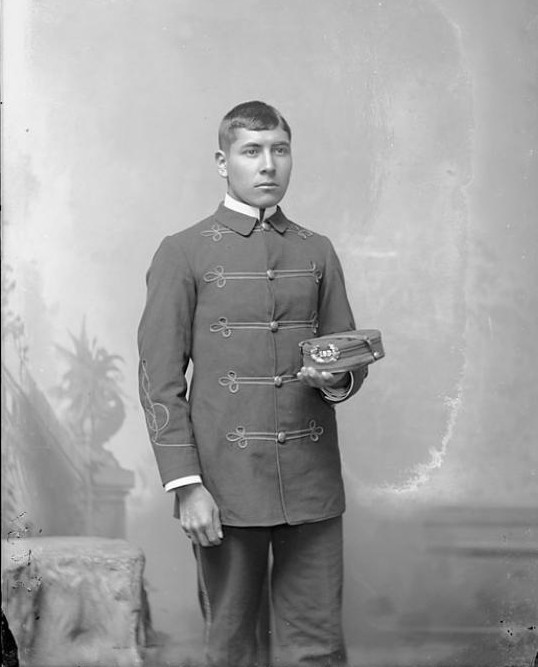
Some family members doubt this is a photo of George although it is labeled as such in the archives.

An interesting article from 2012 unexpectedly came over my virtual transom today. It was about an Osage Indian selling his grandfather’s Carlisle Indian School uniform to the National Museum of the American Indian (NMAI). No, it wasn’t a football uniform. It was his student uniform which was similar to those worn by the cavalry. That may seem strange to those not familiar with the school but it really isn’t. The school’s founder and superintendent for 25 years, Richard Henry Pratt, was a cavalry officer as was his successor. Pratt’s adult life had almost all been spent in the army, either fighting in the Civil War or in the Indian wars later. The military life was what he knew so he dressed the students in military uniforms, assigned them military ranks, arranged them in units, and drilled them in marching.

What was a little surprising was that the man was Osage. Since few of them were football players, I didn’t know much about them. According to his grandson, George Conner was an orphan who arrived at Carlisle in 1885 and stayed until 1890. He returned for a second enrollment at Carlisle, during which he assisted with the physical education program. He finished his schooling in 1899 at age 29 and returned to Oklahoma (Indian Territory at that time). There he put his training in harness making and saddle repair to work when he opened his own shop in Pawhuska, the Osage capitol.

George married Lillian House, who was a matron at St. Louis School (often referred to as Osage girls School), a Catholic institution funded by Mother Mary Katherine Drexel. After George’s stepfather was murdered, the couple considered Pawhuska too dangerous a place to raise a family and moved to Grainola. He took up farming and remained there the rest of his life.

He became involved in the resistance to the Dawes Act and worked with fellow Osages for two decades in an attempt to prevent the division of the reservation into allotments. He also served as the Osage National Council Secretary for a number of years.

In responding to a 1912 letter from Carlisle requesting information about his life after leaving the school, George said in part:

“I feel as that my learning while at Carlisle Indian Industrial School was the foundation of my success in life so far. Does it pay to educate the Indians? Certainly it does. Today there are white people that don’t live far from me that can’t write their own names. Does it pay to educate white children?”

/https://osagenews.org/osage-donated-grandfathers-1886-carlisle-uniform-to-nmai/

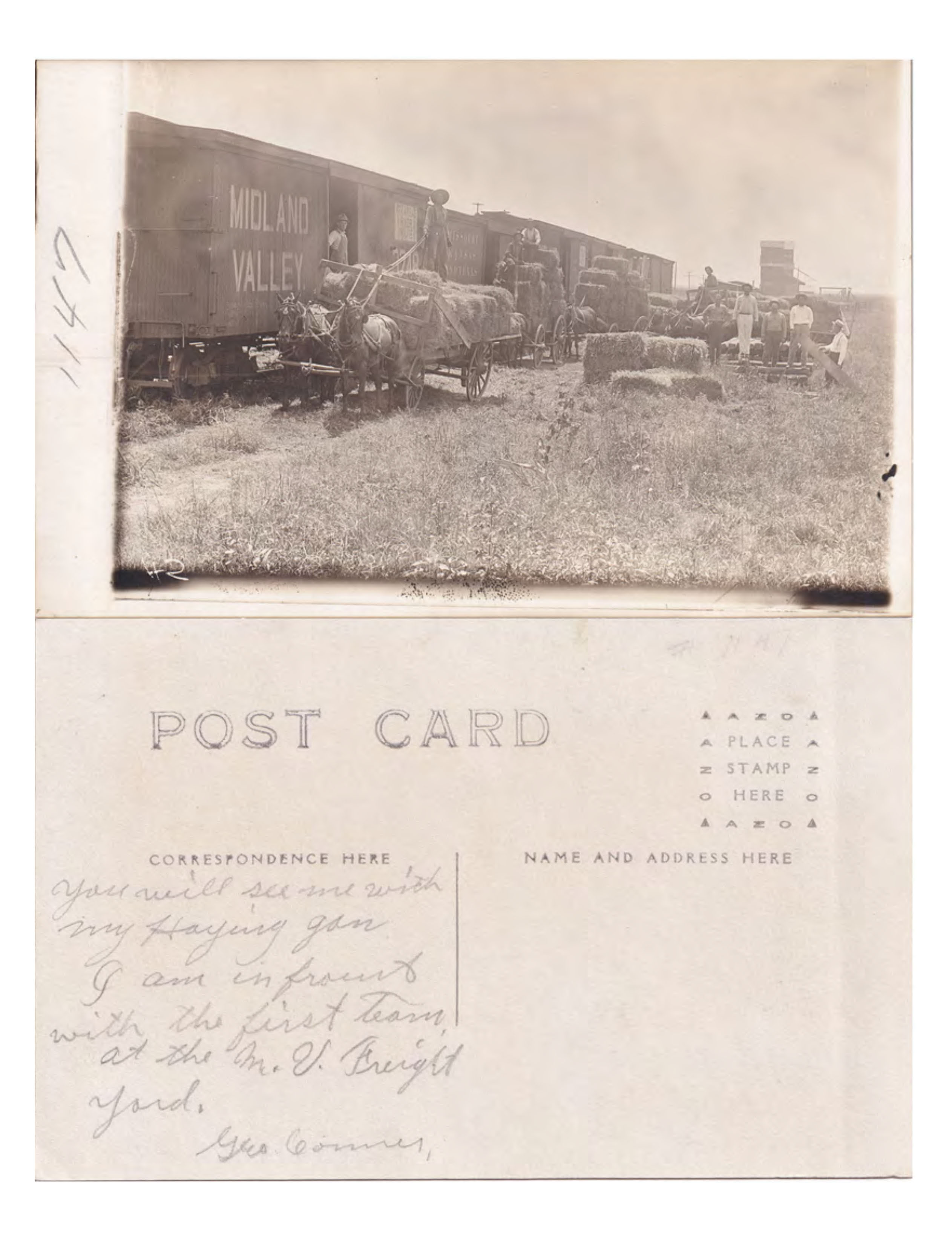
Joe Conner’s wife commented that the photo at the top is definitely not George Conner. Below is a photo that surely is him. However, he was too far from the camera for his face to be seen clearly.

More about Carlisle Indian School founding

January 6, 2023

While looking for a little more about the life of David Pendleton Oakereater, I came across an 1879 newspaper article that brought a little more light to the founding of Carlisle Indian School, although Oakereater was never enrolled there.

Mary Alicia Key Pendleton, wife of Senator George Hunt Pendleton of Cincinnati, Ohio and daughter of Francis Scott Key, spent much of the 1876-77 winter in St. Augustine, Florida. While there, she organized an archery club and applied to Richard Henry Pratt to detail two Indian prisoners at nearby Fort Marion to teach a class of ladies how to shoot bows and arrows. Pratt assigned the task to Making Medicine, Cheyenne aka Oakereater, and Playing Boy, Kiowa aka Etahdleuh Doanmore. So, after only a year and a half of confinement, the prisoners no longer scared the townspeople, at least some of them. One supposes that Mrs. Pendleton figured that if her father could survive the shelling of Fort McHenry, she could manage contact with a few Indians. The young men worked with the club throughout the winter. During this time, Mrs. Pendleton became much interested in the two young men and gave them presents. When their incarceration was over, she paid their expenses to travel to Syracuse to become educated by an Episcopal minister.

She became interested in the education of Indian children in general and used her influence, particularly with her husband, it seems. Sen. Pendleton was credited by using his position on the Indian Committee to move Congress to take action that resulted in the transfer of Carlisle Barracks to the Interior Department, which controlled the Bureau of Indian Affairs.

At this point in the article, The Wichita Weekly Beacon reporter inserted his or her opinion: “This is the entering wedge, and other useless barracks and forts will, no doubt, be poetical justice, though long deferred.” Further research will be required to determine how many army bases would house government Indian schools.

Sen. Pendleton is perhaps best remembered by the 1883 act bearing his name that required civil service exams for government positions. This bill was passed in reaction to James A. Garfield’s assassination by a disappointed office-seeker. With close ties to the Copperhead political faction, he ran on the Democratic ticket as George McClellan’s vice-presidential candidate against Lincoln’s reelection in 1864.

5Q Articles

December 15, 2022

I wonder if other newspapers are doing what my local paper, The Sentinel (Carlisle, PA), is doing. Rather than writing book reviews, they are publishing what they call 5Q articles. 5Q is shorthand for the five questions they provide the author to answer in writing, which they use, with “He said” interspersed randomly to give the appearance of an interview, to flesh out the body of the article. The on-line version includes photos and an image of the book’s front cover but the print version only includes the text. The column on the left was printed on the front page of the paper. The remainder was on page 7.A copy of the print version is provided. It may be necessary to view it in full-screen mode for the text to be large enough to read.

Saint O-kuh-ha-tah Part 4

November 17, 2022

The Great Depression immediately followed by World War II interrupted the mission work Oakerhater had started. It took new people moving into the area in the early 1960s to bring it back to life. An Episcopalian family advertised a religious meeting they were going to hold in their home. Seeing the ad were some Cheyennes who had known Oakerhater. They worked with the new family to revive his old mission.

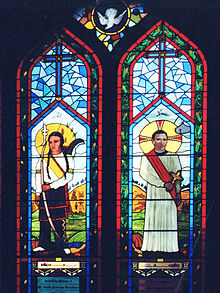
Muskogee Creek scholar Lois Carter Clark researched Oakerhater’s life and works, culminating in his being designated as a saint by the Episcopal Church in 1985. The next year on September 1, the first feast held in his honor was celebrated at the National Cathedral in Washington, DC. Saint George Church in Dayton, Ohio dedicated a large stained glass window to him in its chapel in 2000. The tall six-sided window with pointed ends depicted him as a deacon with Cheyennes looking toward him. A smaller window featured his glyph signature.

St. Paul’s Cathedral of Oklahoma City dedicated a chapel to Oakerhater and replaced a window that was blown out by the 1995 Oklahoma City bombing. Preston Singletary (Tlingit) created a stained glass window featuring his glyph. The church also organized The Oakerhater Guild of St. Paul’s in partnership with Whirlwind Mission of the Holy Family.

The Whirlwind Church gained a permanent site in Watonga in 2003 and dedicated the Oakerhater Episcopal Center in 2007, which provides a place for powwows, a sweat lodge, classes, and an annual Cherokee Dance in Oakerhater’s honor.

Now a national shrine to Saint O-kuh-ha-tuh, Grace Episcopal Church in Syracuse, New York held a Native-American celebration in 2005 to honor him, the first Native-American saint of the Episcopal Church. The new stained glass windows honoring him and designed by his great-granddaughter Roberta Whiteshield-Butler were dedicated in this event.

<end of part 4 of 4>

Saint O-kuh-ha-tuh part 3

October 20, 2022

While at Fort Marion Pratt, having previously observed their artistic bent, gave the prisoners—hostages to some—art supplies and ledger books on which to draw. Historically, plains Indian women painted geometric designs where the men painted people and animals, often depicted in action scenes important to them. Ledger art had already been created by some plains Indians but not to a large extent. Making Medicine was one of the most prolific artists at Fort Marion. His drawings, generally done in pen and ink, chronicled events such as tribal dances, hunts, courting, activities at the fort, and personal achievements. These drawings were done in a style similar to the decorations previously done on hides and personal possessions.

Townspeople and visitors to the fort were attracted to the drawings and Pratt encouraged the artists to sell their works to the tourists. He has since been criticized for commercializing this art. Making Medicine was the most prolific and his drawings, made in ink and colored pencil, were the most popular. Some he signed with this moniker, others with a glyph representing a sun dancer in a lodge.

Henry Benjamin Whipple, Episcopal Bishop of Minnesota, became a frequent visitor and a patron of the Fort Marion arts program. He bought several books of ledger art, which he showed to President Grant as evidence of the progress Pratt was making with his charges.

In 1998, Herman J. Viola compiled ledger art done by Making Medicine and Zotom (Kiowa meaning The Biter) aka Paul Caryl Zotom into a book adding commentary to give it contest. Samples follow.

<end of part three>

Saint O-kuh-ha-tuh part 2

October 8, 2022
Oakerhater at Fort Marion

In October 1879, David Pendleton Oakerhater, as he was then known, left New York for a time to assist Pratt in enlisting children from Indian Territory (Oklahoma today) for his former jailer’s new school in Carlisle, Pennsylvania. In 1880 after returning from this mission, Oakerhater’s wife Nomee (Thunder Woman) died in childbirth in Paris Hill. The next year, their young son Pawwahnee died. Both were buried in the church cemetery. She had earlier bore him three daughters, all of whom had died. Along the way, he had taken a second wife Nanessan (Taking Off Dress) while married to Nomee but had divorced her by 1878. The daughter born to them had died as had his other children.

In May of 1881, Pratt petitioned the Office of Indian Affairs for the money to transport Oakerhater back to Indian Territory from where he had been taken prisoner. The government had paid the travel expenses of the other Fort Marion prisoners to return home after their incarceration was completed but the Episcopal sponsors had paid the travel expenses for the four who went to New York State. Now it was time for the government to return them to Indian Territory. Oakerhater’s reason for returning was to build Episcopal churches at the Indian agencies.

He married again in 1882 to Nahepo (Smoking Woman aka Susie Anna Bent) who took the name Susie Pendleton. Both of their children died young. She died in 1890 at 23 years of age.

In 1887, Oakerhater worked at the Episcopal mission in Bridgeport and in 1889 at the Whirlwind Mission near Fay, seventeen miles west of Watonga. Many of the Whirlwind students suffered from poverty, trachoma, and conjunctivitis. After tribal lands were broken up by the Dawes Act, families often tented near the reservation schools to be near their children and to provide a safer environment. His school and mission were under constant pressure. Locals wanting to exploit the Indians saw his mission and school as a threat and others at the national level deplored the poor conditions there.

He remarried again in 1898, this time to Minnie White Buffalo, who was 20 years younger than him. She brought with her a son from a previous marriage named Bear Raising Mischief.

Oakerhater retired with a pension in 1918 but continued to preach, serving as an Cheyenne chief and holy man. After a brief stop in Clinton, he moved to Watonga, where he lived until he died in 1931. Some of Oakerhater’s works would live on after him.

<end of part two>

Saint O-kuh-ha-tah

October 6, 2022

For about 15 years Emma Newashe’s granddaughter and I have been communicating with each other when one of us has something to share. In September1905, Emma joined her brother Bill at Carlisle Indian School. Both were orphans for whom the Sac and Fox tribe had few resources to help. Bill excelled in athletics and Emma in academics. She was a particularly good writer. This time we didn’t talk much about the Newashes. Instead we talked about a Cheyenne from Oklahoma who had been incarcerated at Fort Marion under Lt. Richard Henry Pratt.

The inmate’s childhood name was Noksowist (Bear Going Straight). His military career began at age 14 in raids against the Otoe and Missouri, for which he was initiated into the tribe’s Bowstring Society. He participated in a number of battles with the U. S. Cavalry and state militias. He is reputed to have been the youngest man to complete the sun dance ritual (Okuh hatuh in Cheyenne). After surrendering at Fort Sill to end the Red River War, he was selected by a reputedly inebriated U. S. Colonel to be one of the 72 “hostiles” sent to Fort Marion for incarceration.

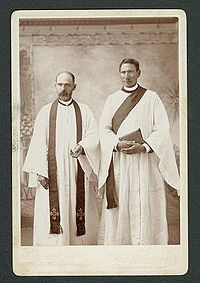
Known at that time as Making Medicine, aka Oakerhater, attended classes given in a casement-turned-classroom in the fort and learned to read and write English. He soon became a leader of the younger men who were confined. At the end of two years he petitioned to have the young men released because they had given up their old ways and desired to be integrated into the majority society. The request was rejected. However, in the next year, 1878, he and the other inmates were released after three years of confinement. Episcopal deaconess Mary Douglas Burnham, who had seen the men in St. Augustine, offered to take four of them home with her. She also arranged funding from Alice Key Pendleton and her husband, Senator George Pendleton, to transport Oakerhater and his wife Nomee to St. Paul’s Church in Paris Hill, New York. There he was educated by the Reverend J. B. Wicks in agriculture, scripture and current events. After six months he was baptized and confirmed at Grace Episcopal Church in Syracuse. At that time he took the Christian name of David and family name of Pendleton, in honor of his patron. Three years later, he was ordained a deacon.

<end of part one>

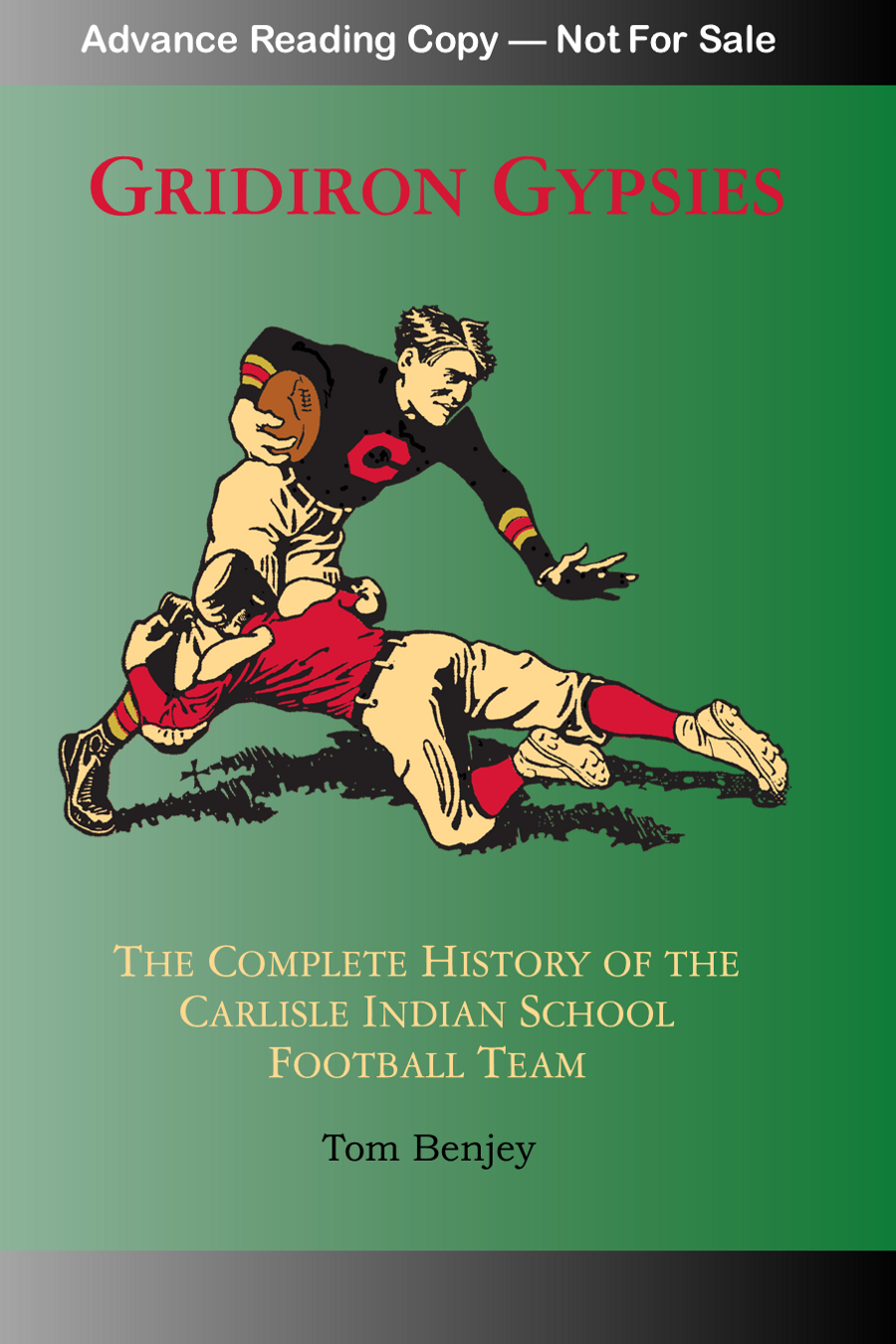
Gridiron Gypsies: The Complete History of the Carlisle Indian School Football Team

June 17, 2022

At long last my latest book, Gridiron Gypsies: The Complete History of the Carlisle Indian School Football Team, is getting close to being published. The text layout, complete with 155 illustrations (period photos and cartoons), a list of players with the years they played, notes, and an index, is complete and a draft cover has been designed. A few softcover copies of the ARC (advance reading copy) will be printed for reviewers that don’t accept digital copies. Since Covid, most reviewers want PDFs but some still want hardcopies. PDFs have been sent to reviewers who accept them and I expect to have print versions in a couple of weeks.

The book will go on sale this fall. Preorders will be accepted after Labor Day. Now I have to design a simple website, GridironGypsies.com, because books are supposed to have websites these days.

Pratt: The Red Man’s Moses

January 23, 2022

While finishing Elaine Goodale Eastman’s 1935 book about Richard Henry Pratt, founder and superintendent of Carlisle Indian School for its first 25 years of operation, I came across the the passage below. Under it is a photograph of Pratt’s grave marker in Arlington Cemetery.