Archive for the ‘Lone Star Dietz’ Category
July 19, 2010
One of the problems with dating Pop Warner’s innovations is that his memory 20 years after the fact was far from perfect, as are most people’s. The well-known difficulties in dating the births of the single-wing and double-wing with certitude are due, at least in part, to Warner’s inconsistent memories. A month and a half ago, I wrote a bit about the 1903 game with Utah in which Joe Baker led the Indians to a 22-0 win over the Mormonites by running the new wing-shift play several times for three second-half touchdowns (they counted 5 points in those days).
In his autobiography—actually a series of magazine articles written by Warner that were compiled into book form—Warner stated that during the 1912 Thanksgiving Day game against Brown, Harvard’s coach, Percy Haughton, was his guest on the sidelines to see Warner’s new surprise play—the wing-shift. Haughton disapproved, saying, “These series plays are never worth a darn. If such plays do work, it is usually in the first attempt, because they are trick plays and surprise is the feature that usually makes them successful.” After seeing Carlisle run them for long gains later in the game, Haughton grudgingly admitted, “Well, it did work that time.”
For a newspaper series of favorite plays from several coaches in the 1930s, Lone Star Dietz described the “Dead-Indian Play.” What he described was the old wing-shift that Carlisle ran so well. Because the wing-shift, or dead-Indian play, was a series of two plays it had to be called ahead of time. The player, generally a back, who carried the ball on the first play would linger on the ground long enough to give six of his teammates time to line up to one side of him. The rest would position themselves in the backfield. When the downed man could see that all were in place, he hopped up and snapped the ball to a backfield man to start the second play, catching the defense off guard.
Tags:1903, 1912, Brown University, Dead-Indian Play, Joe Baker, Percy Haughton, University of Utah, Wing-Shift play
Posted in Carlisle Indian School, Football, James Johnson, Lone Star Dietz, Pop Warner | Leave a Comment »
May 17, 2010
While wrangling grandchildren in Bethesda, MD this weekend, my wife took the impressionable young minds into a bookstore. 12-year-old Joey, a bookie if there ever was one, picked up a copy of The Redskins Encyclopedia by Michael Richman. When he showed it to my wife, she immediately noticed several errors in a paragraph that deals with Lone Star Dietz. The offending paragraph can be found on page 3:
The hands-on Marshall fired Wray, too, and replaced him with William “Lone Star” Dietz, a part-blood Native American. Dietz recruited six football stars from the Haskell Indian School in Kansas, where he had once played with the great Jim Thorpe and later coached for four years. The recruits included “Chief” Larry Johnson, Louis “Rabbit” Weller, and John Orien Crow. The charismatic coach told his players to pose with war paint, feathers, and full headdresses before the 1933 home opener against the Giants.
Where to start? Let’s do them in the order they appear:
1. Dietz recruited six football stars from Haskell
I’ve read this elsewhere but can only verify that he brought four former Haskell students with him—the three Richman listed plus David Ward.
2. …from Haskell Indian School in Kansas…
They came from Haskell Institute (today’s Haskell Indian Nations University) in Lawrence, KS not Haskell Indian School.
3. …where he [Dietz] once played
There is no record of Dietz ever enrolling at Haskell Institute or playing on their football team. He did coach there from 1929 to 1932.
4. …where he [Dietz] once played with the great Jim Thorpe
Lone Star Dietz played with Jim Thorpe at Carlisle not Haskell.
Jim Thorpe attended Haskell Institute before attending Carlisle but did not play on the school’s football team.
What is discouraging is that the author is a veteran journalist and should know that he should have checked his facts. It would have taken him little time to find these errors had he just consulted my biography of Lone Star Dietz and Bob Wheeler’s biography of Jim Thorpe. It is no surprise that yet another journalist has made less than accurate statements about Jim Thorpe and Carlisle Indian School, but it is unfortunate because most readers accept that the author has his facts right and don’t check for themselves.
Tags:Boston Braves, Boston Redskins, Chief Johnson, David Ward, George Preston Marshall, John Orien Crow, Larry Johnson, Michael Richman, Rabbit Weller, The Redskins Encyclopedia
Posted in Carlisle Indian School, Frank Cayou, Haskell Institute, Jim Thorpe, Lone Star Dietz, Washington Redskins | 3 Comments »
May 13, 2010
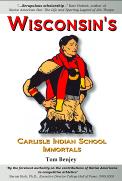
Yesterday, a reader asked about Wisconsin’s Carlisle Indian School Immortals, wondering if it would be a series of blogs or a book. That tells me it’s time to talk about it a bit. Last year I wrote Oklahoma’s Carlisle Indian School Immortals, Volume I of the Native American Sports Heroes Series. I have now completed Volume II of that series. Wisconsin’s Carlisle Indian School Immortals will be released on September 1. Like the earlier book, it follows 17 football stars with ties to a particular state, Wisconsin in this case, from their childhoods on the reservation, generally, to their time at Carlisle, and through their later lives. Background chapters on Carlisle Indian School, its legendary football teams, and coach “Pop” Warner set the stage for the individual biographies.
Not included are busts of the players drawn by Bob Carroll. Bob graciously drew those for Oklahoma’s Carlisle Indian School Immortals just before the end of his life. In their place, is a map that shows all the Indian Reservations in the state of Wisconsin which is intended to assist the reader in knowing where these people spent their early childhoods and, in some cases, returned to after finishing at Carlisle.
Chapters are included for:
Chauncey Archiquette
Wilson Charles
Wallace Denny
Lone Star Dietz
Louis Island
James Johnson
Frank Lone Star
Jonas Metoxen
Thomas St. Germain
Caleb Sickles
George Vedernack
Gus Welch
Joel & Hugh Wheelock
Martin Wheelock
Charles Williams
William Winneshiek
It is my hope that historians, teachers and librarians review this book and make it more available to students who would learn a lot about how disadvantaged people overcame obstacles to excel.
Copies of the softcover version of Oklahoma’s Carlisle Indian School Immortals are now in stock for June 1st release.
Tags:Frank Lone Star, Oklahoma's Carlisle Indian School Immortals, Wallace Denny, William Winneshiek, Wilson Charles, Wisconsin's Carlisle Indian School Immortals
Posted in Caleb Sickles, Carlisle Indian School, Charles Williams, Chauncey Archiquette, Football, George Vedernack, Gus Welch, Hugh Wheelock, James Johnson, Joel Wheelock, Lone Star Dietz, Louis Island, Martin Wheelock, Pop Warner, Thomas St. Germain | 2 Comments »
April 12, 2010
When looking for information on Asa Sweetcorn, I found a 1935 United Press article in which he was mentioned that had nothing to do with his exploits while at Carlisle. Titled “Seek Restoration of Indian School,” the article, datelined Carlisle, Pa., March 15, the article told of former Carlisle Indian School students’ attempt to reopen the school. Charles Dillon, who is best known for his role as “humpback” in the “hidden ball” play run against Harvard in 1903, spearheaded the movement. “Dillon, one of the greatest of the long line of football heroes who wore the colors of the old Indian School, was in town the other day sounding out sentiment on the proposed return of the Redskins.”
Dillon was on his way to Washington, DC to pry loose a few New Deal dollars to launch the program. He felt that little government money would be required to fund the school. He told some old friends in Carlisle, “Our aim is to build a college with Indian money, to be conducted by and for Indians. And only a comparatively few dollars are needed from the government to launch the program.” According to Mr. Dillon, “Scores of graduates of the erstwhile Carlisle Indian School are ready to contribute thousands of dollars toward establishing the school.”
He was to return to Carlisle the following week after negotiating with New Deal officials. Accompanying him were Jim Thorpe, Gus Welch, Albert “Chief” Bender and Asa Sweetcorn. That was a bad time for Indian schools to pry money out of the government. Lone Star Dietz left Haskell Institute in 1933 to coach the Boston Redskins after the government slashed Haskell’s budget. Gus Welch was well aware of funding issues as he replaced Dietz at Haskell. It is easy to understand why Dillon, Thorpe, Bender and Welch supported the initiative because they flourished at Carlisle. Sweetcorn’s involvement is curious because he was “canned” in Carlisle for his antics that reflected less than a studious attitude.
Tags:Asa Sweetcorn, Charles Dillon, Chief Bender, Hidden Ball Play, New Deal
Posted in Carlisle Indian School, Football, Gus Welch, Haskell Institute, Jim Thorpe, Lone Star Dietz, Victor Kelly | Leave a Comment »
March 13, 2010
We are celebrating Dietz’s listing by giving 20% off his biography at www.Tuxedo-Press.com. To learn more about Lone Star Dietz, check out www.LoneStarDietz.com.
The National Football Foundation released this year’s ballot of candidates for induction into the College Football Hall of Fame. Lone Star Dietz is on the ballot again. This year, he is joined by:
- Barry Alverez of Wisconsin
- Jim Carlen of South Carolina, Texas Tech and West Virginia
- Wayne Hardin of Temple and Navy
- Bill McCartney of Colorado
- Billy Jack Murphy of Memphis
- Darryl Rogers of Arizona State, Michigan State, San Jose State, Fresno State and Cal State-Hayward
It will be interesting to see if the injustice done to Lone Star will be corrected this year. It also remains to be seen if the Lone Star Curse over Washington State will ever be lifted. WSU’s last undefeated season was in 1917, Dietz’s last year in Pullman. Their last, and only, Rose Bowl victory was in 1916 when Dietz’s undefeated warriors upset Fritz Pollard and Brown to put West Coast football on the map and to establish the Rose Bowl and all the other bowl games that followed.
Tags:Brown University, College Football Hall of Fame, Fritz Pollard, National Football Foundation, Rose Bowl, Washington State
Posted in Carlisle Indian School, Doctors, Lawyers, Indian Chiefs, Football, Lone Star Dietz | Leave a Comment »
January 12, 2010
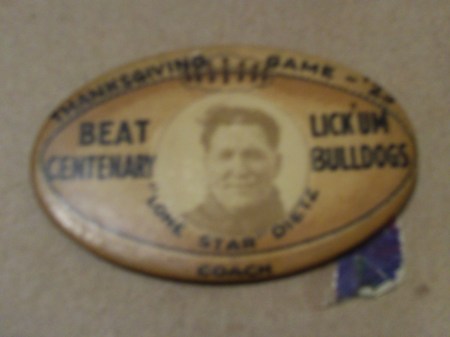
A reader submitted the photo included at the bottom of this post. I’m sorry that it isn’t clearer but this is what I was sent. I have never seen or even heard of one of these buttons before. It is purported to be a button for the 1923 Louisiana Tech-Centenary College annual Thanksgiving Day game. I can’t make out the date from the button but believe that it is authentic because Louisiana Tech played Centenary on Thanksgiving Day in 1922 and 1923, both years that Dietz coached in the Pelican State. Also, it seems unlikely that a forger would pick a relatively obscure event rather than one that would generate more interest (read a higher price). Let’s talk a little about Lone Star’s time in Ruston, Louisiana.
Lone Star coached the Bulldogs for two years compiling an 11-3-1 record with two of the losses coming at the hands of the Centenary Gentlemen. Less than half of those games were played at home at a time when strong teams generally played most of their games at home. (Note that Carlisle Indian School and Haskell Institute were strong teams that played most of their games on the road, a factor that makes their records all the more astounding.) Louisiana Tech had done well before Dietz’s arrival but against weaker opposition. He was apparently hired to upgrade the program and he did.
No reason was given for Dietz’s departure for Wyoming but money cannot be discounted. Wyoming wanted to upgrade its program and hired Dietz to do that. Also, Dietz had remarried in early 1922 to a woman from Indiana and may have needed more income. Even when single, the dapper Dietz was never known as being a miser.
Dietz’s history of putting life into previously lifeless programs while compiling a Hall-of-Fame worthy record is a strong argument for his induction into the College Football Hall of Fame.
Tags:Centenary College, Louisiana Tech
Posted in Carlisle Indian School, Football, Haskell Institute, Lone Star Dietz | 2 Comments »
December 31, 2009
“A Happy New Year” wrought in red electric lights, and suspended across the gymnasium, welcomed the guests to the annual reception of the Standard Debating Society in the gymnasium last Friday night, and suggested the general theme of the evening’s entertainment. The event took the form of a farewell party to 1909 and a welcome to 1910, an idea which was carried out in the menu cards and souvenirs which each represented a dainty 1910 calendar. The Standard colors, orange and black, were attractively used in the decorations, and the music was good. The address of welcome was given by the president of the Society, Francis Coleman. A novel and very enjoyable feature of the program was the singing of “By the Light of the Silvery Moon” with all the lights extinguished except the tiny red ones in the Happy New Year sign. Just before midnight a seated supper was served in the Y. M. C. A. Hall. The menu consisted of chicken salad, wafers, maple nut ice cream, cake, fruit, mints and coffee. Mr. Whitwell, the Standards’ advisory member, as toastmaster, cal1ed for the following toasts: What standards have accomplished, Ray Hitchcock; Our sister and brother societies, R. Charles; Once a Standard, always a Standard, Mr. Nori. The cakes for the prize dances were awarded by the judges, Mrs. Foster, Mrs. Stauffer and Mr. Dietz, as follows: Twostep, lst, Ruth Lydick, Albert Lorentz; 2nd, Emma Newashe, John Farr; Waltz, lst, Rose Hood, Reno Rowland, 2nd, Inez Brown, Harry Woodbury. After the presentation of the prize cakes by Mr. Whitwell, a solo by Montreville Yuda, “I’m Going to Do as I Please,” set the merry feasters in an uproar of applause which lasted until the ringing of bells and the blowing of whistles proclaimed the arrival of 1910, Then a great wave of Happy New Year wishes swept over the hall, and all returned to the gymnasium to welcome in the New Year with dancing. This number was danced with the lights lowered and with only the red welcome to the New Year shining on the dancers. The home waltz ended the program.
Tags:Albert Lorentz, Emma Newashe, Francis Coleman, Harry Woodbury, Inez Brown, John Farr, Montreville Yuda, Mrs. Foster, Ray Hitchcock, Reno Rowland, Rose Hood, Ruth Lydick
Posted in Carlisle Indian School, Lone Star Dietz | Leave a Comment »
November 18, 2009
On Monday, the Supreme Court of the United States refused to hear an appeal of the Washington federal appeals court decision that ruled that the Native American appellants had waited too long to claim that the Redskins trademark was racist. This decision is expected to allow the Redskins to retain trademark protection for their team name. Seventeen years ago, seven activists filed papers to have the Redskins stripped of trademark protection because, in their view, the name is racist and offensive. The activists had success early in the process but lost at the two highest levels. Further attempts with possibly different appellants are expected.
Smithsonian Linguist Emeritus Ives Goddard spent several months researching the term “redskins” and found it had a benign origin. He found that the term was coined long ago by American Indians to differentiate themselves from white and black people. The offensive meaning claimed by the activists appears to have been coined in the 1960s.
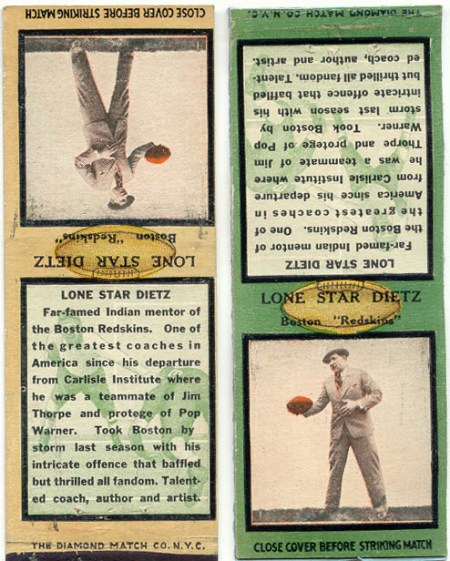
The Boston NFL team was renamed Redskins in 1933 to honor its new head coach, Lone Star Dietz. Dietz’s central role in this controversy has brought his heritage to come under much scrutiny decades after his death.
Tags:redskins, Supreme Court, trademark
Posted in Lone Star Dietz | 3 Comments »
October 19, 2009
Not long ago, I learned that some Carlisle Indians other than the ones on the Oorang Indians also played in the NFL. Chris Willis’s book, The Columbus Panhandles, tells the story of one of the charter members of the NFL (called the American Professional Football Association when it was first formed in 1920). The 1920 Panhandles’ roster included one player that claimed Carlisle Indian School as his alma mater. That was Frank Lone Star. John Steckbeck’s classic about the Carlisle Indian School football teams, Fabulous Redmen, makes no mention of him playing football. An appendix to Willis’s book lists Frank as having played guard and tackle in three games in the 1920 season. A search of newspaper coverage for these games confirms Willis’s data.
Unfortunately, Carlisle’s school records don’t indicate that Frank Lonestar ever played football there—at least not on the varsity squad. Frank Lonestar, Chippewa from Shell Lake, Wisconsin, first arrived at Carlisle in August 1903. After completing the five-year term, he re-enrolled for a three-year term. Just before the end of that term of enrollment, he ran away but re-enrolled in September 1911. He ran away again, returned in March 1912, and left for good in May 1912. While at Carlisle, he learned the printing trade and could have played on the Printers’ shop football team. Shop teams received little press, so it’s not known for sure if he played for them. He kept in touch with the school while working in Cleveland, Ohio. He died at his brother’s home in Shell Lake on October 30, 1915.
Frank’s untimely death made it impossible for him to play for the Columbus Panhandles in 1920. Playing under assumed names was common in the early days of professional football, especially by people whose employment might be jeopardized if their employer learned they were playing football for money.
One possibility is Lone Star Dietz because he was looking for a coaching job at that time. He went by the name William Lone Star at Carlisle. That name is close to Frank Lonestar. Also, Dietz would have likely known that Frank was dead because his death was announced in The Carlisle Arrow. In addition, Frank’s hometown was in the county immediately north of Dietz’s. Tackle was his natural position, too.
In 1920, Lone Star Dietz was 36, an advanced age for an athlete in that era, a factor that would explain him playing only three games. Of course, it may not have been Dietz, but if it wasn’t, who was it?
Tags:Chris Willis, Columbus Panhandles, Fabulous Redmen, Frank Lonestar, John Steckbeck, NFL, Oorang Indians
Posted in Carlisle Indian School, Football, Lone Star Dietz | Leave a Comment »
August 12, 2009
While researching Carlisle Indian School alums who played in the NFL, I came across an unexpected name—Frank Lonestar. Everyone is well aware that Lone Star Dietz coached the Redskins in 1933 and 1934 but I bet few know that Frank Lonestar played for the Columbus Panhandles in 1920, the league’s inaugural year. A website stated that he played three games at guard for the Panhandles that year. So far, I’ve found newspaper coverage for one game with his name in the lineup. That one was a losing effort against the Detroit Heralds.
I was well aware that Frank, a Chippewa from Wisconsin, was much involved in extracurricular activities such as the Invincible Debating Society and was an officer in his class (the same one as Gus Welch), but had no idea that he was a football player of note. He probably played for his shop team, the Printers, but many boys did that. I was unaware of him being on the varsity squad and doubt that he was. He apparently left Carlisle around 1911 to practice his trade after getting useful experience printing school publications. But that’s about all I know about him.
Also on the 1920 Columbus Panhandles, at least for awhile, was Littleboy, or someone with a similar name. The October 17, 1920 Fort Wayne Journal-Gazette included a photo of four stars the local team, the Friars, would be facing when taking on the Columbus Panhandles later that day. Included in the photo and expected lineup was someone named Littleboy. A little research should determine if this person was Carlisle’s Little Boy. This Littleboy played left halfback in the Columbus-Detroit game mentioned previously.
I’m also learning about another Carlisle student who played in the NFL but doesn’t appear to have starred on the legendary Indian teams. Joe “Little Twig” Johnson began his NFL career with the 1922 Oorang Indians, but, unlike the majority of his teammates, had a significant pro career after Oorang’s demise. It appears that the Carlisle Indians were more involved in the early NFL than I thought.
Tags:Columbus Panhandles, Detroit Heralds, early NFL history, Fort Wayne Friars, Frank Lonestar, Indians in the NFL, Joe Little Twig, Littleboy, Oorang Indians
Posted in Carlisle Indian School, Football, Gus Welch, Lone Star Dietz | Leave a Comment »





 Tom Benjey's Weblog
