Archive for the ‘Lone Star Dietz’ Category
May 1, 2013
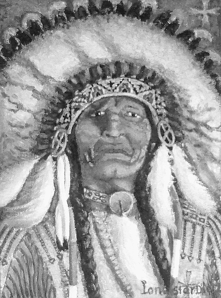
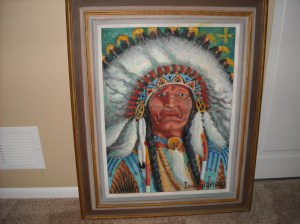
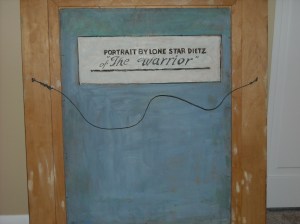
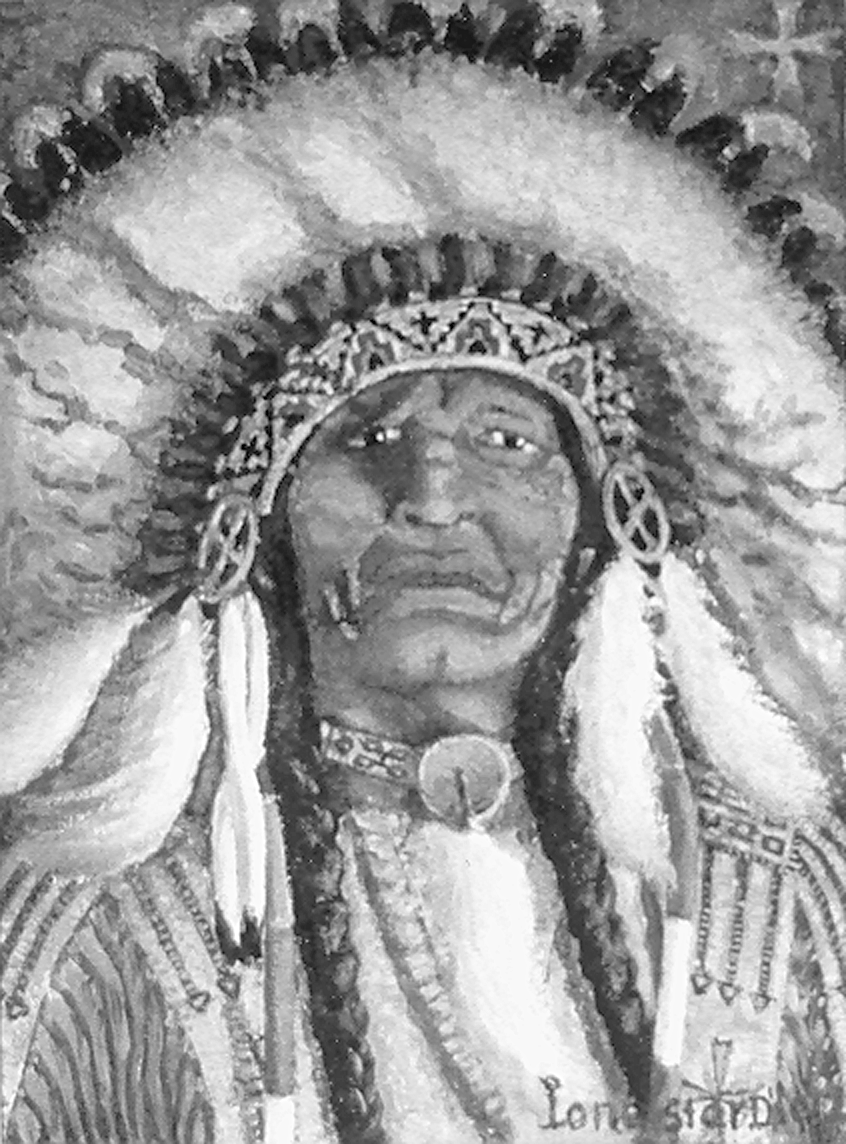
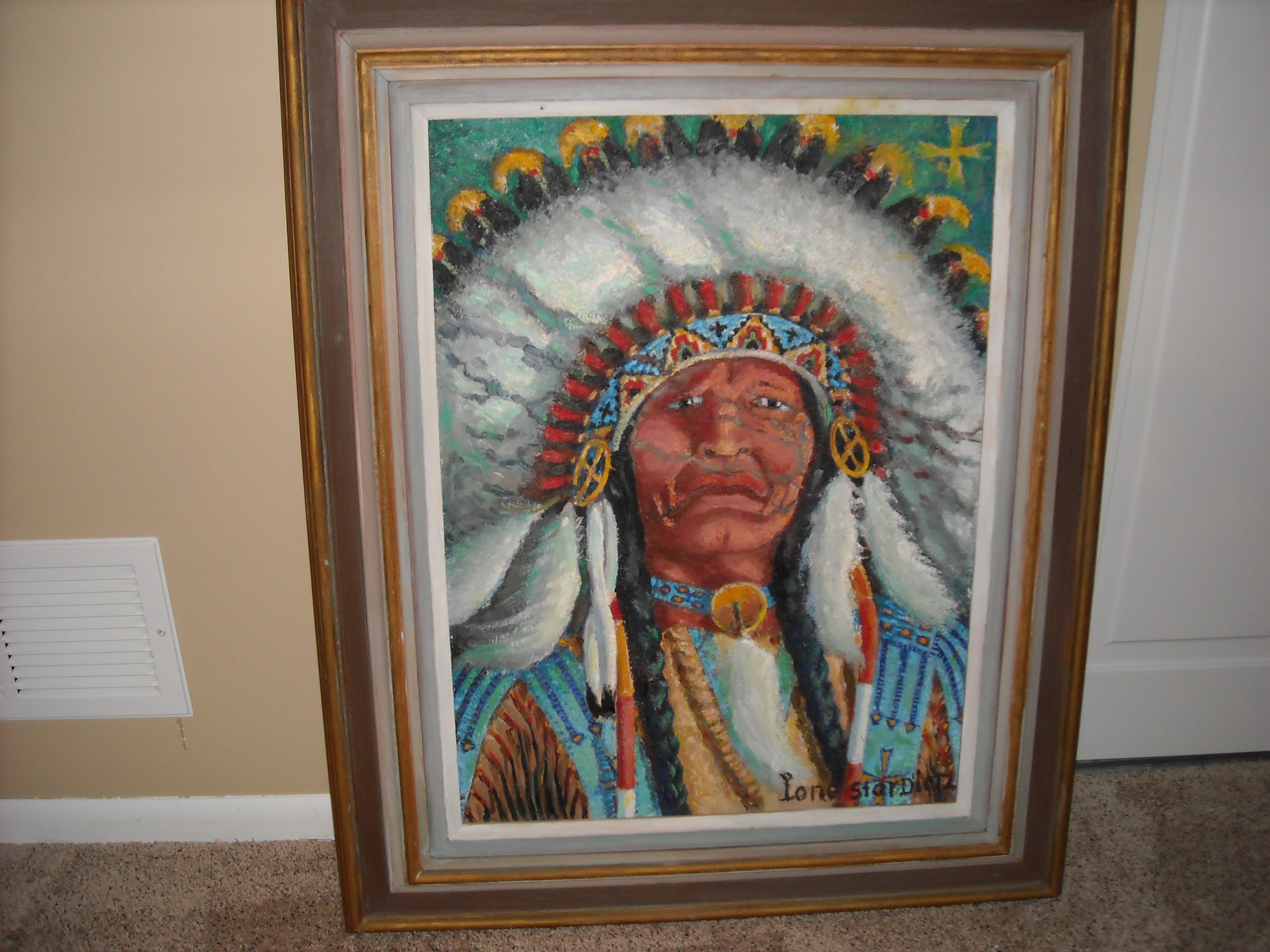
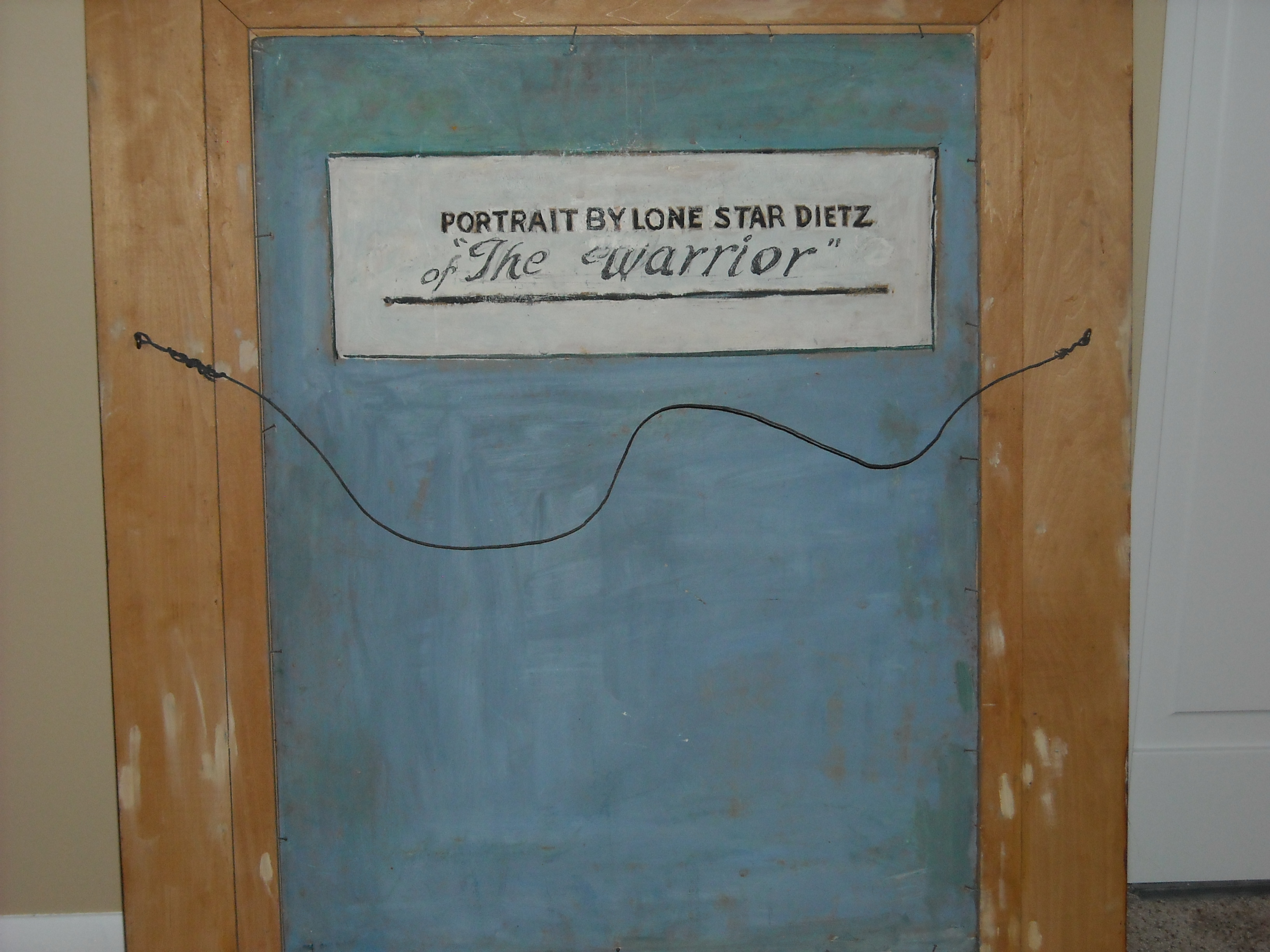
Yesterday, I received n email from the son of Mary Lou Zientek with some photos attached. Mary Lou Zientek was the woman who befriended the Lone Star Dietz and his wife, Doris, in the declining years. Mary Lou managed their estates after Doris died. Mrs. Zientek died on May 7 last year. She distributed artifacts which few valued at that time to places such as Sports Immortals in Boca Raton, Florida (they were in Pittsburgh when Dietz died). She kept a self-portrait Dietz painted in the early 1960s and, one assumes, made a gift to her for her generosity. Previously, I had only seen a black and white photo of the painting See below). Her son sent me color photos. The effect of the painting is much different in color than in black and white. Color photos of both front and back can be seen below. I thank Mr. Zientek for sharing these photos with us.
Posted in Carlisle Indian School, Doctors, Lawyers, Indian Chiefs, Football, Lone Star Dietz, Washington Redskins | Leave a Comment »
February 16, 2013
Earlier this week, I received a totally unexpected call from a reporter from the Washington Examiner regarding Lone Star Dietz. I say unexpected for two reasons. First, I was unaware that Dietz’s name had again percolated up in the media’s attention and second, I hadn’t considered it was 80 years ago that George Preston Marshall renamed his Boston NFL team from the Braves to the Redskins or that an 80th anniversary mattered. I guess the last part makes it three reasons.
Oddly, it seems to me, Washington media seldom contact me about Lone Star and the team never has. Questions and requests for interviews tend to come from other places. As popular as the Redskins have been over the years in the nation’s capitol, one wonders why neither fan clubs nor bookstores have deemed hearing more about the man who is alternately vilified and deified by people who generally haven’t read his biography. On the other hand, I shouldn’t wonder why when Bob Wheeler, author of the definitive biography of Jim Thorpe, has never been on C-SPAN’s BookTV.
Here is a link to the article the reporter was researching when he called me: http://washingtonexaminer.com/thom-loverro-the-disputed-history-of-lone-star-dietz-the-inspiration-for-the-redskins-name/article/2521717
Tags:redskins
Posted in Carlisle Indian School, Football, Lone Star Dietz | 4 Comments »
December 3, 2012
One of the several mysteries surrounding Lone Star Dietz is what transpired between the time he surrendered himself to authorities to serve his 30-day sentence on January 8, 1920 and the third week of March, 1921 when he interviewed for the head coaching job at Purdue. Most of the missing thirteen months remains a mystery but a chance discovery sheds light on a tiny bit of it.
A February 11, 1920 article from the Anaconda Standard briefly discussed his incarceration. Just across the Idaho panhandle from southern Washington State, the Standard often covered Washington State news. Whether this piece was original or was copied from a Spokane newspaper has not yet been determined. That the article was not published the day after Dietz’s sentence was completed argues for its not being an original article.
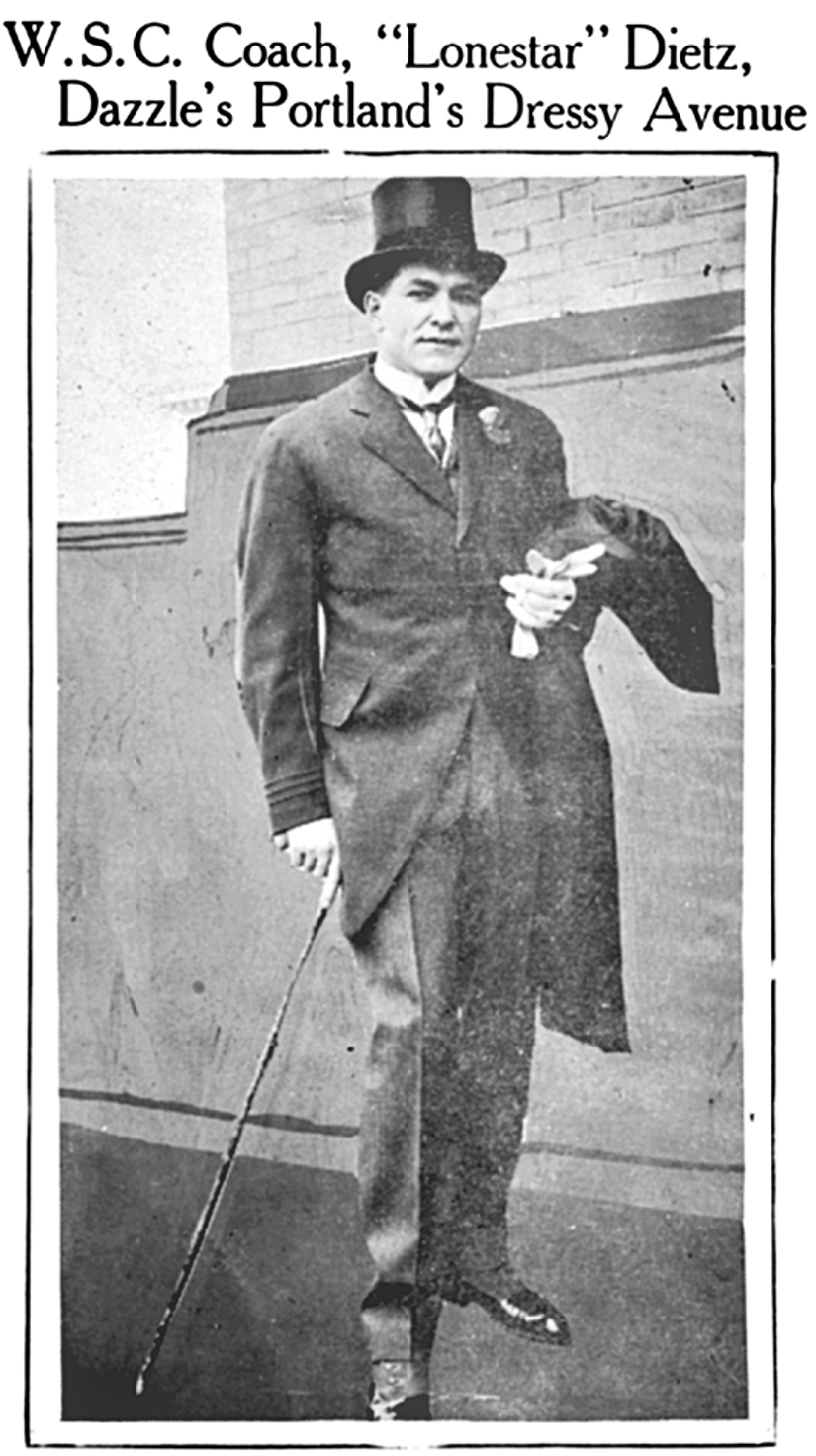
“LONE STAR DIETZ FREE MAN AGAIN” headed the short piece. The article made clear that he pleaded “nolo contendre” to the charges. “He did not plead guilty to the falsification charge, but under a provision of the federal statute simply made no resistance to the accusation.” A Portland Oregonian article written the day of his incarceration revealed a little about his demeanor when he arrived at the jail. It explained that Dietz arrived at the Spokane County Jail to serve a Federal sentence at 4:00 p.m. wearing the same light gray suit he wore throughout his trial. The photo accompanying this article depicted him in formal attire, not the business suit he wore at the time. “He seemed somewhat nervous as he entered the marshal’s office to give himself up to the authorities. Later, as he sat in the marshal’s office and chatted with employees, he seemed to gather himself together and laughed and chatted about his case.” Apparently enjoying having a celebrity who was unlikely to cause trouble in their midst, the jail workers made him feel at home—to the extent one can feel at home in the hoosegow.
Other than that, nothing was previously known regarding what happened while he was in jail but it was correctly assumed he served his sentence without incident. The Standard article tells us that he served in typical Dietz fashion: “During the last two weeks of his confinement in the jail, Dietz was listed as a ‘trusty’ and given the privileges of the jail.” That was not surprising in the least. Now to find out what he did after walking out of the jail.
Tags:draft dodger, hoosegow, sedition, WWI hysteria
Posted in Carlisle Indian School, Football, Lone Star Dietz | 1 Comment »
October 26, 2012
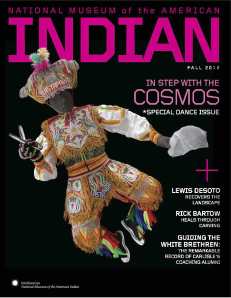
The electronic version of the Fall 2012 edition of the magazine for the National Museum of the American Indian (NMAI) is finally out. My article on Carlisle Indians who went on to coach other teams is on page 46 (page 44 of print version). The idea for this article came to me after attending Lone Star Dietz’s enshrinement ceremony into the College Football Hall of Fame. He is the only Carlisle Indian to be inducted as a coach. Six others, some of whom also coached, were enshrined previously but as players. It is unlikely that any others will receive this honor because no other Carlisle Indian coached as long or with nearly as much success as Dietz.
American Indian athletic prowess is getting much attention this year due to 2012 being the 100th anniversary of Jim Thorpe’s extraordinary triumphs in the pentathlon and decathlon at the 1912 Stockholm Games. Anyone unfamiliar with Native Americans’ success in the Olympics can read my several previous blog entries on this topic.
Worthy of note is that Dietz and the others had great success coaching white college and professional players. Many of them, including Dietz, coached Indian teams at one time or another but the vast majority of their coaching careers were with white college teams. Having played with Carlisle and knowing the Warner System gave these men instant credibility and opened doors for them. After going through those doors, success or the lack of it was the deciding factor. After all, sports have always been a meritocracy. Performance matters above all. Carlisle players succeeded on the field both as players and coaches. The graduate system of coaching that was tried in the early 20th century limited coaching opportunities for those who hadn’t attended major colleges but numerous smaller schools welcomed Carlisle Indians to lead their teams. Although far from an ideal situation, these men were given the opportunity to succeed or fail on their own merits and they largely succeeded.
http://content.yudu.com/A1yt4b/fall2012/resources/index.htm?referrerUrl=http%3A%2F%2Fwww.americanindianmagazine.org%2Fabout-us
Tags:1912 Olympics, coaching football, College Football Hall of Fame, National Museum of the American Indian, NMAI, Stockholm Games
Posted in Albert Exendine, Bemus Pierce, Caleb Sickles, Carlisle Indian School, Doctors, Lawyers, Indian Chiefs, Football, Frank Cayou, Frank Mt. Pleasant, Gus Welch, Haskell Institute, James Phillips, Jim Thorpe, Joe Guyon, Joel Wheelock, Lone Star Dietz, Pop Warner, William Baine, William Gardner | Leave a Comment »
August 14, 2012
Yesterday’s edition of Indian Country Today includes an article by Jack McNeel on Lone Star Dietz. The headline, which probably wasn’t written by Mr. McNeel, understandably focuses on Dietz’s posthumous induction recently into the College Football Hall of Fame. But the article covers more than that. He covered as much of Dietz’s highly eventful life as space would allow.
Something I particularly like is that McNeely chose to use a photograph of Dietz with the Washington State team that isn’t widely used. It’s nice to see something you haven’t seen before. In this case, I probably saw it briefly when going through the Washington State photo archives some years ago but didn’t remember seeing it.
There are a few things in the article that need a little bit of clarification. First, Tournament of Roses wasn’t arranging its annual football game in the fall of 1915 because they had only hosted a game once before and that was back in 1902. The Washington State victory over Brown in 1916 was what established the game as an annual event and much of the credit for that goes to Lone Star Dietz for putting West Coast football on the same level as the eastern powers.
The statement, “Soon after, many college sports were suspended for World War I,” may compress the timeframe too much for readers unaware of what happened during that period. Dietz’s men lost two games in 1916 and were undefeated again in 1917 but weren’t invited to Pasadena because of the popularity of military teams. It was after the 1917 season that college sports were curtailed freeing Dietz to coach many of his former players on the Mare Island Marines team.
The phrase “Indian agent from the Sioux Nation” may be misleading and cause unfamiliar readers to think the agent was an Indian. The agent was a white man assigned to the Pine Ridge Agency, one of several reservations on which Sioux live.
“Benjey’s research indicates that Dietz’s father took the dead baby…” would more accurately be phrased, Benjey’s research indicates that Dietz’s father claimed to have taken the dead baby…. However, W. W. Deitz (he spelled his name differently that Lone Star spelled it) denied that publicly.
Here is a link to the article:
http://indiancountrytodaymedianetwork.com/2012/08/13/william-lone-star-dietz-posthumously-inducted-into-football-hall-of-fame-128617
Tags:College Football Hall of Fame, Indian Country Today, Jack McNeel, Pasadena, Rose Bowl, Tournament of Roses
Posted in Carlisle Indian School, Football, Lone Star Dietz, Washington State University | Leave a Comment »
July 24, 2012
Well, it finally happened. Lone Star Dietz was enshrined in the College Football Hall of Fame last weekend. It isn’t clear to me which activity at the event is the actual enshrinement: the blazer presentation on Friday evening or the enshrinement dinner Saturday night. Attendance apparently isn’t mandatory because Deion Sanders wasn’t present at either event. Lone Star Dietz wasn’t present because he died in 1964. Other deceased inductees were generally represented by their sons but Dietz didn’t have a son. Had I known that Dietz wasn’t going to be represented, I would have suggested that Sheldon Cohen speak on behalf of his late father, Gus, for whom Lone Star acted like a father.
When Russell Maryland, a defensive tackle, was introduced, it was pointed out that he was the eighth Hall-of-Famer from the University of Miami. Lone Star Dietz makes the seventh Carlisle Indian in the College Football Hall of Fame. The other six are: Albert Exendine, Joe Guyon, James Johnson, Jim Thorpe, and Gus Welch. A quick look at the Ball of Fame’s website revealed that six Miami players and two coaches have been inducted. Neither of the coaches played at Miami as both played for Pop Warner at Pitt.
So, as many Carlisle Indian School players have been enshrined as have Miami players. Three of Carlisle’s head coaches have been enshrined: Bill Hickok (as a player at Yale), Pop Warner, and George Woodruff. Gus Welch was Carlisle’s head coach for part of the 1915 season but he was inducted as a Carlisle player. And George Woodruff only coached Carlisle for the 1905 season. Although he led Carlisle to its first victory over Army, he would most likely have been inducted for his work at Penn alone. But one could make the argument that Pop Warner’s record and innovations at Carlisle would have gotten him into the Hall of Fame even if he hadn’t coached later at Pitt, Stanford, and Temple.
Thus, by counting the six players, Dietz and Warner, one could fairly make the argument that little Carlisle, that only fielded teams from 1894 to 1917, has as many Hall-of-Famers as the prodigious producer of professional players, Miami University, which has fielded football teams from 1927 to the present. This is further evidence of the greatness of the tiny Carlisle Indian School football program.

Tags:George Woodruff, Pitt, Russell Maryland, Stanford, Temple, University of Miami
Posted in Albert Exendine, Carlisle Indian School, Ed Rogers, Football, Gus Welch, James Johnson, Jim Thorpe, Joe Guyon, Lone Star Dietz, Pop Warner | Leave a Comment »
July 17, 2012
WordPress tells me that this is my 400th message. At about 300 words each, that comes to 120,000 words—a book. Sure, these messages could, with some effort, be compiled into a book, either print or ebook, but who would buy it? Darn few, most likely.
Here in Central Pennsylvania, Penn State/Sandusky/Paterno/Spanier stories dominate the media and will probably continue to do so for some time. Many have been shocked by the behavior of Penn State’s bureaucracy but I haven’t. What Sandusky did was unthinkable and criminal beyond belief. However, Penn State officials did what college and universities always do—at least when they think they can get away with it—cover it up. Colleges are insular by nature and Penn State is worse than most, possibly because of its relatively remote location. I remember reading in my student days about female students getting raped in dark campus parking lots across the country and how college administrations did their best to keep news of it from being made public. Congress finally did something about this in 1990.
The Clery Act, named for Jeanne Clery, a Lehigh University freshman who was raped and murdered in her campus residence hall in 1986, requires all colleges and universities that participate in federal financial aid programs (about all except Hillsdale College) to keep and disclose information on crimes committed on or near their campuses. Failure to report heinous crimes can result in a school being suspended from federal student aid programs.
There has been a lot of chatter about the NCAA giving Penn State’s football program the “death penalty” but, perhaps, suspending Penn State from the student aid program might be a more effective punishment. The major thing that federal student aid has accomplished has been to increase tuition costs and for schools to increase their revenues. Higher costs make working one’s way through college more difficult with the result that students rack up so much debt that many are unable to pay after leaving college. It may be that eliminating federal loans would be the best thing for students long term.
The only actions taken so far is to paint away Joe Paterno’s halo (and remove Jerry Sandusky) from a mural and to rename Paternoville to Nittanyville. The statue of Joe Paterno remains in front of Beaver Stadium and he is still in the College Football Hall of Fame.
One wonders what Lone Star Dietz is thinking as he readies his better-than-best suit for his induction this weekend. Could it be that he feels vindicated after seeing how the Paterno/Bowden fiasco turned out?

Tags:Clery Act, Joe Paterno, Nittanyville, Paternoville, Sandusky, Spanier
Posted in Carlisle Indian School, Football, Lone Star Dietz | Leave a Comment »
June 8, 2012
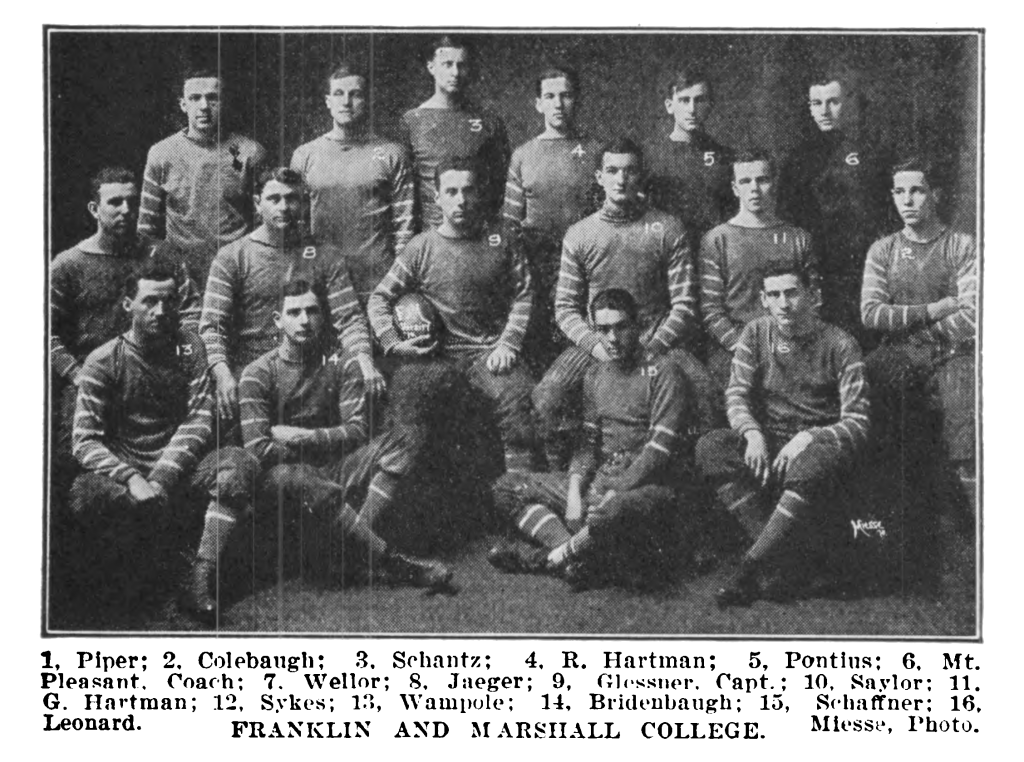
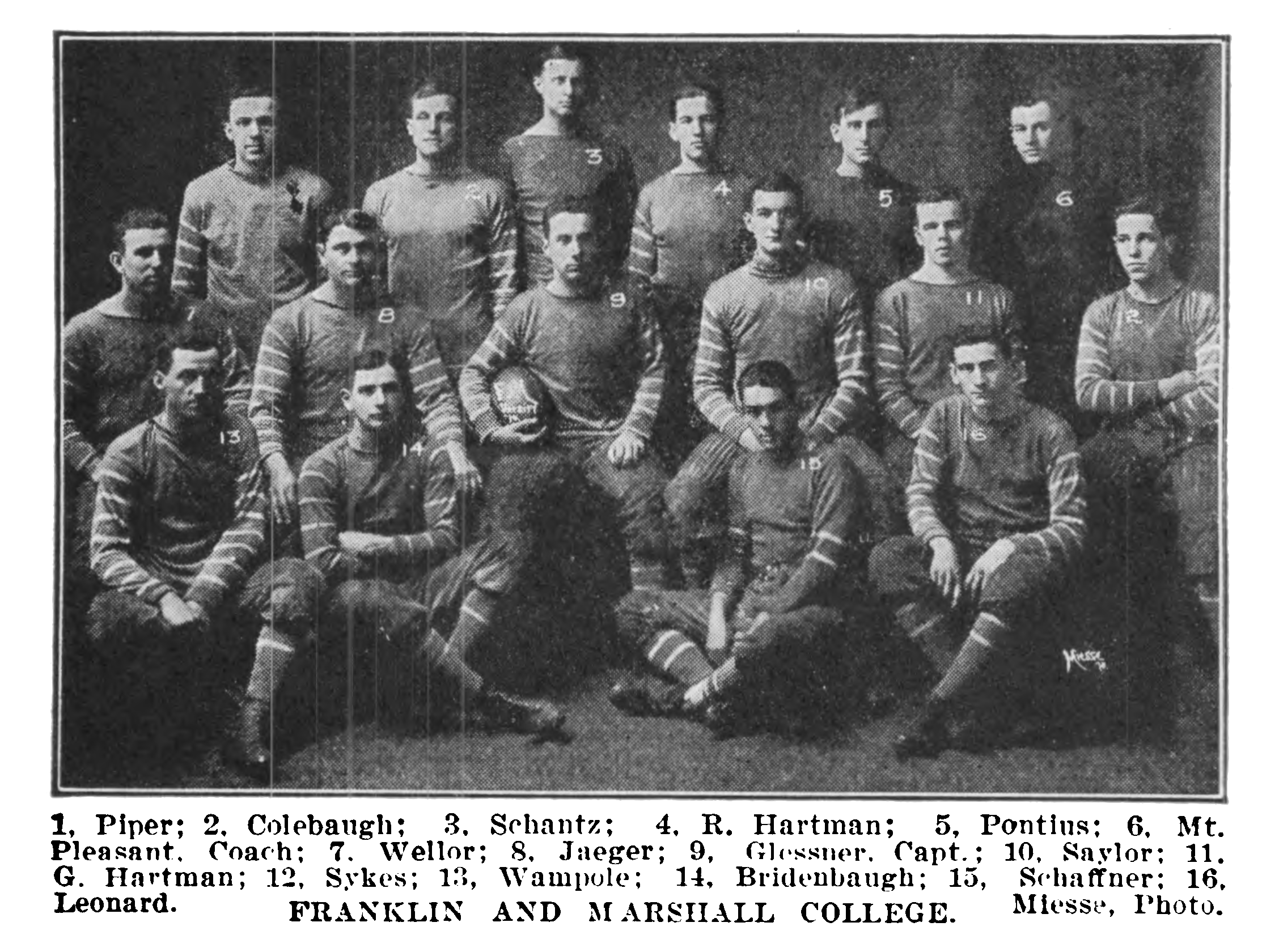
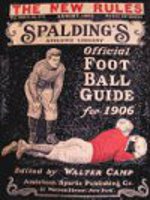
While preparing the 1911 Spalding’s Guide for printing, I noticed that some former Carlisle players could be seen in the numerous 1910 team photos to be found in that volume. That brought to mind an old newspaper article that I can’t lay my hands on now in which the writer opined as to why there were so few football coaches at a time when Carlisle Indian School players were grabbing headlines. I don’t recall his reasoning or conclusions but do remember having read the article.
The truth is that several Carlisle Indian School players tried their hands at coaching with varying success. The names that come quickly to mind are Bemus Pierce, Frank Cayou, Albert Exendine, Caleb Sickles, Lone Star Dietz, James Phillips, Joel Wheelock, Victor “Choc” Kelley, Mike Balenti, and Gus Welch (I keep adding names as they come to me while writing this article). I’m sure there were others. Given enough time to research this issue, I’m sure that I could come up with more. But I don’t have the time right now because I must get the 1901 Spalding’s Guide ready to print.
The lengths of their careers varied, but Exendine, Welch and Dietz all had long coaching careers. Of these, Lone Star Dietz had by far the most success and, as an acknowledgement of that success, was honored by the Helms Foundation many years ago. Next month, the College Football Hall of Fame will honor him. It is highly unlikely that any other Carlisle Indian will receive this honor because only a few had long careers and only Dietz, as far as we know, had a Hall of Fame worthy career as a coach. Also, Exendine and Welch were already inducted as players. My immediate concern is not about the Hall of Fame but with 1910 team photos that include former Carlisle players.
Follows are two of the 1910 team photos. I’ll leave it to the reader to find the Carlisle Indians in them, but here’s a hint: both wore their Carlisle letter sweaters. I take that as an indication of how proud they were of having been part of those great teams.

Tags:Carlisle Indian School Coaches, Franklin and Marshall College, Washington University
Posted in Albert Exendine, Bemus Pierce, Caleb Sickles, Carlisle Indian School, Doctors, Lawyers, Indian Chiefs, Ed Rogers, Football, Frank Cayou, Frank Mt. Pleasant, Gus Welch, James Phillips, Joel Wheelock, Lone Star Dietz, Mike Balenti, Victor Kelly, William Gardner | Leave a Comment »
May 31, 2012
A question that has come up recently is where Lone Star Dietz’s artwork can be purchased, because he is in the news again for being selected for induction into the College Football Hall of Fame, I suppose. I know of no place that his original artwork can be purchased. (I would like to find some myself.) However, some of his works can be seen on public display and others have been reproduced and can be purchased.
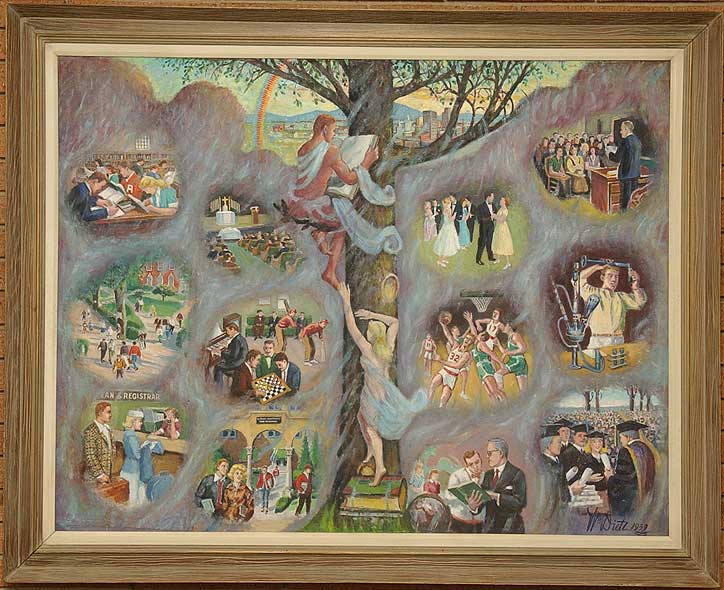
Albright College has four of his paintings on display: the Albright Lion, a portrait of Dick Riffle, a portrait of Lewis Smith, and an unusual collage of the Tree of Learning. Joel Platt has some of Dietz’s artwork in his Sports Immortals museum but they are not generally on display to the public. I was fortunate to find him in when I visited and he showed me a panoramic painting of Pittsburgh he had in his office. The back of the painting contained two titles, “My Pittsburgh” and “Pittsburgh Just Grew.” Apparently, Lone Star changed his mind as to what it should be called.
Most of Dietz’s artwork that I’m aware of is in private collections. A few of those found their way into an article done by Francine Scoboria for Albright College: http://www.albright.edu/reporter/spring2006/lonestar1.html. Occasionally, a reader will send me information on some as I have shared previously in this blog. Hopefully, more will surface in the future.
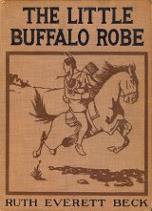
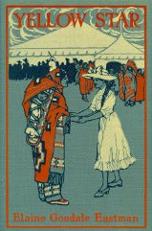
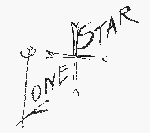
Fortunately, some of Dietz’s smaller pieces have been reproduced on items sold at History on High, Cumberland County Historical Society’s store in Carlisle and Tuxedo Press recently reprinted two books illustrated by Lone Star Dietz and his first wife, Angel DeCora. Yellow Star has four page-sized paintings done jointly by Dietz and DeCora reproduced in grayscale. The Little Buffalo Robe is chockfull of drawings done by Dietz and a few done by DeCora. It also has some full-page artwork done by DeCora. Tuxedo Press also created neckties using Dietz’s unique signature: http://www.tuxedo-press.com/index_files/OrderForm.htm

Tags:Albright College, Cumberland County Historical Society, Dick Riffle, Francine Scoboria, History on High, Joel Platt, Lewis Smith, Sports Immortals
Posted in Doctors, Lawyers, Indian Chiefs, Football, Lone Star Dietz | 8 Comments »
May 24, 2012
Tonight, the National Museum of the American Indian (NMAI) in Washington, DC holds a reception to kick off its new exhibit, “Best in the World: Native Athletes in the Olympics,” to celebrate the athletic achievements of Native Americans on the 100th anniversary of the 1912 Stockholm Games that featured legendary performances by Jim Thorpe and Lewis Tewanima. I am attending because Bob Wheeler, Jim Thorpe’s Boswell, is to speak there. While making preparations for attending this event, I received some unexpected news.
The National Football Foundation (NFF) released its selections for induction in the College Football Hall of Fame Class of 2012 and Lone Star Dietz was finally on the list. As blog followers probably know, Greg and John Witter, first cousins and rabid Washington State football fans, and I campaigned to get Dietz placed on the Hall of Fame ballot some years ago. Getting his won-loss record corrected was the key to getting him nominated but there were larger obstacles yet to come.
Lone Star Dietz died in 1964 and there are few people still alive that knew him. Also, he coached at schools with smaller alumni bases and less clout than the major football factories. Washington State, for example, couldn’t muster the support for him that, say, Ohio State could for John Cooper or Michigan could for Lloyd Carr. While both these recent coaches had very good careers, neither had the impact on the history of the game as did Dietz. It’s one thing to inherit a strong program and be a good steward, but it is quite another to rebuild a floundering program from the ground up, something that Lone Star did multiple times.
The closest he came was in 2006 when the selectors chose Bobby Bowden and Joe Paterno instead of the people who were on the ballot. A couple of years ago, when Lone Star’s name was dropped from the ballot, I gave up all hope of him ever being selected. I didn’t even know that his name was on the Divisional ballot this year, so was shocked when I started receiving phone calls from reporters on Tuesday afternoon.
All I can say is that it’s long overdue. Although he’s being brought in through the back door, so to speak, he will finally be in. He’s the first Carlisle Indian to be inducted as a coach; the rest were as players. Whether this honor is enough to offset the many indignities Dietz suffered and mollify the Lone Star Curse is yet to be seen.
http://seattletimes.nwsource.com/html/cougarfootball/2018262997_dietz23.html
http://www.spokesman.com/stories/2012/may/23/blanchette-wsu-legend-dietz-gets-his-due/

Tags:1912 Olympica, Bobby Bowden, College Football Hall of Fame, Greg Witter, Joe Paterno, John Witter, Lewis Tewanima, Lone Star Curse, National Football Foundation, National Museum of the American Indian
Posted in Carlisle Indian School, Doctors, Lawyers, Indian Chiefs, Football, Jim Thorpe, Lone Star Dietz, Washington Redskins, Washington State University | Leave a Comment »






 Tom Benjey's Weblog
