Archive for the ‘Lone Star Dietz’ Category
June 27, 2008
Carlisle Indian School has been of interest to Hollywood since the movie industry’s earliest days. In 1901, American Mutoscope and Biograph shot a documentary short at the school. Footage included both male and female students swinging clubs. Still photos of this type of exercise can often be found on ebay. Also included in the documentary were a military-style parade of the students including the renowned school band, girls doing a dumbbell drill, boys demonstrating gymnastics events, boys playing a basketball game, and members of the track team high jumping and pole vaulting. No, Jim Thorpe was not filmed because he was not at Carlisle at that time.
In 1913, Selig Polyscope filmed The Tie of the Blood at the school. Little is known about the film other than its main cast members. In 1915 Pathe Weekly filmed the installation of the first Indian Boy Scouts of America troop at the school. Also participating in the parade, exhibitions and ceremonies were local boy scouts and the Indian School’s Campfire Girls. And other films that I do not know about may have been filmed at the school.
Several alumni worked in motion pictures as actors, stuntmen and in other capacities. Lone Star Dietz even invested in the Washington Motion Picture Company and lost his investment. Jim Thorpe not only worked in pictures but had his life story told on film in the 1951 Warner Brothers release, Jim Thorpe – All-American. Interest in putting the Indian school on film waned but in recent years has grown.
In April 2002, Variety Film reported, “Fox 2000 has snapped up a pitch by Craig Sherman and Bob Jury on legendary football coach Glenn S. “Pop” Warner and his first season at the Carlisle Indian School.” In April 2004, Walden Media announced that John Sayles would be bringing Carlisle School to the big screen. In 2005 Steven Spielberg brought Carlisle Indian School to the little screen as part of his Into the West miniseries. And there’s more, so much more interest that Freddie Wardecker has lost count of how many filmmakers have come into his store to look at artifacts. Barb Landis at the Cumberland County Historical Society thinks that she gets at least a call a month from someone interested in doing a movie about the school or Pop Warner or Jim Thorpe or … I even ran into one of them in the Dickinson College archives last year.
The problem is that a historically-accurate film needs to be made but, despite all the talk, no one has stepped up to make it. Do you have any ideas?
Tags:Barb Landis, Cumberland County Historical Society, film, John Sayles, movie, Spielberg, Wardecker, Warner Brothers
Posted in Carlisle Indian School, Dickinson College, Football, Jim Thorpe, Lone Star Dietz, Pop Warner | 2 Comments »
June 20, 2008
A December 1914 newspaper article bemoaned the fact that 12 million soldiers involved in the Great War in Europe adorned their uniforms or marched behind flags with birds depicted in spread-eagle positions. Angel DeCora was interviewed for the article because she had studied the thunderbird at great length. By delving into Indian legends, she learned that the thunderbird or equivalent has been a mark of distinction and authority for many thousands years. She learned the Winnebago version of the thunderbird story and believed it to be as old as the legend of the last mammoth.
According to legend the spirits that dominated land, water and air were in a balanced state for ages with each spirit roughly equal to the others. Clans associated themselves with patron spirits for purposes of recognition and occupation. The thunderbird, apparently an air spirit, was observed in deadly combat with a water spirit by an exhausted warrior of the thunderbird clan as he lay next to a precipice looking down on the still waters below. When the spirits tired they each asked the warrior for help. The warrior, the only human ever to see the spirits, assisted the thunderbird and the water spirit sank, never to be seen again.
To Indians, the thunderbird represents authority, dignity, arbitration and, most important of all, peace. Many believed the emblem of a bird with wide-spread wings was misappropriated by Europeans from ancient America perverting a symbol of arbitration and peace to war and devastation.
Carlisle Indian School and the Society of American Indians both adopted the thunderbird as their emblem. The thunderbird designed by Angel DeCora for the school’s use is at the bottom of this message. The September 4, 1914 issue of The Carlisle Arrow announced that the Alumni Department would adorn various items with the thunderbird. The April 30 blog includes the Alumni Department’s masthead featuring a thunderbird that I mistakenly thought looked more like a bat.
I have a soft spot for Thunderbirds having owned them for over 40 years. I bought a rust-bucket ’56 in 1965, nursed it along for a decade and bought a solid ’57 in 1976 and have kept it all this time. I finally broke down and had it painted. So, it will be out on the road in all its glory soon.

Tags:1957 Thunderbird, Classic Thunderbird, Thunderbird
Posted in Angel DeCora, Carlisle Indian School, Lone Star Dietz | Leave a Comment »
June 12, 2008
Yesterday’s Sentinel contained an article of interest to those interested in the Carlisle Indian School and related topics: http://www.cumberlink.com/articles/2008/06/11/news/local/doc484fd5b21a214085579032.txt
Janet Zettlemoyer and Ilene Whitacre, daughters of John S. Steckbeck, donated their late father’s Carlisle collection to Cumberland County Historical Society. Steckbeck wrote Fabulous Redmen: the Carlisle Indians and their famous football teams in 1951 but the collection that fills 16 copier paper boxes is not limited to Carlisle football items. I’m told that it isn’t limited to Indian School-related items, that it contains a few things of interest to Carlisle (the town) history. However, there is so much stuff to sort through and catalog that it will be some time before collection items are made available to the public.
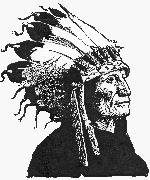
Photographs accompanying the newspaper article include parts of an oil painting and a pen and ink drawing that looks familiar. Discussions with my sources revealed that the oil painting was done by Frank Maze, Dickinson College head football coach 1950-51. It is based on the famous graphic done by Lone Star Dietz that is used as the frontispiece for Steckbeck’s book and on the masthead of this blog. However, Maze put a different head on his version. But whose head was it?
The pen and ink drawing – there turned out to be three in the collection – are Dietz originals of the artwork that adorned the cover of The Red Man magazine. Apparently the collection includes several Dietz items that Steckbeck purchase from the old warrior after he fell on hard times. I can’t wait to see this stuff.
Jim Thorpe historians will not be disappointed as the collection includes an audiotape of Steckbeck’s interview of Thorpe. I hope excerpts from this find their way into the audiobook version of Bob Wheeler’s landmark biography of Thorpe.
The collection also includes glass photo negatives of portraits of Indian School students. Who knows what else might be found in that collection?
Tags:Cumberland County Historical Society, Fabulous Redmen, Frank Maze, John S. Steckbeck, Whitacre, Zettlemoyer
Posted in Carlisle Indian School, Dickinson College, Football, Jim Thorpe, Lone Star Dietz | 1 Comment »
June 6, 2008
The College Football Hall of Fame may have snubbed Lone Star Dietz but Albright College hasn’t. Rick Ferry, Albright’s athletic director, informed me that Lone Star Dietz is to be inducted into the Red and White’s Hall of Fame on October 17. One of Lone Star’s problems in being selected for induction into the College Football Hall of Fame is that few of the sports writers and athletic directors on the Honors Committee are familiar with him or his record. Fortunately, the situation is different at Albright College. Two of the paintings that Lone Star donated to the College, the Albright Lion and a portrait of All-American Dick Riffle, hang where the public can see them in the Bollman Center. Also, photos of Dietz’s teams hang in the equipment cage. If one wants to venture off to other parts of the campus his paintings can be found in other buildings as well.
Another advantage Albright has is that a few people who knew him are still alive and remember him well. One of my pleasures in giving book talks is that one of his old players would sometimes show up. Their stories are wonderful. They often show us a side of Dietz of which we were unaware. Sometimes a child of a deceased player contacts me and shares stories that his father told him about Coach. As great a coach as Dietz was I sometimes think he had more impact on his boys off the field. It will be great to attend the ceremony and see Lone Star receive his due. Now I must revise his chapter in Doctors, Lawyers, Indian Chiefs before it goes to press. But that will be a pleasure.

Tags:Albright College, Hall of Fame, Red & White
Posted in Football, Lone Star Dietz | 2 Comments »
June 4, 2008
It is with much sadness that I share the following message received today from Sheldon Cohen:
My Dad, Gus Cohen, played for Lone Star at Albright. Gus passed away last Tuesday evening, May 27, 2008, at 7:15 P.M. very quietly after having been completely crippled by 2 strokes in February, 2005. Gus was an All-East and 2nd or 3rd team All-American in 1939-1940 and later signed with the Brooklyn Dodgers of the NFL. He was a member of the PA/Berks Sports Hall of Fame and won a Silver Star and multiple Bronze Stars in WWII. He was a devoted alum who was President of the Varsity Club at Albright and recruited a number of student-athletes over the years. Most recently, he had endowed the Gus Cohen Class of 1940 scholarship fund at Albright.
Having become fatherless at 6, Lone Star became Gus’s second father.
One of the things I learned when talking with Lone Star’s former players at Albright College was that he was a disciplinarian in a good way and made an impact on the young men in his charge. Below is a scan of Gus’s photo from a friend’s senior yearbook.

Tags:Albright College, Gus Cohen, Sheldon Cohen
Posted in Football, Lone Star Dietz | 1 Comment »
June 2, 2008
A 1974 Sports Illustrated article that was stuffed into the back of the Sports Immortals brochure included something of particular interest to me: “William (Lone Star) Dietz’ baby curls from his first haircut are not in Los Angeles’ Citizen’s Savings (née Helms) Athletic Foundation Hall.” The article went on to say that Lone Star’s baby curls along with a lot, and I mean a lot, of other sports memorabilia are in Joel Platt’s collection. As Lone Star’s biographer, I find this to be very interesting because I was previously unaware of the existence of Dietz’s locks. Considering that the color of his hair at birth was a significant issue at Lone Star’s WWI draft evasion trial, makes this artifact all the more important.
Leanna Ginder Dietz Lewis raised Lone Star and would have had his baby curls. She probably gave them to him and his wife, Doris, when she visited them in Reading. They would have likely remained in his estate until the executrix gave them to Joel Platt.
The prominent mention of Dietz-related memorabilia and the reference to Helms Athletic Foundation attest to his importance to the history of the game. Preceding the curls in the article were mentions of the Polo Grounds’ home plate crossed by Bobby Thompson after hitting his historic home run, Babe Ruth’s Boston Braves uniform worn when he hit his last three home runs, Bronko Nagurski’s 1934 contract with the Bears, and Pudge Heffelfinger’s Yale pants and pads. Following the curls’ mention were Gene Tunney’s long-count gloves and Cassius Clay’s 1960 Olympic Games sweatshirt. Some company, huh?
The Citizen’s Savings Athletic Foundation was a prestigious institution that inducted Lone Star into its hall of fame in 1976. Jim Thorpe and Pop Warner were the only other Carlislers inducted therein. The prominence of Dietz’s mention by Sports Illustrated is further evidence that he should be ensconced in the College Football Hall of Fame. A photo of an older Lone Star Dietz was slipped into the brochure along with the Sports Illustrated article. See below.

Tags:Citizens Savings Athletic Foundation, Helms Athletic Foundation, Joel Platt, Sports Illustrated, Sports Immortals
Posted in Carlisle Indian School, Doctors, Lawyers, Indian Chiefs, Football, Lone Star Dietz, Washington State University | Leave a Comment »
May 30, 2008
The year was 1975, decades before Cumberland County entered the museum business, when Pittsburgh sports entrepreneur Joel Platt proposed to build a major sports museum on the Harrisburg Pike just east of I-81 exit 52 in Middlesex Township. The Sports Immortals complex was to consist of a hotel, restaurant, recreational facilities and a museum containing over a million pieces of sports memorabilia. At the time Platt’s acquisitions dwarfed the combined collections of the Baseball Hall of Fame in Cooperstown, the Pro Football Hall of Fame in Canton, and the Basketball Hall of Fame in Springfield, MA. It may still as Platt continued to acquire significant items after that.
Rep. Bud Shuster (the congressman who never met a road-building project he didn’t like) enlisted the support of former Cardinals pitcher “Vinegar Bend” Mizell, then Asst. Sec. of Commerce, in an attempt to get federal funds for the Sports Immortals museum. However, it was to be build in Shuster’s district near Breezewood where the Pennsylvania Turnpike and I-70 meet. Apparently this undertaking was unsuccessful because Platt showed up in Carlisle.
Carlisle’s leaders of the day were apparently unimpressed. Word has it that the owner of a motel located near the proposed site was strongly opposed to the project. His concerns had nothing to do with having competition for his restaurant and motel move in nearby; he was concerned about the impact on the community by the element that would be attracted by such a facility. Freddie Wardecker lent me his copy of the brochure that Platt handed out at his presentation and I scanned it into a PDF for your viewing pleasure. It would be interesting to see what the reaction would be today if such a facility was proposed for County land near the Military History Institute. Click on the image below to view the Sports Immortals brochure.

Tags:Carlisle PA, Joel Platt, museum, Sports Immortals
Posted in Carlisle Indian School, Football, Jim Thorpe, Lone Star Dietz | 1 Comment »
May 27, 2008
The advance reading copies (called ARCs in the trade) arrived for my new book and are being sent out to reviewers. This is a big moment in a writer’s life: seeing thousands of hours of hard work turned into something tangible. In the old days (pre-computer), ARCs were called galleys, bound galleys or galley proofs. Authors, editors and publishers go over these babies with a fine-tooth comb looking for errors, typos or things that have changed since writing was complete. It is an impossible task because, after all this scrutiny, some typos escape and find their way into the final book. But we try.
Another important use of ARCs is to see how the photos and artwork come out in print. Overall they came out very well, better than expected. But a cartoon about the Oorang Indians from a 1922 Baltimore newspaper is too dim. The challenge now is to figure out how to darken it without losing the detail.
This weekend I received some additional information and a correction regarding Louis Island from a family member who happened to see a previous blog. That was fortuitous because I want the book to be as accurate as possible. This blog is already proving to be of some value. That encourages me to continue with it.
Having these ARCs provides local booksellers the opportunity to provide their customers something extra. People can look at an ARC and pre-order the book if they choose. The bonus, besides being sure of getting a copy of the book as soon as it comes out, is to receive an inscription of his or her choice signed by the author. On-line booksellers also take pre-orders but personalized inscriptions are impractical.

Tags:Add new tag, ARC, biography, book, galleys, Louis Island
Posted in Albert Exendine, Alex Arcasa, Antonio Lubo, Archie Libby, Arthur Sheldon, Bemus Pierce, Benjamin Caswell, Caleb Sickles, Carlisle Indian School, Charles Guyon, Charles Williams, Dickinson College, Doctors, Lawyers, Indian Chiefs, Ed Rogers, Elmer Busch, Emil Hauser, Football, Frank Cayou, Frank Hudson, Frank Mt. Pleasant, Fred Broker, George May, George Tibbits, George Vedernack, Gus Welch, Hawley Pierce, Henry Broker, Hugh Wheelock, Isaac Seneca, James Johnson, James Phillips, Jim Thorpe, Joe Bergie, Joe Guyon, Joe Libby, Joel Wheelock, John B. Flinchum, Leon Boutwell, Lone Star Dietz, Louis Island, Martin Wheelock, Nicholas Bowen, Nick Lassa, Pete Calac, Pete Hauser, Pop Warner, Sampson Bird, Single-Wing, Stacy Matlock, Stancil Powell, Thomas St. Germain, Victor Kelly, Washington Redskins, Washington State University, Wauseka, William Baine, William Gardner, William Garlow, William Newashe | Leave a Comment »
May 3, 2008
Yesterday, the College Football Hall of Fame announced its induction class of 2008 and Lone Star Dietz was again not selected for induction. It also announced that it has renamed the Division I-A class to the Football Bowl Subdivision class. How ironic. If it hadn’t been for Dietz’s showmanship and coaching acumen, the Rose Bowl may have not gotten off the ground. Countless bowl games might not exist if Lone Star’s Washington State team hadn’t upset Fritz Pollard’s Brown team in 1916. Had Dietz’s team performed as had Stanford did in 1902 against Michigan, they might still be holding chariot races and donkey polo games after the Rose Parade. Instead, he showed the country that Pacific Coast football (or at least his team) was the equal of eastern powers and with that New Year’s Day football became a tradition.
But Lone Star Dietz wasn’t a one-trick pony. He turned around a number of ailing programs and still ended his career with a Hall-of-Fame worthy won-loss record. Some would think that winning over 60% of his games at previously losing institutions would be miraculous. Pundits did when they dubbed him “Miracle Man” for turning around the Haskell program. Doing what he did is a lot harder than inheriting a football dynasty and maintaining a winning record. Many of those dynasties fatten up their records on teams like the ones Dietz turned into winners.
It’s not just about the numbers; it’s also about how they got the numbers and Dietz got them the hard way.
Tags:College Football Hall of Fame, Rose Bowl
Posted in Carlisle Indian School, Football, Lone Star Dietz, Washington State University | Leave a Comment »
April 7, 2008
A mystery has haunted me since shortly after starting to research Lone Star Dietz’s life. Today, with the help of Freddie Wardecker, proprietor of Wardecker’s Mens Wear and Jim Thorpe Museum, and Bob Wheeler, Jim Thorpe’s biographer who, along with his wife Florence Ridlon, succeeded in getting Thorpe’s Olympic medals restored, I solved that mystery.
Lone Star Dietz died in 1964 and his wife, Doris, died three years later. Mary Lou Zientek had befriended the Dietzes and served as executrix of Doris’s estate. The estate consisted mostly of Lone Star’s memorabilia that included promotional photos for his movies and a pair of Jim Thorpe’s gloves. Mrs. Zientek donated many of the items from the Dietz estate to a museum in Pittsburgh. I was unsuccessful in locating any of these items in any museum in Pittsburgh. Today that changed.
Freddie Wardecker told me of a museum in Boca Raton, Florida owned by a man named Joel Platt. It seems that Mr. Platt wanted to build his museum just outside Carlisle some years ago but was turned down, so looked elsewhere. Last week Bob Wheeler mentioned Joel Platt in another context stating that he was from Pittsburgh. Today the light came on for me after Freddie chided me for not being able to locate Platt’s museum on the internet. Following his directions, the web site for Platt’s museum immediately popped up. After a little navigation, Jim Thorpe’s page appeared: http://www.sportsimmortals.com/thumb.cfm?ID=133&category=11&startrow=9
One item jumped out at me. I could never understand why Lone Star had a pair of Jim Thorpe’s gloves or why he would have kept them so long because I thought they were just ordinary men’s gloves. Well, these are not ordinary gloves. Seeing them will explain everything.
The photo shows other items related to Jim Thorpe’s time in Carlisle. Now that the Cumberland County Historical Society has funds for acquiring artifacts, perhaps they can bring Jim Thorpe’s jersey, letter sweater, gloves and other items back to where they belong.

Tags:Bob Wheeler, Cumberland County Historical Society, Gloves, Joel Platt, Sports Immortals, Wardecker, Zientek
Posted in Carlisle Indian School, Football, Jim Thorpe, Lone Star Dietz | Leave a Comment »




 Tom Benjey's Weblog
